
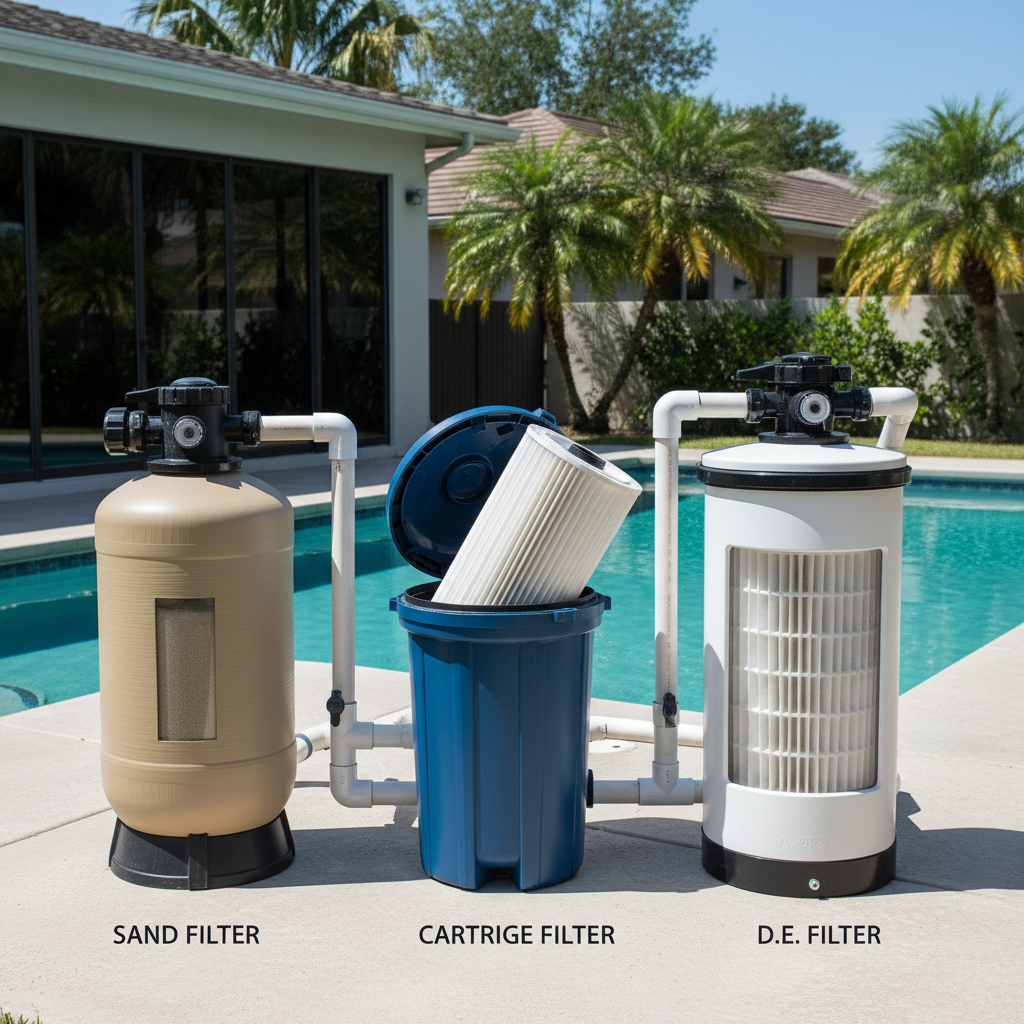
DE Filter vs Sand Filter vs Cartridge: Which Pool Filter Actually Makes Sense for Your Pool?
Your pool filter works harder than any other piece of equipment in your backyard. It runs 8-12 hours daily, trapping everything from dead skin cells to pollen to that mysterious gunk your neighbor’s tree drops every fall. But here’s the thing — choosing between a DE filter vs sand filter vs cartridge isn’t just about price. Pick wrong, and you’re stuck with either constant maintenance headaches or water that never quite looks right.
I’ve helped hundreds of pool owners troubleshoot filter problems, and the pattern is clear: most people buy whatever their pool builder installed without asking questions. Then they spend years fighting their equipment instead of enjoying their pool.
Let’s fix that.
How Pool Filters Actually Work (The 30-Second Version)
All three filter types do the same basic job — water pushes through a filtering medium, particles get trapped, clean water returns to your pool. The difference? What’s doing the trapping and how small a particle it catches.
Think of it like coffee filters. A paper towel works, but a proper filter makes better coffee. Same principle applies to your pool.
Sand Filters: The Low-Maintenance Workhorse
How Sand Filters Clean Your Water
Sand filters push pool water through a bed of specially graded silica sand — typically #20 silica sand with grains around 0.45-0.55mm in diameter. Particles get trapped in the tiny gaps between sand grains. When the filter gets dirty, you backwash it, which reverses water flow and flushes debris out through a waste line.
Filtration Quality
Sand filters catch particles down to 20-40 microns. For reference, a human hair is about 70 microns. So sand catches the big stuff effectively but lets finer particles slip through.
What does this mean in practice? Your water will look good. Not crystal-perfect, but solidly good. Most pool owners are perfectly happy with sand-filtered water.
Maintenance Reality
Here’s where sand shines — it’s genuinely low maintenance:
- Backwash every 2-4 weeks (takes 5 minutes)
- Replace sand every 5-7 years (about $150-200 in sand plus labor)
- No parts to clean or replace regularly
The Hayward ProSeries Sand Filter handles pools up to 30,000 gallons and represents what most homeowners install. It’s not fancy. It just works.
Best For
- Pool owners who want minimal interaction with their filter
- Larger pools (sand filters scale well)
- Tight budgets (lowest operating cost over 10 years)
- People who don’t mind “good” water versus “perfect” water
Cartridge Filters: The Balanced Choice
How Cartridge Filters Work
Water passes through a pleated polyester fabric cartridge — picture a giant, cylindrical air filter. The fabric catches particles in its fibers. When dirty, you remove the cartridge and hose it off. No backwashing, no water waste.
Filtration Quality
Cartridge filters trap particles down to 10-15 microns — about twice as fine as sand. You’ll notice the difference. Water has more sparkle, and that slight haze some sand-filtered pools have? Gone.
Maintenance Reality
This is where cartridge filters demand more from you:
- Hose off cartridges every 4-6 weeks (15-20 minutes)
- Deep clean with filter cleaner every 3-4 months
- Replace cartridges every 2-3 years ($80-150 per cartridge, and many filters use 4 cartridges)
A quality cartridge like the Pleatco Replacement Cartridge makes maintenance easier, but you can’t escape the hands-on nature of this filter type.
Best For
- Above-ground pools and smaller in-ground pools
- Areas with water restrictions (no backwashing means no water waste)
- Pool owners willing to trade time for better filtration
- Moderate budgets
DE Filters: The Perfectionist’s Choice
How DE Filters Work
DE stands for diatomaceous earth — the fossilized remains of tiny aquatic organisms called diatoms. This powder coats a grid inside the filter, and water passes through this DE layer. The result? Filtration so fine it approaches laboratory standards.
After backwashing, you add fresh DE powder through the skimmer. It coats the grids and filtering starts again.
Filtration Quality
DE filters catch particles down to 2-5 microns. That’s smaller than most bacteria. Your water won’t just look clear — it’ll have that “liquid glass” quality you see in resort pools and magazine photos.
Maintenance Reality
Excellence has a price:
- Backwash when pressure rises 8-10 PSI (every 4-6 weeks)
- Add fresh DE after every backwash (about $25 per 25-lb bag, lasts most of a season)
- Complete teardown and grid cleaning 1-2 times per year (takes 45-60 minutes)
- Replace grids every 5-7 years ($150-300 for a full set)
You also need to dispose of used DE properly. Some municipalities require you capture it rather than sending it to storm drains.
Best For
- Pool owners who obsess over water clarity
- Anyone with allergies or sensitivities (DE removes more irritants)
- Pools used for competitive swimming
- People who don’t mind maintenance complexity
The Real Cost Comparison (10-Year Analysis)
Let’s talk actual money, not vague estimates:
Sand Filter (10-Year Cost)
- Filter unit: $400-600
- Sand replacement (once): $200
- Backwash water cost: ~$150
- Total: $750-950
Cartridge Filter (10-Year Cost)
- Filter unit: $300-500
- Replacement cartridges (3-4 sets): $600-1,200
- Filter cleaning solution: $100
- Total: $1,000-1,800
DE Filter (10-Year Cost)
- Filter unit: $500-800
- DE powder: $250
- Grid replacement (once): $200
- Backwash water cost: ~$100
- Total: $1,050-1,350
The surprise? DE filters aren’t necessarily more expensive than cartridge filters long-term. Those cartridge replacements add up.
Making Your Decision: A Practical Framework
Choose Sand If:
You want to think about your filter as little as possible. You’re okay with water that looks great but not magazine-perfect. You have a large pool and want economical operation.
Choose Cartridge If:
You live somewhere with water restrictions or drought concerns. You have a smaller pool. You don’t mind regular maintenance but want better clarity than sand provides.
Choose DE If:
Water clarity is non-negotiable for you. You enjoy pool maintenance (some people genuinely do). You’re willing to learn the slightly steeper learning curve.
Quick Tips for Any Filter Type
1. Check pressure weekly — a 8-10 PSI increase from clean baseline means it’s time to clean
2. Size up, not down — an oversized filter runs more efficiently and lasts longer
3. Keep a maintenance log — track cleanings and part replacements
4. Run your filter 8-12 hours daily — all the filtration quality in the world means nothing if water isn’t cycling through
Frequently Asked Questions
Can I switch from one pool filter type to another?
Yes, but it’s not a simple swap. You’ll likely need new plumbing fittings, possibly a different pump size, and definitely a new filter pad or base. Budget $500-1,500 for a professional conversion. It’s usually only worth it if your current filter fails completely.
How do I know what size filter I need?
Match your filter’s gallons-per-minute (GPM) rating to your pump’s output. A rough rule: your filter should be able to turn over your entire pool volume in 8 hours or less. For a 20,000-gallon pool, that’s about 42 GPM minimum.
Is DE powder dangerous?
Food-grade DE is considered safe, but don’t breathe the dust when adding it. Wear a simple dust mask. And never use pool-grade DE in garden applications — they’re processed differently.
Why does my sand filter have sand in the pool?
Cracked laterals (the tubes at the bottom of the filter) let sand escape into return lines. This requires opening the filter and replacing the damaged lateral — about a $50-100 repair if you DIY, or $150-200 with labor.
How often should I replace my pool filter media?
Sand: 5-7 years. Cartridges: 2-3 years (sooner if you notice permanent staining or degraded filtration). DE grids: 5-7 years, but inspect annually for tears.
Ready to dial in your pool chemistry to match your filter’s performance? Head over to Pool Chemical Calculator to get precise dosing recommendations for your specific pool size. Because even the best filter can’t fix unbalanced water.