
How Long After Shocking Your Pool Can You Swim?
You just dumped a bag of shock in the pool. The kids are asking when they can get in. What’s the actual answer?
The short version: wait at least 8 hours, then test your water. If free chlorine is back down to 1–3 ppm, you’re good to go. If it’s still high, wait longer.
But there’s more to it than a simple time rule — and getting it wrong means either red, irritated eyes or putting people in water that hasn’t fully recovered. Here’s everything you need to know.
Why You Can’t Swim Right After Shocking
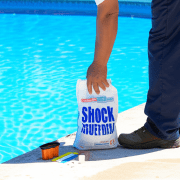
Pool shock works by flooding your water with a massive dose of chlorine — usually 5 to 10 times the normal level, sometimes higher. That’s intentional. The whole point is to break down algae, bacteria, chloramines, and organic contaminants quickly.
At those concentrations, the water is actively harmful. We’re talking skin irritation, burning eyes, respiratory issues if you’re splashing around and breathing the air above the water. Even if the water looks fine, the chemistry isn’t.
The wait isn’t arbitrary. It’s the time your water needs to do the work and return to a safe range.
The 8-Hour Rule (And Why It’s Just a Starting Point)
Most pool shock products say “wait 8 hours” on the label. That’s a reasonable baseline for most situations, but it assumes:
- You shocked at the right dose (1 lb per 10,000 gallons for a maintenance shock)
- Your pool pump was running during that time to circulate the chlorine
- Your pH was in a normal range (7.4–7.6) before you shocked
- You weren’t dealing with a severe algae outbreak requiring a mega-dose
If you double-dosed to kill a green pool, 8 hours probably isn’t enough. If you shocked with the pump running overnight and your cyanuric acid level is healthy (30–50 ppm), 8 hours might actually be conservative.
Bottom line: Use the 8-hour rule as a minimum, not a guarantee.
The Right Way to Know When It’s Safe
Stop guessing by the clock. Test your water before anyone gets in.
Target levels before swimming:
| Parameter | Safe Range |
|———–|———–|
| Free Chlorine | 1–3 ppm |
| pH | 7.4–7.6 |
| Combined Chlorine | Below 0.5 ppm |
Free chlorine is the key number. If it’s above 5 ppm, the water is still too concentrated. Above 10 ppm and you’re looking at serious irritation risk.
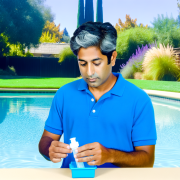
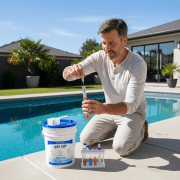
A basic test strip will give you a free chlorine reading in 30 seconds. A liquid test kit (like the Taylor K-2006) is more precise if you want exact numbers. For pools you’re managing seriously, the LaMotte ColorQ Pro 7 gives you digital readings without color-matching guesswork.
Does It Matter What Type of Shock You Used?
Yes. Different shock products behave differently.
Calcium Hypochlorite (Cal-Hypo)
The most common pool shock. Usually 65–78% available chlorine. Raises chlorine fast, burns off relatively quickly. Most people can swim 8–24 hours after using this, assuming normal conditions.
Sodium Dichloro (Dichlor)
Similar effect to cal-hypo, slightly slower burn-off because it contains cyanuric acid (stabilizer). If your CYA is already high, dichlor can cause chlorine to linger longer than expected.
Potassium Monopersulfate (Non-Chlorine Shock)
This is the exception. Non-chlorine shock oxidizes the water without raising chlorine levels. Most products say you can swim 15 minutes after treatment. It’s the go-to if you need fast turnaround — say, before a party.
Liquid Chlorine (Sodium Hypochlorite)
Essentially liquid bleach in a higher concentration. Burns off faster than granular shock, especially in a sunny pool with normal CYA levels. Many pool owners can swim safely within 4–8 hours.
Tips to Speed Up the Wait Time
If you’re in a hurry to get back in the pool, a few things help:
Run your pump the entire time. Circulation distributes the chlorine evenly and speeds up off-gassing. A pool that sat stagnant after shocking will take much longer to normalize.
Shock in the evening. Sunlight destroys unstabilized chlorine fast — sometimes too fast. If your CYA level is low, shocking mid-afternoon means you’re burning off chlorine before it does its job. Shock at dusk so it works overnight with no UV exposure.
Make sure your pH is right before you shock. Chlorine is much more effective at lower pH (7.2–7.4). If your pH is at 7.8 or above, a lot of that shock is wasted. Fix pH first, then shock — and the chlorine will come back down to normal levels faster.
Consider non-chlorine shock for next time. If fast turnaround matters to you regularly, keep a bag of potassium monopersulfate around. It’s not a substitute for regular chlorine shocking (it doesn’t kill algae or bacteria the same way), but for routine oxidation, the 15-minute re-entry is a real advantage.
What Happens If You Swim Too Soon?
Mild overexposure — say, free chlorine at 5–6 ppm — usually means red, irritated eyes and maybe some skin irritation. Not dangerous, but not fun.
Higher concentrations (10+ ppm) can cause more serious eye irritation, skin redness, and respiratory discomfort, especially for kids and people with sensitivities. Chlorine fumes above a heavily shocked pool can also cause coughing and throat irritation just from being nearby.
Nobody’s going to the hospital over this in most cases, but there’s no good reason to rush. Wait it out.
How to Never Have to Guess Again
The real answer is: stop waiting until you have a problem before you shock. If you maintain your pool consistently — testing weekly, keeping chlorine at 1–3 ppm, shocking every 1–2 weeks as maintenance — you’ll rarely need the heavy doses that require long wait times.
A quick shock at proper dosage on a well-maintained pool? 8 hours, test, done.
A double or triple dose on a green pool that got away from you? Plan on 24–48 hours minimum, and test before anyone gets in.
Calculate Before You Shock
Overdosing is one of the main reasons people end up with extended wait times. If you’re putting in too much shock, you’ve got more chlorine to burn off.
The Pool Chemical Calculator app takes the guesswork out of dosing. Enter your pool size, current chlorine level, and target — it tells you exactly how much shock to add.
Download free:
Or use it right now at poolchemicalcalculator.com.
Frequently Asked Questions
Can I swim 4 hours after shocking?
Maybe, but it depends on what you used and how much. Non-chlorine shock: yes, 15 minutes is the typical guideline. Cal-hypo or dichlor at a normal maintenance dose: 4 hours is usually too soon. Test first — if free chlorine is 3 ppm or below, the time doesn’t matter.
Can I swim 24 hours after shocking?
For virtually any type of shock at any dose, yes — assuming your pump ran continuously and you’re not dealing with an unusually cold or overcast day that slows chlorine dissipation. Test to confirm, but 24 hours is generally safe.
What if my chlorine is still high after 24 hours?
Run the pump, make sure you have adequate CYA (30–50 ppm), and check your pH. If chlorine still won’t drop, you may have a stabilizer issue (very high CYA locks chlorine in) or an unusually heavy chlorine load. Wait it out — never try to neutralize with chemicals unless you have a specific reason.
Is it safe to swim with chlorine at 5 ppm?
Most guidelines say 5 ppm is the upper edge of “technically okay.” Many people experience irritation at that level, especially kids. 3 ppm or below is the better target. When in doubt, wait another few hours.
Does shocking every week ruin your pool?
No — regular maintenance shocking is actually good for your pool. It prevents chloramines from building up, keeps algae in check, and extends the life of your chlorine between doses. The key is using the right amount each time.
Keep your pool chemistry tight and the wait-time math gets a lot simpler. A well-maintained pool rarely needs more than a standard shock dose — which means you’re back in the water before dinner.