
How to Lower pH in Your Pool (Without Wrecking Everything Else)
Meta Description: Pool pH too high? Here’s exactly how to lower it using muriatic acid or dry acid, how much to add, and what happens if you ignore it.
URL Slug: how-to-lower-ph-in-pool
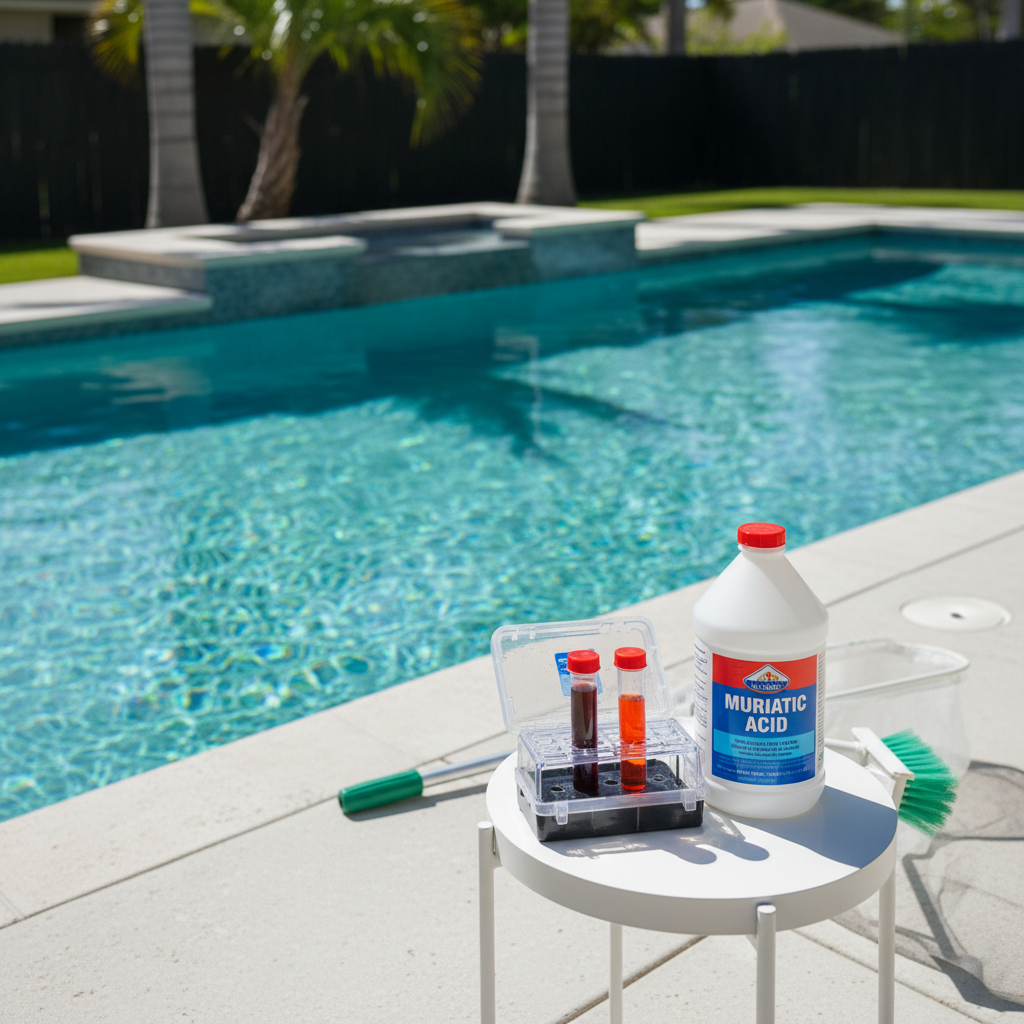
Featured Image: how-to-lower-ph-in-pool.png
Your test strip shows 8.0. Maybe 8.2. You know it should be lower but you’re not sure how much of what to add. So you stare at the shelf of pool chemicals and hope one of them has clear instructions.
They won’t. Most labels give ranges so broad they’re useless for your specific pool.
Here’s what actually works — with real numbers, not guesses.
Why High pH Is a Problem
pH measures how acidic or basic your pool water is. The scale runs 0 to 14, with 7.0 being neutral. Your pool should sit between 7.2 and 7.6. That range does two things: keeps chlorine effective and keeps swimmers comfortable.
When pH climbs above 7.8, problems stack up fast.
Chlorine stops working. At 7.2 pH, about 63% of your free chlorine is in its active killing form (hypochlorous acid). At 8.0? That drops to 21%. Same chlorine reading on your test strip, a third of the sanitizing power. You’re paying for chlorine that sits around doing nothing.
Scale forms on everything. High pH causes calcium to precipitate out of solution and deposit on your tile line, inside pipes, on your heater elements, and in your filter. That white crusty buildup? That’s calcium carbonate, and it gets worse every day your pH stays elevated.
Water turns cloudy. Not always, but often. The same calcium precipitation that causes scale also creates tiny suspended particles. Your filter catches some. The rest just float there, making your pool look dull.
Skin and eye irritation. Despite what most people assume, itchy skin and red eyes after swimming usually come from bad pH — not too much chlorine. Water above 7.8 irritates mucous membranes. So does water below 7.0. The sweet spot matters.
What Causes High pH?
Knowing why it went up helps you keep it down.
Your fill water is alkaline. Municipal water in many areas comes out of the tap at 7.8–8.4. Every time you top off your pool or refill after a drain, you’re pushing pH upward.
Aeration raises pH. Water features, spillovers, spa jets, even heavy splashing — anything that agitates the water surface drives out dissolved CO2. Less CO2 means higher pH. If you run a waterfall 24/7 and wonder why your pH never stays down, that’s why.
Salt chlorine generators. This is a big one. Salt cells produce chlorine through electrolysis, and the byproduct of that process is sodium hydroxide — which is lye. Literally. Salt pool owners fight high pH constantly. It’s not a flaw, it’s the chemistry.
Fresh plaster. Newly plastered pools leach calcium hydroxide for weeks. pH will spike repeatedly during the first 30 days. This is normal and temporary, but you still need to treat it.
Two Options for Lowering pH
There are exactly two chemicals that reliably lower pool pH. Both work. They have different trade-offs.
Muriatic Acid (Hydrochloric Acid)
The workhorse. Most pool professionals use muriatic acid because it’s effective, cheap, and widely available. You’ll find it at every hardware store and pool supply shop.
Strengths:
- Lowers both pH and total alkalinity
- Fast-acting — starts working within an hour
- Cost-effective for regular use
Downsides:
- Produces fumes. Hydrochloric acid vapor is no joke — it’ll burn your nose and throat if you’re not careful.
- Can etch surfaces if added too fast in one spot
- Requires careful handling and storage
A reliable option: HDX Muriatic Acid from Home Depot — standard 31.45% strength. Some brands sell “low-fume” versions at 14.5% that are easier to handle but require roughly double the volume.
Dry Acid (Sodium Bisulfate)
The gentler alternative. Sodium bisulfate comes as a granular powder and does the same job as muriatic acid without the fumes.
Strengths:
- No dangerous fumes
- Easier to measure and store
- Safer for beginners
Downsides:
- More expensive per pH point lowered
- Adds sulfate to your water (not a problem unless you use it heavily for years)
- Dissolves slower than liquid acid
pH Down by Clorox is sodium bisulfate in a pool-friendly package. Works well for occasional adjustments.
Which should you pick? If you’re adjusting pH weekly (especially salt pool owners), muriatic acid makes more financial sense. If you do it once a month and don’t want to deal with fumes, dry acid is simpler.
How Much to Add (The Actual Math)
This is where most guides get vague. “Add some acid and retest.” Thanks for nothing.
Here’s a real dosing chart for muriatic acid (31.45%) based on pool volume:
| Pool Size | pH 7.8 → 7.4 | pH 8.0 → 7.4 | pH 8.2 → 7.4 |
|—|—|—|—|
| 5,000 gal | 6 oz | 10 oz | 14 oz |
| 10,000 gal | 12 oz | 20 oz | 28 oz |
| 15,000 gal | 18 oz | 30 oz | 42 oz |
| 20,000 gal | 24 oz | 40 oz | 56 oz |
These are starting-point estimates. Your actual results depend on total alkalinity (higher TA = more acid needed) and other factors. But they’ll get you in the ballpark on the first try, which is more than most pool store advice manages.
For sodium bisulfate (dry acid), multiply the ounces by roughly 1.5 to get equivalent dry acid weight.
Don’t want to do math? The Pool Chemical Calculator app takes your pH, alkalinity, pool volume, and acid type — then tells you exactly how much to add. Removes the guesswork completely.
Step-by-Step: Lowering pH With Muriatic Acid
1. Test your water. Get an accurate pH and total alkalinity reading. A test kit beats strips here — the Taylor K-2006 is the gold standard for a reason.
2. Calculate your dose. Use the chart above or the Pool Chemical Calculator app. When in doubt, start with less. You can always add more.
3. Turn on your pump. You want full circulation running when you add acid. Never add chemicals to still water.
4. Add the acid slowly. Pour muriatic acid into the deep end while walking along the pool edge. Spread it across the water surface — don’t dump it all in one spot. Keep the bottle low to the water to minimize splashing.
5. Wait and retest. Give the acid at least 30 minutes to circulate. An hour is better. Then test again. pH should have dropped. If it’s still above 7.6, add another smaller dose and wait again.
6. Check alkalinity too. Muriatic acid lowers both pH and alkalinity. If your alkalinity drops below 80 ppm, you’ll need to raise it separately with baking soda after your pH is where you want it.
Safety When Handling Muriatic Acid
Not trying to scare you, but respect the chemical.
- Wear safety glasses. Splashes happen.
- Chemical-resistant gloves. Not just any gloves — acid eats through latex fast.
- Work upwind. Those fumes concentrate quickly in still air.
- Never mix muriatic acid with anything, especially chlorine products. The reaction produces chlorine gas, which is legitimately dangerous.
- If acid contacts skin, rinse immediately with water. Lots of water.
- Store in the original container, sealed, away from metal and other pool chemicals.
The pH-Alkalinity Tug of War
Here’s what trips people up: pH and total alkalinity (TA) are linked. Lowering one tends to lower the other. But they’re not the same thing, and you often want to adjust one without destroying the other.
The relationship works like this:
Total alkalinity is a buffer. It resists pH changes. High TA means your pH is hard to move — it keeps bouncing back up. Low TA means pH swings wildly with every rain shower or chlorine dose.
The target range for TA is 80–120 ppm. If your alkalinity is 150+ ppm and your pH keeps climbing back to 8.0 no matter how much acid you add, the alkalinity is your real problem. Lower that first, and pH becomes much easier to manage.
How to lower alkalinity without crashing pH:
Add muriatic acid in smaller doses spread over several days. Add it to one spot in the deep end with the pump off — this is the one exception to the “always circulate” rule. Concentrated acid in one area hammers alkalinity harder than pH. Run the pump 30 minutes after each dose. Retest the next day.
It takes patience. Alkalinity doesn’t move as fast as pH. But once you get TA into the 80–100 range, you’ll notice pH stays put much longer between adjustments.
How Often Should You Need to Lower pH?
Depends on your setup.
Salt water pools: Expect to add acid weekly. Some salt pool owners add a small dose every 3-4 days. It’s just part of owning a salt system. The electrolysis process generates sodium hydroxide constantly.
Traditional chlorine pools: Maybe every 1-2 weeks during swim season. Less in winter. Rain actually tends to lower pH slightly (rainwater is mildly acidic), so you might catch a break during wet spells.
Pools with water features: More often. Every fountain, waterfall, and bubbler aerates the water and drives pH up.
If you’re adding acid more than twice a week, something else is going on. Check your alkalinity, your fill water chemistry, and whether you’re running aeration features you don’t need to.
Automatic pH Control (Worth the Money?)
For pool owners tired of the weekly acid routine, automatic pH dosing systems exist. They measure pH continuously and inject muriatic acid through a peristaltic pump whenever the level exceeds your setpoint.
Popular systems include the Pentair IntelliChem and Hayward Sense and Dispense. They run $800–$1,500 installed.
Are they worth it? For salt water pool owners who fight pH constantly, absolutely. The system pays for itself in time savings within a year. For a traditional chlorine pool where pH drifts once a week, probably not unless you really hate pool chores.
Common Mistakes When Lowering pH
Adding too much acid at once. Overcorrecting pH below 7.0 is worse than being at 7.8. Low pH corrodes metal fittings, etches plaster, damages vinyl liners, and destroys heater heat exchangers. If you overshoot, add baking soda (sodium bicarbonate) to bring alkalinity and pH back up. Go slow.
Adding acid with the pump off. Unless you’re intentionally targeting alkalinity (see above), always circulate when adding acid. Concentrated acid sitting on your pool floor can bleach or etch the surface.
Testing too soon. You added acid 10 minutes ago and the test strip shows no change. So you add more. Then 2 hours later your pH is 6.8. Give it time. At least 30 minutes with circulation running.
Ignoring alkalinity. You can’t manage pH long-term if your alkalinity is out of range. Fix TA first. pH follows.
Using household vinegar. Yes, vinegar is acidic. No, it doesn’t work for pools. You’d need gallons of it for a meaningful change, and it introduces organic acids that feed bacteria. Muriatic acid or dry acid. That’s it.
FAQ
Can I use muriatic acid in a vinyl liner pool?
Yes. Vinyl pools actually handle acid well as long as you dilute it and add it with the pump running. Don’t pour concentrated acid directly onto the liner — pour it into the water in the deep end while circulating. The diluted acid won’t damage vinyl.
How long after adding acid can I swim?
Wait at least 30 minutes with the pump running. An hour is better. Test to confirm pH is between 7.2 and 7.6 before anyone gets in. If you added a large dose, give it a full circulation cycle — about 4-6 hours.
My pH keeps going back up. What gives?
Two usual suspects. First, your total alkalinity might be too high — TA above 120 ppm buffers pH upward constantly. Second, you might have aeration from water features, returns pointed upward, or a spa spillover. Turn off the features and see if pH stabilizes. If it does, you’ve found your culprit.
Will rain lower my pool pH?
Slightly, yes. Rainwater typically has a pH of 5.0–5.5. A heavy storm can drop your pH by 0.1–0.3 points depending on how much rain falls relative to your pool volume. It also dilutes alkalinity and other chemicals, so test everything after a big rain.
Is pH down the same as muriatic acid?
No. Most “pH Down” products are sodium bisulfate (dry acid), not muriatic acid. Both lower pH, but they’re different chemicals with different dosing. Sodium bisulfate is safer and easier to handle. Muriatic acid is cheaper and more common among experienced pool owners.
Can I add muriatic acid and chlorine at the same time?
Never. Adding acid and chlorine together — or even near each other — can create chlorine gas, which is toxic. Add one, circulate for at least 30 minutes, then add the other. Better yet, add them hours apart.
Last updated: March 2026
Calculate your exact acid dose — free: