
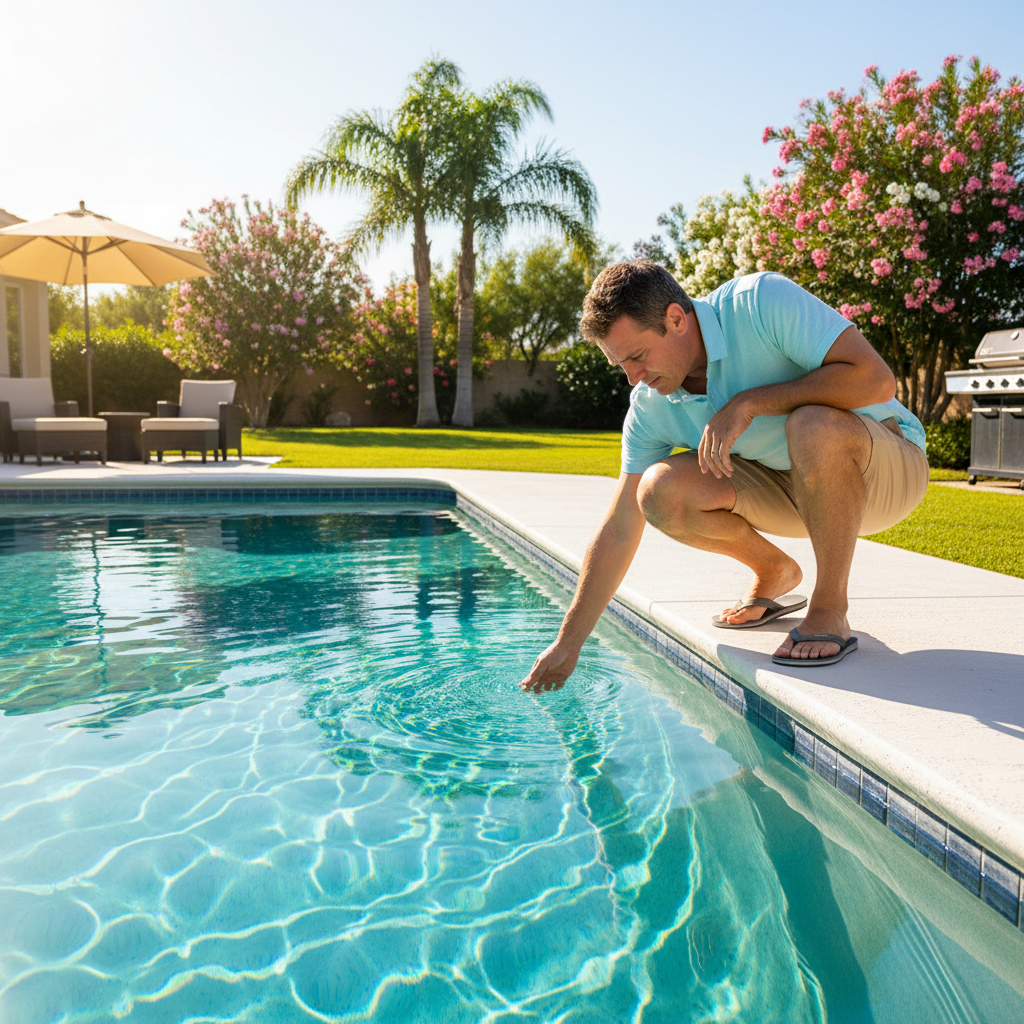
How to Test Pool Water Without a Kit (5 Methods That Actually Work)
How to Test Pool Water Without a Kit (5 Methods That Actually Work)
Your test strips ran out. The liquid reagents expired three seasons ago. But you need to know if the pool is safe to swim in today.
Good news — you can get a rough read on your water without a kit. Bad news — none of these methods replace proper chemical testing for ongoing maintenance. Think of them as a gut check, not a diagnosis.
Here are five ways to evaluate your pool water when you don’t have a testing kit handy.
1. The Visual Clarity Test
Your eyes are surprisingly good pool water sensors. Clear water that you can see the bottom through — every drain cover, every tile line — generally means your chemistry is in a reasonable range.
Here’s what to look for:
| What You See | What It Likely Means |
|---|---|
| Crystal clear, light blue tint | Chemistry is probably fine |
| Slightly hazy or dull | pH or alkalinity is drifting, chlorine may be low |
| Cloudy white/milky | High pH, low chlorine, or filtration problem |
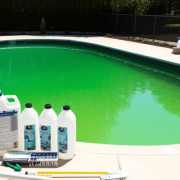
| Green tint | Algae growth — chlorine is definitely low |
| Dark green or black | Severe algae bloom — don’t swim |
| Brown or rusty | Iron or manganese metals in the water |
Put on sunglasses with polarized lenses if you have them. They cut surface glare and let you see deeper into the water. If you can count the screws on your main drain cover from the pool deck, clarity is solid.
This test tells you nothing about specific chemical levels, but it catches the big problems fast.
2. The Smell Test
Here’s something most pool owners get wrong: a strong “chlorine smell” doesn’t mean there’s too much chlorine. It actually means there’s not enough.
That harsh chemical odor comes from chloramines — combined chlorine — which form when free chlorine reacts with sweat, urine, sunscreen, and body oils. When your free chlorine is high enough to burn off those contaminants, the pool shouldn’t smell like much of anything.
What your nose tells you:
- No smell — Free chlorine is doing its job. Water is probably balanced.
- Mild chemical smell — Some chloramines present. Chlorine is working but might be getting low.
- Strong “pool smell” — High chloramines. You need to shock. Free chlorine is too low to keep up with the bather load.
- Musty or earthy smell — Possible algae starting to grow, even if you can’t see it yet.
Stand at the water’s edge, not 20 feet away. You want to smell the water surface, not the general pool area.
3. The Feel Test
Your skin and eyes are pH meters. Seriously — human tissue is sensitive to pH changes, and your pool water touches a lot of skin.
After swimming for 10-15 minutes:
- Eyes burning or red? pH is likely too low (acidic, below 7.2) or chloramines are high.
- Skin feels dry or tight? pH is probably too high (above 7.8).
- Skin feels slippery or soapy? pH is definitely too high, possibly above 8.0. High alkalinity contributes to this too.
- Skin feels normal, eyes comfortable? pH is likely in the 7.2-7.6 sweet spot.
- Hair feels straw-like after swimming? Could indicate high chlorine or very low pH.
This is obviously not precise. Some people have sensitive skin that reacts at perfectly normal pH levels. But if multiple swimmers all report the same symptoms, pay attention.
4. The Copper Coin Test (for pH Direction)
This old-school trick gives you a rough idea of whether your pH is running high or low.
Drop a clean copper penny (pre-1982 pennies are solid copper, newer ones are zinc with copper plating — use an older one if possible) into a white cup of pool water. Let it sit for 30 minutes.
- Penny stays the same — pH is probably in a normal range.
- Penny tarnishes or turns dark quickly — Water is acidic (low pH). Acidic water corrodes metals faster.
- Green tint in the water around the penny — Very acidic water is dissolving copper. Your pH is low, and if you have a copper heat exchanger, it’s getting damaged too.
This won’t tell you if your pH is 7.4 or 7.6. But it can flag when your water has gone strongly acidic, which is the more dangerous direction for your pool equipment.
5. Take a Sample to a Pool Store
This isn’t exactly testing “without a kit,” but it’s testing without *your* kit — and it’s free.
Most pool supply stores — Leslie’s, Pinch A Penny, local shops — offer free water testing. They use professional-grade equipment that measures chlorine, pH, alkalinity, CYA, calcium hardness, and metals all at once.
Tips for getting a good store test:
- Collect water elbow-deep, away from return jets and the skimmer
- Use a clean container — rinse it with pool water first, not tap water
- Bring the sample in within an hour. Chemistry changes as water sits, especially chlorine
- Go in the morning when they’re not slammed with customers
- Ask for a printout — most systems generate one automatically
The Taylor Complete Test Kit is worth owning long-term. It runs about $35 and gives you drop-count accuracy for chlorine, pH, alkalinity, CYA, and acid demand. Way more reliable than strips. But for today? The pool store has you covered.
What You Can’t Test Without a Kit
Let’s be real about the limits. These no-kit methods can catch:
- Obvious clarity problems (algae, cloudiness)
- Extreme pH swings (burning eyes, slippery skin)
- Chloramine buildup (that harsh smell)
- General “something’s off” signals
But they cannot tell you:
- Exact chlorine levels — You need a DPD or OTO test for that
- Precise pH numbers — The difference between 7.2 and 7.8 is invisible without reagents
- Alkalinity or calcium hardness — No sensory test exists for these
- Cyanuric acid levels — Only a turbidity test or lab can measure this
- Metals — Iron and copper require chemical reagents to detect at low levels
For daily maintenance, you really do need a test kit. But for a quick “is it safe to swim right now?” check, the methods above give you a reasonable answer.
The Best Budget Test Option
If you don’t want to invest in a full reagent kit, AquaChek 7-Way Test Strips cost under $15 and cover chlorine, pH, alkalinity, CYA, and hardness. Keep a bottle in your pool shed and you’ll never be stuck guessing again.
For exact dosing calculations once you do have numbers, use the Pool Chemical Calculator app. Plug in your test results and pool size, and it tells you exactly how much of each chemical to add.
Stop guessing with your pool chemicals. The Pool Chemical Calculator app tells you exactly what to add based on your test results.
???? Download on Google Play | ???? Download on the App Store
FAQ
Can you tell if pool water is safe without testing it?
You can get a general idea by checking water clarity, smell, and how it feels on your skin. Clear water with no chemical smell and no skin irritation is usually safe. But for ongoing maintenance, you need actual test results — visual checks can’t detect subtle chemical imbalances that lead to problems over time.
How can I test my pool water for free?
Take a water sample to your local pool supply store. Most stores like Leslie’s and Pinch A Penny offer free computerized water analysis. Collect the sample from elbow depth, away from return jets, and bring it in within an hour for the most accurate results.
What does it mean if my pool smells strongly of chlorine?
It actually means your free chlorine is too low, not too high. That harsh chemical smell comes from chloramines — compounds that form when chlorine combines with sweat, oils, and other contaminants. You need to shock the pool to break apart chloramines and restore free chlorine levels.
How often should I test my pool water?
Test chlorine and pH at least 2-3 times per week during swim season. Test alkalinity and cyanuric acid weekly or biweekly. Calcium hardness can be checked monthly. After heavy rain, pool parties, or extreme heat, test immediately — these events can throw off your chemistry quickly.
Are pool test strips accurate enough?
Test strips give a ballpark reading that’s fine for routine checks. They’re less precise than liquid reagent (drop count) kits, especially for pH and CYA readings where the color differences between levels are subtle. For the most accurate home testing, use a Taylor or LaMotte drop-count kit.