
Pool Algae Treatment: The Complete Guide to Killing and Preventing Algae

# Pool Algae Treatment: The Complete Guide to Killing and Preventing Algae

**Meta Description:** Learn how to treat pool algae fast with this step-by-step guide. Covers green, yellow, and black algae treatment plus prevention tips for crystal-clear water.

**Target Keyword:** pool algae treatment
**URL Slug:** pool-algae-treatment
**Date:** 2026-02-03
**Author:** Pool Chemical Calculator

Dealing with pool algae is one of the most frustrating problems a pool owner can face. One day your water looks fine, and the next you’re staring at a green, slimy mess. The good news? **Pool algae treatment** doesn’t have to be complicated — but you need to act fast and use the right approach for the type of algae you’re dealing with.

Whether you’ve got a mild green tint or a full-blown swamp situation, this guide walks you through exactly how to eliminate algae and keep it from coming back. We’ll cover identification, treatment methods, chemical dosing, and long-term prevention strategies that actually work.

## Identifying the Type of Pool Algae

Before you start dumping chemicals, you need to know what you’re fighting. There are three main types of pool algae, and each requires a different pool algae treatment approach:

### Green Algae (Most Common)
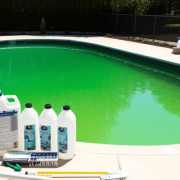
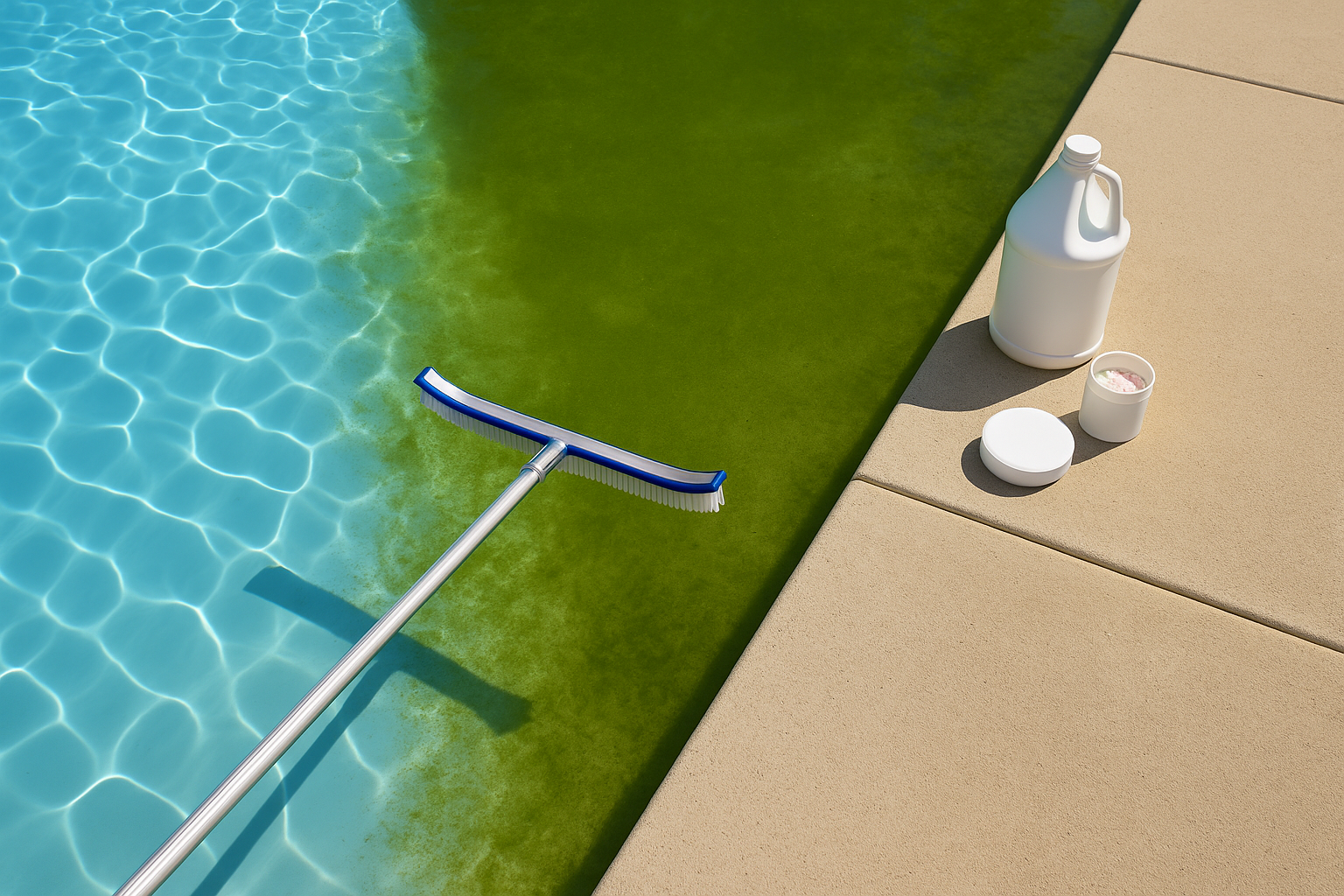
Green algae is the most frequently encountered type and the easiest to kill. It shows up as a green tint in the water, slimy walls, or floating green clouds. Green algae thrives when free chlorine drops below 1 ppm and can spread rapidly in warm temperatures.

**Difficulty:** Easy to treat
**Appearance:** Green water, slimy surfaces, green film on walls

### Yellow/Mustard Algae
Yellow algae (also called mustard algae) appears as yellowish-brown patches on shady walls and floors. It’s chlorine-resistant and often mistaken for dirt or sand. This type is harder to kill and more likely to return.

**Difficulty:** Moderate — requires higher chlorine levels
**Appearance:** Yellowish-brown patches, typically on shaded surfaces

### Black Algae
Black algae is the most stubborn and difficult to eliminate. It appears as dark black or blue-green spots embedded in plaster and concrete surfaces. Black algae has deep roots and a protective outer layer that resists normal chlorine levels.

**Difficulty:** Hard — requires aggressive treatment and physical scrubbing
**Appearance:** Dark spots embedded in pool surfaces, rough texture

## How to Treat Pool Algae: Step-by-Step

Follow these steps for effective pool algae treatment regardless of the type you’re dealing with. For yellow and black algae, you’ll need to increase chemical dosing as noted.

### Step 1: Test and Balance Your Water

Before shocking, test your water chemistry. You need to know your current free chlorine, pH, and cyanuric acid (CYA) levels. Your pH should be between **7.2–7.4** for maximum chlorine effectiveness — lower pH means your chlorine works harder.

Use a reliable test kit like the Taylor K-2006 for accurate readings. [Pool Chemical Calculator](https://poolchemicalcalculator.com) can help you determine exactly what adjustments to make.

### Step 2: Brush All Pool Surfaces

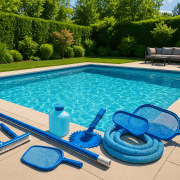
Grab a stiff pool brush and scrub every surface — walls, floor, steps, ladders, and behind the ladder. This breaks up algae colonies and exposes them to the chlorine you’re about to add. For black algae, use a stainless steel bristle brush and scrub each spot aggressively.

**Don’t skip this step.** Brushing is critical because algae forms a protective biofilm that chlorine can’t penetrate without physical disruption.

### Step 3: Shock the Pool (Heavy Dose)

This is the most important part of pool algae treatment. You need to raise your free chlorine to **shock level** — which depends on your CYA level:

– **Green algae:** Raise FC to your CYA × 0.4 (e.g., CYA of 40 = target FC of 16 ppm)
– **Yellow algae:** Raise FC to your CYA × 0.5 (e.g., CYA of 40 = target FC of 20 ppm)
– **Black algae:** Raise FC to your CYA × 0.6 (e.g., CYA of 40 = target FC of 24 ppm)

Use **calcium hypochlorite (cal-hypo) shock** or **liquid chlorine (sodium hypochlorite)** for best results. Avoid dichlor or trichlor for shocking — they add CYA which reduces chlorine’s killing power.

**Pro tip:** Use the [Pool Chemical Calculator app](https://poolchemicalcalculator.com) to calculate exactly how much shock to add based on your pool size and current readings.

### Step 4: Run the Filter 24/7

Keep your pump and filter running continuously until the water clears. This circulates the chlorine throughout the pool and filters out dead algae. You may need to run the filter for 24–72 hours depending on how severe the bloom was.

### Step 5: Brush Again and Maintain Chlorine

After 12–24 hours, brush all surfaces again. Re-test your chlorine level — if it has dropped significantly, add more. You need to maintain shock-level chlorine until the water is clear and the FC level holds overnight (less than 1 ppm loss over 8 hours).

### Step 6: Clean the Filter

Dead algae clogs filters fast. Clean or backwash your filter every 12–24 hours during the treatment process. For cartridge filters, hose them off thoroughly. For DE filters, backwash and add fresh DE. For sand filters, backwash until the water runs clear.

### Step 7: Vacuum Dead Algae

Once the water starts clearing, vacuum the dead algae from the bottom. If possible, vacuum to **waste** (bypassing the filter) to prevent clogging. This is especially important for heavy algae blooms.

## How to Prevent Pool Algae From Coming Back

Killing algae is only half the battle. Prevention is where you save time, money, and frustration:

– **Maintain proper chlorine levels** — Keep free chlorine at 2–4 ppm at all times. Never let it drop below 1 ppm
– **Test water 2–3 times per week** — Consistency is key. Use the [Pool Chemical Calculator](https://poolchemicalcalculator.com) to track your readings
– **Brush weekly** — Even when the pool looks clean, weekly brushing prevents algae from establishing
– **Run your filter 8–12 hours daily** — Proper circulation and filtration prevent dead spots where algae grows
– **Keep CYA in check** — Maintain cyanuric acid between 30–50 ppm. High CYA reduces chlorine effectiveness
– **Use algaecide as backup** — A weekly maintenance dose of algaecide provides an extra layer of protection, especially in warm weather
– **Maintain proper pH** — Keep pH between 7.2–7.6. High pH dramatically reduces chlorine’s killing power

## When to Call a Professional

Most pool algae treatment can be handled by the homeowner. However, consider calling a pool professional if:

– Black algae keeps returning despite repeated treatment
– Your pool has been neglected for months and the water is completely opaque
– You suspect a plumbing or circulation issue contributing to algae growth
– You’re unsure about your pool’s construction material and which chemicals are safe to use

## ???? Recommended Products

*As an Amazon Associate, we earn from qualifying purchases. These are products we genuinely recommend for treating pool algae.*

**[In The Swim Cal-Hypo Shock 24-Pack](https://www.amazon.com/dp/B00456TXR2?tag=poolcalc04-20)** (~$62) — Calcium hypochlorite shock is the best weapon against algae. This 24-pack gives you enough to treat even severe blooms. No CYA added.

**[Taylor K-2006 Complete Test Kit](https://www.amazon.com/dp/B004BGF7TI?tag=poolcalc04-20)** (~$90) — You can’t treat what you can’t measure. The gold standard for pool water testing — measures FC, CC, pH, alkalinity, calcium hardness, and CYA.

**[Pool Mate Algaecide 60](https://www.amazon.com/dp/B004BKONQW?tag=poolcalc04-20)** (~$15) — Non-foaming algaecide for maintenance dosing. Great for weekly prevention once you’ve killed the existing algae.

**[Lalapool 18″ Pool Brush](https://www.amazon.com/dp/B07QMF8Z2D?tag=poolcalc04-20)** (~$14) — Heavy-duty nylon bristle brush for scrubbing algae off walls and floors. Wide 18″ head covers more surface area per pass.

**[In The Swim Liquid Chlorine 4-Gallon](https://www.amazon.com/dp/B07FMN4MBV?tag=poolcalc04-20)** (~$42) — Liquid chlorine (sodium hypochlorite) is fast-acting and adds zero CYA to your pool. Ideal for shocking algae blooms.

**[Pool Mate CYA Stabilizer 7lb](https://www.amazon.com/dp/B004BKONIG?tag=poolcalc04-20)** (~$30) — If your CYA is low (below 30 ppm), you need stabilizer to protect your chlorine from UV breakdown. Critical for outdoor pools.

## ???? Calculate It Instantly with Pool Chemical Calculator

Stop guessing how much shock your pool needs! The **Pool Chemical Calculator** app tells you exactly how much of each chemical to add based on your pool’s size and current readings.

✅ Chlorine, pH, Alkalinity, Calcium Hardness & more
✅ Works for all pool types — chlorine, salt water, above ground
✅ Free to download

**[Download for Android →](https://play.google.com/store/apps/details?id=com.poolchemicalcalculator.poolcalc)**
**[Download for iPhone/iPad →](https://itunes.apple.com/us/app/pool-chem-calculator/id1453351222)**
**[Use Online →](https://poolchemicalcalculator.com)**

## Frequently Asked Questions

### How long does it take to treat pool algae?
Green algae can typically be cleared in 24–48 hours with proper shocking and filtration. Yellow algae may take 3–5 days, and black algae can take 1–2 weeks of aggressive treatment including repeated brushing and shocking.

### Can you swim in a pool with algae?
No, you should not swim in a pool with visible algae. Algae itself isn’t necessarily harmful, but it creates an environment where dangerous bacteria like E. coli can thrive. Additionally, algae makes surfaces slippery and increases the risk of falls.

### How much shock do I need to kill algae?
The amount depends on your pool size, current chlorine level, and CYA level. As a general rule, you need to reach shock-level chlorine: CYA × 0.4 for green algae, CYA × 0.5 for yellow, and CYA × 0.6 for black. Use the [Pool Chemical Calculator](https://poolchemicalcalculator.com) for precise dosing.

### Why does my pool keep getting algae?
Recurring algae usually indicates one or more ongoing issues: insufficient chlorine levels, poor circulation (dead spots in the pool), high CYA levels reducing chlorine effectiveness, inadequate filtration time, or inconsistent water testing and maintenance.

### Is algaecide enough to kill pool algae?
No. Algaecide alone is not strong enough to eliminate an active algae bloom. Chlorine (shocking) is the primary treatment. Algaecide works best as a preventive measure — used weekly to prevent algae from establishing in the first place.