Owning a pool means dealing with chemicals. There’s no way around it. But most pool owners either use too many products they don’t need or skip the ones they actually do. This is the complete pool chemicals list – everything your pool requires, what each chemical does, and when you need it.
Bookmark this page. You’ll come back to it.
The Essential Pool Chemicals (You Need All of These)
These are the non-negotiables. Every pool, whether it’s chlorine, salt water, or above ground, needs these chemicals maintained properly.
1. Chlorine (Sanitizer)
Chlorine kills bacteria, algae, and other nasties that make pool water unsafe. It’s the backbone of pool sanitation and the one chemical you absolutely cannot skip.
Forms available:
- 3-inch tablets – Slow-dissolving, great for daily maintenance. Drop them in a floater or your skimmer basket.
- Liquid chlorine (sodium hypochlorite) – Fast-acting, no stabilizer added. Ideal for weekly shocking or pools with high CYA.
- Granular chlorine (calcium hypochlorite) – Quick-dissolve powder for shock treatments. Raises calcium hardness slightly.
- Dichlor – Stabilized granular chlorine. Good for spas and small dose adjustments.
Target level: 1–3 ppm for residential pools, 3–5 ppm for heavy use.
2. pH Adjuster (pH Up and pH Down)
pH measures how acidic or basic your water is. Too low and it corrodes your equipment and irritates skin. Too high and chlorine stops working effectively – you’re pouring money into water that can’t sanitize itself.
- pH Down (sodium bisulfate or muriatic acid) – Lowers pH when it drifts above 7.6
- pH Up (sodium carbonate / soda ash) – Raises pH when it drops below 7.2
Target level: 7.2–7.6 (7.4 is the sweet spot)
3. Alkalinity Increaser (Sodium Bicarbonate)
Total alkalinity acts as a buffer for pH. Without proper alkalinity, your pH will bounce around constantly – high one day, low the next. It’s frustrating and you’ll waste chemicals chasing it.
Baking soda (sodium bicarbonate) is literally what most “alkalinity increaser” products are. The pool store version just costs 5x more.
Target level: 80–120 ppm
4. Cyanuric Acid (Stabilizer / Conditioner)
Think of CYA as sunscreen for your chlorine. Without it, the sun destroys about 90% of your free chlorine within two hours. With proper CYA levels, your chlorine lasts all day.
Here’s the catch: CYA doesn’t break down or evaporate. It only leaves your pool through splash-out, backwashing, or draining. If it gets too high (above 80 ppm), your chlorine won’t work as well even though your test kit says levels look fine.
Target level: 30–50 ppm (outdoor pools). Indoor pools don’t need it.
5. Calcium Hardness Increaser
Calcium hardness keeps your water from becoming aggressive. Low-calcium water will pull minerals from your plaster, tile grout, and equipment to satisfy itself. That means etched surfaces, corroded heaters, and expensive repairs.
Target level: 200–400 ppm (plaster pools), 150–250 ppm (vinyl/fiberglass)
Shock Treatments
Shocking your pool means adding a large dose of chlorine (or non-chlorine oxidizer) to destroy combined chlorine, organic waste, and algae. Regular chlorine handles daily maintenance. Shock handles the heavy lifting.
6. Calcium Hypochlorite Shock (Cal-Hypo)
The most common pool shock. It’s strong (65–73% available chlorine), dissolves fast, and gets the job done. Always pre-dissolve in a bucket before adding to your pool.
When to use: Weekly maintenance, after heavy rain, after pool parties, when combined chlorine exceeds 0.5 ppm.
7. Non-Chlorine Shock (Potassium Monopersulfate)
An oxidizer that breaks down organic waste without adding chlorine. Useful if your chlorine is already at the right level but the water looks dull or you’re getting that “chlorine smell” (which is actually chloramines, not chlorine).
Bonus: You can swim 15 minutes after adding it, compared to waiting 8+ hours after chlorine shock.
Specialty Chemicals (Use as Needed)
These aren’t daily-use chemicals. You add them when you have a specific problem or want to prevent one.
8. Algaecide
A preventive chemical that inhibits algae growth. It doesn’t replace chlorine – think of it as backup. Most useful during hot months when algae blooms happen fast.
Types: Copper-based (effective but can stain), quat-based (affordable, foams a bit), polyquat (no staining, no foaming, costs more).
9. Clarifier
When your pool looks hazy but your chemistry is fine, clarifier groups tiny particles together so your filter can catch them. It’s a quick cosmetic fix, not a long-term solution. If you’re using clarifier every week, something else is wrong.
10. Flocculant
The nuclear option for cloudy water. Flocculant binds to particles and sinks them to the bottom, where you vacuum them to waste. It works fast but wastes water since you’re bypassing the filter entirely.
11. Metal Sequestrant
If your water source has high iron, copper, or manganese, metals can stain your pool surfaces and turn water green or brown (even with perfect chlorine levels). Metal sequestrant binds to dissolved metals and keeps them in solution so your filter removes them.
12. Phosphate Remover
Phosphates are algae food. They come from fertilizer runoff, leaves, and even your municipal water supply. Removing phosphates won’t replace proper chlorination, but if you’re constantly fighting algae despite good chlorine levels, it can help break the cycle.
The Pool Chemical Testing Essentials
None of these chemicals matter if you can’t measure them. Testing your water regularly is the single most important thing you’ll do as a pool owner.
Test weekly at minimum:
- Free chlorine
- pH
- Total alkalinity
Test monthly:
- Cyanuric acid (CYA)
- Calcium hardness
- Total dissolved solids (TDS)
A good test kit pays for itself in the chemicals you don’t waste. Liquid reagent kits (like the Taylor K-2006) are far more accurate than test strips, though strips work fine for quick daily checks.
—
???? Recommended Products
*As an Amazon Associate, we earn from qualifying purchases. These are products we genuinely recommend for pool maintenance.*
Taylor K-2006 Complete Test Kit (~$90) – The gold standard for pool water testing. Tests chlorine, pH, alkalinity, calcium hardness, and CYA with lab-grade accuracy.
In The Swim 3″ Chlorine Tablets (25 lbs) (~$70) – Slow-dissolving stabilized chlorine tablets. Best value per pound for daily maintenance.
Clorox Pool&Spa pH Down (5 lbs) (~$13) – Sodium bisulfate granules. Safer and easier to handle than muriatic acid for lowering pH.
Arm & Hammer Baking Soda (15 lbs) (~$15) – Pure sodium bicarbonate. Identical to pool store “alkalinity increaser” at a fraction of the price.
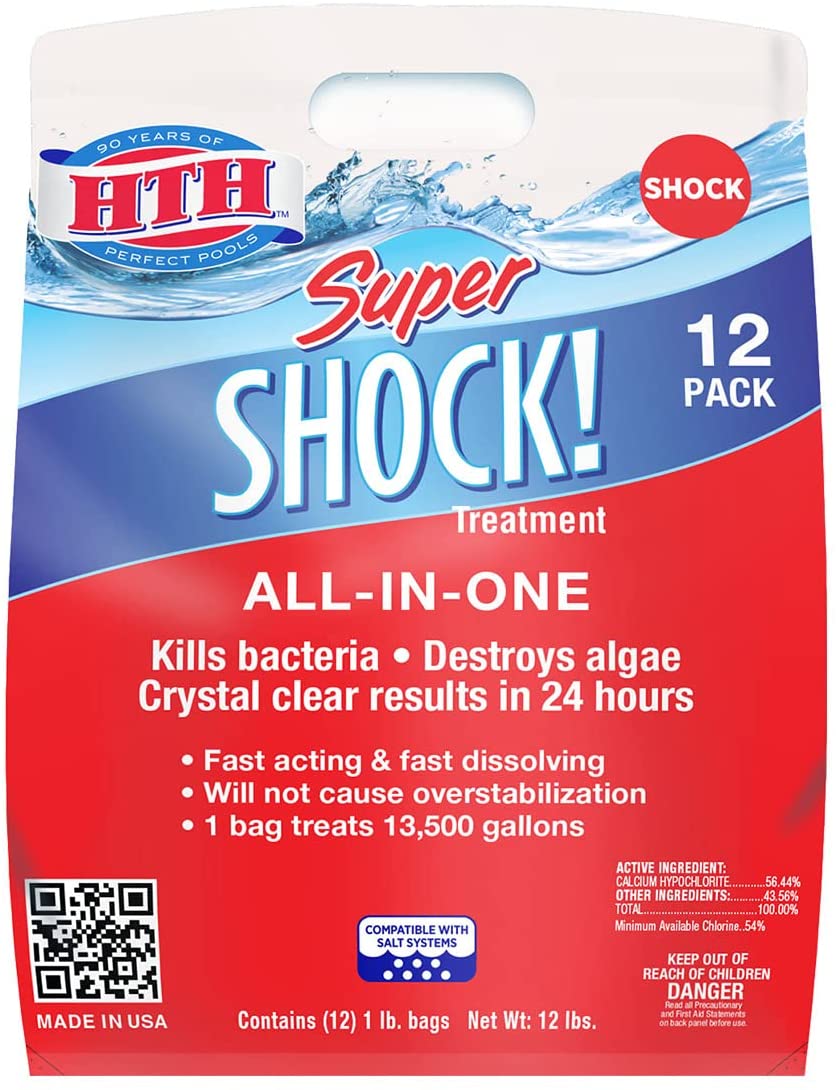
In The Swim Cal-Hypo Pool Shock (24 x 1 lb bags) (~$65) – 68% calcium hypochlorite shock. Pre-portioned bags make weekly shocking easy.
AquaChek 7-Way Test Strips (100 ct) (~$17) – Quick daily testing for free chlorine, bromine, pH, alkalinity, hardness, and CYA. Not as precise as liquid kits but great for daily monitoring.
—
???? Calculate It Instantly with Pool Chemical Calculator
Stop doing pool chemistry math in your head. The Pool Chemical Calculator app tells you exactly how much of each chemical to add based on your pool’s size and current readings.
✅ Chlorine, pH, Alkalinity, Calcium Hardness & more
✅ Works for all pool types – chlorine, salt water, above ground
✅ Free to download
—
Quick Reference: Pool Chemical Cheat Sheet
| Chemical | Target Range | What It Does |
|
—
|
—
|
—
|
| Free Chlorine | 1–3 ppm | Sanitizes water |
| pH | 7.2–7.6 | Controls acidity |
| Total Alkalinity | 80–120 ppm | Buffers pH stability |
| Cyanuric Acid | 30–50 ppm | Protects chlorine from UV |
| Calcium Hardness | 200–400 ppm | Prevents surface damage |
—