
Pool Light Replacement: A Step-by-Step Guide to Brightening Your Backyard Oasis
There’s nothing quite like swimming at night with underwater lights casting that perfect glow. But when your pool light flickers, dims, or dies completely, you’re left with a dark hole in your backyard instead of the relaxing retreat you love. Pool light replacement might sound intimidating — there’s water and electricity involved, after all — but it’s actually a straightforward DIY project that most homeowners can tackle in about 2-3 hours. And you’ll save $150-$300 in electrician fees by doing it yourself.
Let me walk you through everything you need to know, from diagnosing the problem to flipping the switch on your brand-new light.
Signs Your Pool Light Needs Replacing
Before you order a new light, make sure replacement is actually necessary. Sometimes the fix is simpler than you think.
The Light Won’t Turn On At All
Check the obvious stuff first. Is the GFCI outlet tripped? These safety outlets (usually located near your pool equipment) trip frequently. Push the reset button and try again. Still nothing? The bulb might just be burned out, which costs $15-30 to fix versus $100-400 for a complete fixture.
Water Inside the Lens
This is a bigger problem. If you see condensation or actual water droplets inside the light housing, the seal has failed. You might be able to replace just the lens gasket ($10-20), but if the fixture itself is corroded, you’ll need a full replacement. Don’t delay on this one — water intrusion near electrical components is a safety hazard.
Flickering or Intermittent Operation
Flickering usually means one of three things: a loose connection, a failing bulb, or a deteriorating fixture. If you’ve already tried a new bulb and checked your connections, the fixture itself is likely the culprit.
Your Light Is Over 15 Years Old
Pool lights don’t last forever. Incandescent fixtures typically give you 10-15 years before corrosion wins. If yours is pushing two decades, replacement makes more sense than repair — especially since modern LED lights use 80% less electricity and last 50,000+ hours.
Choosing the Right Replacement Light
Here’s where people get confused. Pool lights aren’t universal, so you’ll need to match a few specifications.
Measure Your Existing Niche
The niche is the housing built into your pool wall that holds the light fixture. Standard sizes are:
- Large niche: 10″ diameter (most common for in-ground pools)
- Small niche: 4″ diameter (often found in spas and older pools)
Measure yours before shopping. Installing a 10″ light in a 4″ niche isn’t happening without major construction.
Voltage Matters
Pool lights come in two voltages:
- 120V — Standard household voltage, brighter output
- 12V — Lower voltage, requires a transformer, slightly safer
Check your existing setup. Switching from 120V to 12V (or vice versa) requires electrical modifications and possibly permits. Stick with what you have unless you’re hiring a professional.
LED vs. Incandescent
This isn’t really a debate anymore. LED wins on every metric:
| Feature | LED | Incandescent |
|———|—–|————–|
| Lifespan | 30,000-50,000 hours | 1,000-3,000 hours |
| Energy use | 20-40 watts | 300-500 watts |
| Annual cost | ~$8 | ~$65 |
| Color options | Multiple | White only |
| Upfront cost | $150-400 | $50-100 |
The Hayward ColorLogic LED Pool Light is a popular upgrade that fits most standard niches and offers 10 different colors. Worth the investment.
How to Replace Your Pool Light
Alright, let’s get to work. This job requires basic tools and about 2-3 hours of your time.
What You’ll Need
- Flathead and Phillips screwdrivers
- Voltage tester (non-negotiable for safety)
- Lens gasket lubricant or silicone grease
- New light fixture
- Towel and dry workspace
Step 1: Turn Off the Power
Find your pool light circuit at the breaker panel and flip it off. Then flip off the main pool equipment breaker too, just to be safe. Go back to the light switch and confirm the light won’t turn on.
Here’s the critical part: Use a non-contact voltage tester at the fixture location before touching anything. These cost $15-25 and could save your life. Never skip this step.
Step 2: Remove the Light Fixture
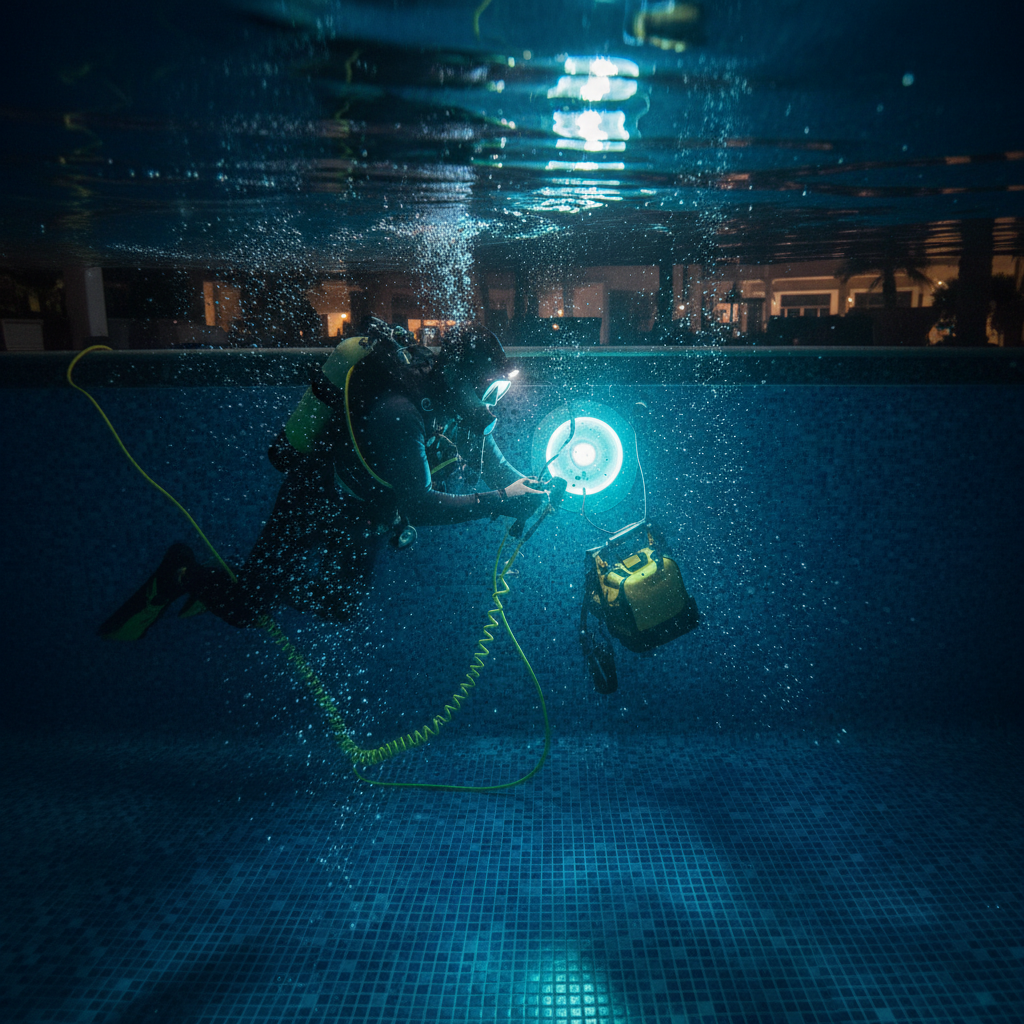
Lower your pool water level 6-12 inches below the light (optional but makes this easier). Most fixtures are held in place by a single screw at the top of the face ring. Remove this screw, then gently pry the fixture out of the niche.
The fixture connects to the electrical supply via a cord that’s coiled inside the niche. Pull the fixture up onto the pool deck — there should be enough cord length to work comfortably. If your cord feels tight, you may need to work in the water or lower the level further.
Step 3: Disconnect the Old Fixture
The wiring connection is usually inside a junction box (called a “J-box”) located behind the pool wall, accessible from your yard or equipment area. Follow the cord from the light fixture to find it.
Open the junction box, document which wires connect where (take a photo with your phone), and disconnect the old fixture. The new light’s cord will connect to the same wires.
Step 4: Install the New Light
Feed the new light’s cord back through the conduit to the junction box. Connect the wires — typically black to black (hot), white to white (neutral), and green to green (ground). Use waterproof wire connectors and wrap connections with electrical tape.
Before sealing everything up, have a helper turn the power back on while you test the new light. Works? Great. Turn power off again.
Step 5: Seal and Replace the Fixture
Apply silicone lubricant to the new lens gasket — this ensures a watertight seal. Coil the excess cord neatly inside the niche (no kinks or sharp bends), press the fixture into place, and replace the retaining screw.
Turn the power on, fill your pool back up if needed, and enjoy your new light.
LED Upgrade Considerations
Upgrading from incandescent to LED isn’t always plug-and-play. Here’s what to watch for.
Transformer Requirements
Some LED lights require a specific transformer to operate correctly. If you’re installing a 12V LED light, make sure your existing transformer outputs the correct wattage. A 300W transformer running a 35W LED light is fine. But a 100W transformer trying to power a 150W fixture isn’t.
Color and Control Options
Modern LED pool lights like the Pentair MicroBrite offer multiple colors and light shows controlled by turning the switch off and on in quick succession. No special controller required — just some patience learning the sequences.
Dimming Compatibility
Most LED pool lights don’t dim properly with standard household dimmers. If you want dimming capability, you’ll need a purpose-built pool light controller. Budget $150-300 for that upgrade.
When to Call a Professional
DIY pool light replacement is manageable for most homeowners, but some situations call for a licensed electrician:
- Water inside the junction box
- Corroded or damaged wiring in the conduit
- Switching voltage types (120V to 12V or reverse)
- Installing a light in a pool that never had one
- Any situation where you’re uncomfortable working near water and electricity
A pro will charge $150-300 for labor plus the cost of the fixture. Worth it for your safety if you’re uncertain.
FAQ
Can I replace my pool light without draining the pool?
Yes, in most cases. The fixture pulls out of the niche with enough cord to reach the deck. You might want to lower water 6-12 inches below the light to make the job easier, but fully draining isn’t necessary.
How long do LED pool lights last?
Quality LED pool lights last 30,000-50,000 hours. Swimming 4 hours per night, 6 months per year, that’s roughly 20-40 years of use. You’ll likely replace the pool before the light.
Can I install a different brand light in my existing niche?
Usually yes, as long as the niche diameter matches (10″ or 4″ typically) and the voltage is compatible. Some brands use proprietary mounting systems, so check compatibility before purchasing.
Why does my new LED light flicker?
Flickering LEDs usually indicate an incompatible transformer or dimmer switch. Make sure your transformer outputs clean power at the correct voltage. Remove any dimmers from the circuit — standard dimmers cause LED flickering.
Is it safe to have electricity in my pool?
Pool lights are specifically engineered for underwater use with multiple safety features. The GFCI protection at the outlet shuts off power within milliseconds if it detects any current leak. When installed correctly, pool lights are completely safe.
Ready to calculate the chemicals you’ll need after your pool maintenance project? Head over to Pool Chemical Calculator to get precise dosing recommendations based on your pool’s size and current water chemistry. No more guessing — just clear, balanced water every time.
> ???? Keep Your Pool Perfectly Balanced
>
> After any pool maintenance project, use the Pool Chemical Calculator app to dial in your water chemistry fast. Get precise dosing for chlorine, pH, alkalinity, and more — based on your exact pool size.
>
> ???? Download on the App Store | Get it on Google Play