???? Recommended Products
As an Amazon Associate, we earn from qualifying purchases. These are products we genuinely recommend for accurate pH management.
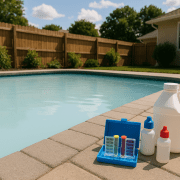
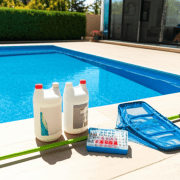
Taylor K-2006 Complete Test Kit (~$90) – Accurate pH testing with phenol red reagent, plus tests for chlorine, alkalinity, calcium hardness, and CYA. Reliable inputs make your calculator results meaningful.
AquaChek 7-Way Test Strips (100 ct) (~$17) – Quick daily pH and alkalinity checks. Good for monitoring trends between thorough Taylor tests.
Clorox Pool&Spa pH Down 5lb (~$13) – Granular sodium bisulfate (dry acid) for safely lowering pH. Easier to handle than muriatic acid, especially for beginners.
Arm & Hammer Baking Soda 15lb (~$15) – Pure sodium bicarbonate for raising total alkalinity, which helps stabilize pH long-term. Not a direct pH raiser, but essential for the buffering system.
—
???? Calculate It Instantly with Pool Chemical Calculator
Stop guessing with your pool chemistry! The Pool Chemical Calculator app tells you exactly how much of each chemical to add based on your pool’s size and current readings.
✅ Chlorine, pH, Alkalinity, Calcium Hardness & more
✅ Works for all pool types – chlorine, salt water, above ground
✅ Free to download
—
Frequently Asked Questions
What is the ideal pH for a swimming pool?
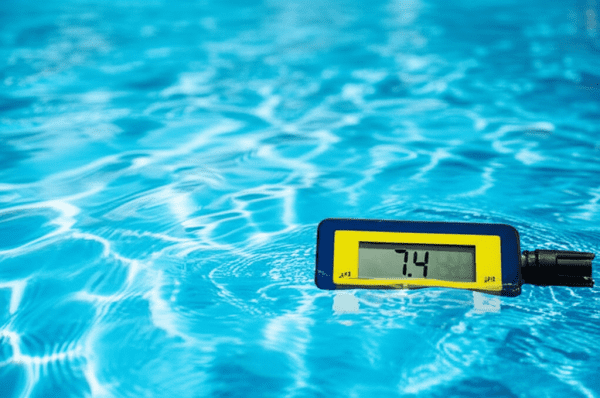
The ideal pH range is 7.2 to 7.8, with 7.4 to 7.6 being the sweet spot. This range maximizes chlorine effectiveness, prevents equipment damage, and keeps swimmers comfortable. Human tears are about 7.4 pH, so water near that level causes the least eye irritation.
How do I lower my pool pH quickly?
Add muriatic acid or dry acid (sodium bisulfate) with the pump running. Pour slowly near a return jet to distribute it evenly. For a 15,000-gallon pool with pH at 7.8, about 12-16 ounces of muriatic acid will bring it down to 7.4. Always retest after 30 minutes and add more if needed – it’s better to undershoot than overcorrect.
Why does my pool pH keep going up?
The most common causes are high total alkalinity (above 120 ppm), a salt chlorine generator (electrolysis naturally raises pH), regular use of liquid chlorine (which has a high pH), and aeration from water features or spillovers. Address the root cause first, then use acid for fine-tuning.
Can I use vinegar to lower pool pH?
Technically yes, but it’s extremely impractical. Vinegar is only about 5% acetic acid, so you’d need gallons and gallons to move the pH in a full-size pool. Muriatic acid or dry acid are far more effective and much cheaper per dose. Stick with products made for pool use.
What’s the difference between pH and alkalinity?
pH measures how acidic or basic your water is right now. Alkalinity measures the water’s ability to resist pH changes – it’s a buffer. You need both in the right range: pH at 7.4-7.6 and alkalinity at 80-120 ppm. When alkalinity is correct, pH stays stable. When it’s off, pH swings wildly after every chemical addition or rainstorm.