
How to Lower Alkalinity in Pool (Without Making Things Worse)
High alkalinity makes your pool a pain to manage. Your pH climbs and stays high, your water gets cloudy, chlorine stops working like it should, and no matter what you try, the chemistry stays stubborn. If you’re wondering how to lower alkalinity in pool water, the answer is muriatic acid combined with aeration. It’s a two-step process, and doing it right means you won’t wreck your pH in the process.
Here’s exactly how to do it, how much acid to add, and what to watch for afterward.
What Is Total Alkalinity and Why Does It Matter?
Total alkalinity (TA) measures the concentration of alkaline substances in your water, mainly bicarbonates and carbonates. Think of it as your pH’s stabilizer. Alkalinity keeps pH from swinging wildly every time you add chemicals, when it rains, or when swimmers get in.
The ideal range for total alkalinity is 80 to 120 ppm (parts per million). Salt water pools do better at the lower end, around 80 to 100 ppm, because the salt cell naturally pushes pH higher over time.
When alkalinity creeps above 120 ppm, your pH climbs along with it and refuses to come back down. That’s when problems start.
Why High Alkalinity Is a Problem
High alkalinity doesn’t just mess with pH. It creates a chain reaction of water chemistry headaches.
Problems caused by high alkalinity:
- Cloudy or hazy water: the most obvious sign something’s off
- Scaling on surfaces: white crusty deposits on tiles, heaters, and salt cells
- Chlorine that doesn’t sanitize properly: high pH reduces chlorine’s killing power by 50% or more
- Stubborn pH: you add acid, pH drops for a few hours, then bounces right back up
- Staining: minerals fall out of solution and leave ugly marks on pool walls
If you’ve been fighting cloudy water or constantly adjusting pH with no lasting results, check your alkalinity. Odds are it’s sitting above 150 ppm.
How to Lower Alkalinity in Pool (Step-by-Step)
Lowering alkalinity takes muriatic acid and patience. You can’t just dump acid in and walk away because muriatic acid lowers both pH and alkalinity at the same time. If you drop pH too far too fast, you create a new set of problems.
The trick is to lower both, then use aeration to raise pH back to normal without raising alkalinity. Here’s the process.
Step 1: Test Your Current Levels
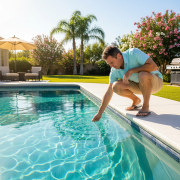
Use a reliable test kit or test strips to measure both alkalinity and pH. You need accurate numbers before you start. A quality test kit like the Taylor K-2006 gives precise readings you can trust.
Step 2: Calculate How Much Acid to Add
This depends on your pool size, current alkalinity level, and target level. The math gets complicated fast, which is why most people either guess (bad idea) or use a pool chemistry calculator (smart move). We’ll cover dosing amounts in the next section.
Step 3: Add Muriatic Acid
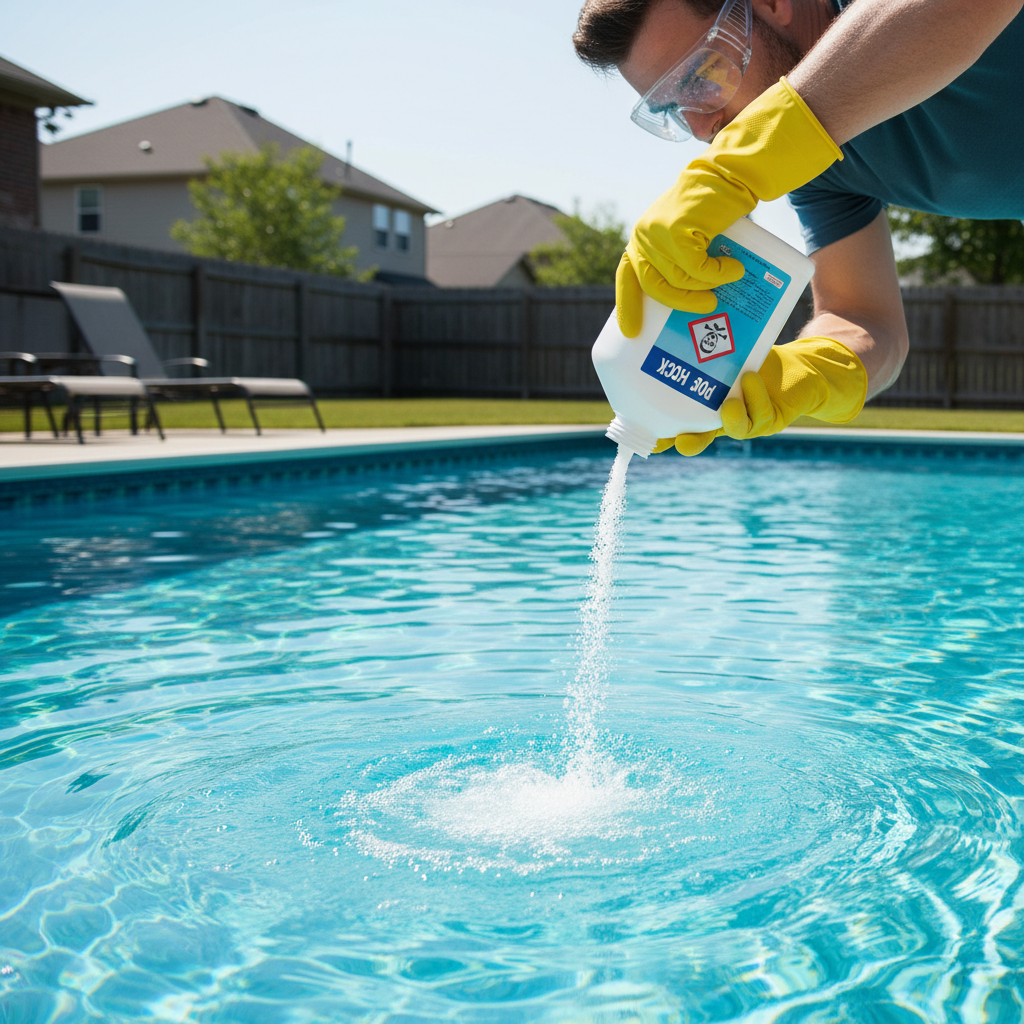
With the pump running, pour muriatic acid around the perimeter of the pool. Never dump it all in one spot. Stay upwind of the fumes and wear gloves and eye protection. Pour slowly near a return jet so it mixes quickly.
Your goal is to drop pH down to around 7.0 to 7.2. This will also start bringing alkalinity down.
Step 4: Aerate the Water
Aeration means exposing the water to air, which naturally raises pH without raising alkalinity. Turn on water features like fountains, waterfalls, or deck jets. If you don’t have those, point return jets upward to create surface agitation. Run the pump continuously during this phase.
Over 12 to 24 hours, pH will climb back toward 7.4 to 7.6 while alkalinity stays lower. This is the magic step that lets you separate pH from alkalinity.
Step 5: Retest and Repeat if Needed
After 24 hours, test again. If alkalinity is still above 120 ppm, repeat the process. Add more acid to drop pH back to 7.0, then aerate again. For significantly high alkalinity (say, 180 ppm or higher), expect to go through this cycle 2 to 3 times over several days.
Don’t rush it. Adding too much acid at once can drop pH dangerously low and damage pool surfaces.
How Much Muriatic Acid to Add
Muriatic acid dosing depends on three things: pool volume, current alkalinity, and how much you want to lower it.
Here’s a rough guide for how much muriatic acid to add per 10,000 gallons of water to lower total alkalinity by 10 ppm:
- 10,000-gallon pool: about 12 to 15 ounces
- 20,000-gallon pool: about 24 to 30 ounces
- 30,000-gallon pool: about 36 to 45 ounces
Keep in mind this is an approximation. Water chemistry doesn’t always behave in a straight line. The safest approach is to add acid in smaller doses, test after each one, and adjust as needed.
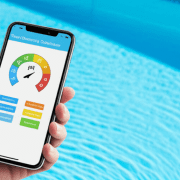
Or skip the guesswork entirely. The Pool Chemical Calculator app does the math for you. Enter your pool size, current alkalinity, and target level, and it tells you exactly how much muriatic acid to add.
Muriatic acid is sold at any pool supply store or hardware store. You can also find it online: pool-grade muriatic acid.
Safety Tips When Using Muriatic Acid
Muriatic acid (hydrochloric acid) is strong stuff. It works great for lowering alkalinity in pool water, but it demands respect.
Safety precautions:
- Always wear gloves and safety goggles: acid splashes cause chemical burns
- Work in a ventilated area: the fumes are harsh on your lungs
- Never mix with other chemicals: especially chlorine or bleach, which can create toxic gas
- Add acid to water, never water to acid: pour acid into the pool, not the other way around
- Store it safely: keep the cap tight, store in a cool dry place away from kids and pets
- Have baking soda on hand: if you spill acid on skin or a surface, neutralize it immediately with baking soda
If you’re uncomfortable handling muriatic acid, dry acid (sodium bisulfate) is a gentler alternative. It lowers alkalinity and pH the same way with less risk of fumes or splashes. It costs a little more, but it’s worth it if safety is a concern.
What to Check After Lowering Alkalinity
Once you’ve brought alkalinity down into the 80 to 120 ppm range, don’t assume you’re done. Adjusting one parameter often affects others.
Test these after lowering alkalinity:
- pH: Should land between 7.4 and 7.6 after the acid-and-aeration cycle
- Free chlorine: Confirm it’s still in the 1 to 3 ppm range and sanitizing properly
- Calcium hardness: Acid doesn’t change calcium levels, but if alkalinity was high for a while, you may have scaling that trapped calcium deposits
If pH won’t stabilize even after alkalinity is corrected, check your water source. Some fill water (especially well water) has high alkalinity or high pH naturally, which means you’ll be fighting a slow drift over time. Top-offs and refills bring the problem back.
Also, keep an eye on alkalinity over the next few weeks. It’s relatively stable compared to pH, but heavy rain, high bather loads, or adding chemicals can shift it again. Test weekly to stay ahead of it.
FAQ
How long does it take to lower alkalinity in a pool?
The acid-and-aeration process takes 24 to 48 hours per cycle. If alkalinity is significantly high (above 180 ppm), expect to repeat the cycle 2 to 3 times over several days. You can’t rush it without risking pH crashes or surface damage.
Can I swim while lowering alkalinity?
Not right after adding acid. Wait at least 4 hours with the pump running to allow the acid to circulate and dilute. Retest pH and chlorine levels before letting anyone swim. If pH is below 7.2 or chlorine is out of range, keep the pool closed until chemistry is balanced.
What if I add too much muriatic acid?
If you overshoot and drop pH below 7.0, add sodium bicarbonate (baking soda) to raise both pH and alkalinity back up. Add it slowly, test frequently, and don’t overcorrect. This is why smaller doses are always smarter than one big dump of acid.
Does lowering alkalinity affect chlorine levels?
Not directly. But because lowering alkalinity involves adjusting pH, and pH affects chlorine’s effectiveness, you should retest free chlorine after balancing alkalinity and pH. If chlorine is low, add more. If it’s in range, you’re good to go.
Will aeration alone lower alkalinity?
No. Aeration raises pH without affecting alkalinity. You need acid to bring alkalinity down, then aeration to bring pH back up. They work together as a two-step process, not as separate solutions.
Stop guessing on chemical doses. The Pool Chemical Calculator app tells you exactly how much muriatic acid to add based on your pool size and current alkalinity levels.
Android: https://play.google.com/store/apps/details?id=com.poolchemicalcalculator.poolcalc
iOS: https://itunes.apple.com/us/app/pool-chem-calculator/id1453351222
Website: https://poolchemicalcalculator.com
The Bottom Line
High alkalinity makes pool maintenance frustrating. Your pH won’t stay put, your water gets cloudy, and chlorine stops working properly. The fix is muriatic acid combined with aeration. Lower pH and alkalinity together with acid, then raise pH back to normal with aeration. Repeat the cycle until alkalinity lands between 80 and 120 ppm.
Test accurately, dose conservatively, work safely, and be patient. Get alkalinity dialed in and the rest of your water chemistry becomes a whole lot easier.
Schema markup below (do not render in published post)