
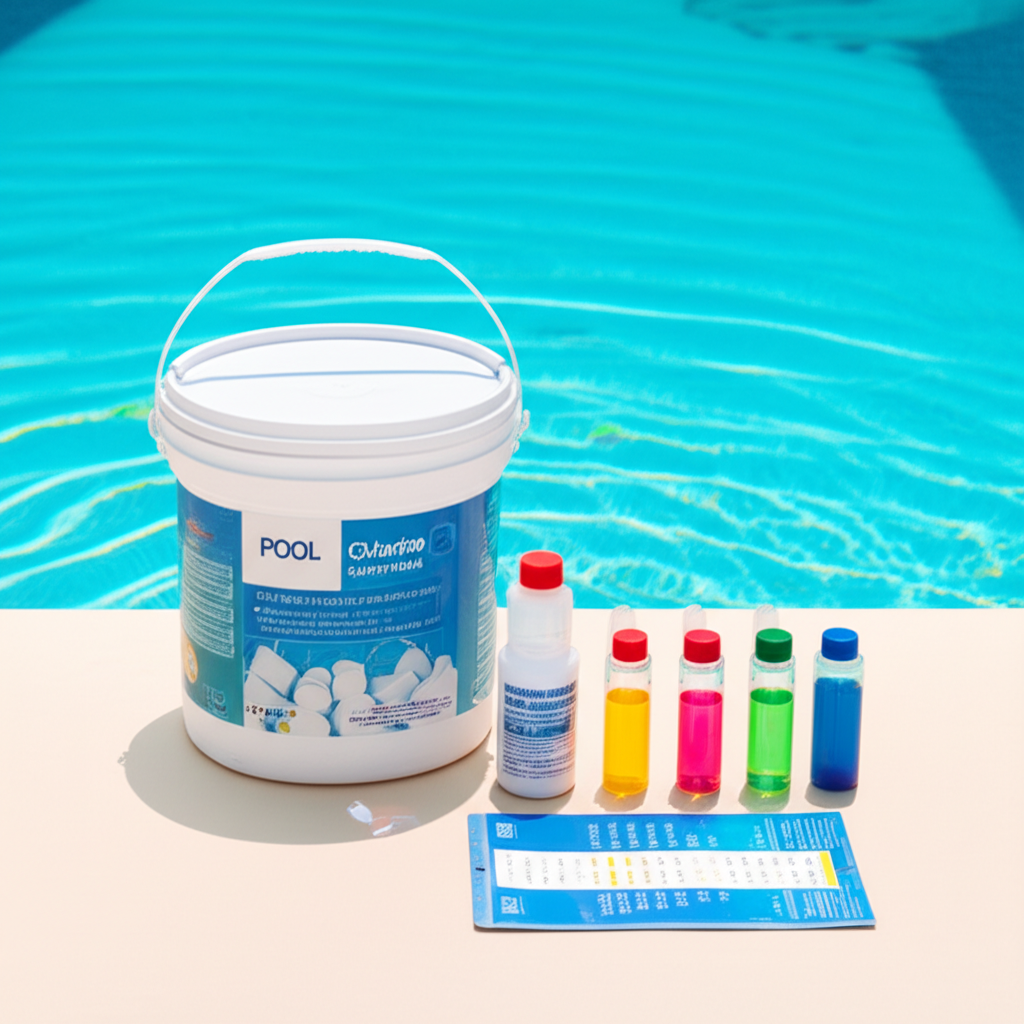
Pool Chemicals for Beginners: Everything You Need to Know
Pool Chemicals for Beginners: Everything You Need to Know
Owning a pool for the first time can feel overwhelming when you walk into the chemical aisle. Dozens of bottles, powders, and tablets line the shelves, and every one of them claims to be essential. The truth is simpler than the marketing suggests. You need about five core chemicals to keep your pool safe and swimmable, and once you understand what each one does, maintaining your water becomes routine.
This guide breaks down every pool chemical a beginner needs to know about, explains when and how to use each one, and helps you avoid the most common mistakes new pool owners make.
The 5 Essential Pool Chemicals Every Beginner Needs
Before you buy anything else, make sure you have these five chemicals on hand. They cover 90% of what your pool needs throughout the season.
Chlorine is your primary sanitizer. It kills bacteria, algae, and other organisms that make pool water unsafe. You can buy it as 3-inch tablets for daily use, liquid chlorine for quick adjustments, or granular shock for weekly treatments. Most pools need a chlorine level between 1 and 3 parts per million (ppm) at all times.
pH increaser (soda ash) and pH decreaser (sodium bisulfate) keep your water’s acidity in the right range. Pool water should stay between 7.2 and 7.6 on the pH scale. Water outside this range causes eye irritation, reduces chlorine effectiveness, and can damage pool surfaces over time.
Alkalinity increaser (sodium bicarbonate) acts as a buffer for your pH level. Total alkalinity should sit between 80 and 120 ppm. When alkalinity is too low, your pH bounces around unpredictably. When it is too high, your pH becomes difficult to adjust.
Cyanuric acid (stabilizer/conditioner) protects your chlorine from the sun. Without it, UV rays break down chlorine in a matter of hours. The ideal range is 30 to 50 ppm for most pools. You only need to add this once or twice per season because it does not break down on its own.
How to Test Your Pool Water
Testing comes before adding any chemicals. You cannot fix what you cannot measure.
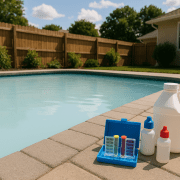
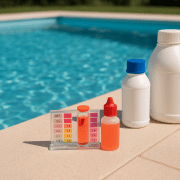
Pick up a basic test kit or test strips that measure at least these four things: free chlorine, pH, total alkalinity, and cyanuric acid. Test strips cost around $15 for 100 strips and give you results in about 15 seconds. For more accurate readings, a liquid drop test kit like the Taylor K-2006 runs about $90 but gives laboratory-grade precision.
Test your water at least twice per week during swimming season. Test more frequently after heavy rain, a pool party with lots of swimmers, or extreme heat. Always test before adding chemicals so you know exactly what your water needs.
Here are the target ranges every beginner should memorize:
- Free chlorine: 1 to 3 ppm
- pH: 7.2 to 7.6
- Total alkalinity: 80 to 120 ppm
- Cyanuric acid: 30 to 50 ppm
- Calcium hardness: 200 to 400 ppm
How to Add Pool Chemicals Safely
Adding chemicals in the wrong order or the wrong way can create dangerous reactions. Follow these rules every time.
Always add chemicals to water, never water to chemicals. When dissolving granular chemicals, fill a 5-gallon bucket with pool water first, then slowly pour the chemical in while stirring. Pour the dissolved solution around the perimeter of the pool with the pump running.
Add one chemical at a time. Wait at least 30 minutes between different chemicals, and retest before adding the next one. This prevents chemical reactions and lets each addition circulate through the entire pool.
Never mix chemicals together. Chlorine and acid can create toxic chlorine gas. Even storing them next to each other can be dangerous if containers leak. Keep all pool chemicals in a cool, dry, well-ventilated area away from direct sunlight.
Adjust in this order: alkalinity first, pH second, then chlorine and other sanitizers last. Alkalinity affects pH, and pH affects chlorine effectiveness, so working in this order prevents you from chasing numbers in circles.
Pool Chemicals for Beginners: A Weekly Routine
Having a consistent schedule makes pool care predictable instead of reactive. Here is a simple weekly routine that works for most residential pools.
Twice per week: Test your water for chlorine and pH. Adjust if needed. This takes about 5 minutes.
Once per week: Run a complete test including alkalinity and stabilizer. Add chlorine shock in the evening after the sun goes down. Shocking your pool once a week prevents algae growth and breaks down combined chlorine (the stuff that causes that strong “chlorine smell” and eye irritation).
Once per month: Test calcium hardness. Check your filter pressure gauge and clean or backwash when pressure rises 8 to 10 PSI above your clean baseline.
Start and end of season: Do a full chemical balance including calcium hardness and cyanuric acid. These change slowly, so monthly or seasonal checks are enough.
Common Beginner Mistakes to Avoid
New pool owners tend to make the same handful of mistakes. Learning from these saves you money and frustration.
Adding chemicals during the day. Chlorine breaks down in sunlight. Adding shock or liquid chlorine at noon wastes about half of it before the sun goes down. Always add chlorine products in the evening or after sunset.
Over-relying on test strips. Strips give you a general idea, but they lose accuracy over time, especially in high humidity. Consider upgrading to a liquid test kit after your first season, or use the Pool Chemical Calculator app for precise dosing based on your results.
Ignoring alkalinity. Most beginners focus only on chlorine and pH. But alkalinity is the foundation. If your alkalinity is off, your pH will not stay where you put it, no matter how much pH adjuster you add.
Adding too much chemical at once. More is not better. Overshooting your target creates a new problem to fix. Use a pool chemical calculator to determine the exact amount based on your pool volume and current readings. A 10,000-gallon pool needs very different amounts than a 25,000-gallon pool.
Forgetting to run the pump. Chemicals need to circulate. Run your pump for at least 8 hours per day, and always run it for at least 30 minutes after adding any chemical. Without circulation, chemicals settle in one area and leave the rest of the pool untreated.
Understanding Pool Shock: When and Why
Pool shock is a large dose of chlorine (or non-chlorine oxidizer) that raises your free chlorine level to 10 ppm or higher. This breakpoint chlorination destroys combined chlorine, kills algae spores, and eliminates bacteria that normal chlorine levels might miss.
Shock your pool once per week as maintenance. Also shock after any of these events: heavy rain, a pool party with many swimmers, visible algae growth, or a strong chlorine smell (which actually means you need more chlorine, not less).
Use calcium hypochlorite (cal-hypo) shock for regular weekly treatments. It dissolves quickly and works fast. Use dichlor shock if you need to add stabilizer at the same time. Always shock in the evening and wait until chlorine drops below 5 ppm before swimming again, which usually takes 8 to 24 hours.
Salt Water Pools: Different Chemicals, Same Principles
If you have a salt water pool, you still need to understand pool chemicals for beginners because salt water pools are not chemical-free. The salt chlorine generator creates chlorine from dissolved salt, but you still need to manage pH, alkalinity, stabilizer, and calcium hardness manually.
Salt water pools tend to push pH higher over time, so you will use pH decreaser more often than a traditional chlorine pool. You also need to maintain your salt level between 2,700 and 3,400 ppm and clean the generator cell every 3 to 6 months.
Recommended Products
As an Amazon Associate, we earn from qualifying purchases. These are products we genuinely recommend for beginners getting started with pool care.
Taylor K-2006 Complete Test Kit (~$90) – The most accurate home testing kit available. Measures chlorine, pH, alkalinity, calcium hardness, and CYA. Worth the investment over test strips.
AquaChek 7-Way Test Strips (100 ct) (~$17) – Great for quick daily checks between full tests. Easy to read and gives you results in 15 seconds.
In The Swim 3″ Chlorine Tablets (25 lbs) (~$70) – Slow-dissolving stabilized chlorine tablets for your skimmer or floating dispenser. One of the best values per pound.
In The Swim Calcium Hypochlorite Pool Shock (24 x 1 lb bags) (~$80) – Individual bags make weekly shocking easy. Just open and pour. No measuring needed.
Clorox Pool&Spa pH Down (5 lb) (~$13) – Granular sodium bisulfate for lowering pH. Easy to dose and dissolves quickly.
Arm & Hammer Baking Soda (15 lb) (~$14) – Pure sodium bicarbonate for raising alkalinity. Identical to pool-branded alkalinity increaser at a fraction of the cost.
Calculate It Instantly with Pool Chemical Calculator
Stop guessing with your pool chemistry! The Pool Chemical Calculator app tells you exactly how much of each chemical to add based on your pool’s size and current readings.
- Chlorine, pH, Alkalinity, Calcium Hardness and more
- Works for all pool types including chlorine, salt water, and above ground
- Free to download
Download for Android
Download for iPhone/iPad
Use Online
Frequently Asked Questions
What pool chemicals do I need as a first-time pool owner?
You need five core chemicals: chlorine (tablets or liquid) for sanitizing, pH increaser and decreaser for acidity control, alkalinity increaser (sodium bicarbonate) to stabilize pH, and cyanuric acid (stabilizer) to protect chlorine from sunlight. A good test kit is also essential so you know what your water needs before adding anything.
How often should I add chemicals to my pool?
Test and adjust chlorine and pH twice per week. Shock your pool once per week in the evening. Check alkalinity and stabilizer levels once per week and adjust as needed. Calcium hardness only needs monthly checks. Running a consistent schedule prevents most water problems before they start.
Can I add all pool chemicals at the same time?
No. Add one chemical at a time and wait at least 30 minutes between additions with the pump running. Mixing certain chemicals, particularly chlorine and acid, can create dangerous reactions including toxic gas. Always adjust alkalinity first, then pH, then chlorine.
How do I know how much chemical to add to my pool?
You need two pieces of information: your pool volume in gallons and your current chemical readings from a test. A pool chemical calculator app can take these numbers and tell you exactly how many ounces or pounds of each chemical to add. Guessing leads to overshooting or undershooting your targets.
What is the most common mistake new pool owners make?
Ignoring total alkalinity. Most beginners only check chlorine and pH, but alkalinity acts as a buffer that keeps pH stable. When alkalinity is too low, pH swings wildly and you end up adding chemicals constantly without seeing improvement. Always balance alkalinity (80 to 120 ppm) before adjusting pH.