
The Best Pool Water Chemistry App for 2026 (And Why You Need One)
Testing your pool water is only half the job. Knowing what the numbers mean — and exactly how much of each chemical to add — is where most pool owners get stuck. You test, see that your pH is 7.8, and then what? Guess how much muriatic acid to pour in and hope for the best?
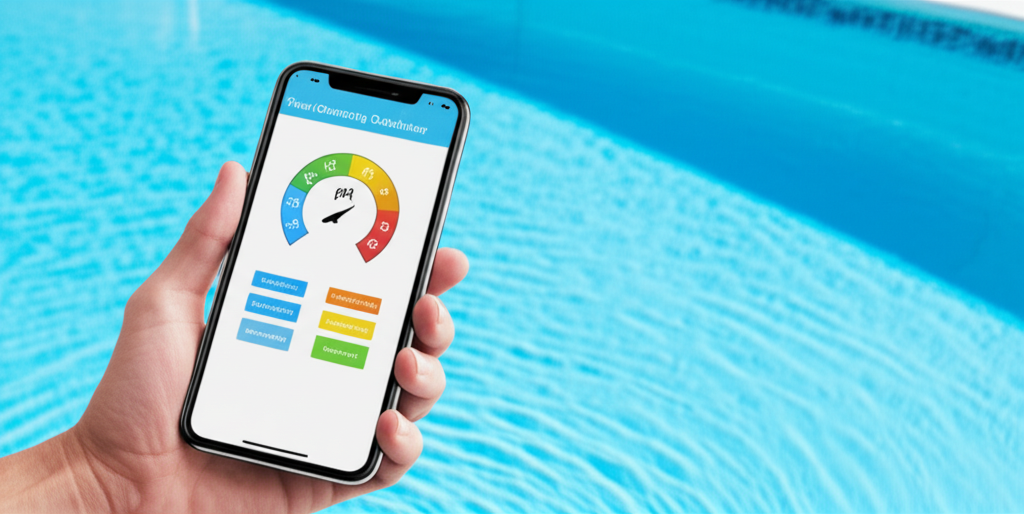
That’s where a pool water chemistry app changes everything. Instead of cross-referencing charts, doing math in your head, or dumping in chemicals and retesting an hour later, you punch in your numbers and get exact dosing amounts in seconds.
What a Pool Water Chemistry App Actually Does
A good pool chemistry app takes the three things you already know — your pool’s volume, your current test results, and your target levels — and calculates the exact amount of each chemical you need to add.
No charts. No guesswork. No “add a little and see what happens.”
Here’s what you should expect from a quality pool water chemistry app:
- Instant dosing calculations for chlorine, pH, alkalinity, calcium hardness, and cyanuric acid
- Support for different chemical types — liquid chlorine vs. tablets vs. granular, muriatic acid vs. dry acid, baking soda vs. alkalinity increaser
- Pool volume calculator so you’re not estimating gallons
- Works for all pool types — in-ground, above ground, salt water, chlorine
Why Phone Apps Beat Paper Charts
Pool chemical dosing charts have been around forever. They work in theory, but in practice they’re clunky and error-prone.
The chart problem:
- Charts round to broad ranges (10,000 gallons, 15,000 gallons) — your 12,500-gallon pool falls between two rows
- They assume you’re using one specific chemical brand
- You need a different chart for every chemical
- They don’t account for adjusting multiple chemicals at once
What an app solves:
- Exact calculations based on your actual pool volume, down to the gallon
- Supports multiple chemical brands and formulations
- Calculates everything in one place
- Saves your pool profile so you don’t re-enter your volume every time
The difference between “add 12-16 oz” from a chart and “add 13.4 oz” from an app might not seem huge. But when you’re adjusting pH, alkalinity, and chlorine in the same session, those rounding errors compound fast. You end up chasing numbers all afternoon.
Features to Look for in a Pool Chemistry App
Not all pool apps are created equal. Some are just glorified calculators. Others try to sell you subscriptions for basic features. Here’s what actually matters:
Accurate Chemical Calculations
This is the whole point. The app needs to use proper chemistry formulas, not simplified estimates. Look for one that handles:
- Free chlorine and combined chlorine
- pH adjustment with both muriatic acid and sodium bisulfate
- Total alkalinity with sodium bicarbonate
- Calcium hardness
- Cyanuric acid (stabilizer)
- Salt level (for salt water pools)
Multiple Chemical Options
You should be able to select the specific product you’re using. Liquid chlorine (12.5% sodium hypochlorite) doses very differently than granular calcium hypochlorite. An app that treats all chlorine the same is going to give you wrong numbers.
Pool Volume Calculator
A surprising number of pool owners don’t know their pool’s exact volume. A built-in calculator that handles rectangular, round, oval, and kidney-shaped pools is a must-have.
Offline Access
You’re standing poolside, phone in one hand, test kit in the other. The last thing you need is a spinning loading wheel because your WiFi doesn’t reach the backyard. The app should work without an internet connection.
Free Core Features
Basic chemical calculations should be free. Period. If an app wants $9.99/month just to tell you how much chlorine to add, keep looking.
Pool Chemical Calculator: Built for This
We built Pool Chemical Calculator because we were tired of the same problems every pool owner faces — confusing charts, rough estimates, and apps locked behind paywalls.
Here’s what it does:
Chemical Calculations:
- Chlorine (liquid, granular, tablets, dichlor)
- pH Up (soda ash) and pH Down (muriatic acid, dry acid)
- Total alkalinity (sodium bicarbonate)
- Calcium hardness
- Cyanuric acid (stabilizer)
- Salt (for salt water generators)
Pool Volume Calculator:
- Rectangular, round, oval, and L-shaped pools
- Enter dimensions, get exact gallons
- Saves to your profile
Works Everywhere:
- Android app, iPhone/iPad app, and web version
- No account required for basic calculations
- Offline capable on mobile
Actually Free:
- All core calculations are free. We don’t gate chlorine behind a paywall. The calculators you need every week are available from day one.
How to Use a Pool Chemistry App (Step by Step)
Getting your pool balanced with an app takes about 5 minutes:
Step 1: Enter your pool volume. If you don’t know it, use the built-in pool volume calculator. Measure length, width, and average depth — the app handles the math.
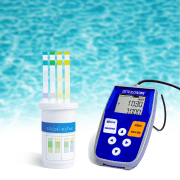
Step 2: Test your water. Use a reliable test kit. We recommend the Taylor K-2006 for accurate liquid reagent testing, or AquaChek 7-Way Test Strips for a quick dip-and-read check.
Step 3: Enter your current readings. Punch in your test results — chlorine, pH, alkalinity, whatever needs adjusting.
Step 4: Get exact dosing. The app calculates precisely how much of each chemical to add. Not a range. Not an estimate. The exact amount.
Step 5: Add chemicals and retest. Follow the app’s recommendations, wait the appropriate time (usually 15-30 minutes with the pump running), and retest to confirm.
That’s it. Five minutes and you know exactly what your pool needs.
Common Pool Water Chemistry Problems (And How the App Helps)
Green Pool After Rain
Rain dumps organic matter and dilutes your chlorine. The app calculates your shock dose based on your actual pool volume — no more “dump a whole bag in and hope.”
pH That Won’t Stay Put
Usually a total alkalinity issue. The app calculates both adjustments so you’re fixing the root cause, not just the symptom.
Cloudy Water Despite “Good” Chemical Levels
Often a calcium hardness or CYA problem that basic test strips miss. The app helps you track all six key parameters, not just chlorine and pH.
Salt Water Pool Showing Low Chlorine
Salt generators need proper salt levels and CYA to produce chlorine efficiently. The app calculates both, plus tells you when your generator just needs a bump in output percentage.
—
???? Recommended Products
As an Amazon Associate, we earn from qualifying purchases. These are products we genuinely recommend for pool water testing and maintenance.
Taylor K-2006 Complete Test Kit (~$90) — The gold standard for pool water testing. Uses liquid reagents instead of strips for lab-grade accuracy on chlorine, pH, alkalinity, calcium hardness, and CYA.
AquaChek 7-Way Test Strips (~$17) — Quick dip-and-read strips for routine checks between full test kit sessions. Tests chlorine, bromine, pH, alkalinity, hardness, and CYA.
LaMotte ColorQ Pro 11 Digital Kit (~$225) — Digital photometer that reads color for you, eliminating the guesswork of matching color shades. Premium option for pool owners who want zero ambiguity.
In The Swim 3″ Chlorine Tablets (25 lbs) (~$70) — Slow-dissolving stabilized tablets for daily chlorine maintenance. One of the best price-per-pound options.
—
???? Calculate It Instantly with Pool Chemical Calculator
Stop guessing with your pool chemistry! The Pool Chemical Calculator app tells you exactly how much of each chemical to add based on your pool’s size and current readings.
✅ Chlorine, pH, Alkalinity, Calcium Hardness & more
✅ Works for all pool types — chlorine, salt water, above ground
✅ Free to download
—
Frequently Asked Questions
What is the best pool water chemistry app?
Pool Chemical Calculator is a free app for Android, iPhone, and web that calculates exact chemical doses for chlorine, pH, alkalinity, calcium hardness, cyanuric acid, and salt based on your pool’s volume and current readings.
Are pool chemistry apps accurate?
Yes — apps that use proper chemistry formulas are more accurate than dosing charts because they calculate for your exact pool volume rather than rounding to broad ranges. Your results are only as good as your test readings, though.
Do I still need a test kit if I use a pool app?
Absolutely. A pool chemistry app tells you how much chemical to add, but you need a test kit to measure your current levels first. The app replaces dosing charts, not the testing step.
Can a pool chemistry app work for salt water pools?
Yes. Quality pool apps include salt level calculations for salt water generators alongside standard chlorine, pH, alkalinity, and calcium hardness.
Is the Pool Chemical Calculator app free?
Yes. All core calculations are free on Android, iPhone, and web. No account or subscription required for the calculators you use every week.