Understanding pool water chemistry is the single most important skill every pool owner needs. Whether you’ve just installed your first backyard pool or you’ve been maintaining one for years, getting your water chemistry right means the difference between a sparkling, safe swimming environment and a murky, skin-irritating mess.
In this guide, we’ll break down everything you need to know about pool water chemistry — from the key chemical parameters to how they interact, and exactly how to keep them in perfect balance.
Why Pool Water Chemistry Matters
Pool water chemistry isn’t just about making water look clear. Improperly balanced water can:
- Damage pool equipment — Corrosive water eats through pumps, heaters, and filters
- Irritate skin and eyes — Unbalanced pH causes burning, itching, and red eyes
- Promote algae and bacteria growth — Low sanitizer levels create unsafe swimming conditions
- Waste money — Adding chemicals without testing first leads to overcorrection and wasted product
When your water chemistry is balanced, your sanitizer works efficiently, your equipment lasts longer, and swimmers actually enjoy being in the water. It’s that simple.
The 5 Key Parameters of Pool Water Chemistry
Every pool owner should monitor these five essential water chemistry measurements:
1. Free Chlorine (FC): Your Primary Sanitizer
Free chlorine is the active, available chlorine in your water that kills bacteria and algae.
- Ideal range: 1–3 ppm (parts per million)
- Minimum safe level: 1 ppm
- Shock level: 10+ ppm (for superchlorination)
Chlorine effectiveness depends heavily on pH and cyanuric acid levels — which is why understanding the full picture of pool water chemistry is critical.
2. pH: The Acidity/Alkalinity Balance
pH measures how acidic or basic your pool water is on a scale of 0–14.
- Ideal range: 7.2–7.6
- Perfect sweet spot: 7.4
Low pH (acidic) corrodes metal equipment and irritates skin. High pH (basic) reduces chlorine effectiveness and causes cloudy water. Even a small drift outside the ideal range dramatically impacts your entire water chemistry balance.
3. Total Alkalinity (TA): The pH Buffer
Total alkalinity acts as a buffer that prevents rapid pH swings. Think of it as the “shock absorber” for your pH level.
- Ideal range: 80–120 ppm
- Adjustment chemical (raise): Sodium bicarbonate (baking soda)
- Adjustment chemical (lower): Muriatic acid
Always adjust alkalinity before adjusting pH, since alkalinity changes affect pH readings.
4. Calcium Hardness (CH): Protecting Your Surfaces
Calcium hardness measures dissolved calcium in your water. Too little causes water to become aggressive, pulling calcium from plaster and grout. Too much leads to scale buildup on surfaces and equipment.
- Ideal range: 200–400 ppm
- Plaster pools: 200–275 ppm
- Vinyl/fiberglass pools: 175–225 ppm
5. Cyanuric Acid (CYA): The Sunlight Shield
Cyanuric acid (also called stabilizer or conditioner) protects chlorine from being destroyed by UV sunlight. Without it, you’d lose most of your chlorine within hours on a sunny day.
- Ideal range: 30–50 ppm
- Salt water pools: 60–80 ppm
- Maximum: 100 ppm (beyond this, chlorine becomes ineffective)
Learn more about pool stabilizer and its role in your water chemistry balance.
How Pool Water Chemistry Parameters Interact
Here’s what makes pool water chemistry tricky: everything affects everything else.
- High CYA reduces chlorine’s sanitizing power, requiring higher FC levels
- Low alkalinity makes pH unstable and difficult to control
- High pH makes chlorine up to 5x less effective
- High calcium + high pH creates scale deposits on every surface
- Low calcium + low pH creates corrosive water that damages equipment
This is why testing a single parameter and adjusting it in isolation rarely works. You need to see the complete picture.
How to Test Your Pool Water Chemistry
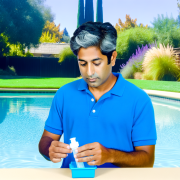
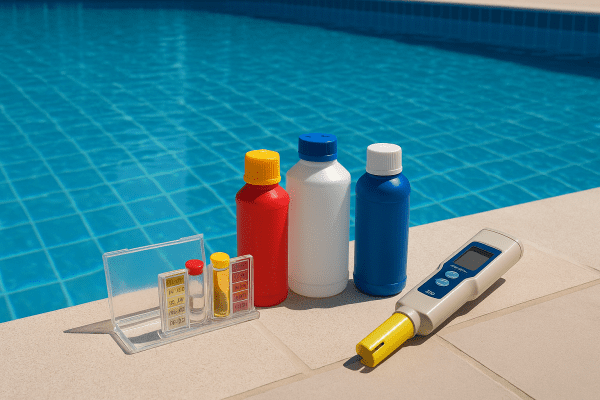
Test Strips (Quick & Easy)
Dip a test strip in your pool water and compare colors to the chart. They test multiple parameters at once but are less precise than other methods. Good for daily spot-checks.
Liquid Test Kits (Most Accurate for Home Use)
Reagent-based kits like the Taylor K-2006 provide laboratory-grade accuracy for FC, pH, TA, CH, and CYA. These are the gold standard for serious pool owners.
Digital Testers
Electronic testers measure specific parameters with high precision. Great for pH and chlorine, but you’ll still need a liquid kit for alkalinity and calcium hardness.
Professional Lab Testing
Take a water sample to your local pool supply store for a comprehensive analysis. Do this at the start of each season and whenever you can’t resolve a water chemistry problem.
Pro tip: Test your water at least 2–3 times per week during swimming season, and always test before adding any chemicals.
Step-by-Step: How to Balance Pool Water Chemistry
Follow this exact order for the best results:
Step 1: Test Everything First
Before adding anything, get readings for FC, pH, TA, CH, and CYA. Write them down or enter them into a pool chemistry calculator.
Step 2: Adjust Total Alkalinity
If TA is out of range, fix it first. It stabilizes pH, so correcting it first prevents chasing your tail.
Step 3: Adjust pH
With alkalinity in range, bring pH to 7.2–7.6. Use muriatic acid to lower or soda ash to raise.
Step 4: Adjust Calcium Hardness
Add calcium chloride to raise hardness, or partially drain and refill to lower it.
Step 5: Adjust Cyanuric Acid
Add stabilizer if CYA is below 30 ppm. If it’s too high, the only reliable fix is partial water replacement.
Step 6: Adjust Chlorine
Finally, bring free chlorine to 1–3 ppm. Now that all other parameters are balanced, your chlorine will work at maximum efficiency.
Step 7: Retest After 24 Hours
Let the water circulate for a full cycle, then retest to confirm everything held.
???? Calculate It Instantly with Pool Chemical Calculator
Stop guessing with your pool chemistry! The Pool Chemical Calculator app tells you exactly how much of each chemical to add based on your pool’s size and current readings.
✅ Chlorine, pH, Alkalinity, Calcium Hardness & more
✅ Works for all pool types — chlorine, salt water, above ground
✅ Free to download
Download for Android →
Download for iPhone/iPad →
Use Online →
Common Pool Water Chemistry Problems (and Fixes)
| Problem | Likely Cause | Fix |
|---|---|---|
| Cloudy water | High pH, low chlorine, or high calcium | Test all levels, adjust in order |
| Green water | Algae (low chlorine + high phosphates) | Shock treatment + algaecide |
| Eye/skin irritation | pH below 7.0 or chloramines | Adjust pH, shock to break chloramines |
| Scale buildup | High calcium + high pH | Lower pH, reduce calcium hardness |
| Chlorine disappears fast | Low CYA (no UV protection) | Add cyanuric acid stabilizer |
Frequently Asked Questions
How often should I test pool water chemistry?
Test your pool water at least 2–3 times per week during swimming season. In hot weather or after heavy rain, daily testing is recommended. In the off-season, test weekly to prevent damage to equipment and surfaces.
What is the most important pool chemical to monitor?
Free chlorine is the most critical parameter because it’s your primary defense against bacteria and algae. However, pH directly affects chlorine’s effectiveness — at pH 8.0, chlorine is only about 20% effective. So monitoring both together is essential.
Can I swim immediately after adding pool chemicals?
It depends on the chemical. After adding pH adjusters or alkalinity increasers, wait at least 20 minutes with the pump running. After shocking, wait until free chlorine drops below 5 ppm (typically 8–24 hours). Never swim immediately after adding any chemical.
What causes pool water chemistry to change?
Several factors constantly affect your water chemistry: sunlight (destroys chlorine), rain (dilutes chemicals and lowers pH), swimmer load (introduces contaminants), temperature changes (warmer water consumes chlorine faster), and source water during top-offs.
Is pool water chemistry different for salt water pools?
Salt water pools still require balanced chemistry — the same pH, alkalinity, calcium, and CYA monitoring applies. The main difference is that a salt chlorine generator produces chlorine continuously, so daily chlorine adjustments are less frequent. However, salt cells tend to raise pH, so you’ll likely need to add acid more often.
Mastering pool water chemistry comes down to understanding how the five key parameters interact, testing regularly, and adjusting in the right order. It’s not complicated — but it does require consistency.
If you want to take the guesswork out of chemical dosing completely, the Pool Chemical Calculator does the math for you. Just plug in your readings and pool size, and get exact amounts for every chemical adjustment.
Your pool is an investment. Treat the water right, and it’ll treat you right.