
Pool Maintenance Checklist: Daily, Weekly & Monthly Tasks
A consistent pool maintenance routine is the difference between crystal-clear water and a green swamp that costs hundreds to fix. Regular upkeep prevents costly repairs, extends equipment life by years, and keeps your pool safe for swimmers. Skip a few weeks, and you’re looking at algae blooms, equipment failure, and potential health hazards.
This comprehensive checklist breaks down exactly what you need to do daily, weekly, monthly, and seasonally to maintain a sparkling clean pool. Whether you’re a new pool owner or a seasoned veteran, these routines will save you time, money, and frustration.
Quick Reference: Ideal Pool Chemistry Levels
Before diving into maintenance tasks, here are the target ranges you should aim for. Print this table and keep it near your test kit—you’ll reference it constantly.
| Parameter | Ideal Range | Why It Matters |
|---|---|---|
| pH | 7.4 – 7.6 | Affects chlorine efficiency, comfort, equipment life |
| Free Chlorine | 1 – 3 ppm | Kills bacteria, algae, and viruses |
| Total Alkalinity | 80 – 120 ppm | Buffers pH, prevents wild swings |
| Cyanuric Acid (CYA) | 30 – 50 ppm | Protects chlorine from UV breakdown |
| Calcium Hardness | 200 – 400 ppm | Prevents etching and scaling |
Use the pH calculator and chlorine calculator to dial in your chemistry precisely. Guessing chemical doses wastes money and creates more problems than it solves.
Daily Pool Maintenance Tasks (5-10 Minutes)
Daily tasks prevent small problems from becoming big headaches. These quick checks take less than 10 minutes but make a massive difference in water quality. Think of them as preventative medicine for your pool.
1. Skim the Surface
Remove leaves, bugs, and floating debris with a skimmer net. Surface debris breaks down and contributes to algae growth if left unchecked. Organic matter also consumes chlorine, forcing you to add more chemicals.
Skim in the morning before debris sinks to the bottom—once it settles, you’ll need to vacuum it up, which takes far longer. In fall, you may need to skim twice daily as leaves drop relentlessly. Keep a leaf rake on hand if you have trees near the pool.
2. Check Water Level
Water level should be at the middle of your skimmer opening. If it’s too low, the pump can run dry and burn out the motor—a $400-800 repair. Too high, and the skimmer can’t do its job properly, allowing debris to accumulate.
Top off as needed with a garden hose. Evaporation rates vary by climate: expect 1/4 to 1/2 inch per day in hot, dry conditions. After a pool party with lots of splashing, you may lose an inch or more.
3. Verify Pump & Filter Operation
Listen for unusual noises—grinding, squealing, or humming without spinning indicates motor problems. Check that water is flowing through return jets at normal pressure. A weak stream suggests a clogged filter or impeller.
Your pump should run 8-12 hours daily depending on pool size, usage, and season. A 20,000-gallon pool needs about 10 hours in summer, less in cooler months. Use a timer to automate this—manual operation inevitably leads to forgotten run times.
A silent pump means trouble. Investigate immediately before you destroy the motor. Common culprits: tripped breaker, failed capacitor, or seized motor bearings.
4. Eyeball Water Clarity
You should be able to see the main drain clearly from poolside. Stand at the deep end and look down—if you see sharp details on the drain cover, clarity is good. If it’s blurry or you can’t see it at all, something’s wrong.
Cloudy water signals chemistry imbalance, inadequate filtration, or early-stage algae growth. Catch it early before it becomes a full-blown green swamp. Check your filter pressure and test chemistry immediately if clarity drops.
Weekly Pool Maintenance Checklist
Weekly tasks dive deeper into water chemistry and circulation system health. Set aside 30-45 minutes once per week—Sunday mornings work well for most pool owners. Establish a routine and stick to it religiously.
1. Test Water Chemistry (Non-Negotiable)
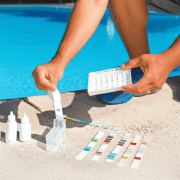
Test pH, chlorine, alkalinity, and cyanuric acid weekly using test strips or a liquid test kit. Test strips are convenient but less accurate. Liquid test kits (like Taylor K-2006) cost more upfront but provide precise readings and last longer.
Record results in a notebook or app. Consistent testing reveals trends before they become problems. For example, pH dropping weekly suggests alkalinity is too low—fix alkalinity and pH stabilizes.
If pH drifts outside 7.4-7.6, use the pH calculator to determine how much acid or base to add. For alkalinity adjustments, check the alkalinity calculator. Always adjust alkalinity before pH—alkalinity acts as a buffer.
2. Brush Walls, Steps, and Floor
Algae clings to surfaces before it blooms into the water. Brushing dislodges algae spores and prevents them from establishing a foothold. Brush from shallow to deep end, paying extra attention to corners, steps, ladders, and around light fixtures—algae loves these spots.
Use a nylon brush for vinyl liners to avoid tearing. Stainless steel brushes work for concrete, plaster, or fiberglass. Brush at least once weekly, more often if you see algae forming. A good brushing session takes 10-15 minutes for an average pool.
3. Vacuum the Pool
Manual vacuuming removes dirt, sand, and debris that settled since your last session. Start at the shallow end and work toward the deep end. Overlap strokes and work slowly to avoid kicking up sediment—rushing defeats the purpose.
Robotic or automatic pool cleaners can handle this task 2-3 times per week if you have one, but you’ll still need to manually vacuum tight corners and steps occasionally. Robots miss about 10-15% of the pool surface.
For manual vacuum setup: attach the vacuum head to the pole, connect the hose, submerge everything to eliminate air, and plug into the skimmer or dedicated vacuum port. Running the vacuum with air in the line destroys suction.
4. Empty Skimmer and Pump Baskets
Turn off the pump before opening the strainer basket—opening it while running can suck air into the system and cause loss of prime. Remove leaves, debris, hair ties, and anything else the filter caught.
A clogged basket restricts flow, forcing your pump to work harder and shortening its lifespan. Check both the skimmer basket (in the pool deck) and the pump strainer basket (in the equipment pad). In fall, you may need to empty these daily.
5. Check Filter Pressure
Your filter pressure gauge shows how hard the pump is working. Note your clean filter baseline pressure when freshly backwashed or cleaned—usually 8-15 psi depending on your system size and type.
When pressure rises 8-10 psi above baseline, it’s time to backwash or clean the filter. For example, if your clean pressure is 12 psi, backwash when it hits 20-22 psi. High pressure means the filter is clogged, reducing flow and filtration efficiency.
Low pressure (below baseline) suggests an air leak, clogged impeller, or closed valve somewhere in the system. Track pressure weekly in your maintenance log.
6. Shock the Pool (If Needed)
Shock weekly during heavy use, after rainstorms, or if you notice algae starting. Shocking oxidizes contaminants that regular chlorine can’t handle—sunscreen, body oils, sweat, urine, and organic matter.
It also breaks down chloramines (combined chlorine), which cause that “chlorine smell” and irritate eyes. Use the shock calculator to determine the right dose for your pool size and current free chlorine level.
Shock at dusk or night—sunlight breaks down chlorine before it can do its job, wasting 80-90% of the product. Run the pump for at least 8 hours after shocking to circulate the chemicals thoroughly. Wait until chlorine drops below 5 ppm before swimming.
Monthly Pool Maintenance Tasks
Monthly deep-dive tasks keep equipment running smoothly and prevent expensive repairs down the road. These aren’t glamorous, but they’re the difference between 10 years of reliable service and constant breakdowns.
1. Deep Clean the Filter
Backwashing removes surface-level dirt, but it doesn’t eliminate oils, lotions, and fine particles embedded deep in the filter media. Once a month, perform a thorough filter cleaning based on your filter type:
- Sand filters: Backwash for 3-5 minutes until water runs clear. Once or twice per season, add filter cleaner through the skimmer, backwash, and rinse. Sand media lasts 5-7 years before replacement.
- Cartridge filters: Remove cartridges, spray with a hose from top to bottom between pleats, soak in filter cleaner overnight, rinse thoroughly, and reinstall. Replace cartridges every 2-3 years or when pleats show wear.
- DE (diatomaceous earth) filters: Backwash, open the filter tank, hose down grids, add fresh DE powder according to manufacturer specs (usually 1 lb per 10 sq ft of filter area). Grids last 5-7 years.
2. Inspect Pool Equipment
Walk around your equipment pad with a checklist. Look for trouble signs before they escalate:
- Leaks around pump seals, valves, or pipe fittings (even small drips indicate failing seals)
- Cracks in PVC pipes or fittings (sun and age make plastic brittle)
- Worn or dry O-rings on pump lid, filter, or chlorinator (replace if cracked)
- Unusual motor sounds—grinding, squealing, humming (bearings or capacitor failing)
- Corrosion on metal parts, especially around saltwater chlorinators
- Loose electrical connections or frayed wires (fire hazard)
Catch small issues now before they escalate into $500+ emergency repair bills. A $5 O-ring replacement today prevents a $200 service call tomorrow.
3. Test Calcium Hardness
Calcium hardness is the forgotten parameter—most pool owners ignore it until they have problems. Low calcium (under 150 ppm) causes etching of plaster, grout deterioration, and corrosion of metal fixtures. High calcium (over 400 ppm) leads to scaling, cloudy water, and rough pool surfaces.
Test monthly and adjust gradually—calcium changes take time to stabilize. To raise calcium, add calcium chloride. To lower it, partially drain and refill with fresh water (there’s no chemical that removes calcium).
4. Check Salt Cell (Saltwater Pools)
If you have a saltwater chlorinator, inspect the cell monthly for calcium buildup. White crusty deposits on the plates reduce chlorine production efficiency. Clean with a mild acid solution (diluted muriatic acid or vinegar) per manufacturer instructions.
Verify salt level is between 2700-3400 ppm using the salt calculator. Too low and the cell can’t produce enough chlorine. Too high and you risk corrosion damage. Salt cells typically last 3-5 years before replacement.
5. Lubricate O-Rings and Gaskets
Apply pool-safe silicone lubricant to pump lid O-rings, valve O-rings, chlorinator O-rings, and other seals. This prevents drying, cracking, and air leaks. A dry O-ring is a leaky O-ring.
Remove the O-ring, wipe it clean, apply a thin coat of lubricant, and reinstall. Do this monthly during swim season. Replace any O-ring that feels stiff, shows cracks, or has lost its round shape.
Seasonal Pool Maintenance
Spring Opening
Remove the winter cover and clean it thoroughly before storing—mildew and dirt shorten cover life. Reconnect all equipment, refill to proper level, and balance chemistry completely. Test every parameter, not just pH and chlorine.
Shock heavily (2-3x normal dose) to kill any bacteria that accumulated over winter. Run the filter 24/7 for the first 2-3 days until water is crystal clear. Brush walls and vacuum daily during this period. Opening properly prevents weeks of green water headaches.
Summer Peak Season
Increase pump run time to 10-12 hours daily as temperatures rise. Heat accelerates algae growth and chlorine consumption. Test chemistry 2-3 times per week during heavy use—pool parties, kids swimming daily, or heat waves.
Keep extra chlorine and shock on hand—summer demand is high and you don’t want to scramble for supplies when the pool turns cloudy. Monitor water level closely as evaporation peaks in July and August.
Fall Prep
Reduce chemical use as temperatures drop and swimming decreases. Keep skimming leaves daily—fall debris is relentless and will stain your pool if left to decompose. Consider a leaf net over your regular cover to catch the bulk of leaves.
Clean and store pool toys, floats, and games. Lower pump run time gradually as water temperature drops below 70°F.
Winter Closing
Balance chemistry completely before closing—pH 7.4-7.6, alkalinity 80-120 ppm, calcium 200-400 ppm. Shock the pool and add winterizing algaecide. Lower water level 4-6 inches below skimmer opening.
Blow out all plumbing lines with a shop vac or compressor to remove standing water. Add non-toxic antifreeze to lines in freezing climates. Drain pump, filter, heater, and chlorinator completely. Store removable equipment indoors if possible.
Install a winter cover securely. Proper winterizing prevents $1,000+ freeze damage to equipment and surfaces. Spring opening is infinitely easier when you close correctly.
Printable Pool Maintenance Checklist Summary
Daily:
- Skim surface debris (2 min)
- Check water level, top off if needed (1 min)
- Verify pump operation, listen for unusual noises (1 min)
- Inspect water clarity from poolside (30 sec)
Weekly:
- Test water chemistry: pH, chlorine, alkalinity, CYA (5 min)
- Brush walls, steps, floor thoroughly (15 min)
- Vacuum pool completely (20 min)
- Empty skimmer and pump baskets (3 min)
- Check filter pressure, record in log (1 min)
- Shock if needed (heavy use, rain, algae signs) (5 min)
Monthly:
- Deep clean filter (backwash + chemical clean) (30 min)
- Inspect all equipment for leaks, cracks, corrosion (10 min)
- Test calcium hardness, adjust if needed (5 min)
- Check and clean salt cell if applicable (10 min)
- Lubricate O-rings and gaskets (5 min)
Seasonal:
- Spring: Open, shock heavily, balance all chemistry, run filter continuously for 2-3 days
- Summer: Increase run time (10-12 hrs), test 2-3x weekly, keep extra chemicals on hand
- Fall: Manage constant leaf debris, reduce chemicals as temperature drops
- Winter: Balance chemistry, shock, add algaecide, lower water, blow out lines, drain equipment, install cover
???? Stop Guessing — Use the Pool Chemical Calculator
Get exact chemical doses for your specific pool size. Used by over 500,000 pool owners.
Frequently Asked Questions
How often should I test my pool water?
Test at minimum once per week during swim season. If you’re using the pool heavily, have had a rainstorm, or notice water clarity issues, test 2-3 times per week. Commercial pools test daily. Consistent testing catches problems before they escalate into expensive fixes.
Can I skip daily skimming if I have a robotic cleaner?
No. Robotic cleaners handle the bottom and walls but don’t remove surface debris. Leaves and bugs float for hours before sinking, breaking down and contributing to algae growth. They also consume chlorine while decomposing. Skim daily regardless of your cleaner setup—it takes 2 minutes and prevents hours of vacuuming later.
What happens if I don’t brush my pool walls weekly?
Algae starts as a microscopic film on pool surfaces. Without brushing, it establishes a foothold, multiplies rapidly, and blooms into the water. By the time you see green water, you’re looking at days of shocking, scrubbing, and filter cleaning. Weekly brushing prevents this entirely by dislodging spores before they take hold.
How do I know when to backwash my filter?
Check your pressure gauge. Note the pressure when the filter is freshly cleaned—usually 8-15 psi depending on your system. When it rises 8-10 psi above that baseline, backwash. For example, if your clean pressure is 12 psi, backwash when it hits 20-22 psi. Never backwash based on a schedule alone—pressure is the accurate indicator.
Is shocking necessary if my chlorine levels are fine?
Yes. Regular chlorine handles daily sanitization, but combined chlorine (chloramines) builds up from swimmer waste, sunscreen, body oils, and organic matter. Chloramines cause that “pool smell” and irritate eyes and skin. Shocking breaks down chloramines and oxidizes contaminants that regular chlorine can’t eliminate. Shock weekly during heavy use even if free chlorine reads 2-3 ppm.
Should I run my pool pump 24/7?
No. Most pools need 8-12 hours of pump operation daily, depending on size, bather load, and season. Running 24/7 wastes hundreds in electricity annually and wears out your motor prematurely. Variable-speed pumps can run longer at lower speeds for efficiency. Use a timer to run during off-peak electricity hours if your utility offers time-of-use rates. In winter, reduce to 4-6 hours daily.
Consistent pool maintenance isn’t glamorous, but it’s the single best investment you can make in your pool’s longevity and your family’s safety. Follow this checklist religiously, and you’ll enjoy crystal-clear water all season while your neighbors fight algae blooms. Use the stabilizer calculator for cyanuric acid adjustments, and bookmark this page for your weekly routine.