Recommended Dosage
0 oz
Determine the right amount of sanitizer to add to your pool.
Recommended Dosage
0 oz
Always add chemicals to water, never water to chemicals. Circulate pool water for at least 1 hour after adding.
Free Chlorine (FC): The active sanitizer available to kill biological threats. This is your primary "good" number.
Combined Chlorine (CC): Chlorine that has bonded with contaminants (chloramines). High CC implies a dirty pool and causes "pool smell" and red eyes.
Total Chlorine (TC): The sum of FC + CC. Always test FC separately to know your true sanitation level.
Liquid pool chlorine and household bleach are both Sodium Hypochlorite. The only difference is strength: pool chlorine is usually 10-12.5%, while bleach is 6-8.25%. You can absolutely use plain, unscented bleach in a pinch—just check the label to ensure it has no "splash-less" thickeners or scents.
The power of chlorine is heavily dependent on pH. At a pH of 8.5, chlorine is mostly inactive (only ~10% effective). By keeping pH down near 7.4, you make your chlorine almost 10x more potent, saving you money and keeping water safer.

Slow-dissolving tablets for steady chlorination.
As an Amazon Associate, we earn from qualifying purchases.
Sunlight destroys unstabilized chlorine in minutes. Stabilizer (Cyanuric Acid) acts like sunscreen for your chlorine. A level of 30-50 ppm protects the sanitizer without reducing its effectiveness too much. Without it, you're throwing money away.
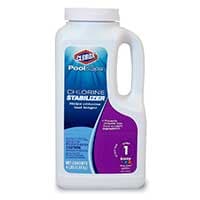
Cyanuric Acid (CYA) for UV protection.
As an Amazon Associate, we earn from qualifying purchases.
Shocking means raising the Free Chlorine level to 10-20+ ppm to oxidize chloramines and kill algae. You should only shock when necessary (e.g., CC > 0.5 ppm, visible algae), not just blindly every week. Follow the "Breakpoint Chlorination" rule for best results.
Consistency is key. Letting chlorine drop to zero even for half a day invites algae. Once algae blooms, it can take days and aggressive chemical treatment to clear. Test daily or every other day to keep FC in the 2-4 ppm sweet spot.
Track multiple pools, save history, and manage equipment. The ultimate tool for pool professionals.
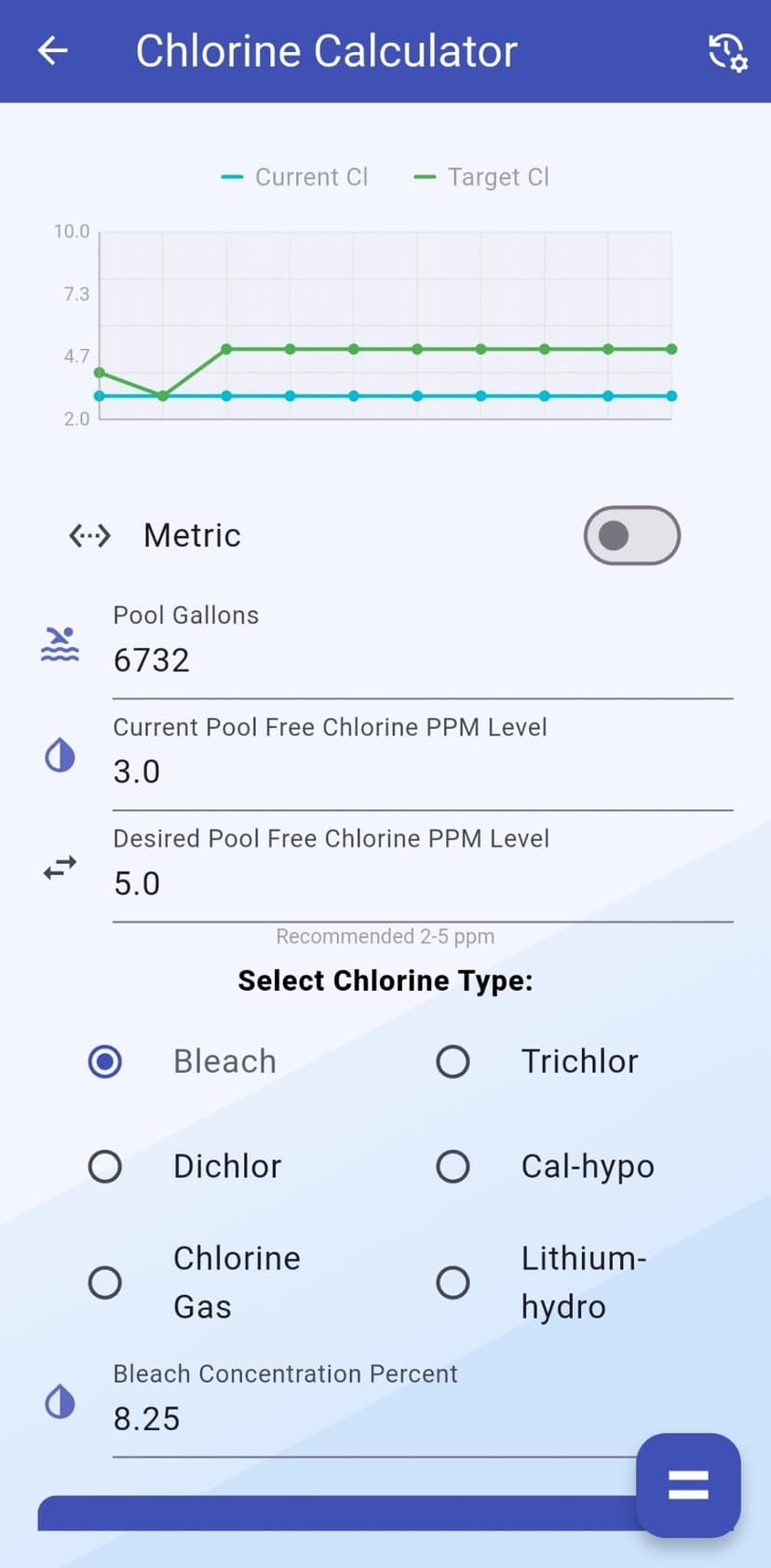
Maintaining proper Free Chlorine (FC) levels is the most critical part of pool maintenance. Chlorine acts as both a sanitizer, killing bacteria and viruses, and an algaecide, preventing the growth of algae. Without sufficient chlorine, your pool can quickly become unsafe and unsightly.
Liquid chlorine (Sodium Hypochlorite) is the preferred choice for many pros because it doesn't add Cyanuric Acid (CYA) or Calcium to your water. Trichlor tabs are convenient but continuously raise CYA levels, which can eventually "lock" your chlorine and make it ineffective.
When Combined Chlorine (CC) exceeds 0.5 ppm, you need to "shock" the pool. This process, called breakpoint chlorination, requires raising the FC level to 10 times the CC level to fully oxidize organic contaminants.
Understand how phosphates impact algae growth and chlorine demand.
Step-by-step instructions on the right way to sanitize and shock.
Are alternative sanitizers really worth it? A deep dive into the options.
Why chlorine remains the king of pool sanitization.