
Pool pH Level: The Complete Guide to Testing, Adjusting & Maintaining Perfect pH
Quick Reference: Pool pH Levels
| Parameter | Ideal Range | Action Needed |
|---|---|---|
| Ideal pH | 7.4 – 7.6 | None – perfect balance |
| Acceptable pH | 7.2 – 7.8 | Monitor closely |
| Low pH (Acidic) | Below 7.2 | Add soda ash or baking soda |
| High pH (Basic) | Above 7.8 | Add muriatic acid or dry acid |
| Test Frequency | 2-3 times per week | Daily during heat waves |
What Is Pool pH and Why Does It Matter?
Pool pH measures how acidic or basic your pool water is on a scale from 0 to 14. A pH of 7.0 is neutral. Anything below 7.0 is acidic, and anything above 7.0 is basic (alkaline).
For swimming pools, the ideal pH range is 7.4 to 7.6. This narrow range isn’t arbitrary—it’s where your pool operates most efficiently and safely.
Why 7.4-7.6 Is the Sweet Spot
This specific range matters for three critical reasons:
- Matches human tears and mucous membranes – pH 7.4-7.6 is closest to your body’s natural pH, preventing eye irritation and skin discomfort
- Maximizes chlorine effectiveness – At pH 7.5, chlorine is about 50% effective. At pH 8.0, effectiveness drops to just 20%
- Prevents equipment damage – Low pH corrodes metal components and etches plaster. High pH causes scaling and cloudy water
Use our free pH calculator to determine exactly how much chemical you need to adjust your pool’s pH.
The Science Behind pH Balance
Understanding pH chemistry helps you maintain your pool more effectively. pH is measured on a logarithmic scale, meaning each full pH point represents a 10-fold change in acidity or alkalinity.
For example, water at pH 6.0 is 10 times more acidic than water at pH 7.0. Water at pH 8.0 is 10 times more alkaline than water at pH 7.0.
The pH-Chlorine Effectiveness Relationship
Here’s the critical data every pool owner should know:
| pH Level | Chlorine Effectiveness | Impact |
|---|---|---|
| 7.0 | 75% | Good but slightly acidic |
| 7.5 | 50% | Ideal balance point |
| 8.0 | 20% | Poor – need 5x more chlorine |
| 8.5 | 10% | Nearly useless chlorine |
This is why maintaining proper pH is more important than just adding more chlorine. At pH 8.0, you’d need to use 5 times more chlorine to achieve the same sanitizing effect as pH 7.5.
How to Test Pool pH Accurately
Accurate testing is the foundation of proper pH management. You have three main options:
1. Test Strips (Quick but Less Precise)
Accuracy: ±0.2-0.5 pH units
Cost: $10-20 for 50 strips
Best for: Quick daily checks
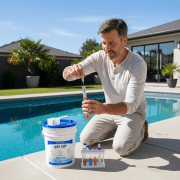
Dip the strip for 1-2 seconds, remove immediately, and compare to the color chart within 15 seconds. Don’t let the strip sit in water—this causes dye bleeding and false readings.
2. Liquid Test Kits (More Accurate)
Accuracy: ±0.1 pH units
Cost: $15-30 for 100+ tests
Best for: Precision testing before adjustments
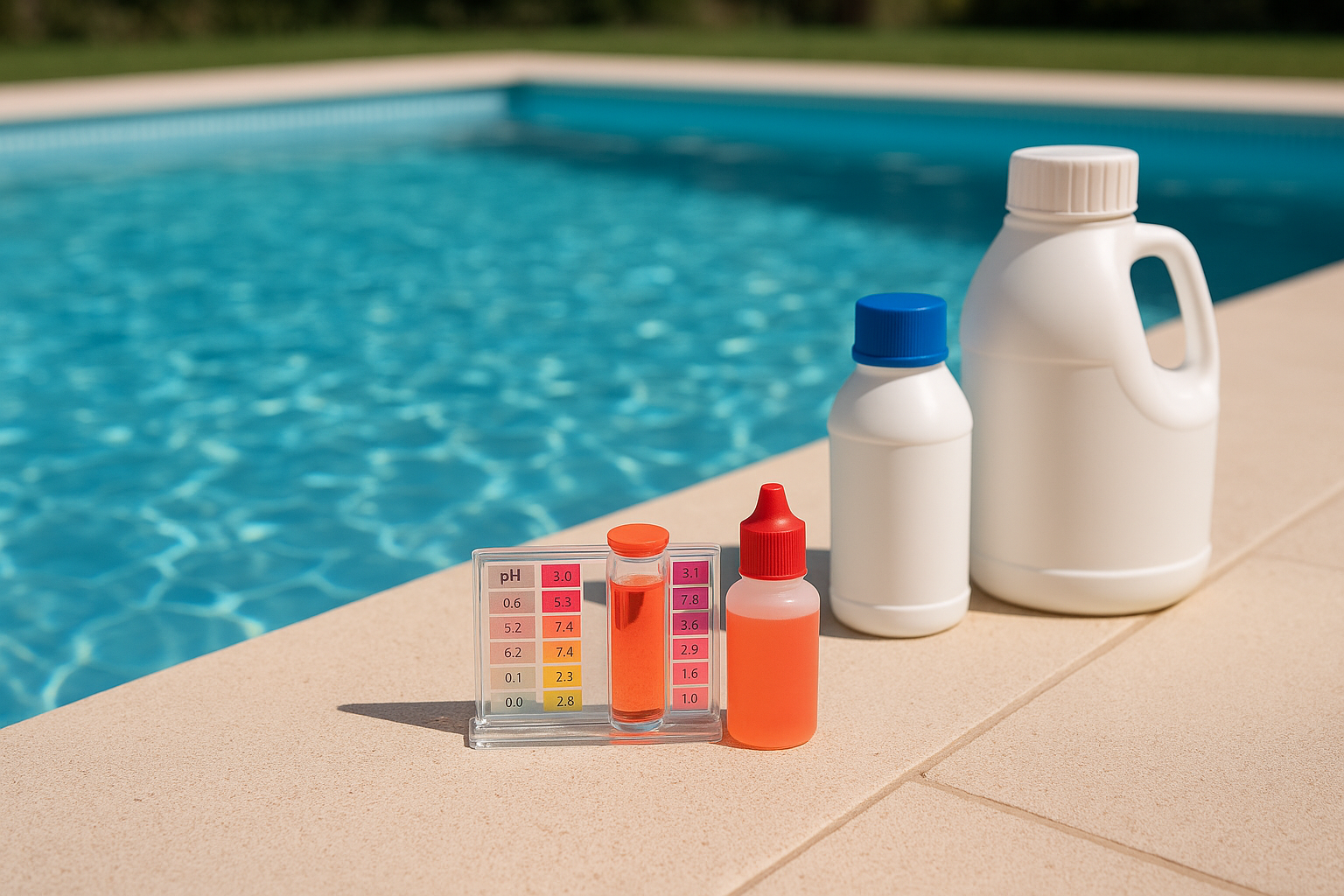
Fill the tube to the line, add the specified drops of phenol red indicator, cap and shake. Match the color to the chart in natural light—indoor lighting can skew results.
3. Digital pH Meters (Most Accurate)
Accuracy: ±0.01 pH units
Cost: $30-100+
Best for: Serious pool owners and commercial pools
Calibrate monthly using pH 7.0 and pH 10.0 buffer solutions. Rinse the probe before and after each use. Store the probe in storage solution, never tap water.
When to Test
- Regular maintenance: 2-3 times per week
- After heavy rain: Rain can dilute chemicals and lower pH
- After adding chemicals: Wait 4-6 hours, then test
- Heat waves: Test daily—high temps accelerate chemical consumption
- Heavy usage: Test before and after pool parties
Learn more about comprehensive pool water testing techniques.
???? Get Accurate Pool Chemical Dosing Instantly
Pool Chemical Calculator takes the guesswork out of pool maintenance. Just enter your pool size and current readings — get exact amounts of chemicals needed.
Available on:
How to Raise pH (When Water Is Too Acidic)
Low pH (below 7.2) causes several problems:
- Eye and skin irritation
- Corrosion of metal fixtures, ladders, and pump components
- Etching of plaster and grout
- Rapid chlorine dissipation
- Vinyl liner wrinkling
Chemicals to Raise pH
Soda Ash (Sodium Carbonate) – Fast Acting
- Dosage: 6 oz per 10,000 gallons raises pH by ~0.2
- Application: Dissolve in bucket, pour around perimeter
- Wait time: 1 hour before retesting
- Side effect: Also raises total alkalinity slightly
Baking Soda (Sodium Bicarbonate) – Gentler
- Dosage: 1.5 lbs per 10,000 gallons raises pH by ~0.1
- Application: Broadcast across pool surface
- Wait time: 6 hours before retesting
- Bonus: Primarily raises total alkalinity, pH increase is secondary
Step-by-Step: Raising pH Safely
- Test current pH using your preferred method
- Calculate needed chemical – Use our pH calculator for exact amounts
- Dissolve soda ash in a 5-gallon bucket (for faster action) or broadcast baking soda directly
- Pour around pool perimeter with pump running
- Wait appropriate time (1 hour for soda ash, 6 hours for baking soda)
- Retest and adjust if needed—add in small increments
Pro tip: If both pH and alkalinity are low, use baking soda first. If only pH is low but alkalinity is fine, use soda ash.
How to Lower pH (When Water Is Too Alkaline)
High pH (above 7.8) creates different issues:
- Cloudy, milky water appearance
- Reduced chlorine effectiveness (20% or less at pH 8.0+)
- Calcium scaling on pool surfaces and equipment
- Clogged filters from calcium buildup
- Skin irritation and dry, itchy feeling
Chemicals to Lower pH
Muriatic Acid (Hydrochloric Acid) – Liquid, Fast, Strong
- Dosage: 8 oz per 10,000 gallons lowers pH by ~0.2
- Application: Dilute 10:1 with water in bucket, pour slowly in deep end
- Wait time: 1 hour before retesting
- Safety: Wear goggles and gloves. Add acid to water, never water to acid
- Side effect: Also lowers total alkalinity
Dry Acid (Sodium Bisulfate) – Granular, Safer to Handle
- Dosage: 12 oz per 10,000 gallons lowers pH by ~0.2
- Application: Broadcast over deep end with pump running
- Wait time: 4 hours before retesting
- Benefit: No fumes, easier storage, safer for inexperienced pool owners
Step-by-Step: Lowering pH Safely
- Test current pH and alkalinity – Both usually need lowering together
- Calculate chemical needed – Our calculator accounts for both pH and alkalinity
- Prepare acid safely:
- For muriatic acid: Pour acid into bucket of water (never reverse!)
- For dry acid: Measure directly, no mixing needed
- Apply to deep end with pump running for circulation
- Brush pool floor to prevent acid from sitting on surfaces
- Wait and retest – Don’t rush. Give chemicals time to distribute
Important: Never add more than 32 oz muriatic acid or 3 lbs dry acid per 10,000 gallons at once. Large doses can damage surfaces.
The pH-Alkalinity Connection
Total alkalinity acts as a pH buffer—it resists pH changes. Think of alkalinity as pH’s stabilizer.
Ideal total alkalinity: 80-120 ppm
When alkalinity is in range, your pH stays stable. When alkalinity is too low, pH bounces around wildly. When alkalinity is too high, pH becomes difficult to lower.
Adjustment Strategy
If pH is high but alkalinity is normal:
Add small amounts of acid. Aerate the water (fountains, waterfalls, jets) to raise pH back up without affecting alkalinity.
If both pH and alkalinity are high:
Add acid to lower both, then retest in 24 hours.
If pH is low but alkalinity is normal:
Use soda ash to raise pH without significantly affecting alkalinity.
If both pH and alkalinity are low:
Use baking soda to raise alkalinity first. pH will rise as a secondary effect.
Use our alkalinity calculator to balance both parameters correctly.
Common pH Problems and Solutions
Problem: pH Keeps Dropping
Causes:
- Low total alkalinity (below 80 ppm)
- Acid rain or acidic debris
- Chlorine tablets (trichlor) – these are acidic
- Heavy swimmer load – body oils and sweat are acidic
Solution:
Raise total alkalinity to 100-120 ppm using baking soda. Switch from trichlor tablets to cal-hypo shock or liquid chlorine. Test pH every other day until stable.
Problem: pH Keeps Rising
Causes:
- High total alkalinity (above 150 ppm)
- New plaster (leaches alkaline compounds for months)
- Aeration from waterfalls, jets, or fountains
- Liquid chlorine or cal-hypo (both raise pH)
Solution:
Lower alkalinity to 80-100 ppm with muriatic acid. Reduce aeration when possible. If using cal-hypo, test pH more frequently. For new plaster, expect to add acid weekly for the first 6-12 months.
Problem: Cloudy Water Despite Balanced pH
pH is only one factor. Check:
- Chlorine level: Should be 1-3 ppm free chlorine
- Alkalinity: 80-120 ppm
- Calcium hardness: 200-400 ppm
- CYA (stabilizer): 30-50 ppm for traditional chlorine, 70-80 for salt pools
Cloudy water with correct pH often means low chlorine or high calcium. Shock the pool and run the filter continuously until water clears. Check our stabilizer calculator for proper CYA levels.
Seasonal pH Management
Summer (High Usage, Heat)
- Test pH daily during heat waves
- Expect faster pH drops from increased chlorine demand
- Evaporation concentrates chemicals—add fresh water, then rebalance
- Pool parties = test before and after
Spring (Opening)
- pH often drops over winter from rain and debris
- Test after removing cover and before adding shock
- Balance pH before shocking—shock is more effective at proper pH
Fall (Closing)
- Adjust pH to 7.4-7.6 before winterizing
- Proper pH prevents corrosion during months of inactivity
- Don’t over-chlorinate if pH is high—it won’t work anyway
Winter (Covered Pools)
- Test monthly if temperature stays above 65°F
- Rainwater infiltration can lower pH significantly
- Algae can still grow in covered pools with improper pH
Pool Type-Specific pH Tips
Saltwater Pools
Salt chlorine generators naturally raise pH because they produce sodium hypochlorite (high pH). Expect to add muriatic acid weekly during peak season. Target pH 7.4 rather than 7.6 to give yourself buffer room.
Read more about saltwater pool chemistry.
Above Ground Pools
Smaller water volume means pH can swing faster. Test more frequently (3-4 times per week). Use smaller chemical doses and retest after 1-2 hours. Vinyl liners are especially vulnerable to low pH damage.
Check out our complete above ground pool maintenance guide.
Indoor Pools
Less evaporation and no rain means more stable pH. But aeration from water features and lack of UV degradation can raise pH steadily. Install proper ventilation to prevent chloramine buildup, which affects pH readings.
Plaster Pools
New plaster releases calcium hydroxide (very alkaline) for 6-12 months. Expect to add acid 2-3 times per week initially. Never let pH exceed 7.8 or you’ll get permanent calcium scaling. Brush weekly to prevent buildup.
FAQ: Pool pH Questions
What happens if I swim in a pool with wrong pH?
Low pH (below 7.0): Stinging eyes, skin irritation, dry itchy skin after swimming, damaged swimsuits. The water feels “sharp.”
High pH (above 8.0): Cloudy water, ineffective chlorine, slippery surfaces, dry skin, scale formation. The water feels “slimy.”
Neither is dangerous for short exposure, but both are uncomfortable and indicate your pool isn’t properly sanitized.
Can I add chlorine and pH chemicals at the same time?
No. Always adjust pH first, wait 4-6 hours, then add chlorine or shock. Adding them simultaneously can cause dangerous chemical reactions and damage pool surfaces. Chlorine effectiveness depends on proper pH, so balancing pH first makes your chlorine more effective.
Why does my pH test show different results than the pool store?
Test kit age (reagents expire), water temperature during testing, lighting conditions, and timing all affect results. Pool store tests are usually more accurate because they use fresh reagents and calibrated equipment. If your home test differs significantly, replace your reagents or upgrade to a digital meter.
How long after adding acid can I swim?
Wait at least 30 minutes after adding muriatic acid or 1 hour after dry acid, and ensure the pump has run to circulate the chemical. Retest before swimming to confirm pH is in the safe range (7.2-7.8). Never swim immediately after adding acid—it can burn skin and eyes if not fully mixed.
Does shocking raise or lower pH?
Depends on the shock type:
- Calcium hypochlorite (cal-hypo): Raises pH significantly
- Lithium hypochlorite: Raises pH moderately
- Dichlor: Neutral to slightly acidic
- Trichlor: Very acidic, lowers pH
- Non-chlorine shock (MPS): Lowers pH slightly
Always test and adjust pH before shocking, then retest 24 hours later.
Can I use baking soda from the grocery store?
Yes! Grocery store baking soda (sodium bicarbonate) is chemically identical to “pool” baking soda, just way cheaper. Buy the large bags at warehouse stores. Use it to raise total alkalinity and slightly raise pH. A 13.5 lb box raises alkalinity in a 10,000-gallon pool by about 10 ppm.
What’s the best pH for a saltwater pool?
Target 7.4 for saltwater pools. Salt chlorine generators constantly push pH upward, so starting at the lower end of the ideal range (7.4) gives you buffer room before hitting 7.8. You’ll likely add muriatic acid weekly to keep pH in check. This is normal for salt pools.
Key Takeaways
- Ideal pH is 7.4-7.6 – This balances swimmer comfort, chlorine effectiveness, and equipment protection
- Test 2-3 times per week – More often during extreme weather or heavy use
- Adjust pH before adding chlorine – Proper pH makes chlorine 2-5x more effective
- Balance alkalinity first – It stabilizes pH and prevents wild swings
- Small adjustments are safer – Add chemicals in increments, wait, retest
- Use accurate calculators – Guessing wastes money and can damage your pool
???? Get Accurate Pool Chemical Dosing Instantly
Pool Chemical Calculator takes the guesswork out of pool maintenance. Just enter your pool size and current readings — get exact amounts of chemicals needed.
Available on:
Maintaining proper pH isn’t complicated, but it is critical. Master this one parameter and you’ll prevent 80% of common pool problems. Your pool will be clearer, your equipment will last longer, and swimming will be more comfortable.
For complete pool care guidance, see our pool maintenance checklist.
Frequently Asked Questions
What is the ideal pH level for a swimming pool?
The ideal pH level for a swimming pool is 7.4 to 7.6. This range matches the pH of human tears and mucous membranes, preventing eye irritation while maximizing chlorine effectiveness. At pH 7.5, chlorine is about 50% effective. An acceptable range is 7.2 to 7.8, but aim for 7.4-7.6 for optimal pool performance.
How do I raise the pH in my pool?
To raise pool pH, use soda ash (sodium carbonate) for fast results or baking soda (sodium bicarbonate) for gradual increase. Add 6 oz of soda ash per 10,000 gallons to raise pH by about 0.2, or use 1.5 lbs of baking soda per 10,000 gallons for a gentler 0.1 pH increase. Dissolve in a bucket and pour around the pool perimeter with the pump running. Wait 1 hour (soda ash) or 6 hours (baking soda) before retesting.
How do I lower the pH in my pool?
To lower pool pH, use muriatic acid (hydrochloric acid) or dry acid (sodium bisulfate). Add 8 oz of muriatic acid per 10,000 gallons to lower pH by approximately 0.2. For dry acid, use 12 oz per 10,000 gallons for the same effect. Always add acid to water (never water to acid), pour in the deep end with pump running, and wait 1-4 hours before retesting. Wear safety goggles and gloves when handling acids.
Why does my pool pH keep going up?
Pool pH rises due to high total alkalinity (above 150 ppm), aeration from waterfalls or jets, new plaster leaching alkaline compounds, or using high-pH chlorine sources like cal-hypo or liquid chlorine. To fix persistent pH rise, lower total alkalinity to 80-100 ppm using muriatic acid, reduce aeration when possible, and test pH more frequently. For new plaster pools, expect to add acid weekly for 6-12 months.
Why does my pool pH keep going down?
Pool pH drops when total alkalinity is too low (below 80 ppm), from acidic chlorine sources like trichlor tablets, acid rain, heavy swimmer load, or organic debris. To prevent pH from dropping, raise total alkalinity to 100-120 ppm using baking soda, switch from trichlor tablets to cal-hypo shock or liquid chlorine, and test pH every other day until stable. Low alkalinity is the most common cause of pH instability.
How often should I test my pool’s pH?
Test pool pH 2-3 times per week during normal conditions. Increase to daily testing during heat waves, after heavy rain, after pool parties, or when making chemical adjustments. Always test pH before adding chlorine or shock to ensure maximum effectiveness. Test after adding any pH-adjusting chemicals, waiting 4-6 hours for the chemical to fully circulate before retesting.
Can I swim in a pool with high or low pH?
Swimming in a pool with incorrect pH is uncomfortable but not immediately dangerous for short periods. Low pH (below 7.0) causes stinging eyes, skin irritation, and corroded equipment. High pH (above 8.0) reduces chlorine effectiveness to 20% or less, creates cloudy water, and causes slippery surfaces. For safety and comfort, always maintain pH between 7.2 and 7.8, ideally 7.4-7.6, before swimming.