
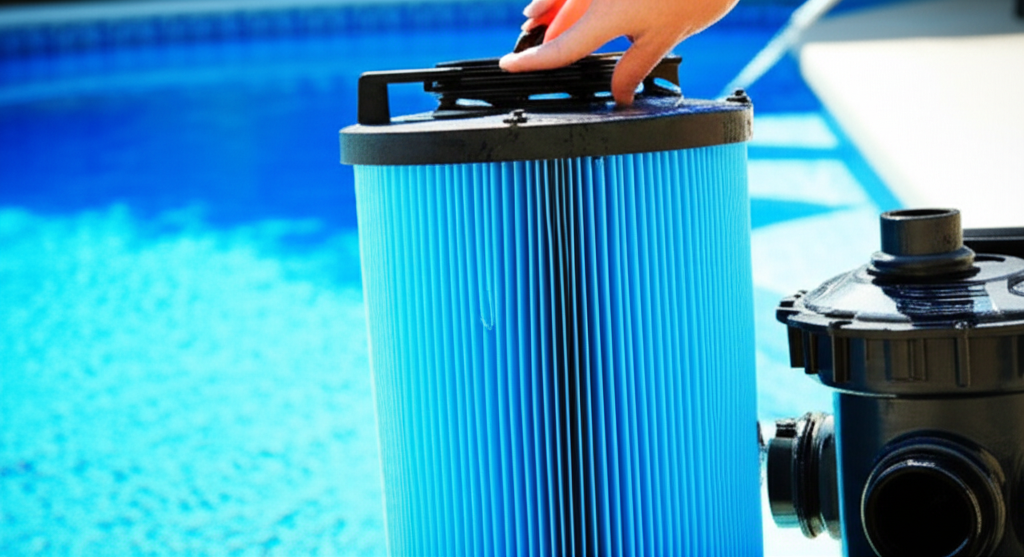
Pool Filter Cleaning: Complete Guide for All Filter Types
Why Pool Filter Cleaning Matters
Your filter traps particles as small as 10-50 microns. For reference, a human hair measures about 70 microns. These trapped particles accumulate over time and create resistance. This reduces flow and forces your pump to work harder.
Signs your filter needs cleaning:
- Pressure gauge reads 8-10 psi above normal baseline
- Water flow from return jets is weaker
- Pool water is cloudy despite balanced chemistry
- Pump runs louder or hotter than usual
- 4-6 weeks have passed since your last cleaning (cartridge filters)
- 6-12 months have passed since your last backwash (sand filters)
A dirty filter doesn’t just affect water clarity. It can damage your pump, increase energy costs by 30-50%, and shorten your equipment’s lifespan.
—
How to Clean a Cartridge Pool Filter
Cartridge filters are the most common type in residential pools. They require no backwashing and trap particles as small as 10-15 microns.
What You’ll Need:
- Garden hose with spray nozzle or pressure washer (low pressure only)
- Filter cleaner solution (commercial or DIY with TSP or muriatic acid)
- Large bucket or trash can
- Rubber gloves
- Replacement cartridge (if current one is worn out)
Step-by-Step Cleaning Process:
Step 1: Turn Off the Pump
Turn off your pool pump and release system pressure before opening the filter housing. Most filters have a manual air relief valve. Turn it to release trapped air.
Step 2: Remove the Filter Cartridge
Open the filter housing (usually a top clamp or threaded lid) and lift out the cartridge. Inspect it for tears, worn pleats, or crushed areas. If you find damage, replace the cartridge.
Step 3: Rinse with a Hose
Spray the cartridge pleats from top to bottom using a garden hose at a 45-degree angle. Rotate the cartridge to clean all pleats. This removes surface dirt and debris.
For heavily soiled cartridges, use a filter cleaning wand or pressure washer attachment designed for pool filters. Standard pressure washers above 1500 psi can damage the filter media. Use low pressure only.
Step 4: Deep Clean with Filter Cleaner (Every 3-4 Cleanings)
For a deep clean, soak the cartridge in a filter cleaning solution.
Fill a large bucket or trash can with enough water to submerge the cartridge. Add commercial filter cleaner (follow product instructions) or make your own with 1 cup of TSP (trisodium phosphate) per 5 gallons of water.
Soak for 8-12 hours. Overnight works well.
For stubborn oils and scale, use a diluted muriatic acid soak: 1 part acid to 10 parts water. Use extreme caution and proper ventilation when handling acid.
Step 5: Final Rinse
After soaking, rinse the cartridge thoroughly to remove all cleaner residue. Leftover chemicals will foam when the pump restarts.
Step 6: Reassemble and Restart
Place the clean (or new) cartridge back into the housing. Make sure the lid is properly sealed. Close the air relief valve and restart the pump. Check for leaks and verify that pressure has returned to baseline (usually 8-15 psi, depending on your system).
Pro tip: Keep a spare cartridge on hand. When it’s time to clean, swap in the spare and take your time deep cleaning the dirty one. Your pool has no downtime.
—
How to Clean a Sand Pool Filter
Sand filters are durable and low-maintenance. They can last 5-7 years before the sand needs replacing. Cleaning a sand filter happens through backwashing. This reverses water flow to flush out trapped debris.
What You’ll Need:
- Backwash hose (usually included with the filter)
- Waste outlet (drains to yard, sewer, or designated area)
Step-by-Step Backwashing Process:
Step 1: Turn Off the Pump
Never change valve settings while the pump runs. This can damage the multiport valve.
Step 2: Set Valve to “Backwash”
Turn the multiport valve handle to the “Backwash” position. Attach the backwash hose to the waste port and direct it to an appropriate drainage area. Do not drain into your pool.
Step 3: Run the Pump
Turn the pump back on and let it run for 2-3 minutes. Watch the sight glass (if your filter has one). You’ll see dirty water flowing out. When the water runs clear, the backwash is complete.
Step 4: Rinse
Turn off the pump. Set the valve to “Rinse” and run the pump for 30-60 seconds. This clears out remaining debris and resets the sand bed.
Step 5: Return to Normal Filtration
Turn off the pump. Set the valve back to “Filter” and restart. Check the pressure gauge. It should be back to baseline (typically 10-15 psi).
How often to backwash:
- When pressure rises 8-10 psi above baseline
- After shocking or heavy pool use
- Every 4-6 weeks during swimming season
When to replace sand:
Replace sand media every 5-7 years. Over time, the sharp edges that trap particles become smooth and rounded. This reduces filtration effectiveness. If backwashing doesn’t restore pressure or your water is consistently cloudy, you need fresh sand.
—
How to Clean a DE (Diatomaceous Earth) Filter
DE filters provide the finest filtration. They trap particles down to 3-5 microns. They require the most maintenance. Cleaning involves backwashing and recharging with fresh DE powder.
What You’ll Need:
- DE powder (food-grade diatomaceous earth)
- Backwash hose
- Scoop or measuring cup
- Filter cleaner (for deep cleaning, annually)
Step-by-Step Cleaning Process:
Step 1: Backwash the Filter
Follow the same backwashing steps as a sand filter. Turn off pump, set to backwash, run for 2-3 minutes, rinse, return to filter.
Step 2: Recharge with Fresh DE Powder
After backwashing, you must add fresh DE powder to recoat the filter grids.
Check your filter manual for the correct amount. This is typically 1 pound of DE per 10 square feet of filter area.
With the pump running, pour the DE powder slowly into the skimmer. The DE will flow through the system and coat the filter grids.
Step 3: Deep Clean (Annually)
Once per year, open the filter housing and manually clean the grids.
Turn off the pump and release pressure. Remove the grids and hose them down thoroughly. Soak in a filter cleaning solution to remove oils and scale. Rinse, reassemble, and recharge with fresh DE.
Important safety note: Wear a dust mask when handling DE powder. Food-grade DE is non-toxic, but inhaling the fine dust can irritate your lungs.
How often to clean:
- Backwash and recharge when pressure rises 8-10 psi
- Deep clean the grids once per year (usually at opening or closing)
- Replace grids every 3-5 years if damaged or worn
—
???? Recommended Filter Cleaning Products
As an Amazon Associate, we earn from qualifying purchases. These products make filter maintenance easier and extend equipment life.
Unicel C-4326 Replacement Cartridge (~$45). High-quality replacement cartridge for Hayward Star-Clear and similar models. 25 sq ft surface area fits most residential pools.
Leisure Time Filter Clean (~$14). Powerful granular cleaner for cartridge filters. Removes oils, minerals, and organic buildup. One bottle lasts an entire season.
Natural Chemistry Pool Perfect Filter Perfect (~$18). Enzymatic filter cleaner that breaks down oils and organic waste. Biodegradable and safe for all filter types.
Water TechniX Pool Filter Cleaning Wand (~$25). Attaches to your garden hose and directs water deep into cartridge pleats. Speeds up the cleaning process.
Rx Clear DE Powder 25 lbs (~$35). Food-grade diatomaceous earth for DE filters. 25-pound bucket lasts multiple seasons for most residential pools.
Pro Team Filter Cleaner Tablet (~$20). Drop-in filter cleaning tablets for cartridge filters. Dissolve oils and minerals overnight without scrubbing.
HTH Filter Sand 50 lbs (~$18). Premium #20 silica sand for sand filters. Specifically sized for optimal filtration. Replace every 5-7 years.
—
???? Track Your Filter Maintenance with Pool Chemical Calculator
Keeping track of filter cleaning schedules, pressure readings, and maintenance history is easy with the Pool Chemical Calculator app.
✅ Log filter cleanings and pressure readings
✅ Set reminders for backwashing and deep cleaning
✅ Track chemical dosing and water balance
✅ Free to download
Download for Android →
Download for iPhone/iPad →
Use Online →
—
Filter Cleaning Schedule: How Often Should You Clean?
Cartridge Filters:
- Quick rinse: Every 4-6 weeks during swim season
- Deep clean soak: Every 3-4 months (or 3-4 quick rinses)
- Replace cartridge: Every 2-3 years (or sooner if damaged)
Sand Filters:
- Backwash: When pressure rises 8-10 psi (typically every 4-6 weeks)
- Replace sand: Every 5-7 years
DE Filters:
- Backwash and recharge: When pressure rises 8-10 psi (every 4-8 weeks)
- Deep clean grids: Once per year
- Replace grids: Every 3-5 years
Pro tip: Write down your filter’s baseline pressure when it’s freshly cleaned. This becomes your reference point. When pressure rises 8-10 psi above baseline, clean the filter.
—
When Cleaning Doesn’t Help
If you’ve cleaned your filter but still experience cloudy water, weak flow, or high pressure, check these potential issues.
1. Worn Filter Media
Cartridge pleats tear, sand becomes rounded, and DE grids crack. Cleaning won’t fix physical damage. You need a replacement.
2. Undersized Filter
If your filter is too small for your pool’s volume or bather load, it will clog quickly no matter how often you clean it. Consult a pool pro to verify your filter is properly sized.
3. Pump or Plumbing Issues
If pressure is consistently high even after cleaning, you may have a clogged impeller, closed valves, or kinked hoses. Inspect your entire circulation system.
4. Chemical Imbalance
High calcium hardness or poor water chemistry can cause scaling and mineral buildup inside the filter. A muriatic acid soak often resolves this.
—
FAQs About Pool Filter Cleaning
How do I know when my pool filter needs cleaning?
Check your filter’s pressure gauge. When pressure rises 8-10 psi above your baseline (the pressure when the filter is freshly cleaned), clean the filter. Other signs include reduced water flow from return jets, cloudy water despite balanced chemistry, and louder pump operation.
Can I clean my pool filter with a pressure washer?
Yes, but use caution. Use low pressure (below 1500 psi) and a wide spray pattern. High-pressure washers can damage cartridge pleats and tear the filter media. A garden hose with a dedicated filter cleaning wand is safer and works well for most cleanings.
How often should I clean my cartridge pool filter?
Rinse your cartridge filter every 4-6 weeks during swim season, or whenever pressure rises 8-10 psi above baseline. Every 3-4 cleanings, perform a deep soak in filter cleaner to remove oils and minerals. Replace the cartridge every 2-3 years or sooner if you notice tears or crushed pleats.
Should I backwash my sand filter after shocking?
Yes. Shocking oxidizes contaminants and causes them to clump together. Your filter captures these particles. After shocking, your filter works overtime to remove these particles. Backwashing afterward clears out the accumulated debris and restores flow.
What happens if I never clean my pool filter?
A clogged filter reduces circulation. This leads to cloudy water, algae growth, and chemical imbalances. Your pump has to work harder to push water through the blockage. This increases energy costs by 30-50% and shortens the pump’s lifespan. In extreme cases, excessive pressure can crack the filter housing or damage internal components.
—
—
Pool filter cleaning is one of the most important maintenance tasks you can do. A clean filter means crystal-clear water, lower energy costs, and equipment that lasts years longer.
Whether you have a cartridge, sand, or DE filter, the process is straightforward once you understand the basics. Check your pressure gauge regularly. Clean when it’s 8-10 psi above baseline. Don’t skip the deep cleaning sessions.
For personalized chemical dosing and maintenance reminders based on your specific pool setup, download the Pool Chemical Calculator app. It takes the guesswork out of pool care.
Related Articles: