
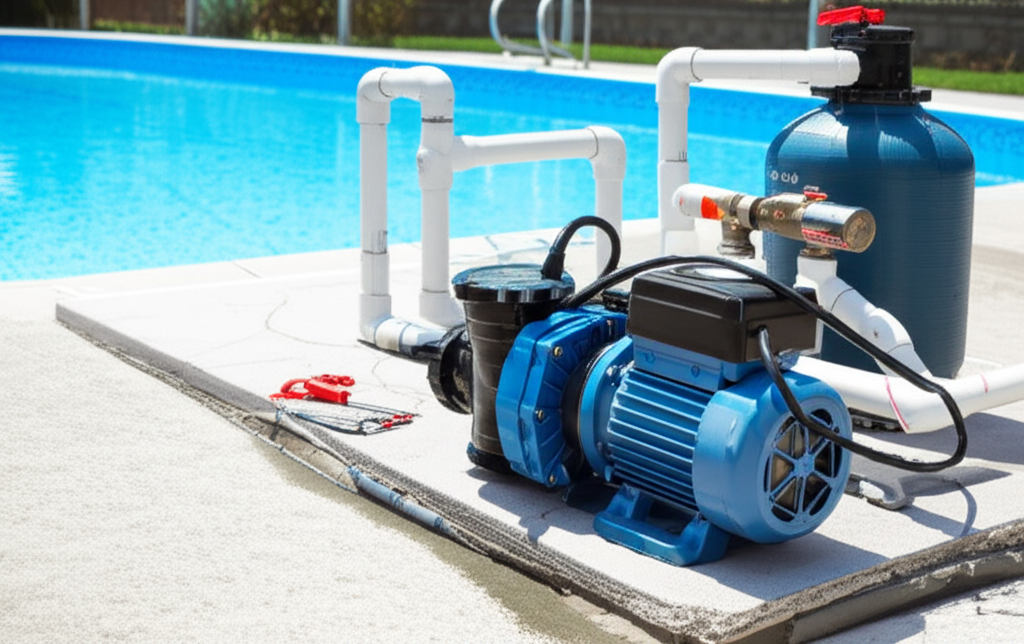
Pool Pump Repair: DIY Troubleshooting and Fixes for Common Problems
## How Your Pool Pump Works
Understanding basic pump operation makes troubleshooting easier.
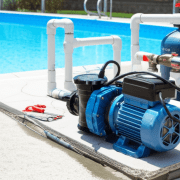
Your pump has three main parts:
**Motor**
The electric motor spins a shaft that drives the impeller. Residential pumps typically use 0.5 to 2.0 horsepower motors. Variable-speed models use permanent magnet motors for better efficiency.
**Impeller**
This spinning component creates suction to pull water from your pool and push it through the filter. The impeller sits inside the pump housing. A mechanical seal separates it from the motor.
**Strainer Basket**
The clear lid holds a removable basket. This basket catches debris before water reaches the impeller. It protects the impeller from leaves, hair, and other materials.
The process works like this: The motor spins the impeller. This creates suction that pulls water from your skimmer and main drain. Water flows through the strainer basket, past the impeller, and out to the filter. From there it returns to your pool through the return jets.
When any part fails (seal, O-ring, impeller, motor), you see symptoms like leaks, poor circulation, or complete shutdown.
—
## Pump Won’t Prime (No Water Flow)
This is the number one complaint from pool owners. You turn on the pump. It runs. No water appears in the strainer basket or returns to the pool.
### Why Pumps Lose Prime
Air leaks cause most priming problems. When air enters the suction side of your pump (anywhere between the pool and the impeller), the pump cannot generate enough vacuum to pull water.
Common air leak sources include:
– Loose pump lid or worn lid O-ring
– Cracked suction-side plumbing
– Loose threaded connections at pump or skimmer
– Drain plugs not fully tightened
– Damaged valve seals
– Water level below skimmer opening
Clogged impellers rank second. Debris stuck in the impeller prevents it from spinning fast enough to create suction.
Clogged skimmer or pump baskets also block water flow.
### Fix a Pump That Won’t Prime
**Check Water Level**
Your pool’s water level needs to reach at least halfway up the skimmer opening. When water sits too low, the pump pulls air instead of water. Add water and test again.
**Inspect the Pump Basket**
Turn off the pump. Open the pump lid and remove the strainer basket. Clean out debris. Look at the pump lid O-ring for cracks, dryness, or twisting. Apply a thin coat of [Magic Lube](https://www.amazon.com/dp/B000BQSF5S?tag=poolcalc04-20) to the O-ring. Reseat it properly in its groove.
**Prime the Pump Manually**
Remove the pump lid. Fill the pump housing completely with water from a garden hose or bucket. This gives the pump a head start for pulling water from the pool. Replace the lid. Make sure it centers properly and tightens evenly.
**Open All Valves**
Check that all suction-side valves (skimmer, main drain) open fully. A closed or partially closed valve prevents water flow.
**Find Air Leaks**
Turn on the pump and watch the pump lid. If you see bubbles churning in the strainer basket, you have an air leak.
Check these common sources:
– Pump lid O-ring (replace if cracked or flattened)
– Drain plugs (tighten or replace O-rings)
– Threaded connections (inspect unions and fittings for cracks)
– Valve stems (check multiport or ball valve seals)
To locate leaks, run the pump and inspect all connections. Look for air bubbles or dripping water. Apply soapy water to suspected areas. Bubbles will form at the leak point.
**Clear the Impeller**
If the pump still won’t prime, turn it off. Remove the pump housing to access the impeller. Look for leaves, sticks, or debris stuck in the impeller vanes. Use needle-nose pliers or a screwdriver to remove obstructions carefully.
**Replace the Mechanical Seal**
Water leaking from the seal plate (between motor and pump housing) means your mechanical seal has failed. This requires disassembly and replacement. See the seal replacement section below for details.
—
## Pool Pump Making Loud Noises
Grinding, screeching, humming, or rattling noises signal a problem. Ignoring these sounds leads to expensive failure.
### What Different Noises Mean
**Loud grinding or rattling**
Debris stuck in the impeller or worn motor bearings. Turn off the pump immediately.
**High-pitched screeching**
Failing motor bearings. The motor will seize completely if you don’t address this soon.
**Humming but not starting**
Seized impeller, bad capacitor, or failing motor.
**Cavitation (rattling gravel sound)**
Insufficient water reaching the pump. Usually caused by clogged basket, closed valve, or air leak.
### Fix Noisy Pumps
**Remove Debris from Impeller**
Turn off the pump. Open the pump housing and inspect the impeller for sticks, leaves, rocks, or other debris. Even small obstructions cause loud grinding. Remove debris and reassemble.
**Test Motor Bearings**
If noise comes from the motor (not the pump housing), the bearings likely wore out. Turn off the pump. Manually spin the motor shaft (accessible from the back of the motor). It should spin smoothly and quietly. If it grinds, feels rough, or won’t spin, the bearings need replacement.
Most residential pool pump motors have sealed bearings you cannot service. You need to replace the entire motor or upgrade to a new pump.
**Test the Capacitor**
A motor that hums but won’t start probably has a dead start capacitor. This cylindrical component sits on top or on the side of the motor. Capacitors cost $15 to $30 and you can replace them easily. They store electrical charge and can shock you even when the pump is off.
Safety warning: Discharge the capacitor before removal. Short the terminals with an insulated screwdriver. If you’re uncomfortable working with electrical components, call a professional.
Replace the capacitor with an exact match. Check the voltage (usually 230V or 115V) and microfarad (µF) rating printed on the old capacitor.
**Stop Cavitation**
If the pump sounds like it’s choking or rattling, it’s not getting enough water. Check:
– Low water level in pool
– Clogged skimmer or pump basket
– Closed or partially closed valves
– Air leaks on suction side
Fix the underlying water flow issue. The noise will disappear.
—
## Pool Pump Leaking Water
Water leaking from your pool pump wastes hundreds of gallons. It can damage your motor if left unchecked.
### Locate the Leak Source
**Pump lid area**
Worn lid O-ring or cracked pump lid. Easy fix.
**Drain plugs**
Loose plugs or worn O-rings. Very common. Very easy to fix.
**Seal plate (between motor and pump housing)**
Failed mechanical seal. Moderate difficulty repair.
**Pump housing**
Cracked housing from freeze damage or over-tightening. Usually requires replacement.
### Fix Pool Pump Leaks
**Pump Lid Leak**
Turn off the pump. Relieve pressure by opening the air relief valve if your pump has one. Remove the pump lid and inspect the O-ring.
If the O-ring shows cracks, flattening, twisting, or dryness, replace it with a new one. Clean the O-ring groove in the lid and housing. Apply a thin coat of [Jack’s Magic Lube](https://www.amazon.com/dp/B000BQSF5S?tag=poolcalc04-20) to the O-ring. Do not use petroleum-based lubricants. They degrade rubber.
Reinstall the O-ring and lid. Make sure the lid centers and seats evenly.
For replacement O-rings, the [Hayward SPX1600Z2 Pump Lid O-Ring](https://www.amazon.com/dp/B004GATW5I?tag=poolcalc04-20) fits most Hayward Super Pump models. Measure your old O-ring if unsure.
**Drain Plug Leak**
Most pumps have one or two drain plugs at the bottom of the housing for winterization. These often loosen over time. O-rings wear out.
Turn off the pump. Remove the drain plug(s) and inspect the O-ring. Replace worn O-rings with [Pentair 071131 Drain Plug O-Ring](https://www.amazon.com/dp/B005CNYMKA?tag=poolcalc04-20) or equivalent. Apply Teflon tape or O-ring lube and reinstall. Tighten firmly but not too tight. Over-tightening cracks the housing.
**Seal Plate Leak (Mechanical Seal)**
Water dripping from the seal plate (where motor connects to pump housing) means the mechanical seal failed. This seal prevents water from leaking past the motor shaft into the motor.
Seal failure causes:
– Normal wear (seals last 2 to 5 years)
– Running the pump dry (no water in housing)
– Debris damaging the ceramic seal face
– Motor vibration from worn bearings
This repair requires moderate skill. You need to disassemble the pump and motor.
Tools needed:
– Screwdrivers (Phillips and flathead)
– Adjustable wrench or socket set
– Seal puller or flathead screwdriver
– Replacement seal kit for your pump model
Steps to replace:
1. Turn off power to the pump at the breaker
2. Drain the pump housing
3. Remove the motor from the pump housing (usually 4 bolts)
4. Remove the impeller (may require an impeller wrench or strap wrench)
5. Remove the old seal from the seal plate and motor shaft
6. Install the new seal per kit instructions (ceramic face, spring, and rubber boot)
7. Reassemble in reverse order
Replacement seals by brand:
– [Hayward Super Pump Seal Kit](https://www.amazon.com/dp/B002R0DRJK?tag=poolcalc04-20)
– [Pentair WhisperFlo Seal Kit](https://www.amazon.com/dp/B004T5LR9M?tag=poolcalc04-20)
– [Sta-Rite Dyna-Glas Seal Kit](https://www.amazon.com/dp/B001AZOPG0?tag=poolcalc04-20)
Not comfortable doing this yourself? Mechanical seal replacement typically costs $150 to $250 from a pool service company. Still cheaper than a new pump.
**Cracked Pump Housing**
If the housing itself cracked, you need to replace the entire pump housing or buy a new pump. Cracks usually result from:
– Freeze damage (water left in pump during winter)
– Over-tightening bolts or drain plugs
– Age and UV degradation
Small cracks can sometimes be patched with [Pool Putty Epoxy](https://www.amazon.com/dp/B000BQYMLE?tag=poolcalc04-20). This is a temporary fix at best.
—
## Pool Pump Low Pressure and Weak Flow
Your return jets barely trickle water. Your pressure gauge shows lower than normal PSI. You have a circulation problem.
### Common Causes
– Clogged filter (dirty cartridge, sand, or DE filter)
– Clogged impeller (debris blocking water flow)
– Clogged skimmer or pump basket (restricting suction)
– Air leak (reducing pump efficiency)
– Failing impeller (worn or broken impeller vanes)
– Wrong valve position (multiport valve not in Filter mode)
### Fix Low Pressure
**Clean the Filter**
A dirty filter causes most low pressure problems. Backwash, clean, or replace your filter media per manufacturer instructions.
**Clean All Baskets**
Empty the skimmer basket(s) and pump basket. Even partially full baskets significantly restrict flow.
**Inspect the Impeller**
Remove the pump housing. Check the impeller for debris. Hair, string, and plastic wrap around the impeller shaft and reduce pumping efficiency.
**Find Air Leaks**
Air in the system reduces pressure. Look for bubbles in the pump basket or returns. Fix any leaks using the steps in the Won’t Prime section above.
**Check Impeller for Damage**
If the impeller vanes show cracks, breaks, or heavy wear, water flow will be weak. Replace the impeller with a new one matched to your pump model.
—
## Essential Pool Pump Repair Parts and Tools
Note: As an Amazon Associate, we earn from qualifying purchases.
[Hayward Super Pump Rebuild Kit](https://www.amazon.com/dp/B01HNFHP36?tag=poolcalc04-20) (around $35). Includes shaft seal, O-rings, and diffuser gasket for complete pump overhaul.
[Pentair Pool Pump Seal Kit](https://www.amazon.com/dp/B004T5LR9M?tag=poolcalc04-20) (around $25). Mechanical seal for Pentair WhisperFlo, IntelliFlo, and SuperFlo pumps.
[Jack’s Magic Lube](https://www.amazon.com/dp/B000BQSF5S?tag=poolcalc04-20) (around $12). Silicone-based O-ring lubricant. Never use petroleum jelly. It degrades rubber seals.
[Pool Pump Capacitor (Universal)](https://www.amazon.com/dp/B07QQ2Z4SL?tag=poolcalc04-20) (around $18). Fixes motors that hum but won’t start. Check voltage and µF rating before ordering.
[Impeller Removal Tool](https://www.amazon.com/dp/B0849W6QN9?tag=poolcalc04-20) (around $15). Makes removing stubborn impellers much easier. Compatible with most brands.
[Hayward Pump Lid O-Ring](https://www.amazon.com/dp/B004GATW5I?tag=poolcalc04-20) (around $8). Fits Hayward Super Pump and NorthStar models. Replace every 2 to 3 years.
[Pentair Drain Plug O-Ring (10-Pack)](https://www.amazon.com/dp/B005CNYMKA?tag=poolcalc04-20) (around $10). Universal fit for most pump drain plugs. Keep spares on hand.
[Pool Putty Underwater Epoxy](https://www.amazon.com/dp/B000BQYMLE?tag=poolcalc04-20) (around $15). Emergency repair for small cracks in pump housing or plumbing. Not a permanent fix.
—
## Track Pump Runtime and Maintenance
Knowing when to clean your filter, check your impeller, or replace your seal prevents breakdowns before they happen.
The Pool Chemical Calculator app lets you:
– Log pump runtime and track filter cleaning schedules
– Set maintenance reminders for seal replacement, bearing checks, and more
– Monitor pressure trends to catch problems early
– Store pump model info and parts lists
– Free to download
[Download for Android](https://play.google.com/store/apps/details?id=com.poolchemicalcalculator.poolcalc)
[Download for iPhone/iPad](https://itunes.apple.com/us/app/pool-chem-calculator/id1453351222)
[Use Online](https://poolchemicalcalculator.com)
—
## When to Replace vs Repair Your Pool Pump
Sometimes repair costs more than the pump is worth. This is especially true if your pump is old or inefficient.
### Repair If
– The pump is less than 5 years old
– Only one component is broken (seal, O-ring, capacitor)
– The motor runs smoothly and quietly
– Repair cost is under $150
### Replace If
– The pump is over 8 years old
– The motor is failing (bad bearings, burnt windings)
– The housing is cracked
– You’re spending $200 or more on repairs
– You have a single-speed pump (upgrade to variable-speed and save $300 to $800 per year on electricity)
Upgrade recommendation: If your pump is old and inefficient, consider a variable-speed model like the [Pentair SuperFlo VS](https://www.amazon.com/dp/B07F2S91TF?tag=poolcalc04-20) (around $850) or [Hayward MaxFlo VS](https://www.amazon.com/dp/B084JG7W6S?tag=poolcalc04-20) (around $700). Variable-speed pumps use 30% to 90% less energy. They often pay for themselves in 2 to 3 years through energy savings. Many states offer rebates for upgrading.
—
## FAQs About Pool Pump Repair
### How long do pool pumps last?
Most pool pumps last 8 to 12 years with proper maintenance. Single-speed pumps tend to fail sooner due to continuous high-speed operation. Variable-speed pumps often last 12 to 15 years because they run at lower RPMs most of the time. Mechanical seals, O-rings, and capacitors wear out every 2 to 5 years and should be replaced as needed.
### Can I run my pool pump with a small leak?
No. Even small leaks waste water and damage motors if water reaches the windings. They indicate a failing component that will get worse. Leaking seals allow air into the system. This reduces pump efficiency and potentially causes the pump to lose prime. Fix leaks as soon as you notice them to avoid bigger problems.
### Why does my pool pump turn off after a few minutes?
Pumps that start and then shut off usually overheat. Common causes include inadequate ventilation, a clogged impeller, or motor failure. Check that the motor vents are clear. Make sure the pump housing has water in it. Verify the motor bearings aren’t seized. If the motor is hot to the touch, let it cool down. Investigate the cause before running it again.
### How much does pool pump repair cost?
DIY repairs typically cost $10 to $50 for parts like O-rings, seals, and capacitors. Professional repairs range from $100 to $300 depending on the problem. Mechanical seal replacement usually costs $150 to $250. Full motor replacement costs $250 to $500. If your repair quote exceeds $300, consider replacing the entire pump with a more efficient model.
### What causes a pool pump to overheat?
Common causes include poor ventilation (pump in direct sun or enclosed space), low water flow (clogged filter or impeller), running the pump dry (no water in housing), failing motor bearings, or a bad capacitor. Ensure the pump has adequate airflow. Clean all baskets and filters. Never run the pump without water. If the motor continues to overheat, it may need replacement.
—
—
Pool pump problems frustrate every pool owner at some point. The good news: you can fix most issues yourself without calling a professional. Whether you’re dealing with leaks, loud noises, priming problems, or weak flow, a methodical approach to troubleshooting saves you time and money.
Regular maintenance prevents most pump failures. Clean your baskets weekly. Inspect O-rings annually. Replace seals every few years. Your pump will give you years of reliable service.
When the time comes to upgrade, modern variable-speed pumps offer quieter operation, better efficiency, and lower energy bills. Many models cut energy costs in half.
For pump runtime tracking, maintenance schedules, and personalized pool care recommendations, download the Pool Chemical Calculator app. It’s free, easy to use, and removes guesswork from pool maintenance.
**Related Articles:**
– [Pool Filter Cleaning: Complete Guide for All Filter Types](https://poolchemicalcalculator.com/news/pool-filter-cleaning)
– [Pool Water Chemistry: The Complete Guide](https://poolchemicalcalculator.com/news/pool-water-chemistry)
– [Cloudy Pool Water: Causes, Fixes & Prevention](https://poolchemicalcalculator.com/news/cloudy-pool-water)