# Pool Calcium Hardness: The Complete Guide to Perfect Water Balance
**Meta Description:** Learn everything about pool calcium hardness – ideal levels, how to test, raise, and lower calcium, plus common problems and prevention. Protect your pool from corrosion and scaling.
**URL Slug:** pool-calcium-hardness
**Featured Image:** pool-calcium-hardness.png
—

You see white scale forming on your pool tile. Your pool equipment starts corroding. The water looks slightly cloudy despite perfect chlorine levels. Your hands feel unusually dry after swimming.
These are all signs of calcium hardness problems. Most pool owners test pH and chlorine religiously. They ignore calcium hardness until visible damage appears. By then, you’re looking at expensive repairs.
Calcium hardness measures the dissolved calcium and magnesium in your water. Too little creates corrosive water that destroys pool surfaces and equipment. Too much creates scaling and cloudiness. Getting it right protects your pool and keeps water comfortable.
This guide shows you how to test, adjust, and maintain proper calcium hardness levels so you never face preventable damage.
—
## What Is Pool Calcium Hardness?
Calcium hardness refers to the concentration of dissolved calcium and magnesium minerals in your pool water. It’s measured in parts per million (ppm).
When water contains high amounts of these minerals, we call it hard water. Low amounts create soft water. Both extremes cause problems.
**Where calcium comes from:**
Your pool’s calcium level comes from three main sources:
– Fill water (tap water calcium content varies by region)
– Calcium-based pool chemicals (calcium hypochlorite shock, calcium chloride)
– Concrete or plaster pool surfaces (slowly leach calcium into water)
**Why it matters:**
Water naturally seeks chemical equilibrium. When calcium levels are wrong, the water tries to balance itself by taking calcium from pool surfaces or depositing excess calcium onto them.
Soft water is aggressive. It pulls calcium from concrete, plaster, grout, metal fittings, and equipment to satisfy its mineral deficit. Hard water is saturated. It deposits excess calcium as white scale on surfaces, inside pipes, and throughout your filtration system.
—
## Ideal Calcium Hardness Levels
The target range for calcium hardness depends on your pool type:
| Pool Type | Ideal Range | Acceptable Maximum |
|———–|————-|——————-|
| Concrete or plaster pools | 200-400 ppm | 450 ppm |
| Vinyl liner pools | 175-225 ppm | 275 ppm |
| Fiberglass pools | 175-225 ppm | 275 ppm |
| Saltwater pools | 200-400 ppm | 450 ppm |
Concrete and plaster pools tolerate higher calcium levels because these surfaces contain calcium. The water won’t aggressively pull calcium from plaster when levels stay within range.
Vinyl and fiberglass pools need lower calcium levels. These surfaces don’t contain calcium. High calcium creates scaling without any protective benefit.
**The Langelier Saturation Index (LSI) connection:**
Calcium hardness alone doesn’t tell the complete story. The LSI uses calcium hardness, pH, total alkalinity, temperature, and total dissolved solids to predict whether water will be corrosive or scale-forming.
An LSI between -0.3 and +0.3 indicates balanced water. Outside this range, adjust calcium hardness along with other parameters.
> **???? Pro Tip:** The [Pool Chemical Calculator](https://poolchemicalcalculator.com) app automatically factors calcium hardness into your overall water balance calculations. It tells you exactly how much calcium chloride to add based on your pool size and current test results.
>
> ???? [Download for iPhone](https://itunes.apple.com/us/app/pool-chem-calculator/id1453351222) | [Download for Android](https://play.google.com/store/apps/details?id=com.poolchemicalcalculator.poolcalc)
—
## Problems Caused by Low Calcium Hardness
When calcium hardness drops below 150 ppm, your water becomes corrosive. The damage happens slowly, making it easy to miss until it’s severe.
### Concrete and Plaster Damage
Corrosive water etches concrete and plaster surfaces. You’ll notice:
– Rough, pitted concrete floors and walls
– Plaster delaminating (separating from the gunite underneath)
– Exposed aggregate in concrete
– Grout eroding from between tiles
This damage is permanent. You cannot repair etched concrete or delaminated plaster. Resurfacing a pool costs $5,000 to $15,000.
### Metal Corrosion
Soft water attacks any metal in contact with pool water:
– Ladder rails develop rust or green patina
– Pump housings and filter tanks corrode
– Heat exchanger coils in pool heaters fail
– Metal light fixtures deteriorate
– Screws and bolts rust through
Replacing corroded equipment costs hundreds to thousands of dollars per component.
### Tile and Grout Erosion
The grout between pool tiles dissolves when exposed to corrosive water. Tiles become loose. Water seeps behind them, causing further damage.
Regrouting a pool costs $800 to $2,500 depending on size.
### Uncomfortable Water
Low calcium creates water that feels slippery or slimy. Your skin absorbs water more readily, making fingers and toes wrinkle faster. Some swimmers report itchy skin after prolonged exposure to very soft water.
—
## Problems Caused by High Calcium Hardness
When calcium exceeds 400 ppm, the water becomes saturated. Excess calcium precipitates out, causing visible problems.
### Scaling
Scale appears as white, gray, or brownish crusty deposits. It forms on:
– Pool tile (especially at the waterline)
– Inside pipes and plumbing
– Filter media and cartridges
– Pool heater elements
– Salt cell plates in saltwater systems
– Pool walls and floors
Scale is calcium carbonate. It starts as a thin film. Over time it builds into thick, rough deposits that are difficult to remove.
Severe scaling in equipment reduces flow rates and efficiency. Scaled heater elements fail prematurely. Scaled salt cells produce less chlorine.
### Cloudy Water
When calcium levels reach 600 to 800 ppm, the water cannot hold any more dissolved calcium. Fine calcium particles float in suspension, creating cloudiness.
This cloudiness won’t respond to shock treatment or clarifiers. You must reduce calcium concentration.
### Reduced Chemical Effectiveness
Saturated water struggles to dissolve new chemicals. When you add chlorine or other treatments, they may not fully dissolve. This creates a cascade of chemistry problems as you add more chemicals trying to fix imbalances.
### Skin and Eye Irritation
Free-floating calcium particles irritate skin and eyes. Swimmers experience dry, itchy skin after leaving the pool. Eyes become red and irritated.
—
## How to Test Pool Calcium Hardness
Test calcium hardness at pool opening, monthly during swim season, and whenever you notice water balance issues.
### Testing Methods
**Option 1: Liquid test kit**
A quality test kit like the [Taylor K-2006 Complete Test Kit](https://www.amazon.com/dp/B004BGF7TI?tag=poolcalc04-20) includes a calcium hardness test. These kits use a titration method with EDTA reagent and calmagite indicator.
Follow the kit instructions precisely. Count the number of drops needed to change the sample color. Multiply by the conversion factor to get ppm.
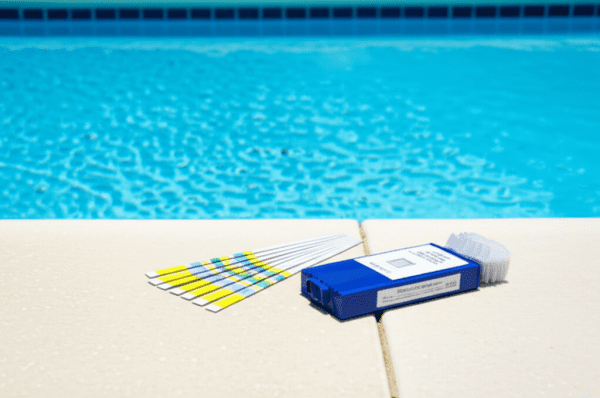
**Option 2: Test strips**
[AquaChek TruTest Digital Test Strips](https://www.amazon.com/dp/B01MRLYZFW?tag=poolcalc04-20) measure calcium hardness along with other parameters. Dip the strip, wait the specified time, and scan with the smartphone app.
Test strips are less accurate than liquid tests. Use them for routine monitoring. Confirm with a liquid test before making major adjustments.
**Option 3: Pool store testing**
Most pool supply stores offer free water testing. They’ll measure calcium hardness and provide a printed report.
This option works well if you don’t test frequently or want professional confirmation before draining your pool.
### When to Test
Test calcium hardness:
– At pool opening each spring
– Monthly during swimming season
– When water becomes cloudy without obvious cause
– After adding large amounts of calcium-based chemicals
– Before making major chemical adjustments
– If you notice scaling or corrosion
—
## How to Raise Calcium Hardness
If testing reveals calcium hardness below 175 ppm, you need to add calcium chloride.
### Step 1: Calculate How Much Calcium Chloride You Need
For every 10 ppm increase per 10,000 gallons, add approximately 1.25 pounds of calcium chloride.
**Example calculation:**
– Pool volume: 20,000 gallons
– Current calcium: 150 ppm
– Target calcium: 250 ppm
– Increase needed: 100 ppm
20,000 gallons = 2 × 10,000
100 ppm increase = 10 × 10 ppm
Total calcium chloride needed: 1.25 lbs × 10 × 2 = 25 lbs
### Step 2: Add Calcium Chloride Properly
**Recommended products:**
– [DryTec Calcium Chloride (50 lbs)](https://www.amazon.com/dp/B07G85G96F?tag=poolcalc04-20): Bulk option for large adjustments or concrete pools
– [In The Swim Calcium Hardness Increaser (10 lbs)](https://www.amazon.com/dp/B00CSXB9P6?tag=poolcalc04-20): Good for most residential pools
– [Clorox Pool&Spa Calcium Hardness Increaser (5 lbs)](https://www.amazon.com/dp/B08THGH7R6?tag=poolcalc04-20): Convenient size for smaller adjustments
**Application steps:**
1. Ensure pH and total alkalinity are balanced first
2. Turn on your pool pump
3. Add calcium chloride gradually along the pool perimeter
4. Pour near return jets for faster distribution
5. Keep pump running for at least 8 hours after adding
6. Wait 24 hours before swimming
7. Retest after 48 hours to confirm the increase
**Important:** Calcium chloride generates heat when it dissolves. Never add it directly to the skimmer. The concentrated solution can damage plastic components.
Add calcium hardness in increments if you need a large increase. Split the dose over 2 to 3 days to avoid overshooting your target.
### Step 3: Retest and Adjust
Wait at least 48 hours for the calcium chloride to fully dissolve and distribute. Then retest.
If you’re still below target, add more in small increments. If you overshot the target, you’ll need to dilute by draining and refilling (see next section).
—
## How to Lower Calcium Hardness
There is no chemical that removes calcium from pool water. You have three options for lowering calcium hardness.
### Method 1: Partial Drain and Refill (Most Common)
This is the standard method for reducing calcium levels.
**Steps:**
1. Test your tap water’s calcium hardness before draining (some areas have tap water with 300+ ppm calcium)
2. Calculate what percentage of water to replace based on current and target levels
3. Turn off all pool equipment
4. Use a submersible pump or your pool’s main drain to remove water
5. Drain no more than 1/3 to 1/2 of the water at one time (to prevent hydrostatic pressure issues)
6. Refill with fresh water
7. Run the pump for 24 hours to circulate
8. Retest all chemistry parameters
9. Rebalance pH, alkalinity, and chlorine as needed
**Calculation example:**
Current calcium: 500 ppm
Target calcium: 250 ppm
Tap water calcium: 100 ppm
You need to replace enough water so that the blend equals 250 ppm.
Formula: (Current × Remaining %) + (Tap × Replaced %) = Target
(500 × 0.6) + (100 × 0.4) = 300 + 40 = 340 ppm (still too high)
(500 × 0.4) + (100 × 0.6) = 200 + 60 = 260 ppm (close enough)
Replace 60% of the water.
### Method 2: Reverse Osmosis Filtration
Mobile water recycling services use RO filtration to remove calcium, cyanuric acid, and other dissolved solids without draining the pool.
A truck-mounted RO system filters your pool water and returns it cleaned. The process takes 8 to 12 hours for a typical residential pool.
**Advantages:**
– Conserves water (important in drought areas)
– No risk of hydrostatic pool pop
– Removes cyanuric acid and other contaminants simultaneously
**Disadvantages:**
– Costs $400 to $1,200 depending on pool size
– Not available in all areas
– Takes longer than draining
Search for “mobile pool water recycling” or “reverse osmosis pool service” in your area.
### Method 3: Sequestering Agents
Products like [Natural Chemistry Scale Free](https://www.amazon.com/dp/B002ITKFCM?tag=poolcalc04-20) or [Jack’s Magic The Blue Stuff](https://www.amazon.com/dp/B00S6AYFD4?tag=poolcalc04-20) don’t lower calcium levels. Instead, they keep calcium dissolved in solution to prevent scaling.
Use sequestering agents as a temporary measure while you plan a drain and refill. They cannot permanently fix high calcium. They only delay scaling problems.
—
## How to Prevent Calcium Hardness Problems
Consistent testing and maintenance prevent calcium-related damage before it starts.
### Test Your Fill Water
Before filling a new pool or adding significant amounts of water, test your tap water’s calcium content.
If your municipal water or well water has calcium hardness above 300 ppm, you’ll struggle to keep pool calcium in the ideal range. Consider:
– Using a hose filter with calcium-reducing media
– Partially filling with delivered softened water
– Planning annual partial drains to reset calcium levels
### Choose Pool Chemicals Wisely
Calcium hypochlorite (cal-hypo) shock adds calcium to your pool. Each pound of cal-hypo adds roughly 0.8 ppm of calcium per 10,000 gallons.
If you already have high calcium, switch to sodium hypochlorite (liquid chlorine) or lithium hypochlorite shock. These add zero calcium.
### Test Monthly During Pool Season
Test calcium hardness at least once per month during swimming season. Catch rising levels before they cause problems.
Track your results in a log or app. Rising calcium levels indicate you need to drain soon.
### Schedule Preventive Partial Drains
Many pool professionals recommend draining and replacing 1/4 to 1/3 of your water annually. This resets not only calcium but also cyanuric acid and total dissolved solids.
Do this in early spring before pool opening or in fall during closing.
—
## Common Calcium Hardness Mistakes
**Mistake 1: Testing with strips instead of a liquid kit**
Test strips give rough estimates. They lack the precision needed to make accurate calcium adjustments. Invest in a quality liquid test kit for calcium testing.
**Mistake 2: Adjusting calcium before balancing pH and alkalinity**
Always balance total alkalinity first, then pH, then calcium hardness. Calcium behavior depends heavily on pH. Adjusting calcium when pH is wrong leads to unpredictable results.
**Mistake 3: Using calcium-based chemicals with hard fill water**
If your tap water already has 300 ppm calcium, using cal-hypo shock guarantees you’ll exceed 400 ppm within weeks. Switch to liquid chlorine.
**Mistake 4: Ignoring rising calcium levels**
Calcium increases gradually in most pools. By the time you notice scaling, your levels might be 600+ ppm. Test regularly and drain proactively when levels reach 350 ppm.
**Mistake 5: Draining too much water at once**
Draining a pool completely or removing more than half the water creates risk of the pool shell popping out of the ground due to hydrostatic pressure. Never drain more than 50% at one time.
**Mistake 6: Adding calcium chloride directly to the skimmer**
Concentrated calcium chloride generates significant heat as it dissolves. This can warp or melt plastic skimmer baskets and plumbing. Always add it around the perimeter while the pump runs.
—
## Frequently Asked Questions
**Q: What is the ideal calcium hardness for a pool?**
For concrete and plaster pools, maintain 200 to 400 ppm calcium hardness. Vinyl and fiberglass pools do best at 175 to 225 ppm. These ranges protect pool surfaces from corrosion while preventing scaling. Always balance pH and total alkalinity before adjusting calcium hardness.
**Q: How often should I test calcium hardness?**
Test calcium hardness monthly during swim season. Also test at pool opening, after adding large amounts of water, and whenever you notice scaling or cloudy water. If you use calcium-based shock products regularly, test every 2 weeks because calcium can accumulate quickly.
**Q: Can I swim after adding calcium hardness increaser?**
Wait at least 24 hours after adding calcium chloride before swimming. The product needs time to fully dissolve and distribute throughout the pool. Swimming in water with concentrated calcium chloride can irritate skin and eyes. Always run your pump for 8 to 12 hours after adding calcium hardness increaser.
**Q: Does calcium hardness affect chlorine effectiveness?**
Calcium hardness indirectly affects chlorine by influencing pH stability and overall water balance. High calcium above 600 ppm can create saturated water that prevents proper chemical dissolution. Extremely low calcium below 100 ppm creates corrosive conditions that damage chlorine feeders and other equipment. Keep calcium in the ideal range to maintain overall water chemistry balance.
**Q: Why is my calcium hardness high when I use soft water?**
Even if your fill water is soft, calcium can increase from pool chemicals and surface erosion. Calcium hypochlorite shock, calcium chloride added for hardness adjustment, and calcium leaching from plaster all raise calcium levels over time. If you’re certain your fill water is soft and you haven’t added calcium products, have your plaster inspected for excessive erosion.
—
—
## Protect Your Pool with Balanced Calcium
Calcium hardness protects your pool investment. Too little causes thousands of dollars in corrosion damage to concrete, plaster, and equipment. Too much creates scaling that clogs filters and ruins heaters.
Test monthly. Maintain 200 to 400 ppm for concrete pools or 175 to 225 ppm for vinyl and fiberglass. Raise calcium with calcium chloride when levels drop. Lower it with partial draining when it climbs too high.
The **Pool Chemical Calculator** app takes the guesswork out of calcium adjustments. It calculates exact doses based on your pool size and current test results.
???? [Download for iPhone](https://itunes.apple.com/us/app/pool-chem-calculator/id1453351222) | [Download for Android](https://play.google.com/store/apps/details?id=com.poolchemicalcalculator.poolcalc) | ???? [Web Version](https://poolchemicalcalculator.com)
**Related Articles:**
– [Pool Water Chemistry: The Complete Guide](https://poolchemicalcalculator.com/news/pool-water-chemistry)
– [Pool pH Levels: Everything You Need to Know](https://poolchemicalcalculator.com/news/pool-ph-level)
– [Cloudy Pool Water: Causes, Fixes & Prevention](https://poolchemicalcalculator.com/news/cloudy-pool-water)
– [Pool Stabilizer (Cyanuric Acid): The Complete Guide](https://poolchemicalcalculator.com/news/pool-stabilizer-cyanuric-acid)