
The LSI Calculator Guide: Protecting Your Pool Surface from the Inside Out
In our previous deep dives into pool chemistry, we covered the “Big Three”—pH, Chlorine, and Alkalinity. But if you really want to graduate from “pool owner” to “water master,” there is one metric that rules them all: the Langelier Saturation Index (LSI).
Have you ever noticed white, crusty deposits on your tile line? That’s scale. Or perhaps you’ve seen “pitting” or rough patches on your plaster? That’s etching. Both are signs that your water is “unbalanced,” and no, pH alone won’t tell you the whole story. The LSI is the true measure of whether your water is corrosive, scale-forming, or perfectly neutral.
What is the LSI? The Science of “Hungry” Water
The Langelier Saturation Index was developed to predict whether water will deposit calcium carbonate or dissolve it. Think of your pool water like a cup of coffee. You can only dissolve so much sugar into that coffee before it starts settling at the bottom.
Your pool water has a “saturation point” for calcium.
-
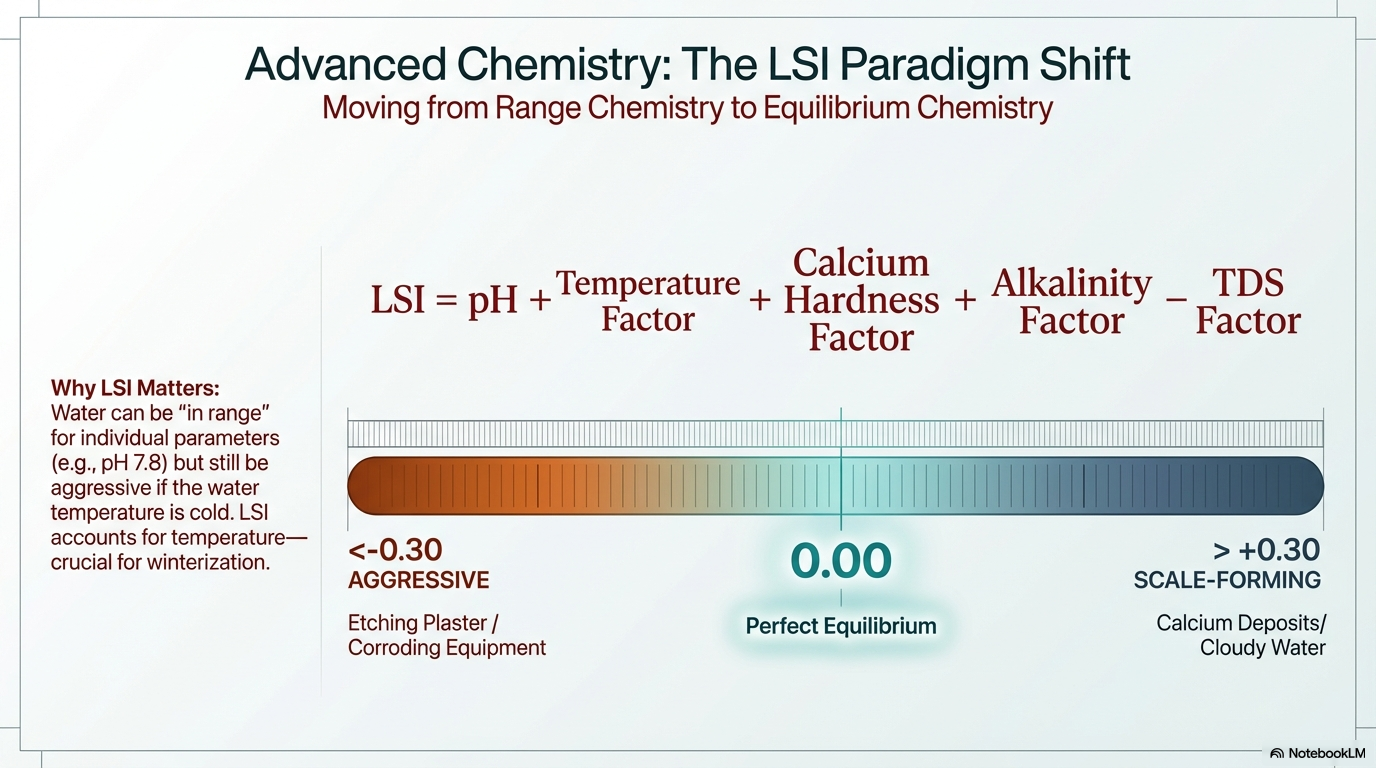
Aggressive Water (Negative LSI): The water is “under-saturated.” It is hungry for calcium and will literally eat the plaster or grout out of your pool walls to satisfy its appetite.
-
Scale-Forming Water (Positive LSI): The water is “over-saturated.” It has more calcium than it can hold, so it spits the excess out onto your pipes, heaters, and tiles.
The Six Factors of the LSI Equation
Unlike pH, which is a single measurement, the LSI is a calculation based on six different variables. This is why a digital Pool Chemical Calculator is your best friend—doing this math by hand is a headache!
-
pH: The most volatile factor. Even a small change in pH significantly swings your LSI.
-
Water Temperature: Cold water is more corrosive; hot water is more scale-forming. This is why pools often etch in the winter and scale in the summer.
-
Calcium Hardness: The amount of dissolved calcium already in the water.
-
Total Alkalinity: The “buffer” that keeps your pH stable.
-
Cyanuric Acid (CYA): High stabilizer levels actually affect your alkalinity reading, requiring a “correction” in the LSI formula.
-
Total Dissolved Solids (TDS): The sum of everything dissolved in the water (salts, minerals, etc.).
Why the “Standard Range” Can Be Deceptive
Most pool stores tell you to keep your pH at 7.4. But did you know that if your water is 50°F in the winter, a pH of 7.4 might actually be corrosive? Conversely, in a 90°F hot tub, that same 7.4 might cause scaling.
The LSI teaches us that “ideal levels” are relative. The goal is a final LSI score between -0.30 and +0.30.
-
0.00 is perfect equilibrium.
-
Below -0.30: You risk permanent damage to your pool surface and equipment (think leaking heaters).
-
Above +0.30: You risk clogged filters and “sandpaper” walls.
Using the LSI to Save Money and Equipment
By balancing for LSI rather than just chasing individual numbers, you extend the life of your pool significantly.
-
Protect Your Heater: Scale acts as an insulator, making your heater work harder and eventually causing the copper heat exchanger to fail.
-
Preserve Your Plaster: A high-quality plaster job should last 15–20 years. Corrosive water can ruin it in under five.
-
Salt Cell Efficiency: For saltwater pools, keeping a slightly negative LSI can help prevent the salt cell from “scaling up,” which means less cleaning with harsh acids.
How to Master LSI with the Pool Chemical Calculator
Manually calculating the LSI involves complex charts and “factor constants.” Fortunately, we live in 2025.
When you use the Pool Chemical Calculator, you simply input your latest test results. The app automatically applies the temperature and CYA corrections and gives you an instant LSI score. If you’re in the “red zone,” it tells you exactly which chemical to adjust to bring the water back into a “neutral” state.
Conclusion: Stop Chasing Bubbles, Start Balancing
Mastering the LSI is the ultimate way to be a proactive pool owner. It moves you away from “fixing problems” and toward “preventing damage.” Whether you are winterizing your pool or prepping for a summer heatwave, your LSI score is the only number that truly tells you if your water is healthy for your pool’s “bones.”
Take the guesswork out of your pool’s health. Download the Pool Chemical Calculator today to get your real-time LSI score and protect your investment for years to come.
Download on the Google Play Store
Internal Links to Explore:
Recommended Products
As an Amazon Associate, we earn from qualifying purchases.
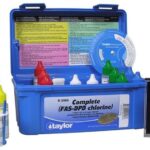
- Taylor K-2006 Complete Pool Water Test Kit ($90) — The gold standard of pool test kits. Tests free/combined chlorine, pH, alkalinity, calcium hardness, and CYA.
- Pool Mate Calcium Hardness Increaser (25 lbs) ($40) — Raises calcium hardness to prevent corrosive water from damaging pool surfaces and equipment.
- Arm & Hammer Baking Soda (15 lbs) ($15) — Pure sodium bicarbonate — raises alkalinity without significantly affecting pH. Fraction of pool store prices.
- Clorox Pool&Spa pH Down (5 lbs) ($13) — Sodium bisulfate granules for safely lowering pool pH. Easy-to-use and dissolves quickly.