
Too Much Cyanuric Acid in Pool? Here’s How to Fix It (Without Draining Everything)
You tested your water, and now you’re staring at a number that doesn’t look right. Your cyanuric acid level is reading 100 ppm. Or 150. Maybe the test maxed out entirely. Having too much cyanuric acid in your pool is one of the most frustrating problems you can face, and unfortunately, one of the most common. The kicker? There’s no chemical you can add to lower it. But don’t panic. You’ve got options, and most of them won’t require draining your entire pool.
Quick answer
Too Much Cyanuric Acid in Pool? Here’s How to Fix It (Without Draining Everything): You tested your water, and now you’re staring at a number that doesn’t look right. Your cyanuric acid level is reading 100 ppm. Or 150. Maybe the test maxed out entirely. Having too much cyanuric acid in your pool is.
Let me walk you through what’s happening, why it matters, and exactly how to fix it.
What Is Cyanuric Acid and Why Is It in Your Pool?
Cyanuric acid, usually shortened to CYA, acts like sunscreen for your chlorine. Without it, the sun’s UV rays can destroy about 90% of your free chlorine within two hours. With the right amount of CYA, usually 30 to 50 ppm for most outdoor pools, your chlorine lasts much longer.
Here’s where people get into trouble. CYA doesn’t evaporate. It doesn’t break down in any meaningful way. It doesn’t get filtered out. The only ways it leaves your pool are through splash-out, backwashing, leaks, overflow, or draining water.
And if you’re using stabilized chlorine like trichlor tablets or dichlor granules, you’re adding CYA every single time you sanitize the pool.
How CYA Builds Up Over Time
A single 3-inch trichlor tablet can add roughly 6 ppm of cyanuric acid to 10,000 gallons of water. If you use 2 to 3 tablets per week during swim season, you’re adding around 12 to 18 ppm weekly.
Stretch that over a long summer and the numbers get ugly fast. Even with some dilution from rain or backwashing, it’s easy to end up with a pool that has far more stabilizer than it needs.
That’s usually how people end up asking why their chlorine reads fine on paper, but the water still looks lousy.
Why High Cyanuric Acid Is a Problem
A lot of pool owners don’t notice high CYA right away. The water may still look okay for a while. But once the chlorine loses effectiveness, things can go sideways in a hurry.
Your Chlorine Gets Handcuffed
CYA protects chlorine, but too much of it overprotects chlorine. At high levels, a larger portion of your chlorine becomes tied up and less effective at killing algae and bacteria.
Think of it like sunscreen. A little protection is great. Wrap chlorine in three winter coats and now it can’t do its job.
At 40 to 50 ppm CYA, keeping free chlorine around 3 to 4 ppm usually works well. But if your CYA is 150 ppm, you’d need dramatically more chlorine to get the same sanitizing power. That’s expensive, annoying, and a common reason people end up stuck in a cycle of constant shocking.
You Can Get Algae Even With “Normal” Chlorine
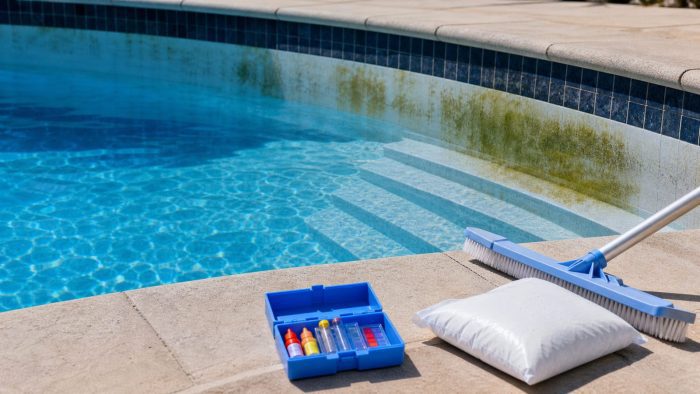
This is the classic high-CYA trap. Your strip says chlorine is present, maybe 2 or 3 ppm, but algae still shows up. You shock it, the water improves for a minute, and then it comes roaring back.
If that sounds familiar, high cyanuric acid is a prime suspect.
It Makes Recovery Harder and More Expensive
Once a pool gets cloudy or green, high CYA makes cleanup harder because you need more chlorine and more patience. Instead of a quick correction, you’re suddenly burning through liquid chlorine and wondering why the pool store bill keeps climbing.
What CYA Level Is Too High?
For most outdoor residential pools:
- 30 to 50 ppm is a solid target
- 60 to 70 ppm is manageable, but you’re getting high
- 80+ ppm starts causing real problems for many pools
- 100+ ppm is usually where partial draining becomes the smart move
Saltwater pools often run a little higher, sometimes around 60 to 80 ppm, but even then there is a ceiling. More is not better.
How to Test Cyanuric Acid Correctly
Don’t rely only on pool store testing. Some stores are great. Some are wildly inconsistent. If you’re serious about water chemistry, test it yourself.
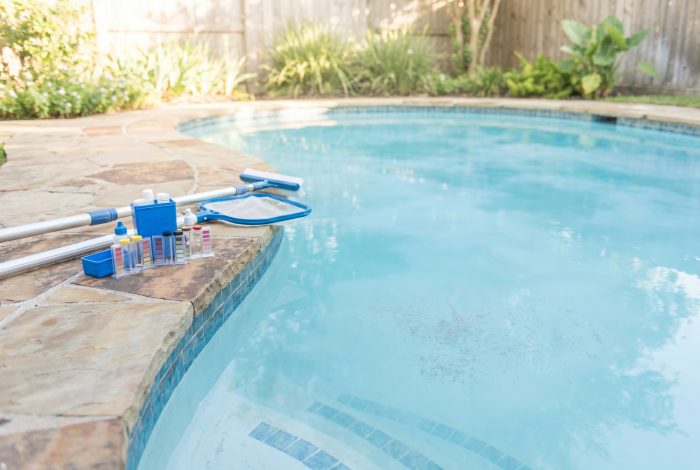
The Taylor K-2006 test kit is one of the best options for accurate pool testing, especially if you’re troubleshooting.
If the Test Maxes Out
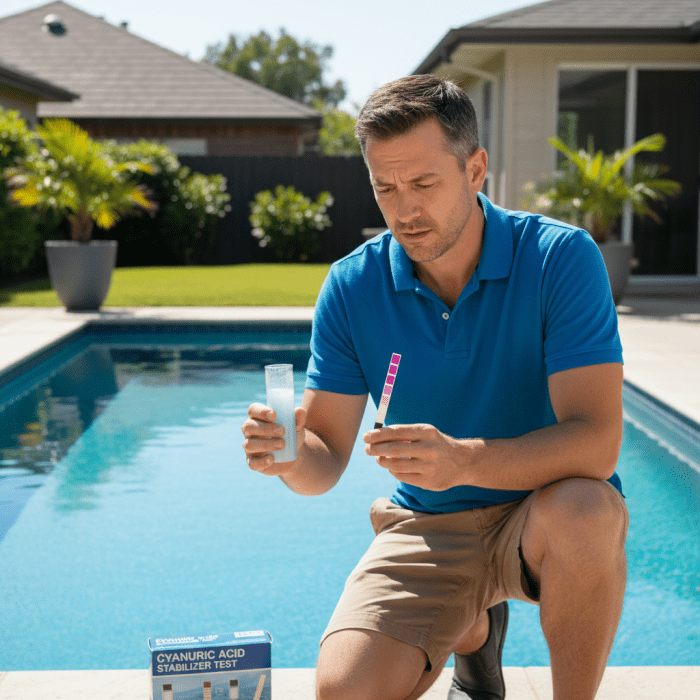
Most CYA tests top out around 100 ppm. If your reading is off the chart, use a diluted sample:
1. Fill the test container halfway with pool water.
2. Fill the other half with distilled water.
3. Run the test as usual.
4. Multiply the result by 2.
So if your diluted sample reads 80 ppm, your actual CYA is about 160 ppm.
Not ideal. But at least now you know what you’re dealing with.
How to Lower Cyanuric Acid in a Pool
Here’s the blunt truth: the only reliable way to lower CYA is to remove water and replace it with fresh water.
There are products that claim to reduce cyanuric acid biologically. Sometimes they help a little. Sometimes they do almost nothing. If your CYA is seriously high, draining and refilling is still the cleanest fix.
Option 1: Partial Drain and Refill
This is the method that works.
Use this formula to estimate the percentage of water you need to replace:
Percent to drain = 1 – (target CYA / current CYA)
Example:
- Current CYA: 150 ppm
- Target CYA: 50 ppm
- 1 – (50 / 150) = 0.67
- You need to replace about 67% of the water
That’s a lot, which is why most pool owners do it in stages.
Safe Step-by-Step Process
1. Test and record your current CYA.
2. Decide your target level.
3. Calculate how much water needs to be replaced.
4. Turn off the pump and heater.
5. Drain part of the water using a submersible pump or the waste setting.
6. Refill with fresh water.
7. Run the pump for 24 hours.
8. Retest and repeat if needed.
Don’t Drain the Whole Pool Unless You Absolutely Have To
This matters. A full drain can damage some pools.
- Vinyl liner pools can wrinkle or shift.
- Fiberglass pools can lift if groundwater pressure is high.
- Concrete pools are safer, but even then, a full drain isn’t always smart.
A staged drain, usually one-third at a time, is a much safer move.
What About CYA Reducer Products?
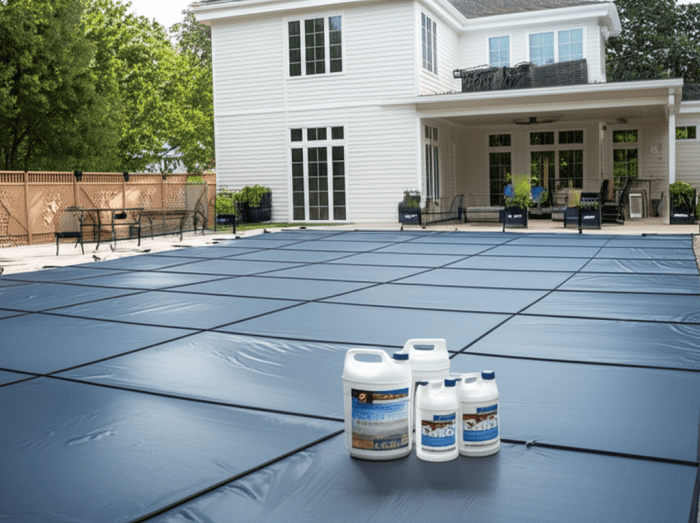
You’ll see products like Bio-Active Cyanuric Acid Reducer marketed as an easier solution. They may work in some situations, especially when CYA is only moderately high and water conditions are ideal.
But if your CYA is 100, 150, or higher, I’d skip the gamble. Water replacement is faster, more predictable, and usually cheaper than throwing money at a maybe.
How to Prevent High Cyanuric Acid From Coming Back
Fixing the problem is one thing. Not creating it again is the real win.
Stop Living on Tablets All Summer
Trichlor tablets are convenient. That’s why people love them. But they quietly add stabilizer every time you use them.
They’re fine in moderation. They’re a mess when they’re your only chlorine source for months.
Switch to Unstabilized Chlorine
Liquid chlorine adds no cyanuric acid. Neither does regular bleach labeled for pool-safe use, as long as it’s the right type and concentration. Cal-hypo shock also avoids adding CYA, though it does raise calcium hardness.
A pool chemical test kit plus a consistent liquid chlorine routine will keep you out of trouble more reliably than guessing with tablets.
Test CYA Monthly
Don’t wait for your pool to get weird. Test CYA at least once a month during swim season, and more often if you’re using tabs regularly.
Even basic pool test strips with stabilizer readings can help you catch a trend early, before it turns into a drain-and-refill weekend.
Real-World Example
Let’s say you’ve got a 15,000-gallon pool and your CYA comes back at 120 ppm. You want to get down to 50 ppm.
Using the formula:
1 – (50 / 120) = 0.583
You need to replace about 58% of the water.
That means roughly 8,700 gallons. Doing that all at once might be risky depending on your pool type, so splitting it into two partial drains is usually the smarter play.
And once you’re done, stop feeding the pool a steady diet of trichlor tablets unless you actually need more stabilizer.
Use the Pool Calculator Instead of Guessing
If you’re trying to figure out how much water to replace, use the Pool Chemical Calculator app.
It also helps you calculate how much chlorine to add after refilling and where your target chemistry should land. That’s a lot better than doing back-of-the-napkin math while standing next to a hose for six hours.
You can also grab it here:
- iPhone/iPad: https://itunes.apple.com/us/app/pool-chem-calculator/id1453351222
- Android: https://play.google.com/store/apps/details?id=com.poolchemicalcalculator.poolcalc
FAQ
Can you lower cyanuric acid without draining water?
Not reliably. Some products claim to reduce CYA biologically, but results are inconsistent. If your CYA is truly high, replacing water is the dependable fix.
Is 100 ppm cyanuric acid too high?
Yes, for most residential pools that’s too high. At that level, chlorine becomes much less effective unless you keep free chlorine significantly elevated.
Can too much cyanuric acid make pool water cloudy?
Yes, indirectly. High CYA weakens chlorine’s ability to sanitize the water, which can lead to algae growth, haziness, and ongoing water quality problems.
How often should you test cyanuric acid?
At least once a month during the swim season. Test more often if you use trichlor tablets or dichlor shock regularly.
What’s the fastest way to lower CYA in a pool?
A partial drain and refill is the fastest reliable method. The exact amount depends on your current CYA, target CYA, and pool volume.
—
As an Amazon Associate, Pool Chemical Calculator earns from qualifying purchases. Accurate readings make every chlorine, pH, alkalinity, calcium, and CYA dose safer. Raises free chlorine quickly without adding stabilizer, which is useful when CYA is already high. Fast daily checks between full liquid tests, especially during heavy swim season.Recommended pool supplies

Get exact pool chemical doses
Pool Chemical Calculator turns your test readings, pool volume, and target levels into exact treatment amounts for chlorine, pH, alkalinity, calcium, stabilizer, salt, and more.
Open the Pool Chemical Calculator app or download it from the App Store and Google Play.