
Saltwater Pool Feels Slimy: Causes, Fixes, and What to Test First
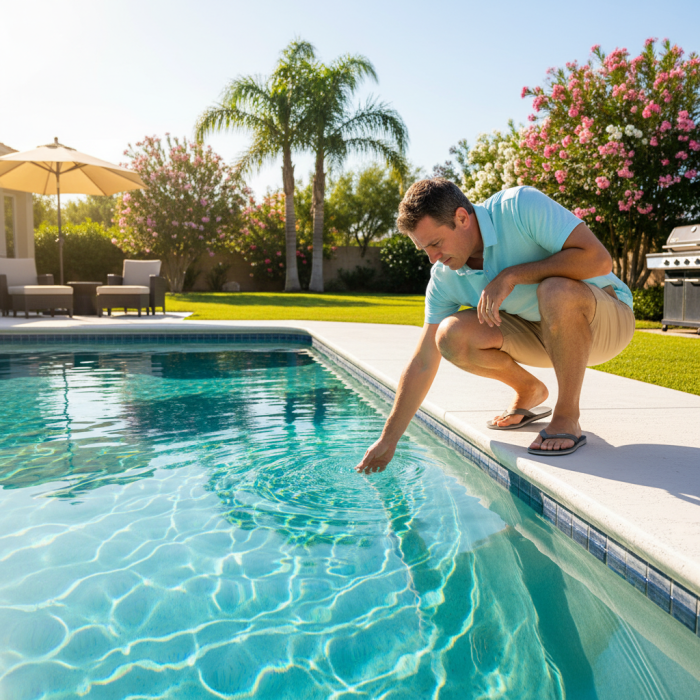
You reach down to grab the ladder and your hand slides right off. The pool walls feel like they’re coated in something slippery. And when you get out, your skin feels weirdly slick instead of clean. If your saltwater pool feels slimy, you’re dealing with one of the most common — and most misunderstood — problems in salt pool ownership.
Quick answer
Saltwater Pool Feels Slimy: Causes, Fixes, and What to Test First: You reach down to grab the ladder and your hand slides right off. The pool walls feel like they’re coated in something slippery. And when you get out, your skin feels weirdly slick instead of clean. If your saltwater.
Here’s the good news: that slippery sensation isn’t permanent, and fixing it doesn’t require draining your pool or calling an expensive technician. But you do need to understand what’s actually happening in your water. That slimy feeling could stem from three or four different causes, and each one requires a different solution.
Let’s break down exactly why this happens and what you can do about it today.
What’s Actually Causing That Slimy Feeling?
Before you start dumping chemicals into your pool, you need to identify the culprit. That slippery sensation has several possible sources, and misdiagnosing the problem wastes money and time.
High pH Levels: The Most Common Culprit
Nine times out of ten, a slimy saltwater pool comes down to elevated pH. And here’s the thing about salt chlorine generators — they naturally push pH upward every single day.
The electrolysis process that converts salt to chlorine also produces sodium hydroxide (a base). This continuously raises your water’s pH. In traditional chlorine pools, you’re adding acidic chlorine products that help balance things out. Salt pools don’t get that benefit.
When pH climbs above 7.8, the water starts feeling slippery. Get above 8.0, and it’s unmistakably slimy. Your skin produces natural oils, and high-pH water doesn’t rinse them away properly. Instead, it creates a soap-like reaction right there on your body.
The technical explanation: High pH causes a process called saponification. The alkaline water reacts with the fatty acids on your skin and creates actual soap. You’re essentially bathing in very diluted lye water. It’s not dangerous at normal pool pH levels, but it definitely feels weird.
Early-Stage Algae Growth (Biofilm)
That slime on your pool walls might be exactly what it feels like — a living thing. Biofilm is the first stage of algae colonization, and it forms before you see any green color.
Biofilm is a thin layer of bacteria and microscopic algae held together by a slimy matrix. Think of it like the slippery coating on river rocks. In your pool, biofilm typically starts in areas with poor circulation: behind ladders, in corners, around return jets, and on steps.
Here’s the scary part: biofilm protects the organisms inside it from chlorine. You might have perfectly adequate free chlorine readings while biofilm thrives on your surfaces. The slime layer acts as a shield.
High Total Dissolved Solids (TDS)
Salt pools naturally run higher TDS than traditional pools — after all, you’re maintaining 2,800-3,400 ppm of salt alone. But when other dissolved solids accumulate (calcium, metals, organic compounds), the water gets thick.
High TDS water doesn’t feel crisp and clean. It feels heavy and slippery. If you haven’t drained and refilled any water in 3+ years, accumulated TDS could be your problem.
Excess Cyanuric Acid (Stabilizer)
Cyanuric acid (CYA) doesn’t directly cause sliminess, but it creates conditions where sliminess thrives. When CYA exceeds 80-100 ppm, your chlorine becomes dramatically less effective. At 150 ppm, your salt cell is basically churning out useless chlorine that can’t kill anything.
The result? Biofilm grows unchecked, and suddenly your pool feels like a swamp.
How to Diagnose Your Specific Problem
Grab your test kit. You need accurate numbers before doing anything else.
Test These Four Things Right Now
1. pH Level
Target range: 7.2-7.6
If reading: Above 7.8 — this is likely your primary issue
2. Free Chlorine
Target range: 2-4 ppm
If reading: Below 1 ppm — biofilm is probably forming
3. Cyanuric Acid
Target range: 30-50 ppm for salt pools (some go up to 70)
If reading: Above 100 ppm — your chlorine isn’t working properly
4. Salt Level
Target range: Check your cell’s manual (typically 2,800-3,400 ppm)
If reading: Too low — your cell isn’t producing enough chlorine
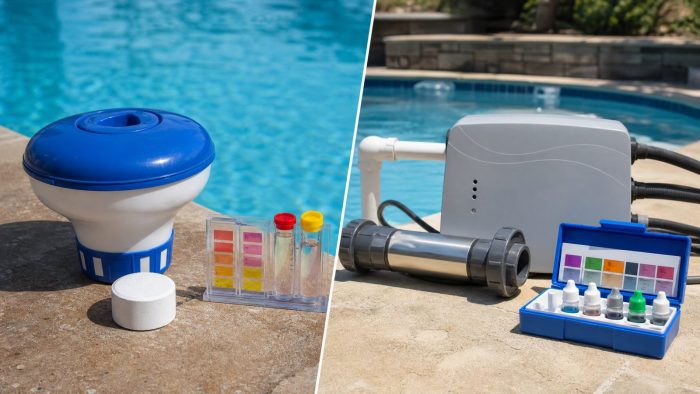
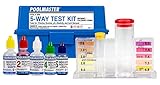
For accurate results, I recommend using a quality drop-based test kit rather than strips. The Taylor K-2006 Complete Test Kit gives you laboratory-grade accuracy for all these measurements. It’s what pool professionals use.
The Touch Test
After testing, do a simple physical inspection:
- Walls feel slimy but water feels fine: Probably biofilm
- Water itself feels slippery, walls are fine: Probably high pH
- Everything feels off, water looks slightly dull: Could be high TDS or CYA
Fixing High pH in Your Saltwater Pool
If testing revealed pH above 7.6, start here. This is the fastest fix and resolves most sliminess complaints within 24 hours.
What You’ll Need
- Muriatic acid OR dry acid (sodium bisulfate)
- Safety glasses and chemical-resistant gloves
- A measuring cup dedicated to pool chemicals
- Calculator for dosing
Step-by-Step pH Reduction
Step 1: Calculate Your Dose
For a 10,000-gallon pool with pH at 8.0, you’ll need approximately:
– 12-16 oz of muriatic acid (31.45% strength), OR
– 1.5 lbs of dry acid (sodium bisulfate)
These amounts lower pH by roughly 0.3-0.4 points. For larger pools, multiply accordingly. For smaller pH drops, reduce proportionally.
Step 2: Pre-Dilute (Optional but Safer)
Fill a 5-gallon bucket with pool water. Add the acid to the water (never water to acid). This reduces concentration and prevents etching your pool surface.
Step 3: Add to Pool
Pour the diluted solution in front of a return jet with the pump running. Walk around the pool perimeter while pouring to distribute evenly.
Step 4: Wait and Retest
Run the pump for 4-6 hours minimum. Retest pH. Add more acid if needed, but never add more than 1 quart per 10,000 gallons in a single treatment.
Step 5: Recheck in 48 Hours
Salt cells push pH up continuously. You might need to establish a regular acid addition schedule — many salt pool owners add small amounts weekly.
Preventing Future pH Climb
Your salt cell will always raise pH. Accept this as part of salt pool ownership. But you can minimize the drift:
- Aerate less: Waterfalls, fountains, and spillovers accelerate pH rise. Run them less frequently if pH is a constant battle.
- Consider a CO2 injection system: For chronic high-pH pools, automated CO2 injection maintains perfect pH without adding chemicals.
- Check total alkalinity: TA between 70-80 ppm (lower than traditional pool recommendations) helps keep pH more stable in salt pools.
Eliminating Biofilm and Early Algae
If your walls feel slimy but water chemistry looks decent, biofilm is your enemy. Here’s how to destroy it.
The Brush-Then-Shock Method
Step 1: Lower the pH First
Chlorine works best at lower pH. Get your water to 7.2 before shocking.
Step 2: Brush Every Surface Aggressively
Use a stainless steel brush for plaster pools or a nylon brush for vinyl and fiberglass. The Milliard Heavy Duty Pool Brush handles both surface types with replaceable bristles.
Brush the walls, floor, steps, behind the ladder — everywhere. You’re breaking up the biofilm’s protective layer so chlorine can reach the organisms inside.
Step 3: Shock to Breakpoint
Your target: 10x your current CYA level in ppm of free chlorine (the CYA/Chlorine ratio).
If your CYA reads 50 ppm, shock to 25-30 ppm free chlorine minimum. For CYA at 100 ppm, you’d need 40+ ppm chlorine — and at that point, diluting your pool water makes more sense than super-shocking.
For salt pools, add liquid chlorine (sodium hypochlorite) or calcium hypochlorite for shocking. Don’t rely on your salt cell — it can’t produce shock levels fast enough.
Step 4: Maintain Elevated Chlorine
Keep free chlorine above normal levels (8-12 ppm) for 24-48 hours. Brush daily during this period. Biofilm is stubborn.
Step 5: Run Your Filter Continuously
Don’t cycle your pump during the shocking process. Run it 24 hours straight until chlorine returns to normal levels.
Adding an Algaecide Barrier
After clearing biofilm, a quality algaecide prevents regrowth. Look for polyquat-based algaecides (polyquat 60) rather than copper-based ones, which can stain salt pool surfaces.
Add algaecide weekly as a maintenance dose during swim season.
Dealing with High Cyanuric Acid
CYA doesn’t dissipate, evaporate, or break down. Once it’s high, there’s only one reliable solution: dilution.
How Much Water to Drain
The math is straightforward. If your CYA reads 150 ppm and you want 50 ppm, you need to replace roughly 2/3 of your water.
For a 15,000-gallon pool:
– Drain 10,000 gallons
– Refill with fresh water
– Retest and add salt as needed
This is expensive and time-consuming, but it’s the only permanent fix. Some products claim to reduce CYA through biological processes, but results are inconsistent and slow.
Preventing CYA Buildup
Stop using stabilized chlorine products like trichlor tablets or dichlor. These add CYA every time you use them. In a salt pool, you don’t need them — your cell produces unstabilized chlorine.
If you do shock with dichlor occasionally, switch to liquid chlorine or cal-hypo instead.
Managing Total Dissolved Solids
High TDS rarely requires emergency action, but it does explain that “thick” water feeling.
When to Dilute
If TDS exceeds 3,000 ppm above your salt level (meaning 6,000+ ppm total for a salt pool), partial drainage helps. Replace 1/4 to 1/3 of your water annually to keep TDS manageable.
Symptoms of High TDS
- Cloudy water that won’t clear
- Scale formation despite balanced calcium
- Chlorine seems less effective
- Water feels “heavy”
Maintaining That “Soft Water” Feel Long-Term
Salt pools feel amazing when balanced properly. That silky sensation isn’t sliminess — it’s soft water without harsh chlorine. Here’s how to keep it that way.
Weekly Testing Schedule
Every Saturday (or pick your day), test:
– Free chlorine
– pH
– Salt level (every 2-3 weeks is fine)
Every month, test:
– CYA
– Calcium hardness
– Total alkalinity
Optimal Salt Pool Ranges
| Parameter | Target Range |
|---|---|
| pH | 7.2-7.6 |
| Free Chlorine | 2-4 ppm |
| Salt | Per your cell (usually 2,800-3,400 ppm) |
| Cyanuric Acid | 30-50 ppm |
| Total Alkalinity | 70-80 ppm |
| Calcium Hardness | 200-400 ppm |
Acid Addition Schedule
Most salt pools need muriatic acid added weekly. Start with 8 oz per 10,000 gallons weekly and adjust based on your pH readings. Keep a log to dial in your specific pool’s needs.
Quick Troubleshooting Reference
Slimy walls + pH above 7.8 = Lower pH with muriatic acid
Slimy walls + pH normal + chlorine low = Biofilm; brush and shock
Slimy water + CYA above 80 = Dilute pool water, then shock
Slippery feeling after swimming = pH too high; also check your salt cell is producing
Slimy spots only in corners/shadows = Poor circulation creating dead zones; adjust return jets
Frequently Asked Questions
Why does my saltwater pool feel slimy but my chlorine level is fine?
High pH is the most common cause. Even with adequate chlorine, pH above 7.8 creates that slippery sensation through saponification — a chemical reaction between alkaline water and your skin’s natural oils. Test your pH and lower it to 7.2-7.6. Also, biofilm can exist underneath adequate chlorine readings because it protects itself from sanitizer penetration.
How often should I add acid to my saltwater pool?
Most saltwater pools need muriatic acid added weekly. Start with 6-8 oz per 10,000 gallons and adjust based on your pH drift. Some pools with water features or heavy aeration need acid twice weekly. Keep a log of additions and pH readings to establish your pool’s specific rhythm.
Can high salt levels make my pool feel slimy?
Not directly. Salt at normal pool levels (2,800-3,400 ppm) doesn’t create sliminess. However, if your salt cell isn’t generating enough chlorine due to low salt, biofilm can develop. Check that your salt level matches your cell manufacturer’s recommendation and that the cell is actually producing chlorine.
Is the slimy feeling in saltwater pools dangerous?
Usually no. High pH causing slippery water isn’t harmful at typical pool levels (below 8.2). However, if biofilm is the cause, that’s a sanitation issue. Biofilm harbors bacteria and pathogens, so it should be addressed quickly through brushing and shocking.
Why do my pool walls feel slimy but the water feels normal?
This pattern indicates biofilm — a thin layer of bacteria and early algae colonizing your surfaces. Biofilm forms in areas with poor circulation before spreading. Brush all surfaces thoroughly, then shock your pool to at least 10 ppm free chlorine. Maintain elevated chlorine for 24-48 hours with continuous filtration.
Fix Your Pool Chemistry Today
Tired of guessing how much acid to add or whether your chlorine is actually effective? Stop the trial-and-error approach.
Use Pool Chemical Calculator to get exact dosing recommendations based on your pool volume and current chemistry readings. Enter your test results, and you’ll know precisely how much muriatic acid, chlorine, alkalinity increaser, calcium hardness increaser, stabilizer, salt, or any other chemical you need — no more dumping and hoping.
???? iPhone / iPad: https://itunes.apple.com/us/app/pool-chem-calculator/id1453351222
???? Android: https://play.google.com/store/apps/details?id=com.poolchemicalcalculator.poolcalc
???? Full guide: https://poolchemicalcalculator.com/news/saltwater-pool-feels-slimy/
Your pool should feel silky and clean, not slimy. Get the numbers right, and it will.
As an Amazon Associate, Pool Chemical Calculator earns from qualifying purchases. Lowers high pH and helps bring alkalinity down when used carefully. Raises free chlorine quickly without adding stabilizer, which is useful when CYA is already high. Accurate readings make every chlorine, pH, alkalinity, calcium, and CYA dose safer.Recommended pool supplies


Get exact pool chemical doses
Pool Chemical Calculator turns your test readings, pool volume, and target levels into exact treatment amounts for chlorine, pH, alkalinity, calcium, stabilizer, salt, and more.
Open the Pool Chemical Calculator app or download it from the App Store and Google Play.