
Baking Soda in Pool, When to Use It, How Much to Add, and What It Actually Fixes
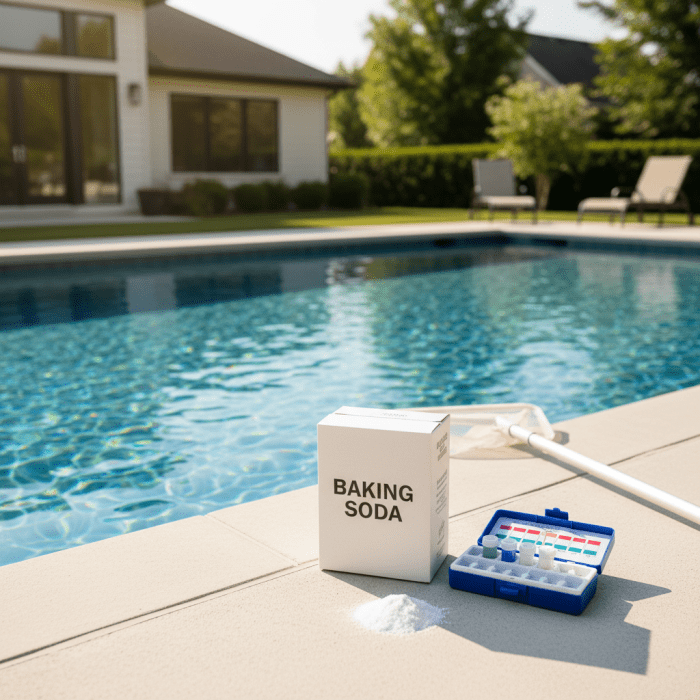
If your pool pH keeps bouncing around or your alkalinity is low, baking soda can absolutely help. But it isn’t magic, and it isn’t the fix for every water problem.
Quick answer
Baking Soda in Pool, When to Use It, How Much to Add, and What It Actually Fixes: If your pool pH keeps bouncing around or your alkalinity is low, baking soda can absolutely help. But it isn’t magic, and it isn’t the fix for every water problem. Baking soda raises total alkalinity first. It may.
Baking soda raises total alkalinity first. It may nudge pH up a little, but that isn’t its main job. Think of alkalinity like a shock absorber for your pool water. When it is too low, your pH gets jumpy, chemicals work less predictably, and the water gets harder to manage.
The short version: if your total alkalinity is under about 80 ppm, baking soda is often the right move.
What baking soda does in pool water
Baking soda is sodium bicarbonate. In pool care, it is mostly used to raise total alkalinity.
That matters because alkalinity helps stabilize pH. When alkalinity is too low, your pool can swing from fine to irritating in a hurry. One rainstorm, one dose of chlorine, or one top-off with fresh water can throw things off.
Here is what baking soda is good for:
- Raising low total alkalinity
- Helping stabilize pH
- Making water feel less aggressive to plaster, metal, and equipment
- Reducing the roller-coaster effect where pH keeps drifting fast
Here is what it is not good for:
- Lowering pH
- Lowering chlorine
- Clearing cloudy water by itself
- Replacing proper pool chemicals across the board
Ideal pool alkalinity and pH targets
For most backyard pools, these are solid target ranges:
- Total alkalinity: 80 to 120 ppm
- pH: 7.4 to 7.6 is ideal, 7.2 to 7.8 is acceptable
- Chlorine: 1 to 3 ppm for most residential pools
If your alkalinity is below 80 ppm, baking soda is worth considering.
If your pH is low but your alkalinity is already fine, soda ash may be the better tool. That is where people get tripped up. Baking soda and soda ash are not interchangeable.
How much baking soda to add to a pool
A common rule of thumb is this:
1.5 pounds of baking soda per 10,000 gallons raises total alkalinity by about 10 ppm.
That is the number most pool owners need.
A few rough examples:
- 10,000 gallon pool, alkalinity at 60 ppm, target 80 ppm = about 3 pounds
- 15,000 gallon pool, alkalinity at 70 ppm, target 90 ppm = about 4.5 pounds
- 20,000 gallon pool, alkalinity at 50 ppm, target 80 ppm = about 9 pounds
Do not dump in a huge correction all at once unless you are very confident in your testing. Safer play: add part of the dose, circulate, retest, then adjust.
If you want a faster way to dial in the dose, use the Pool Chemical Calculator app to calculate the exact amount for your pool size and current reading.
- iPhone:
- Android:
How to add baking soda to your pool the right way
You don’t need fancy technique here, but you do need a little patience.
Step 1: Test the water first
Check these before adding anything:
- Total alkalinity
- pH
- Free chlorine
Test strips are okay for a quick glance, but a liquid test kit is usually more trustworthy.
If you need one, these are solid options:
- Taylor K-2006 test kit:
- AquaChek test strips:
Step 2: Measure the dose
Calculate how much you need based on pool volume and your current alkalinity level.
Small corrections are easier to control. That matters.
Step 3: Broadcast it across the pool
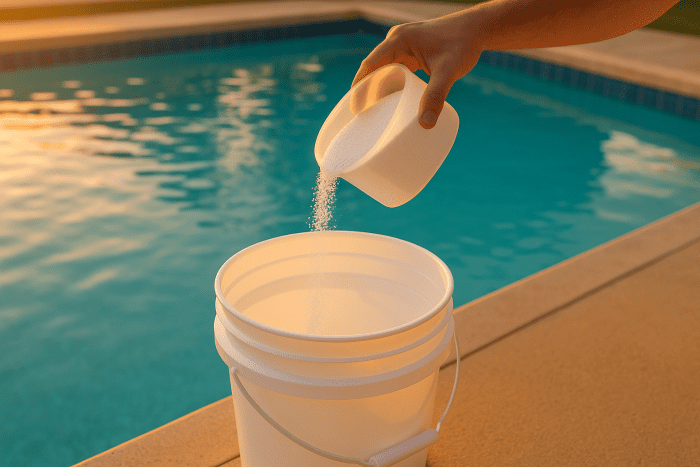
With the pump running, scatter the baking soda across the surface of the deep end or around the perimeter. Don’t just dump one giant mound in a single spot.
Brush if needed to help it dissolve.
Step 4: Let the water circulate
Run the pump for at least 6 hours. Overnight is even better.
Step 5: Retest before adding more
This is the part people skip. And it is how they overshoot.
Retest alkalinity and pH before making another adjustment.
Can you swim after adding baking soda to a pool?
Usually, yes. In most cases you can swim once the baking soda has dissolved and circulated, which is often within a few hours.
That said, if you are making a bigger chemistry correction, wait until the water is mixed and re-tested. It is the smarter move.
Baking soda vs soda ash, what is the difference?
This is the big confusion point.
Baking soda raises total alkalinity a lot and pH a little.
Soda ash raises pH a lot and total alkalinity some.
If your problem is low alkalinity, use baking soda.
If your problem is low pH but alkalinity is already okay, soda ash may be the better choice.
A decent soda ash option here:
- ARM & HAMMER Super Washing Soda:
What happens if you add too much baking soda?
Too much baking soda can push alkalinity too high. And once alkalinity gets too high, your pH becomes harder to lower cleanly, scaling risk goes up, and the water can start looking dull or cloudy.
Signs you overdid it:
- Total alkalinity climbs above 120 to 150 ppm
- pH starts creeping up
- Water looks cloudy after treatment
- You keep fighting scale on tile or equipment
If that happens, stop adding alkalinity increaser and re-test. Sometimes the fix is simply time, circulation, and letting the chemistry settle. In more stubborn cases, you may need muriatic acid to bring alkalinity and pH back down in a controlled way.
Is household baking soda okay for pools?
Yes, plain baking soda is generally fine as long as it is just sodium bicarbonate without perfumes, cleaners, or weird additives.
A lot of pool owners use regular grocery-store baking soda because it is often cheaper than branded “alkalinity increaser.” Same chemistry. Different label.
Bulk option if you want to keep some on hand:
- ARM & HAMMER Baking Soda, 13.5 lb:
When baking soda will not solve the problem
Baking soda helps with low alkalinity. That is it.
It won’t fix every issue that looks chemistry-related.
For example:
- If your chlorine disappears fast, baking soda is not the answer
- If your pool is green, you likely need chlorine, filtration, and maybe brushing
- If your pH is high already, adding baking soda may make things worse
- If your calcium hardness is off, baking soda will not help
Pool care gets a lot easier when you treat the actual cause instead of tossing in whatever sounds safe.
Best way to know if your pool needs baking soda
Test total alkalinity first. Always.
If it is below 80 ppm, baking soda is a smart next move.
If it is already in range, pause before adding anything. Too many pool problems come from “fixing” water that was not broken.
And if you are juggling pH, chlorine, alkalinity, and dosage math at the same time, use the app instead of guessing.
- iPhone:
- Android:
FAQ
Does baking soda raise pH in a pool?
A little, yes. But its main effect is raising total alkalinity. If you need a bigger pH increase, soda ash is usually more effective.
How long does baking soda take to work in a pool?
You will usually see the effect after 6 to 24 hours of circulation. Retest after the water has fully mixed.
How much baking soda do I add to a 10,000 gallon pool?
About 1.5 pounds raises total alkalinity by roughly 10 ppm in a 10,000 gallon pool.
Can too much baking soda make pool water cloudy?
Yes. Overdosing can raise alkalinity too high and contribute to cloudy water or scaling conditions.
Is alkalinity increaser the same as baking soda?
Usually, yes. Most alkalinity increaser products are just sodium bicarbonate.
How-To Schema
1. Test total alkalinity, pH, and chlorine.
2. Calculate the baking soda dose based on pool volume.
3. Add baking soda with the pump running.
4. Let the water circulate for at least 6 hours.
5. Retest before adding more.
Final take
Baking soda is one of the simplest pool chemistry fixes you can make. Cheap, easy, effective. But only when you use it for the right problem.
If your alkalinity is low, it works great.
If your water issue is something else, baking soda is just a white powder making you feel productive.
Test first, dose carefully, retest, then adjust. Your pool will thank you.
As an Amazon Associate, Pool Chemical Calculator earns from qualifying purchases. Raises total alkalinity so pH is less likely to bounce around after treatment. Accurate readings make every chlorine, pH, alkalinity, calcium, and CYA dose safer. Fast daily checks between full liquid tests, especially during heavy swim season.Recommended pool supplies

Get exact pool chemical doses
Pool Chemical Calculator turns your test readings, pool volume, and target levels into exact treatment amounts for chlorine, pH, alkalinity, calcium, stabilizer, salt, and more.
Open the Pool Chemical Calculator app or download it from the App Store and Google Play.