
Small Pool Maintenance Tips: Keep Your Compact Oasis Crystal Clear Without the Hassle
Got a small pool in your backyard? You’re not alone. Thousands of homeowners choose pools under 10,000 gallons because they fit better, cost less, and still deliver that refreshing escape on hot summer days. But here’s the thing about small pool maintenance tips that surprises most people: smaller doesn’t always mean easier. In fact, compact pools can be trickier to manage because chemical imbalances happen faster and mistakes get magnified. The good news? Once you understand the unique quirks of small pool care, you’ll spend less time maintaining and more time floating.
Quick answer
Small Pool Maintenance Tips: Keep Your Compact Oasis Crystal Clear Without the Hassle: Got a small pool in your backyard? You’re not alone. Thousands of homeowners choose pools under 10,000 gallons because they fit better, cost less, and still deliver that refreshing escape on hot summer days. But here’s.
Why Small Pools Need a Different Approach
Think of your pool like a cup of coffee. A small pool is an espresso shot — concentrated and sensitive. A large pool is a full carafe — diluted and forgiving. Drop one sugar cube into each. The espresso tastes dramatically sweeter. The carafe barely notices.
Your pool chemistry works the same way. One sweaty swimmer in a 5,000-gallon pool has double the impact of one sweaty swimmer in a 10,000-gallon pool. Rain, leaves, sunscreen, dog hair — everything hits harder when there’s less water to absorb it.
The Volume Problem
Most pool chemical instructions assume you have a 10,000+ gallon pool. Pour in the recommended amount of shock into your 4,000-gallon above-ground pool? You just overdosed your water by 150%. This is why small pool owners need to calculate doses carefully — or use a tool that does it for them.
The Speed Factor
Chemical changes happen 2-3 times faster in small pools. Your pH can swing from 7.4 to 7.8 in a single afternoon. Algae can bloom overnight because there’s less chlorine reserve to fight it off. This means you’ll test more often, but add smaller amounts.
Essential Weekly Maintenance Schedule
Here’s your week at a glance. Print this out, stick it on your pool shed wall, and actually follow it.
Monday: Test and Adjust
Grab your test kit or strips first thing in the week. You’re checking three things:
- Chlorine: 1-3 ppm (aim for 2 ppm in small pools)
- pH: 7.2-7.6 (7.4 is the sweet spot)
- Alkalinity: 80-120 ppm
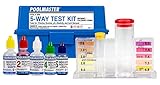
For reliable results, I recommend the Taylor K-2006 Test Kit. It’s what pool professionals use, and it’s accurate down to 0.2 ppm for chlorine. Test strips work for quick checks, but this kit tells you exactly what’s happening.
Wednesday: Quick Skim and Brush
Spend 10 minutes mid-week on physical maintenance. Skim the surface with a leaf net. Brush the walls and floor, paying attention to corners where algae loves to start. This takes longer to skip than to do — neglecting it creates chemical problems you’ll spend hours fixing.
Saturday: Filter Check and Vacuum
Your filter works harder in a small pool because there’s less water diluting contaminants. Clean or backwash your filter every 7-10 days instead of the standard 2-4 weeks larger pools can stretch.
Vacuum the bottom, even if it looks clean. Fine sediment settles invisibly and creates a buffet for algae spores.
Chemical Dosing for Small Pools
This is where most small pool owners mess up. And I get it — pool chemical labels are written for big pools.
The Golden Rule: Halve It, Then Test
When adding any chemical to a pool under 7,500 gallons, start with half the recommended dose. Wait 4 hours with the pump running. Test again. Add more if needed.
You can always add more chlorine. You can’t remove what you’ve already poured in.
Specific Dosing Guidelines
For a 5,000-gallon pool (common for many above-ground and small inground pools):
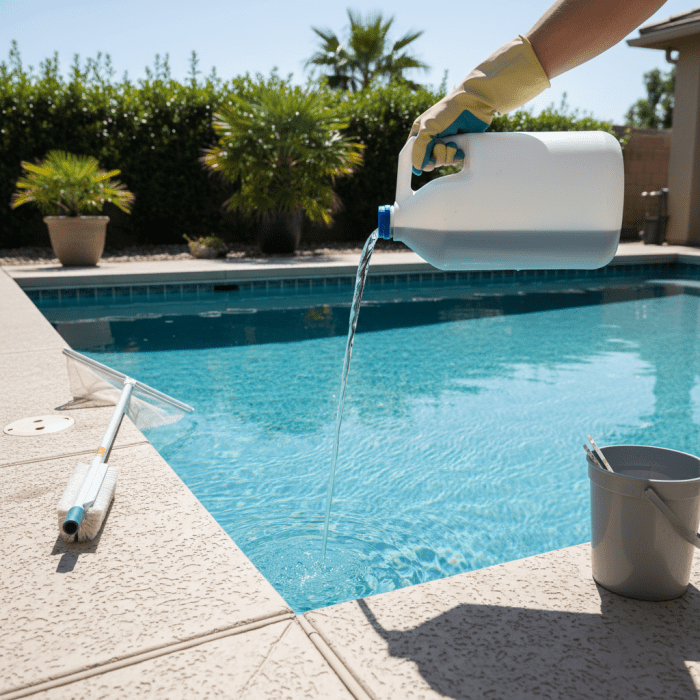
- To raise chlorine by 1 ppm: Add 2 oz of liquid chlorine or about 0.5 oz of granular shock
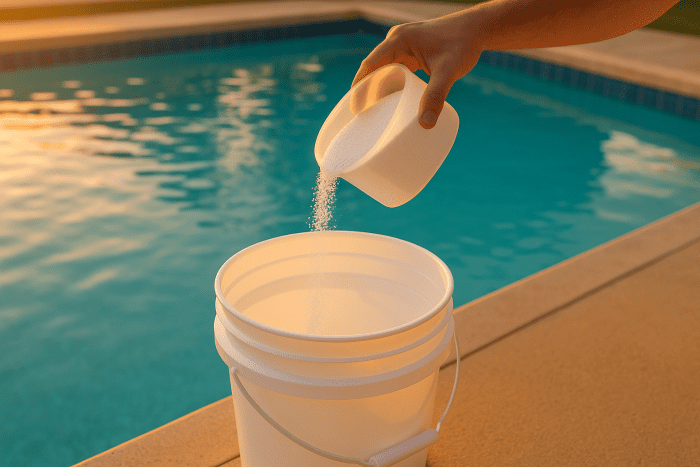
- To lower pH by 0.2: Add 3 oz of muriatic acid (always diluted in a bucket first)
- To raise alkalinity by 10 ppm: Add 5 oz of baking soda
These numbers matter. Writing “add some shock” doesn’t help anyone. Get a kitchen scale that measures ounces and keep it with your pool supplies.
Consider a Smaller Chlorinator
Standard chlorine floaters dispense too much chlorine for small pools. Look for adjustable models with multiple settings or buy a small pool floating chlorinator designed for pools under 8,000 gallons. These hold fewer tablets and release chlorine more slowly.
Filtration and Circulation Tips
Your pump doesn’t need to run 24/7. But it needs to run enough to turn over your entire water volume at least once daily.
Calculate Your Turnover Rate
Here’s the math: divide your pool gallons by your pump’s gallons-per-hour flow rate. A 6,000-gallon pool with a pump moving 1,500 GPH needs 4 hours minimum to cycle all the water. Run it 6-8 hours to be safe, split between morning and evening.
Upgrade Undersized Equipment
Many small pools come with comically weak pumps and filters. That 500 GPH pump included with your 4,500-gallon pool? It needs 9 hours just to turn the water over once. Consider upgrading to a 1,000+ GPH pump if you’re fighting constant clarity issues.
Fighting Algae in Small Pools
Algae loves small pools. Less chlorine reserve means faster growth. Warmer water (small pools heat up quickly) accelerates reproduction. And that one shady corner where sunlight doesn’t reach? Perfect algae habitat.
Prevention Protocol
- Maintain chlorine at 2-3 ppm during summer months (not 1 ppm)
- Brush walls twice weekly instead of once
- Add algaecide every 2 weeks as prevention, not just treatment
- Keep phosphate levels under 100 ppb (algae food source)
When You See Green
Act immediately. In a large pool, you might have a day or two. In a small pool, green tint today means green swamp tomorrow.
Shock hard: use 2 lbs of calcium hypochlorite per 5,000 gallons. Brush everything. Run the filter continuously. Backwash or clean the filter every 8 hours until clear. This isn’t overkill — it’s appropriate response for concentrated water.
Seasonal Considerations
Summer Heat
Small pools can hit 90°F in direct sunlight. Chlorine dissipates faster at high temperatures. Test every 2-3 days during heat waves and consider adding stabilizer (cyanuric acid) if levels drop below 30 ppm.
Fall Leaves
One oak tree can drop enough leaves in a week to turn your small pool into compost tea. Invest in a quality leaf net cover that you can lay over the water during peak leaf season. Removing leaves before they sink saves hours of vacuuming and prevents tannin staining.
Winter Closing
Small pools freeze faster and deeper. Lower water levels 4-6 inches below the skimmer, not the standard 1-2 inches. This gives ice room to expand without cracking your skimmer box.
Common Mistakes to Avoid
Over-chlorinating after every swim: Your family splashing around for 30 minutes doesn’t require shock treatment. A quick chlorine top-up of 1 oz is plenty.
Ignoring calcium hardness: Yes, small pools need calcium too. Aim for 200-400 ppm to protect your liner or plaster from the water leeching minerals.
Skipping water replacement: Small pools accumulate dissolved solids faster. Drain and refill 1/3 of your water mid-season to “reset” your chemistry.
Take the Guesswork Out
Stop eyeballing chemical doses. Stop dumping and hoping. Your small pool deserves precision — and you deserve to actually enjoy it instead of constantly fixing problems.
Head over to poolchemicalcalculator.com and punch in your exact pool volume. You’ll get specific doses down to the ounce for every chemical adjustment. It’s free, it’s fast, and it works for pools of any size. Your compact backyard oasis will thank you.
Frequently Asked Questions
How often should I test my small pool water?
Test at least twice weekly during swimming season. Small pools experience faster chemical changes than larger pools, so the standard “once a week” advice doesn’t cut it. During heat waves or heavy use, bump that up to every other day. A quick 2-minute test prevents hours of problem-solving later.
Can I use regular pool chemicals in a small pool?
Yes, but you’ll need to adjust doses significantly. Most product labels assume 10,000+ gallon pools. For a 5,000-gallon pool, start with half the recommended amount, wait 4 hours, then test and add more if needed. Never add the full dose upfront — overcorrecting is a bigger problem in small pools.
Why does my small pool turn green so quickly?
Three reasons: lower chlorine reserve, faster heating, and higher bather load relative to water volume. One swimmer in a 5,000-gallon pool introduces twice the contaminants per gallon compared to a 10,000-gallon pool. Combat this by maintaining slightly higher chlorine levels (2-3 ppm instead of 1-2 ppm) and brushing walls twice weekly.
How long should I run my pump in a small pool?
Run your pump long enough to turn over the entire water volume 1.5-2 times daily. For a 5,000-gallon pool with a 1,000 GPH pump, that’s 7-10 hours. Split the run time between morning and evening for best circulation. Running it less saves electricity but costs more in chemicals and headaches.
Do small pools need different equipment?
Standard equipment often overwhelms small pools. Look for adjustable chlorine floaters designed for under 8,000 gallons. Consider a variable-speed pump if yours runs too strong. And size your filter appropriately — oversized filters aren’t harmful, but undersized ones cause constant clarity problems.
As an Amazon Associate, Pool Chemical Calculator earns from qualifying purchases. Raises free chlorine quickly without adding stabilizer, which is useful when CYA is already high. Accurate readings make every chlorine, pH, alkalinity, calcium, and CYA dose safer. Lowers high pH and helps bring alkalinity down when used carefully.Recommended pool supplies


Get exact pool chemical doses
Pool Chemical Calculator turns your test readings, pool volume, and target levels into exact treatment amounts for chlorine, pH, alkalinity, calcium, stabilizer, salt, and more.
Open the Pool Chemical Calculator app or download it from the App Store and Google Play.