
Intex Pool Maintenance: The Complete Guide to Crystal-Clear Water All Summer
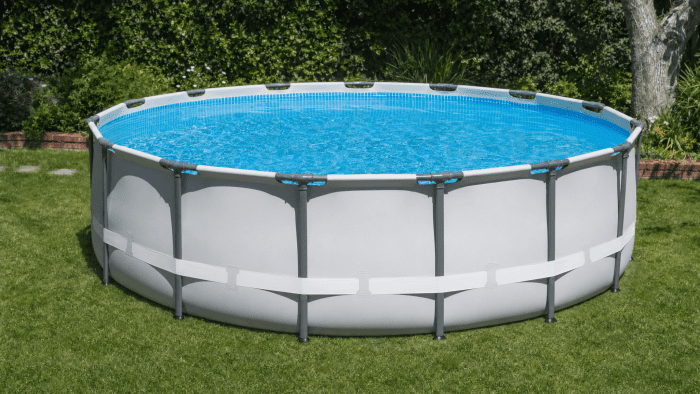
Your Intex pool is set up, filled, and ready to go. But here’s the thing — Intex pool maintenance works a bit differently than caring for a traditional in-ground pool. The smaller water volume, vinyl walls, and compact filtration systems create unique challenges that catch many first-time owners off guard. And nobody wants to spend their summer battling green water or watching their pool liner deteriorate after one season.
Quick answer
Intex Pool Maintenance: The Complete Guide to Crystal-Clear Water All Summer: Your Intex pool is set up, filled, and ready to go. But here’s the thing — Intex pool maintenance works a bit differently than caring for a traditional in-ground pool. The smaller water volume, vinyl walls, and compact.
The good news? Once you understand the basics, keeping your Intex pool sparkling clean takes about 15-20 minutes per day. That’s it. Let me walk you through exactly what you need to do.
Why Intex Pools Need Special Attention
Think of your Intex pool like a small apartment compared to a house. Everything happens faster in a smaller space. Temperature swings hit harder. Chemical imbalances show up quicker. And contamination from swimmers, rain, or debris affects the water more dramatically.
Most Intex pools hold between 1,000 and 15,000 gallons — a fraction of a typical in-ground pool’s 20,000+ gallons. This means:
- Chemical changes happen fast. One afternoon rainstorm can dilute your chlorine by 50%.
- Algae spreads quickly. What takes days in a big pool takes hours in yours.
- The filter works harder. Those small pump systems weren’t designed for heavy loads.
Understanding these differences is half the battle.
Daily Maintenance Tasks (5-10 Minutes)
Skim the Surface
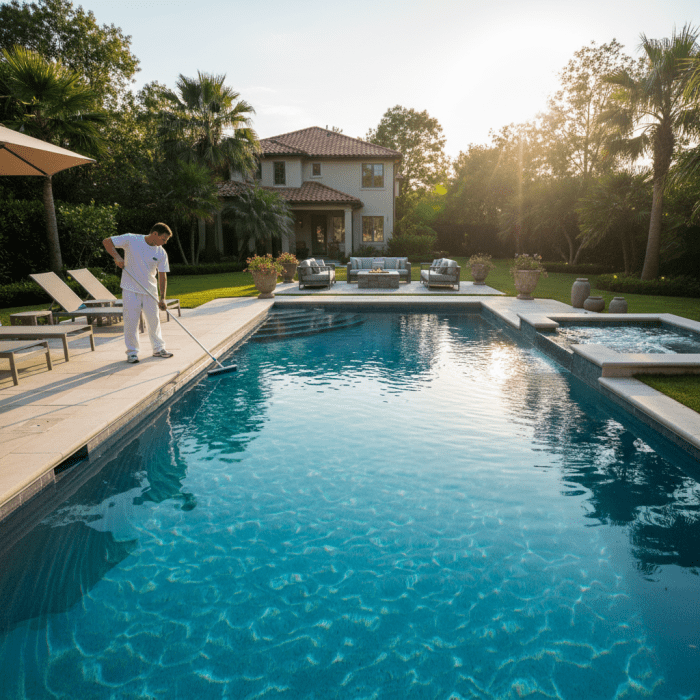
Grab a leaf skimmer and remove floating debris before it sinks. Leaves, bugs, grass clippings, and pollen all decompose in your water, eating up chlorine and feeding algae. A 2-minute skim each morning prevents hours of chemistry headaches later.
Pro tip: Do this before running your filter pump. You’ll catch debris before it clogs your system.
Check Your Filter Pump
Your Intex pump should run 8-12 hours daily during swimming season. I know — that sounds like a lot. But here’s the math: most Intex pumps circulate 1,000-2,500 gallons per hour. Your pool needs at least one complete water turnover per day, ideally two.
For a 10,000-gallon pool with a 2,500 GPH pump:
- One turnover = 4 hours
- Two turnovers = 8 hours
Run the pump during the hottest part of the day when algae growth peaks.
Quick Visual Inspection
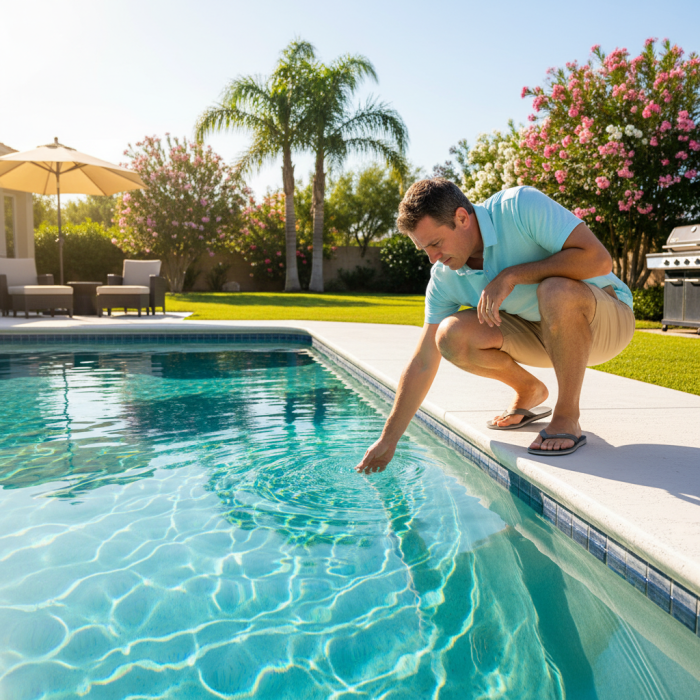
Glance at your water each day. Is it clear? Can you see the bottom? Any green tinge along the walls? Catching problems early — when water looks “slightly off” — prevents full-blown algae blooms that require shocking and days of treatment.
Weekly Maintenance Tasks (20-30 Minutes)
Test Your Water Chemistry
This is non-negotiable. Test your water at least twice per week, preferably every 2-3 days during hot weather or heavy use.
Here are your target ranges:
| Parameter | Ideal Range | Danger Zone |
|———–|————-|————-|
| Free Chlorine | 1-3 ppm | Below 1 ppm |
| pH | 7.2-7.6 | Below 7.0 or above 7.8 |
| Total Alkalinity | 80-120 ppm | Below 60 ppm |
| Cyanuric Acid | 30-50 ppm | Above 100 ppm |
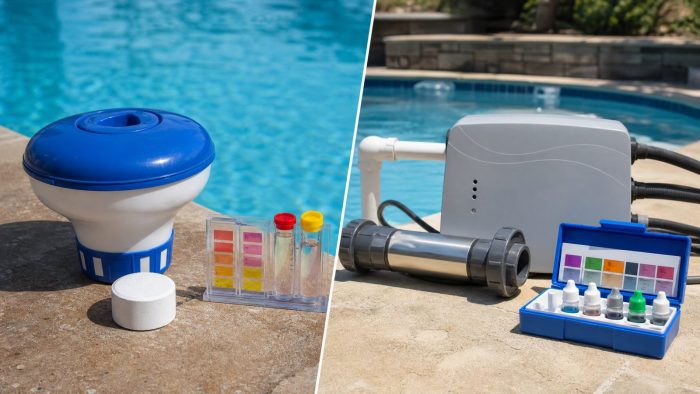
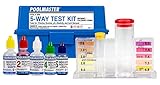
A reliable test kit makes this easy. I recommend test strips for quick daily checks and a liquid test kit for more accurate weekly readings.
Clean or Replace Your Filter
Intex pools typically use one of two filter types:
Filter Cartridges (Type A/C or Type B): Rinse with a garden hose every 1-2 weeks. Replace when rinsing no longer removes the grime — usually every 2-4 weeks during heavy use. Stock up on replacement cartridges so you’re never caught without one.
Sand Filters: Backwash when pressure rises 8-10 PSI above the clean baseline. Replace sand every 3-5 years.
Brush the Walls and Floor
Vinyl liner pools love to collect algae in the seams and corners where circulation is weak. Use a soft-bristled brush (never wire!) to scrub the walls, floor, and especially the waterline where oils accumulate. This dislodges algae spores so your filter and chlorine can eliminate them.
Vacuum Debris
A manual pool vacuum or automatic cleaner removes settled debris your skimmer misses. For Intex pools, the Intex rechargeable handheld vacuum works well for small to medium pools without requiring complicated hose setups.
Understanding Intex Pool Chemistry
Chlorine: Your Primary Weapon
Chlorine kills bacteria, viruses, and algae. But it gets used up fast in small pools. You have several options:
3-inch Stabilized Tablets: The most common choice. Use a floating dispenser — never throw tablets directly into the pool. They’ll bleach your liner. One tablet treats roughly 5,000 gallons for about a week.
Liquid Chlorine: Fast-acting but dissipates quickly. Good for raising levels fast.
Saltwater Chlorine Generators: Yes, some work with Intex pools. They create chlorine from salt, reducing your chemical handling. But the upfront cost ($100-300) might not make sense for a seasonal pool.
pH: The Chemistry Multiplier
Here’s something most pool owners don’t realize: pH affects how well your chlorine works. At pH 7.2, about 65% of your chlorine is active. At pH 8.0, only 20% is active. Same amount of chlorine, drastically different effectiveness.
If you’re constantly adding chlorine but still seeing algae, check your pH first.
Cyanuric Acid: Sunlight Protection
Outdoor pools need cyanuric acid (CYA) to protect chlorine from UV degradation. Without it, sunlight destroys 90% of your chlorine within 2 hours.
But there’s a catch. CYA doesn’t evaporate or break down. It only leaves through splash-out, backwashing, or draining. In Intex pools, this builds up fast. Once CYA exceeds 100 ppm, your chlorine becomes ineffective no matter how much you add.
The fix: Use non-stabilized chlorine occasionally, and drain/refill 25% of your water if CYA gets too high.
Seasonal Intex Pool Care
Opening Your Pool
1. Clean the liner and walls before filling
2. Fill with fresh water
3. Run the pump for 24 hours
4. Test and balance chemicals
5. Wait for chlorine to reach 1-3 ppm before swimming
Mid-Season Refresh
Around mid-July, consider draining 25-30% of your water and refilling with fresh. This dilutes accumulated CYA, dissolved solids, and other gunk that builds up over weeks of use.
Closing for Winter
Most Intex pools should be drained, cleaned, dried completely, and stored indoors. Leaving water in the pool over winter risks ice damage, liner degradation, and mosquito breeding in spring.
Fold the liner loosely — tight folds crack vinyl. Store in a climate-controlled space if possible.
Troubleshooting Common Problems
Cloudy Water
Usually caused by inadequate filtration, high pH, or low chlorine. Clean your filter, check chemistry, and run the pump longer.
Green Water (Algae)
Shock with 3x normal chlorine dose, brush walls, run filter 24/7 until clear. This might take 2-4 days.
Slimy Walls
Early-stage algae. Brush immediately and add chlorine. You caught it early — nice work.
Foamy Water
Body oils, lotions, and detergent residue from swimsuits. Use enzyme-based clarifier and encourage pre-swim showers.
FAQ
How often should I change the water in my Intex pool?
For pools used regularly, plan a complete drain and refill at least once per season — typically mid-summer. If you notice persistent chemistry problems, cloudiness that won’t clear, or CYA levels above 100 ppm, drain sooner.
Can I use regular household bleach in my Intex pool?
Yes, unscented liquid bleach (6% sodium hypochlorite) works as pool chlorine. Use about 3/4 cup per 1,000 gallons to raise chlorine by 2 ppm. Avoid bleach with additives like fragrances or surfactants.
How long can I leave my Intex pool up without maintenance?
Honestly? About 2-3 days before problems start. Chlorine depletes, algae spores land, and debris accumulates constantly. If you’re going on vacation, ask a neighbor to add chlorine and run the pump daily. Coming home to a green swamp ruins the post-vacation mood.
Why does my Intex pool lose water so quickly?
Some evaporation is normal — up to 1/4 inch daily in hot, dry weather. More than that suggests a leak. Check all hose connections, the drain plug, and inspect the liner for punctures. A simple bucket test confirms whether you’re dealing with evaporation or a leak.
Is a saltwater system worth it for an Intex pool?
It depends on how many seasons you’ll use the pool. Saltwater generators cost $100-300 but eliminate daily chlorine handling. For a pool you’ll use 3+ seasons, the convenience often justifies the cost. For a one-summer setup, stick with tablets.
Keep Your Intex Pool Perfect All Summer
Maintaining your Intex pool doesn’t require a chemistry degree. It requires consistency — a few minutes daily, a bit more weekly, and the right knowledge to spot problems before they spiral.
Need help calculating exactly how much chlorine, pH adjuster, or shock to add? Stop guessing and use our free Pool Chemical Calculator to get precise measurements for your pool size. Just enter your current readings, and we’ll tell you exactly what to add.
Your pool’s waiting. Go enjoy it.
As an Amazon Associate, Pool Chemical Calculator earns from qualifying purchases. Raises free chlorine quickly without adding stabilizer, which is useful when CYA is already high. Accurate readings make every chlorine, pH, alkalinity, calcium, and CYA dose safer. A clean cartridge improves circulation and helps cloudy water clear faster.Recommended pool supplies


Get exact pool chemical doses
Pool Chemical Calculator turns your test readings, pool volume, and target levels into exact treatment amounts for chlorine, pH, alkalinity, calcium, stabilizer, salt, and more.
Open the Pool Chemical Calculator app or download it from the App Store and Google Play.