
Pool Chlorine Lock: What to Do When Chlorine Stops Working
You’ve been adding chlorine to your pool all week. The bucket’s nearly empty. But when you test the water, your free chlorine reading barely moves. Meanwhile, your combined chlorine (chloramines) sits stubbornly high. Sound familiar? You’re probably dealing with pool chlorine lock — a frustrating condition where your chlorine seems trapped and unable to do its job.
Quick answer
Pool Chlorine Lock: What to Do When Chlorine Stops Working: You’ve been adding chlorine to your pool all week. The bucket’s nearly empty. But when you test the water, your free chlorine reading barely moves. Meanwhile, your combined chlorine (chloramines) sits stubbornly high.
Here’s the good news: chlorine lock is fixable. And once you understand what’s happening in your water, you can solve it in 24-48 hours. This guide walks you through exactly what causes this problem, how to confirm you have it, and the step-by-step process to get your chlorine working again.
What Is Chlorine Lock, Really?
Chlorine lock describes a situation where chlorine becomes “locked up” in a form that can’t sanitize your pool. You keep adding chlorine, but it doesn’t produce the expected results. Your test kit shows chlorine present, but algae starts growing anyway. Swimmers complain about red eyes and that harsh “pool smell.”
The technical explanation? When chlorine enters your pool, it breaks into hypochlorous acid (the stuff that kills germs) and hypochlorite ions. This is your “free chlorine” — the active, working form. But when chlorine reacts with nitrogen compounds from sweat, urine, body oils, and environmental debris, it forms chloramines. These are your “combined chlorine.”
Combined chlorine is essentially chlorine that’s been used up. It’s still technically chlorine, but it’s bound to other molecules and can’t sanitize effectively. It’s like a security guard who’s already busy escorting someone out — they can’t watch the door anymore.
The Chlorine Lock vs. High Chlorine Demand Debate
Some pool professionals argue that “chlorine lock” isn’t a real condition — that what people call chlorine lock is simply high chlorine demand. And they’re partially right. True chemical “locking” (where chlorine literally can’t function) is rare.
But here’s what matters to you: whether you call it chlorine lock, high chlorine demand, or chloramine buildup, the symptoms and solutions are similar. Your chlorine isn’t working, and you need to fix it.
The three main culprits are:
- High chloramine levels — Combined chlorine above 0.5 ppm indicates a problem
- Cyanuric acid (CYA) that’s too high — Above 80-100 ppm, CYA can bind chlorine so tightly it can’t sanitize
- Extreme contamination — Heavy organic loads that consume chlorine faster than you can add it
How to Tell If You Have Chlorine Lock
Before you start treatment, confirm you actually have chlorine lock. Here’s how to diagnose it properly.
Step 1: Test Your Water Accurately
You need to test for three things:
- Free chlorine (FC) — The active, sanitizing chlorine
- Total chlorine (TC) — All chlorine in the water
- Combined chlorine (CC) — Calculated as TC minus FC
If your combined chlorine is above 0.5 ppm, you have a chloramine problem. Many experts say any combined chlorine above 0.2 ppm warrants action.
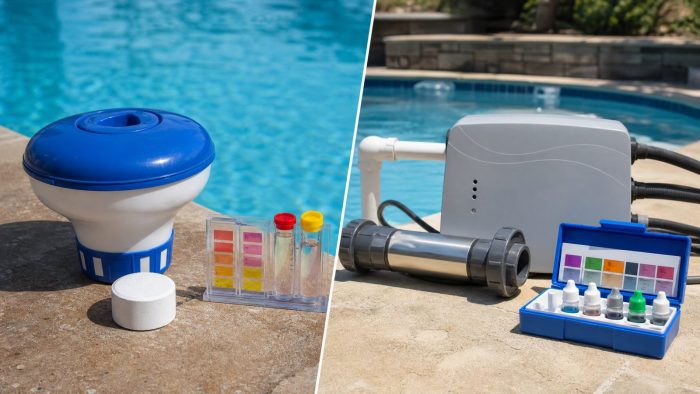
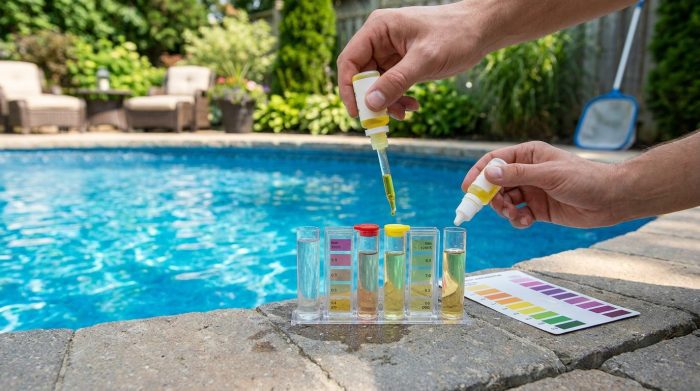
A basic test strip won’t cut it here. You need a DPD test kit that measures both free and total chlorine separately. The Taylor K-2006 Test Kit is the gold standard for accurate readings — it’s what pool professionals use.
Step 2: Check Your Cyanuric Acid Level
CYA (stabilizer) protects chlorine from UV breakdown. But too much creates problems. Test your CYA level — if it’s above 80 ppm, that’s likely contributing to your chlorine ineffectiveness.
Here’s the relationship: At 30 ppm CYA, you need about 3 ppm free chlorine for proper sanitation. At 100 ppm CYA, you’d need 8+ ppm free chlorine for the same effect. The stabilizer literally holds onto chlorine molecules, slowing their ability to kill bacteria and algae.
Step 3: Look for These Symptoms
You probably have chlorine lock or high chlorine demand if:
- ✓ Chlorine levels don’t rise despite adding more product
- ✓ Water looks dull, hazy, or slightly green
- ✓ Strong “chlorine smell” (that’s actually chloramines, not chlorine)
- ✓ Swimmers report eye and skin irritation
- ✓ Algae grows even with “normal” chlorine readings
- ✓ Combined chlorine tests above 0.5 ppm
How to Fix Chlorine Lock: Your Action Plan
The fix depends on what’s causing your problem. Work through these solutions in order.
Solution 1: Breakpoint Chlorination (Shock Treatment)
This is the most common and effective fix for chloramine buildup. Breakpoint chlorination means adding enough chlorine to destroy all the combined chlorine in your pool.
The math is specific: You need to reach a free chlorine level that’s 10 times your combined chlorine reading.
For example: If your combined chlorine is 1.5 ppm, you need to hit 15 ppm free chlorine and hold it there until the chloramines oxidize away.
Here’s How to Do It:
What you’ll need:
– Calcium hypochlorite (cal-hypo) shock or liquid chlorine (sodium hypochlorite)
– Your test kit
– Pool calculator (more on this below)
Step-by-step process:
- Test your water and record free chlorine, total chlorine, and pH
- Calculate your combined chlorine (total minus free)
- Determine your target — Multiply combined chlorine by 10
- Calculate how much shock you need — For a 20,000-gallon pool with 1.5 ppm combined chlorine, you’d need to add approximately 2.5-3 lbs of cal-hypo shock to reach 15 ppm
- Lower your pH first — Chlorine works best at pH 7.2-7.4. If your pH is 7.8+, bring it down before shocking
- Add shock after sunset — UV destroys chlorine. Shock at dusk for best results
- Run your pump for 24 hours straight
- Test every 4-6 hours — You want to maintain that high chlorine level until combined chlorine drops below 0.5 ppm
- Don’t swim until free chlorine drops below 5 ppm
Pro tip: Cal-hypo shock adds calcium to your water. If you have hard water or a plaster pool, liquid chlorine (bleach) might be a better choice since it doesn’t affect calcium hardness.
Solution 2: Partial Drain and Refill (For High CYA)
If your cyanuric acid is above 80-100 ppm, shocking alone won’t solve your problem. CYA doesn’t break down or evaporate — the only way to lower it is dilution.
Here’s the process:
- Test your current CYA level — Let’s say it’s 120 ppm
- Calculate how much water to drain — To get from 120 ppm to 40 ppm, you’d need to replace about 65% of your water
- Drain to your calculated level — Never fully drain a pool (it can pop out of the ground)
- Refill with fresh water
- Rebalance all chemistry — Fresh water changes everything
- Test CYA again after 24 hours of circulation
This is labor-intensive and wastes water, but sometimes it’s the only option. Prevention is easier — avoid using stabilized chlorine (trichlor tablets) exclusively. Each tablet adds more CYA to your pool.
Solution 3: Non-Chlorine Shock (Potassium Monopersulfate)
Non-chlorine shock oxidizes contaminants without adding more chlorine to the equation. It’s useful when:
- You want to swim shortly after treatment
- You’re already dealing with high chlorine levels
- You need to eliminate chloramines but don’t want to raise chlorine further
Doheny’s Non-Chlorine Shock works well for this purpose. Use 1 lb per 10,000 gallons as a maintenance dose, or 2 lbs per 10,000 gallons for a heavy treatment.
However, non-chlorine shock doesn’t kill algae. If you’re seeing green, you need real chlorine.
Solution 4: The SLAM Method (For Severe Cases)
SLAM stands for Shock, Level, And Maintain. It’s the nuclear option for pools that won’t respond to regular shocking.
The approach:
- Bring chlorine to “shock level” based on your CYA — at 30 ppm CYA, that’s 12 ppm FC; at 50 ppm CYA, that’s 20 ppm FC
- Test every 2-4 hours during daylight
- Add chlorine as needed to maintain shock level
- Brush the entire pool daily — walls, floor, steps, everything
- Run your filter 24/7 and clean it when pressure rises 25%
- Continue until you pass three tests:
- CC drops to 0.5 ppm or less
- You lose 1 ppm FC or less overnight
- Water is crystal clear
SLAM can take 3-7 days for badly contaminated pools. It uses a lot of chlorine — budget for 10-20+ lbs of shock for a typical residential pool.
Preventing Chlorine Lock From Coming Back
Once you’ve fixed the problem, keep it from returning.
Maintain Proper CYA Levels
Keep cyanuric acid between 30-50 ppm for most pools. If you use trichlor tablets, switch to a mix of trichlor and cal-hypo shock, or use liquid chlorine exclusively and add CYA separately as needed.
Shock Regularly
Even with a salt system or good chemistry, shock your pool every 1-2 weeks during heavy use. After pool parties? Shock that night. Heavy rain? Shock. Just do it.
Maintain Good Hygiene Practices
This sounds obvious, but:
- Shower before swimming
- Don’t pee in the pool (tell your kids — urine is a major chloramine source)
- Keep pets out of the pool
- Remove leaves and debris promptly
- Run your filter 8-12 hours daily minimum
Test Frequently
Weekly testing catches problems early. Test twice weekly during hot weather or heavy use. The Taylor K-2005 Test Kit is an excellent mid-range option that handles all essential tests accurately.
Common Mistakes to Avoid
Don’t just keep adding more chlorine. If you’ve added 3x your normal amount and chlorine still isn’t rising, stop. Adding more won’t help — you need to address the underlying issue.
Don’t shock during the day. Sunlight destroys chlorine rapidly. You’ll waste 30-50% of your shock treatment to UV rays. Always shock at dusk.
Don’t ignore pH. Chlorine is 50% less effective at pH 7.8 compared to pH 7.2. Low pH before shocking makes your chlorine work dramatically harder.
Don’t use the pool during treatment. Yes, it’s tempting. But swimming in high-chlorine water irritates eyes and skin, and you’ll add more contaminants that consume the chlorine you just added.
Don’t drain your pool completely. Groundwater pressure can literally lift an empty pool out of the ground. Never drain more than 1/3 without professional guidance.
When to Call a Professional
Some situations warrant expert help:
- Your pool is green/black and hasn’t responded to 7 days of SLAM
- You suspect your equipment (pump, filter, or salt cell) is failing
- CYA is over 150 ppm and you’re unsure about draining procedures
- You have a plaster pool with staining or etching concerns
- Your test results don’t make sense and you can’t figure out what’s wrong
A pool service visit typically costs $75-150 for diagnostics. Sometimes that’s money well spent versus dumping hundreds of dollars of chemicals into a pool that has an equipment problem.
FAQ
How long does it take to fix chlorine lock?
Most chlorine lock situations resolve within 24-48 hours with proper breakpoint chlorination. Severe cases using the SLAM method can take 5-7 days. If your CYA is extremely high and you need to partially drain, add another 1-2 days for refilling and rebalancing.
Can I swim with chlorine lock?
You shouldn’t. High chloramine levels cause eye irritation, skin rashes, and respiratory issues. That “strong chlorine smell” indicates chloramines are off-gassing, and breathing them isn’t great for you. Wait until combined chlorine drops below 0.5 ppm and free chlorine is in the normal 1-3 ppm range.
Does baking soda help with chlorine lock?
No. Baking soda raises alkalinity and slightly raises pH. It doesn’t address chloramines or high CYA. Using baking soda when you have chlorine lock might actually make things worse by raising pH and reducing chlorine effectiveness.
How much shock do I need for breakpoint chlorination?
You need to reach 10x your combined chlorine reading. For a 15,000-gallon pool with 1 ppm combined chlorine, you’d need about 1.5 lbs of calcium hypochlorite shock to hit 10 ppm. Calculate your exact needs using a pool calculator for accuracy — the amount varies with your pool size and current chemistry.
Will draining my pool lower CYA and fix chlorine lock?
Partial draining reduces CYA through dilution — that’s the only way to lower it. If CYA is your problem (above 80-100 ppm), then yes, dilution helps. If your issue is chloramines and your CYA is normal, draining wastes water and money. Test first to identify the actual problem.
Get Your Pool Chemistry Right
Figuring out exactly how much shock to add, how much water to drain, or what your ideal CYA level should be involves math. And doing pool math wrong means wasted chemicals and more frustration.
Save yourself the headache. Use our free Pool Chemical Calculator to get precise dosing recommendations for your exact pool size and current chemistry. Just enter your numbers, and we’ll tell you exactly what to add.
Need help calculating shock doses? Use Pool Chemical Calculator to determine exactly how much chlorine, shock, pH adjuster, alkalinity increaser, stabilizer, or other balancing chemical your pool needs based on your volume and current test results. No guessing, no over-treating, just clear water fast.
???? iPhone / iPad: https://itunes.apple.com/us/app/pool-chem-calculator/id1453351222
???? Android: https://play.google.com/store/apps/details?id=com.poolchemicalcalculator.poolcalc
???? Full guide: https://poolchemicalcalculator.com/news/pool-chlorine-lock-what-to-do/
As an Amazon Associate, Pool Chemical Calculator earns from qualifying purchases. Raises free chlorine quickly without adding stabilizer, which is useful when CYA is already high. Accurate readings make every chlorine, pH, alkalinity, calcium, and CYA dose safer. Useful for algae cleanup, cloudy water, high bather load, and weekly oxidation routines.Recommended pool supplies


Get exact pool chemical doses
Pool Chemical Calculator turns your test readings, pool volume, and target levels into exact treatment amounts for chlorine, pH, alkalinity, calcium, stabilizer, salt, and more.
Open the Pool Chemical Calculator app or download it from the App Store and Google Play.