
Pool Freeze Protection During a Power Outage: What to Do Before Pipes Freeze
Quick answer
If a freeze is coming and your pool loses power, treat the plumbing and equipment as an emergency: shut off unsafe electrical equipment, keep people away from wet electrical areas, and call a qualified pool or electrical professional if you cannot safely restore circulation. If the pool has not been fully winterized, the priority is preventing trapped water from freezing in the pump, filter, heater, chlorinator, skimmer, and exposed lines. Do not improvise a generator connection or run a pump from an indoor extension cord.
Quick answer
Pool Freeze Protection During a Power Outage: What to Do Before Pipes Freeze: Quick answer If a freeze is coming and your pool loses power, treat the plumbing and equipment as an emergency: shut off unsafe electrical equipment, keep people away from wet electrical areas, and call a qualified.
The correct response depends on whether the pool is designed to stay open with freeze protection or has already been closed for winter. Open systems generally need safe circulation restored; fully winterized systems should remain drained, plugged, and protected rather than being restarted casually.
First, identify which situation you have
An open pool with freeze protection
If your pool normally stays open through winter, its freeze-protection mode usually starts circulation when air or water temperature falls near the controller’s configured threshold. A power outage disables that protection. The immediate questions are whether the plumbing still contains water, whether the equipment area is already freezing, and whether power can be restored safely.
A fully winterized pool
If the lines were blown out, equipment was drained, plugs were installed, and the cover is on, leave the system in its winterized state. Do not add water to drained equipment or start a pump that has not been correctly reassembled and primed. Check the manufacturer’s winterization instructions or call the professional who closed the pool.
A partially closed pool
This is the riskiest situation. A pool may look closed while the pump, filter, heater, or return lines still hold water. Assume the equipment is vulnerable until you confirm which sections were drained and which remain water-filled.
What to do during the outage
Step 1: Make the equipment area electrically safe
Stay out of standing water and do not touch breakers, plugs, controllers, or a generator while wet. Turn off pool equipment at the disconnect or breaker if the electrical system is dry and you can do so safely. Never connect a portable generator to a pool circuit with a homemade cable or backfeed a house panel. A licensed electrician should handle generator transfer equipment.
Step 2: Check the weather and the equipment condition
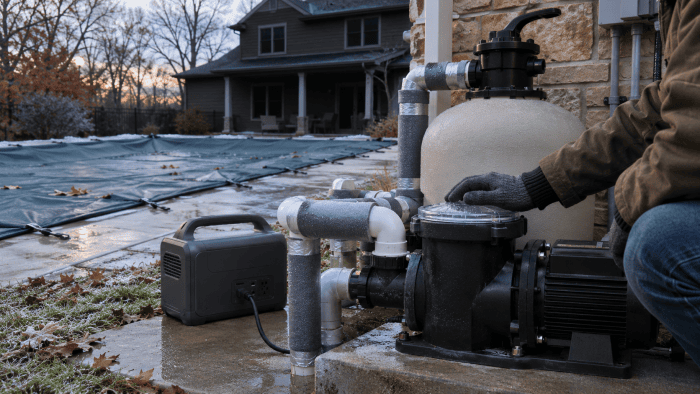
Note the expected duration of the outage, the forecast low, and whether the pump basket, filter tank, heater, salt cell, and exposed plumbing are full of water. Do not break ice around fittings or force frozen valves. Photograph the equipment before changing anything; that helps a pool professional diagnose the system later.
Step 3: Restore circulation only when it is safe
If utility power returns and the equipment is not frozen, check for leaks, confirm valves are in their normal operating position, fill the pump basket, open the air-relief valve as appropriate, and prime the pump according to its manual. Watch the equipment while it starts. Stop immediately if the motor hums without moving water, the filter leaks, the pressure spikes, or water sprays near electrical components.
If you have an approved transfer switch and a properly sized generator installed by a professional, follow that system’s instructions. A small portable power station may not safely start a pool motor, and running the wrong load can damage the generator or the pump.
Step 4: Protect equipment that cannot circulate
For a water-filled system that cannot be powered, call a pool professional or qualified service technician to drain the pump, filter, heater, chlorinator, and accessible lines. Do not randomly remove plugs from a pressurized system. Do not pour automotive antifreeze into pool plumbing. Only use a product explicitly labeled for pool plumbing, and only as part of a documented winterization procedure.
Step 5: Recheck after power returns
Once circulation is restored, inspect every connection for leaks and confirm the pump is actually moving water. Test the water with a reliable kit and use the free chlorine calculator, pH calculator, and pool volume calculator to avoid guessing at chemical doses after the emergency.
How to prevent a repeat outage problem
- Document the normal winter mode. Record whether the pool stays open, the freeze-protection temperature, the pump schedule, and the location of the disconnect.
- Test freeze protection before winter. Confirm that the controller, temperature sensor, pump, valves, and alarm are working before the first hard freeze.
- Protect the electrical system. Keep connections elevated and dry, use GFCI protection, and have a licensed electrician install any standby generator transfer equipment.
- Keep a winterization record. Write down which lines and components were drained, where plugs are stored, and which valves were moved.
- Plan a service contact. During a prolonged outage, a pool professional can safely drain vulnerable equipment faster than trial-and-error repairs.
What not to do
- Do not run a gasoline generator in a garage, shed, or enclosed equipment room.
- Do not connect a generator directly to a pool outlet or house receptacle.
- Do not use a damaged extension cord, submerged cord, or cord without the required outdoor rating and protection.
- Do not restart a pump that may be frozen or running dry.
- Do not chip ice off plumbing, valves, or a pool cover with sharp tools.
- Do not assume a cover prevents freeze damage; a cover protects the water surface, not every pipe and equipment component.
Affiliate disclosure: As an Amazon Associate, Pool Chemical Calculator may earn from qualifying purchases.
Frequently Asked Questions
Should I run my pool pump during a power outage?
No. A pump cannot run without power, and improvised power connections are dangerous. Restore it only through the normal electrical system or a professionally installed generator transfer system, and only after confirming the equipment is not frozen or damaged.
How long can pool pipes go without circulation in freezing weather?
There is no dependable universal time. Wind, pipe exposure, water temperature, insulation, and the actual temperature all matter. Treat a prolonged outage before or during a hard freeze as urgent, especially when water remains in exposed equipment.
Can I use a portable generator for my pool pump?
Only with a correctly sized, code-compliant connection installed or approved by a qualified electrician. Never backfeed a building or connect a generator with a male-to-male cable.
Should I add pool antifreeze during an outage?
Not automatically. Pool plumbing antifreeze is not a substitute for draining and blowing out lines, and automotive antifreeze must never be used. Follow the equipment manufacturer and product label, or have a pool professional winterize the system.
What should I check after the power comes back?
Look for leaks, cracked housings, a full pump basket, normal filter pressure, and steady return flow. Then test sanitizer and pH before swimming or adding chemicals. If the motor only hums, trips a breaker, or cannot prime, shut it down and call for service.
Related Pool Chemical Calculator tools
Use the Pool Chemical Calculator app to calculate exact doses after circulation is restored. For equipment planning, pair water-volume calculations with the pool maintenance blog and your pump manufacturer’s instructions.
Final takeaway
During a freeze-related outage, safety comes before circulation. Keep improvised electricity out of the equation, determine whether the pool is open or fully winterized, and get water out of vulnerable equipment through a qualified professional when you cannot restore safe circulation. Once the system is stable, test the water and calculate treatment amounts instead of guessing.
Recommended pool supplies
As an Amazon Associate, Pool Chemical Calculator earns from qualifying purchases.

Raises free chlorine quickly without adding stabilizer, which is useful when CYA is already high.
View on Amazon
Accurate readings make every chlorine, pH, alkalinity, calcium, and CYA dose safer.
View on Amazon
Removes leaves and debris before they consume chlorine and stain the pool.
View on AmazonGet exact pool chemical doses
Pool Chemical Calculator turns your test readings, pool volume, and target levels into exact treatment amounts for chlorine, pH, alkalinity, calcium, stabilizer, salt, and more.
Open the Pool Chemical Calculator app for iOS, Android, or web.