
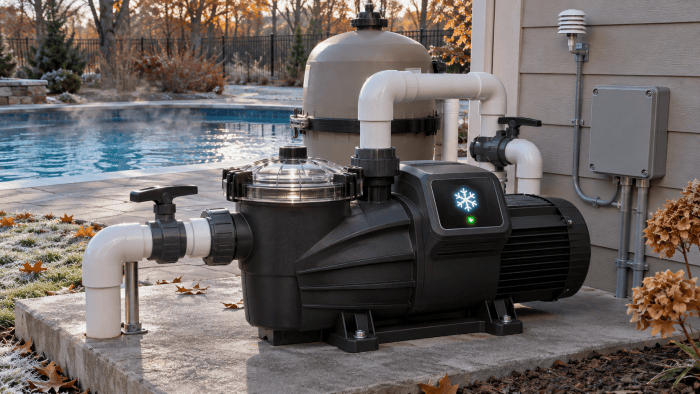
Pool Pump Freeze Protection Setting: What Temperature and Speed Should You Use?
Quick answer
Set pool-pump freeze protection to start around 36–38°F, assign every circuit that must circulate water, and choose a pump speed that produces steady visible circulation without running the pump dry or exceeding the equipment’s limits. The exact setting belongs to your automation and pump manual: Pentair IntelliSync documents adjustable start and end temperatures plus a freeze-protection speed, while Jandy AquaLink systems commonly use a default near 38°F and require you to assign protected equipment. Test the sensor, confirm the pump actually starts, and do not rely on freeze mode during a power outage or when the system is closed and winterized.
Quick answer
Pool Pump Freeze Protection Setting: What Temperature and Speed Should You Use?: Quick answer Set pool-pump freeze protection to start around 36–38°F, assign every circuit that must circulate water, and choose a pump speed that produces steady visible circulation without running the pump dry or.
Freeze protection is an automatic response to cold air, not a complete winterization plan. It normally turns on a pump or assigned equipment when an air-temperature sensor reaches the trigger point. Water moving through open, water-filled plumbing is less likely to freeze, but a closed valve, blocked skimmer, failed sensor, tripped breaker, or unprotected heater can still leave water trapped in a vulnerable component.
Recommended pool pump freeze protection settings
| Setting | Practical starting point | Why it matters |
|—|—:|—|
| Start temperature | 36–38°F | Gives the system a margin before the outdoor air reaches 32°F. |
| End temperature | Follow the controller’s default or set it a few degrees above start | Prevents rapid on/off cycling near the threshold. |
| Freeze-protection speed | The lowest speed that maintains reliable circulation, often a moderate speed on a variable-speed pump | Speed is equipment-specific; verify flow at the returns and never run the pump dry. |
| Protected circuits | Main filter pump plus any spa, water-feature, cleaner, or valve circuits that contain water | Freeze mode protects only what is assigned and hydraulically connected. |
These are starting points, not universal numbers. Pentair’s IntelliSync guide shows separate start temperature, end temperature, and pump-speed controls and describes freeze protection at an air-sensor reading near 36°F. Jandy AquaLink documentation describes a default activation temperature of 38°F, an adjustable range on some controllers, and a separate device-assignment step. Use the manual for your exact controller and sensor.
How to set pool pump freeze protection
1. Identify the controller and sensor
Find the automation brand and model in the app, control panel, or equipment pad. Look for an air-temperature sensor near the equipment, not a pool-water temperature reading. If the displayed air temperature is obviously wrong, fix the sensor or wiring before trusting automatic protection.
2. Enable freeze protection
Open the automation settings and find Freeze Protect, Freeze Protection, or Freeze Guard. Turn it on. If the system has separate settings for the pool and spa, inspect both bodies of water.
3. Set the trigger temperature
For many residential systems, 36–38°F is a sensible starting range. A colder setting may wait too long; a warmer setting can use more electricity but gives more margin. Do not copy a number from another pool if your equipment pad, climate, exposed plumbing, or sensor location is different.
4. Assign every needed circuit
Confirm that the filter pump is assigned. If a spa, spillover, waterfall, solar loop, booster pump, or other water-filled line can trap water, follow the manufacturer’s instructions for assigning it. Some automation systems rotate valves or alternate bodies of water; watch the first freeze event to make sure that movement actually occurs.
5. Choose and verify pump speed
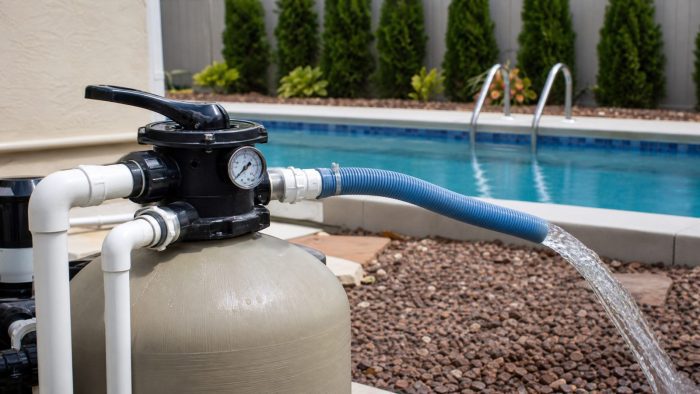
Set the freeze-protection RPM or speed high enough to show steady circulation at the returns and maintain prime. A low-speed setting that only hums, loses prime, or leaves a heater or branch line stagnant is not protection. Do not exceed the pump, filter, heater, or plumbing limits just to force more flow.
6. Test before the freeze
With the equipment running, inspect the pump basket for a full prime, the pressure gauge for a normal reading, and the returns for circulation. Check that valves are in the expected position and that no breaker or timer is tripped. A controller saying “freeze protection active” proves the logic engaged; it does not prove that water is moving everywhere.
What temperature should pool freeze protection be set to?
For an open pool in a climate with occasional freezes, 36–38°F is a practical starting range. The correct value depends on the accuracy and location of the air sensor, wind exposure, the amount of exposed plumbing, and the controller’s own operating range. Setting the trigger at exactly 32°F is risky because air temperatures can vary around the equipment and water can already be cold before the sensor reaches that number.
If the pool is fully winterized, freeze protection is usually disabled because the circulation system has been drained, blown out, and plugged. Leaving a pump scheduled to run against an empty or partially drained system can damage equipment. If a hard freeze is approaching and you are unsure whether the pool is open or closed correctly, shut off power only after following the equipment manufacturer’s winterization procedure or call a qualified pool professional.
What pump speed should freeze protection use?
There is no safe universal RPM. Use the minimum speed that maintains prime and dependable circulation through all protected paths. Variable-speed pumps may need a different freeze speed than their normal filtration speed, especially when a heater, spa loop, or water feature is included. Check the return flow, filter pressure, and pump basket; then verify that the speed does not cause excessive pressure or noisy cavitation.
Never use freeze protection as an excuse to ignore a pump that is sucking air, leaking, or repeatedly losing prime. Air leaks at the lid O-ring, low water at the skimmer, a blocked basket, and a closed valve can all defeat the intended protection.
Troubleshooting: freeze protection is enabled but the pump does not run
- Check the displayed air temperature. Compare it with a reliable outdoor thermometer. A failed or mislocated sensor can prevent activation.
- Confirm the circuit assignment. The pump may be enabled for normal schedules but excluded from freeze protection.
- Check power and breakers. Look for a tripped breaker, GFCI, disconnect, timer, or service switch. Do not open energized equipment.
- Inspect water level and baskets. Keep the water high enough for the skimmer to draw and clear debris from the skimmer and pump baskets.
- Verify valves and returns. A valve stuck in the wrong position can leave a branch line or heater full of still water.
- Check for prime and normal pressure. Shut down and get professional help if the pump runs dry, leaks, or behaves abnormally.
- Plan for a power outage. Automation cannot circulate water without power. For a prolonged outage, follow the equipment manufacturer’s emergency drain/winterization instructions.
Freeze protection and pool chemistry
Freeze mode is not a substitute for balanced water. Test before a cold snap and keep pH, alkalinity, calcium hardness, and sanitizer in the ranges recommended for your surface and chemical system. Use the pool volume calculator for accurate dosing, then use the chlorine calculator and pH calculator instead of guessing by pool size.
If the pool is covered or closed, do not add chemicals blindly. Follow the closing plan for your pool type, water temperature, and sanitizer. The Pool Chemical Calculator app can keep the dose calculations in one place.
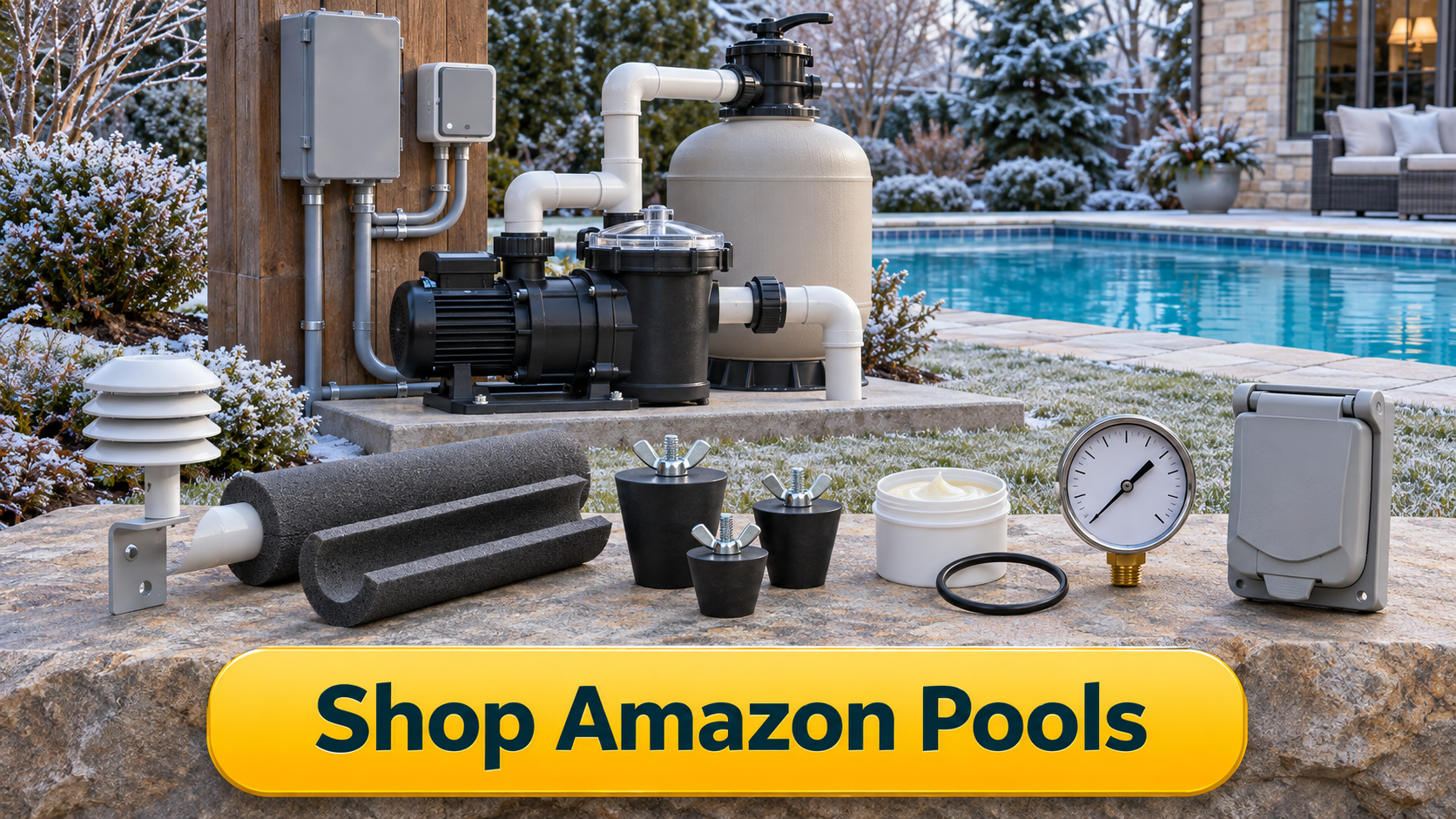
Useful freeze-protection supplies
For sensor replacement, pump protection, winterizing plugs, pipe insulation, or a reliable outdoor thermometer, compare pool freeze-protection supplies on Amazon. As an Amazon Associate, Pool Chemical Calculator may earn from qualifying purchases.
Affiliate disclosure: As an Amazon Associate, Pool Chemical Calculator may earn from qualifying purchases.
FAQ
Should pool freeze protection be set to 32°F?
Usually no. Many systems start in the mid-to-upper 30s to provide margin before freezing conditions reach exposed plumbing. Follow your controller manual and local conditions.
Does freeze protection turn on the pool heater?
Not necessarily. Pentair documentation notes that the heater may not activate simply because freeze protection is running. Freeze protection usually aims to circulate water; heating and freeze protection are separate controls.
Will freeze protection protect a pool during a power outage?
No. It needs power, a working sensor, and a functioning pump and valves. If power may be out for an extended period, use the manufacturer’s emergency winterization procedure.
Should the pump run continuously during a freeze?
An open pool may need continuous circulation during sustained freezing weather, but the exact schedule depends on the climate and system. Follow the automation and equipment manufacturer’s guidance, and verify actual flow rather than assuming a schedule is enough.
Can freeze protection run a salt chlorine generator?
Do not assume it will. Some systems circulate during freeze mode without producing chlorine. Check the automation and chlorinator manuals, and do not use cold-weather freeze mode as a reason to raise output beyond the manufacturer’s limits.
Bottom line
Start with a 36–38°F trigger, assign all necessary equipment, choose a verified circulation speed, and test the sensor and flow before the next freeze. Freeze protection is useful insurance for an open pool, but it cannot compensate for bad valves, a failed sensor, lost prime, no power, or a system that should have been fully winterized.
Recommended pool supplies
As an Amazon Associate, Pool Chemical Calculator earns from qualifying purchases.

Raises calcium hardness to reduce corrosive water risk in plaster, concrete, and equipment.
View on Amazon
Keeps saltwater chlorine generators in range without unnecessary additives.
View on Amazon
Accurate readings make every chlorine, pH, alkalinity, calcium, and CYA dose safer.
View on AmazonGet exact pool chemical doses
Pool Chemical Calculator turns your test readings, pool volume, and target levels into exact treatment amounts for chlorine, pH, alkalinity, calcium, stabilizer, salt, and more.
Open the Pool Chemical Calculator app for iOS, Android, or web.