
UV Pool Sanitizer Worth It? Pros, Cons, Costs, and Chlorine Reality
You’ve probably heard pool store employees or that neighbor with the pristine water mention UV sanitizers. Maybe you’ve seen them online, promising crystal-clear water with fewer chemicals. But here’s the real question every pool owner asks: is a UV pool sanitizer worth it for your specific situation, or is it just expensive overkill?
Quick answer
UV Pool Sanitizer Worth It? Pros, Cons, Costs, and Chlorine Reality: You’ve probably heard pool store employees or that neighbor with the pristine water mention UV sanitizers. Maybe you’ve seen them online, promising crystal-clear water with fewer chemicals. But here’s the real question.
After helping thousands of homeowners balance their pool chemistry, I can tell you this: UV sanitizers aren’t magic wands, but they’re also not gimmicks. The truth sits somewhere in the middle — and whether one makes sense for you depends on factors most salespeople won’t mention.
Let me break this down without the marketing fluff.
What Exactly Does a UV Pool Sanitizer Do?
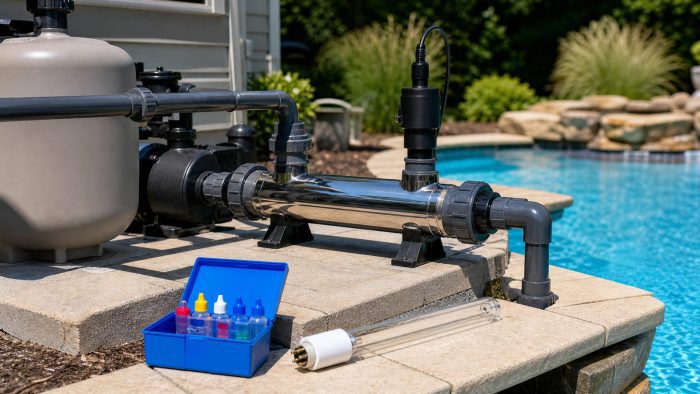
Before we talk money, let’s understand what you’re actually buying. A UV pool sanitizer uses ultraviolet light (specifically UV-C rays at 254 nanometers) to kill microorganisms as water flows through the unit. Think of it like a tiny sun inside a tube, zapping bacteria, viruses, and algae as they pass by.
Here’s the critical part most people miss: UV sanitizers work through exposure, not residual protection. The UV light destroys pathogens in that moment — but once water leaves the chamber and returns to your pool, it has zero ongoing protection. A kid sneezes in the shallow end? The UV system 30 feet away can’t do anything about it until that water eventually cycles through.
This is why UV systems supplement chlorine rather than replace it. You’ll still need 0.5-1.0 ppm of chlorine as a residual sanitizer. But that’s 50-70% less chlorine than a traditional pool, which is where the benefits start adding up.
How UV Differs from Chlorine-Only Systems
Traditional chlorine does double duty: it kills pathogens AND provides lasting protection. The downside? Higher chlorine levels mean more chloramines (that “pool smell”), potential skin irritation, and faded swimsuits.
UV handles the heavy lifting of pathogen destruction — we’re talking 99.9% kill rates for bacteria like E. coli and even chlorine-resistant parasites like Cryptosporidium and Giardia. Your reduced chlorine levels just maintain a safety net.
UV vs. Ozone vs. Salt Water: Quick Comparison
| System | Pathogen Kill Rate | Residual Protection | Chemical Reduction | Upfront Cost |
|---|---|---|---|---|
| UV | 99.9% | None | 50-70% less chlorine | $500-$2,000 |
| Ozone | 99.9% | Minimal (short half-life) | 60-90% less chlorine | $1,000-$3,000 |
| Salt Water | Standard | Yes (generates chlorine) | None (creates chlorine) | $1,400-$2,500 |
| Chlorine Only | 99.9% (slower) | Yes | Baseline | $50-$200/year |
The Real Costs: Breaking Down Your Investment
Let’s get specific about money. Vague “it depends” answers don’t help you make decisions.
Upfront Equipment Costs
Residential UV pool sanitizers range from $400 for basic units to $2,500 for premium systems. The sweet spot for most 15,000-25,000 gallon pools sits around $800-$1,200.
A solid mid-range option is the Delta UV E-46 System, which handles pools up to 46,000 gallons and runs about $700-900. For smaller pools under 15,000 gallons, the Pentair BioShield UV Sanitizer offers excellent performance around $500-600.
Professional installation adds $200-$400 depending on your plumbing complexity. DIY-friendly homeowners can save this, but you’ll need basic plumbing skills and about 3-4 hours.
Ongoing Operating Costs
Here’s where UV systems either pay off or drain your wallet:
UV Bulb Replacement: Every 12-18 months, expect to spend $80-$200 on a replacement bulb. The bulb may still glow after 18 months, but its sanitizing power drops significantly. Don’t skip this.
Electricity: UV units draw 40-100 watts, running whenever your pump runs. At 8 hours daily and $0.12/kWh, that’s roughly $15-$35 per year.
Quartz Sleeve Cleaning: The glass tube surrounding the bulb needs cleaning 2-3 times per season. This takes 10 minutes and costs nothing beyond a soft cloth.
Annual UV Operating Cost: $95-$235
Chemical Savings: The Other Side of the Equation
Now for the good news. With UV handling primary sanitation, your chemical costs drop meaningfully:
- Chlorine reduction: 50-70% less chlorine needed. If you spend $300/year on chlorine, you’ll save $150-$210.
- Shock treatment reduction: You’ll shock less frequently — maybe monthly instead of bi-weekly during swim season. Save another $40-$60 annually.
- Algaecide reduction: With better pathogen control, algae problems become rare. Save $30-$50 per season.
Typical Annual Chemical Savings: $220-$320
The 5-Year Cost Analysis
Let’s run real numbers for a 20,000-gallon pool:
| Expense | UV System | Chlorine Only |
|---|---|---|
| Year 1 (equipment + install) | $1,100 | $0 |
| Annual chemicals | $180 | $450 |
| Annual UV maintenance | $150 | $0 |
| 5-Year Total | $2,420 | $2,250 |
Wait — UV costs more over 5 years? Yes, but barely. And this calculation ignores several factors that tip the scales.
Benefits That Don’t Show Up on Spreadsheets
Pure cost analysis misses why homeowners actually love their UV systems. These “soft” benefits matter.
Dramatically Better Water Quality
UV-treated water feels different. I’m not exaggerating. Lower chlorine means:
- No red, irritated eyes after swimming
- Hair that doesn’t turn green or feel like straw
- Swimsuits that last 2-3 seasons instead of one
- No “pool smell” clinging to your skin
If you have kids who swim daily during summer, or you use your pool for exercise, this quality-of-life improvement is substantial.
Health Benefits for Sensitive Swimmers
Asthma and eczema sufferers often can’t tolerate standard chlorine levels. UV systems keep water safe while reducing the chemical irritants that trigger symptoms. I’ve heard from dozens of parents who installed UV specifically because their child could finally swim comfortably.
And here’s something most people don’t consider: chloramines (the real “chlorine smell”) are respiratory irritants. Indoor pool facilities have increasingly adopted UV specifically to reduce airborne chloramine levels. Your backyard pool benefits the same way.
Effective Against Chlorine-Resistant Pathogens
Cryptosporidium can survive in properly chlorinated water for 7+ days. A 2016 CDC study found Crypto caused 58% of pool-related disease outbreaks between 2000-2014.
UV destroys Crypto in seconds. If your pool sees heavy use, hosts swim parties, or welcomes young children (who occasionally have “accidents”), this protection has real value.
Reduced Environmental Impact
You’re putting fewer chemicals into the environment. When you backwash your filter or drain water, lower chemical concentrations mean less impact on local water systems. It’s not the primary reason to buy UV, but it’s a nice bonus.
Who Should Absolutely Get a UV Sanitizer
Based on real homeowner experiences, UV makes the most sense for:
Heavy-use pools: If 4+ people swim most days during summer, UV’s pathogen destruction keeps up with the contamination load better than chlorine alone.
Families with young children: Kids under 6 contribute more organic material (let’s be honest — accidents happen). UV provides an extra safety layer.
Swimmers with sensitivities: Asthma, eczema, chlorine allergies, or general chemical sensitivity? UV is a near-mandatory upgrade.
Indoor pools: Chloramines accumulate in enclosed spaces. UV breaks them down, dramatically improving air quality.
Pool owners who hate maintenance: With UV handling heavy sanitation, your chemistry stays stable longer. Less frequent adjustments, fewer surprises.
Who Should Skip UV (At Least for Now)
UV doesn’t make financial sense for everyone:
Occasional swimmers: If your pool sits unused most weekdays and only sees action during weekend parties, standard chlorine handles the load fine.
Budget-constrained homeowners: That $800-$1,200 could buy a variable-speed pump upgrade that saves $300+ annually in electricity. Better ROI.
Pools with existing ozone systems: Ozone already reduces chlorine dependency. Adding UV provides marginal improvement at significant cost.
Very small pools: Under 10,000 gallons? Chemical costs are already low enough that UV savings barely register.
How to Choose the Right UV System
If you’ve decided UV makes sense, here’s how to avoid buying the wrong unit.
Sizing Your System Correctly
UV effectiveness depends on exposure time — how long water stays in the UV chamber. Units are rated by flow rate (gallons per minute) and pool volume.
The math: Your UV unit should handle your pump’s flow rate while providing adequate contact time. Most manufacturers publish sizing charts, but the general rule is:
- Pools under 15,000 gallons: 40-watt UV system
- 15,000-30,000 gallons: 60-80 watt system
- 30,000-50,000 gallons: 100+ watt system
- Over 50,000 gallons: Multiple units or commercial-grade systems
Undersizing is the #1 mistake. An undersized unit runs water through too quickly, reducing kill rates. When in doubt, size up.
Key Features Worth Paying For
Flow sensor: Prevents the bulb from running dry and overheating if water flow stops. Essential.
Hour counter: Tracks bulb runtime so you know when replacement is actually needed. Otherwise you’re guessing.
Visual indicator window: Lets you confirm the bulb is working without disassembly.
Stainless steel chamber: More durable than plastic, better heat dissipation, longer lifespan.
The SpectraLight UV System includes all these features and has earned solid reviews from residential pool owners.
Installation Placement
Install your UV unit after your filter and before any heater or chemical feeders. You want filtered water entering the UV chamber (debris blocks UV rays) and you don’t want UV exposure degrading heater components or concentrated chemicals.
Installation: DIY or Professional?
The DIY Approach
If you’ve done basic plumbing work — replaced a pump, installed a chlorinator — UV installation is manageable. You’ll need:
- PVC cutter and glue
- Union fittings (usually included)
- 3-4 hours on a Saturday
- Willingness to cut into your existing plumbing
Cost savings: $200-$400 vs. professional installation
When to Hire a Pro
Call a pool professional if:
- Your equipment pad has complex plumbing with limited space
- You’re uncomfortable cutting into pressurized lines
- Your electrical panel needs a new dedicated circuit
- The warranty requires professional installation (check this first)
Many pool companies offer package deals combining equipment and installation. Get three quotes.
Maintaining Your UV System for Maximum Lifespan
UV systems are low-maintenance, but “low” doesn’t mean “zero.”
Monthly Tasks (5 Minutes)
- Check the visual indicator to confirm the bulb is lit
- Verify water flow through the system
- Look for any moisture or leaks around seals
Quarterly Tasks (15 Minutes)
- Clean the quartz sleeve with a soft cloth and mild acid solution (vinegar works)
- Check hour counter and estimate remaining bulb life
- Inspect O-rings for wear
Annual Tasks (30-45 Minutes)
- Replace UV bulb at 12-18 month intervals
- Replace O-rings if showing any degradation
- Clean chamber interior if accessible
The Bottom Line: Is UV Worth Your Money?
For most homeowners with pools seeing regular use, yes — a UV sanitizer delivers value through better water quality, reduced chemical costs, and improved swimmer comfort. You won’t see dramatic financial savings, but you’ll break even within 5-7 years while enjoying noticeably better water every single swim.
Skip UV if you’re budget-constrained, swim infrequently, or already have an ozone system.
Still unsure? Start by calculating your actual chemical spending for the past season. If you’re above $350 annually and you swim regularly, UV’s combination of savings and benefits probably makes sense for your situation.
Ready to optimize your pool chemistry? Whether you install UV or stick with traditional sanitation, keeping your water balanced is critical. Use Pool Chemical Calculator to get exact dosing recommendations from your current test results — chlorine, pH, alkalinity, calcium hardness, stabilizer, salt, and more.
???? iPhone / iPad: https://itunes.apple.com/us/app/pool-chem-calculator/id1453351222
???? Android: https://play.google.com/store/apps/details?id=com.poolchemicalcalculator.poolcalc
???? Full guide: https://poolchemicalcalculator.com/news/uv-pool-sanitizer-worth-it/
Frequently Asked Questions
Can a UV sanitizer completely replace chlorine in my pool?
No. UV only sanitizes water passing through the chamber — it provides no lasting residual sanitizer protection. You should still keep a measurable chlorine residual, commonly around 0.5-1.0 ppm for residential supplemental systems to handle contamination that enters the pool between filtration cycles. Think of UV as a powerful in-line sanitizer and chlorine as the residual protection that stays in the pool water.
How often do UV bulbs need replacement, and what happens if I don’t change them?
Replace UV bulbs every 12-18 months, regardless of whether they still illuminate. UV-C output drops significantly even while visible light continues. Running an old bulb means your system appears to work while providing little actual sanitation. Most units have hour counters — don’t ignore them.
Will a UV system help with cloudy water or algae problems?
UV kills algae spores circulating through your plumbing, which helps prevent new outbreaks. But UV won’t clear existing cloudiness or kill algae already attached to pool surfaces. You’ll need proper filtration and chemical treatment for current problems — UV prevents future ones.
Does UV sanitization work with saltwater pools?
Absolutely. UV pairs excellently with salt chlorine generators. The salt cell produces chlorine for residual protection while UV handles primary sanitation. Many saltwater pool owners find they can run their generators at lower output levels after adding UV, extending cell lifespan.
How much electricity does a UV pool sanitizer use?
Typical residential units draw 40-100 watts. Running 8 hours daily at average electricity rates ($0.12/kWh), expect $15-$35 annually in added electric costs. That’s roughly equivalent to running a single 60-watt light bulb.
As an Amazon Associate, Pool Chemical Calculator earns from qualifying purchases. Keeps saltwater chlorine generators in range without unnecessary additives. Raises calcium hardness to reduce corrosive water risk in plaster, concrete, and equipment. Helps small particles clump together so the filter can clear cloudy water faster.Recommended pool supplies


Get exact pool chemical doses
Pool Chemical Calculator turns your test readings, pool volume, and target levels into exact treatment amounts for chlorine, pH, alkalinity, calcium, stabilizer, salt, and more.
Open the Pool Chemical Calculator app or download it from the App Store and Google Play.