
Pool Filter Size Calculator: How to Choose the Right Filter for Your Pool
Understanding Pool Filter Sizing Basics
Before you punch numbers into a calculator, you need to understand what those numbers actually mean.
Quick answer
Pool Filter Size Calculator: How to Choose the Right Filter for Your Pool: Understanding Pool Filter Sizing Basics Before you punch numbers into a calculator, you need to understand what those numbers actually mean. What is Turnover Rate? Turnover rate is how long it takes your filtration.
What is Turnover Rate?
Turnover rate is how long it takes your filtration system to cycle all the water in your pool through the filter. Industry standard says you want all your pool water filtered at least once every 8 hours. Some pool pros recommend 6 hours for heavily used pools.
Here’s why this matters: if your filter can’t keep up with the volume of water, contaminants build up faster than they get removed. You end up adding more chlorine, running the pump longer, and still staring at hazy water.
Use our turnover rate calculator to find your exact requirement based on pool size and usage.
The GPM Connection
GPM (gallons per minute) is the universal language of pool equipment. Your pump has a GPM rating. Your filter has a GPM rating. These two numbers need to play nice together.
Here’s the relationship:
- Your pump pushes water at a certain GPM
- Your filter can only handle water up to a certain GPM
- If the pump overpowers the filter, you get high pressure and poor filtration
- If the filter can handle way more than the pump delivers, you’re probably fine (just overspent)
Pool Volume: The Starting Point
Everything starts with knowing how many gallons your pool holds. Don’t guess. A “medium-sized” pool could be 12,000 gallons or 25,000 gallons depending on depth and shape.
Rectangular pools: Length × Width × Average Depth × 7.5 = Gallons
Oval pools: Length × Width × Average Depth × 5.9 = Gallons
Round pools: Diameter × Diameter × Average Depth × 5.9 = Gallons
Or skip the math and use our pool volume calculator for instant results.
How to Size Your Pool Filter: Step-by-Step
Let me walk you through the actual calculation process.
Step 1: Calculate Your Required Flow Rate
Take your pool volume and divide by your target turnover time in minutes.
Example for a 24,000-gallon pool with 8-hour turnover:
- 24,000 gallons ÷ 480 minutes (8 hours) = 50 GPM minimum
Your filter needs to handle at least 50 GPM without choking.
Step 2: Check Your Pump’s Flow Rate
Look at your pump’s spec sheet or nameplate. Most residential pool pumps push between 30-80 GPM depending on horsepower and head pressure. Variable speed pumps complicate this because their GPM changes with speed settings.
Rough guidelines for single-speed pumps:
- 1 HP pump: 40-60 GPM typical
- 1.5 HP pump: 50-70 GPM typical
- 2 HP pump: 60-80 GPM typical
Step 3: Match Filter Capacity to Flow Rate
Your filter’s design flow rate should meet or exceed both your required GPM (from Step 1) and your pump’s output (from Step 2). Aim for 1.5x your minimum requirement when possible. This gives you a cushion as the filter gets dirty between cleanings.
Step 4: Consider the Filter Media Type
Not all filters work the same way. Each type has different sizing considerations.
Filter Types and Sizing Differences
Cartridge Filters
Cartridge filters are sized by square footage of filter media. More square footage means more filtering capacity and longer intervals between cleaning.
Sizing guidelines for cartridge filters:
- Small pools (up to 15,000 gallons): 100-200 sq ft
- Medium pools (15,000-25,000 gallons): 200-400 sq ft
- Large pools (25,000+ gallons): 400-500+ sq ft
The sweet spot for most residential pools is around 200-300 sq ft. These cartridges need cleaning every 2-4 weeks depending on debris load.
When your cartridge gets grimy, a good filter cartridge cleaner works better than just hosing it off. The cleaner breaks down oils and sunscreen residue that water alone won’t touch.
Sand Filters
Sand filters are sized by their tank diameter, which determines how much sand they hold. More sand = more filtration surface area.
Common sand filter sizes:
- 19″ diameter: Up to 14,000 gallons (30-35 GPM)
- 21″ diameter: Up to 21,000 gallons (35-40 GPM)
- 24″ diameter: Up to 29,000 gallons (45-50 GPM)
- 26″ diameter: Up to 37,000 gallons (50-60 GPM)
Sand filters need backwashing when pressure rises 8-10 PSI above clean baseline. Replace the sand every 5-7 years.
DE (Diatomaceous Earth) Filters
DE filters provide the finest filtration — they can catch particles down to 2-5 microns while sand catches 20-40 microns and cartridges catch 10-15 microns.
DE filters are sized by square footage of filter grids:
- 24 sq ft: Up to 12,000 gallons
- 36 sq ft: Up to 18,000 gallons
- 48 sq ft: Up to 24,000 gallons
- 60 sq ft: Up to 30,000 gallons
- 72 sq ft: Up to 36,000 gallons
DE filters cost more and require more maintenance, but they produce the clearest water.
When Your Filter Size is Wrong
Sometimes you inherit a pool with the wrong filter. Here’s how to diagnose and fix sizing problems.
Signs Your Filter is Undersized
- Pressure gauge reads high even after cleaning (over 25 PSI is concerning)
- You’re cleaning or backwashing more than once a week
- Water stays cloudy despite proper chlorine levels
- Pump strains or makes unusual noises
- Filter media wears out faster than expected
The fix: You’ll need a larger filter. There’s no hack or workaround that makes an undersized filter adequate. Running the pump longer doesn’t compensate for insufficient filter capacity — it just wears out your undersized filter faster.
Signs Your Filter is Oversized
Honestly? An oversized filter rarely causes problems. You might notice:
- Pressure gauge barely moves even when dirty
- You could probably run the pump fewer hours
The fix: Not much to fix. Enjoy the lower maintenance. You might be able to reduce your pump run time and save on electricity.
When Filter and Pump Don’t Match
This is the more common issue. If your pump pushes water faster than your filter can handle:
- Pressure spikes quickly
- Water bypasses the filter media
- Filtration efficiency drops
- Equipment life shortens
The fix: Either upgrade the filter to match the pump, or install a variable speed pump and dial back the flow rate.
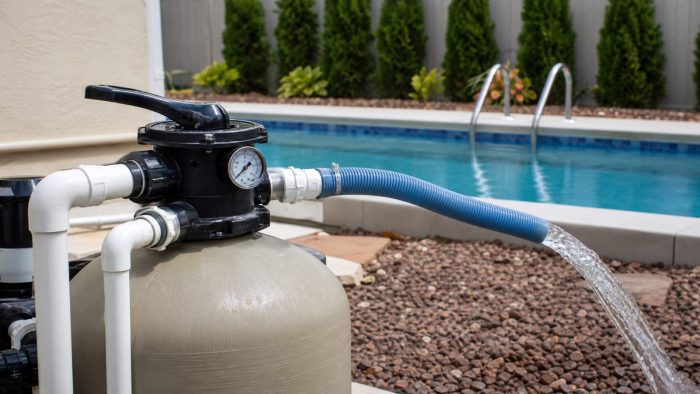
A reliable filter pressure gauge helps you monitor this relationship. Replace your gauge if the needle sticks or readings seem inconsistent.
Real-World Sizing Examples
Let me run through some common scenarios.
Example 1: Average Backyard Pool
- Pool size: 18,000 gallons
- Turnover goal: 8 hours
- Calculation: 18,000 ÷ 480 = 37.5 GPM minimum
- Pump: 1 HP (approximately 50 GPM)
- Filter choice: Cartridge filter 200+ sq ft, sand filter 21″+, or DE filter 36+ sq ft
Example 2: Large Family Pool
- Pool size: 32,000 gallons
- Turnover goal: 8 hours
- Calculation: 32,000 ÷ 480 = 67 GPM minimum
- Pump: 1.5-2 HP (approximately 60-75 GPM)
- Filter choice: Cartridge filter 400+ sq ft, sand filter 26″+, or DE filter 60-72 sq ft
Example 3: Small Plunge Pool
- Pool size: 8,000 gallons
- Turnover goal: 6 hours (faster for heavy use)
- Calculation: 8,000 ÷ 360 = 22 GPM minimum
- Pump: 3/4 HP (approximately 35 GPM)
- Filter choice: Cartridge filter 100 sq ft, sand filter 19″, or DE filter 24 sq ft
Filter Maintenance Affects Performance
Even a perfectly sized filter underperforms when it’s dirty. And “dirty” doesn’t just mean visible debris.
Cleaning Frequency by Filter Type
Cartridge filters: Hose off every 2-4 weeks. Deep clean with filter cleaner monthly. Replace cartridges every 2-3 years.
Sand filters: Backwash when pressure rises 8-10 PSI above baseline (usually every 1-2 weeks during swimming season). Replace sand every 5-7 years or consider filter sand alternatives that last longer.
DE filters: Backwash and add fresh DE when pressure rises 8-10 PSI. Tear down and clean grids 1-2 times per season. Replace grids every 7-10 years.
Reading Your Pressure Gauge
Your pressure gauge tells you everything. Note the “clean” pressure right after backwashing or installing a new cartridge. That’s your baseline.
- Baseline + 5-8 PSI: Getting dirty, monitor closely
- Baseline + 8-10 PSI: Time to clean/backwash
- Baseline + 10+ PSI: Clean immediately — you’re stressing the system
- Way below baseline: Possible pump problem, air leak, or broken gauge
Making the Final Decision
Here’s my advice after walking hundreds of pool owners through this process:
If you’re on the fence between two sizes, go bigger. The upfront cost difference is usually $50-150 between filter sizes. That’s nothing compared to fighting a filter that can’t keep up.
Match filter type to your maintenance style. Hate the idea of regular cleaning? Oversized cartridge or sand filter. Want crystal-clear water and don’t mind the extra work? DE filter all the way.
Consider future changes. Planning to add a spa or water features? Size for the total water volume you’ll eventually have.
Track your overall pool chemistry with our free pool calculator app — it factors in your pool size for chemical dosing, turnover calculations, and maintenance scheduling.
Frequently Asked Questions
What size filter do I need for a 15,000 gallon pool?
For a 15,000-gallon pool with standard 8-hour turnover, you need at least 31 GPM flow capacity. That translates to a cartridge filter around 150-200 sq ft, a sand filter with 19-21″ tank, or a DE filter with 24-36 sq ft of grid area. I’d lean toward the higher end of those ranges for better performance between cleanings.
Can my pool filter be too big?
Technically yes, but practically no. An oversized filter just means you’ll clean it less often and your water quality might be slightly better. The only real downside is higher upfront cost. You won’t damage anything by having more filtration capacity than you strictly need.
How do I know if my filter is the right size for my pump?
Check both specs and compare GPM ratings. Your filter’s maximum flow rate should meet or exceed your pump’s output. If your pressure gauge spikes quickly after cleaning, or you notice water clarity issues despite proper chemistry, your filter might be undersized for your pump. When in doubt, the filter’s GPM rating should be 1.5x your pump’s output.
Should I size my filter for turnover rate or pump GPM?
Both. Calculate your required GPM based on turnover rate first. Then verify your pump can deliver that flow. Finally, choose a filter that handles the higher of those two numbers. This ensures your system works efficiently whether you’re calculating from water volume or equipment capacity.
How often should I replace my pool filter?
It depends on filter type. Cartridge filters last 2-3 years with proper cleaning. Sand filter media lasts 5-7 years before it rounds off and stops filtering effectively. DE filter grids last 7-10 years with good maintenance. Replace any filter element when you notice declining performance despite cleaning, visible damage, or when pressure won’t return to baseline after maintenance.
Ready to size your filter with confidence? Start by calculating your exact pool volume, then use our pool calculator app to dial in your filtration requirements and keep your water chemistry balanced all season long.
Recommended pool supplies
As an Amazon Associate, Pool Chemical Calculator earns from qualifying purchases.

A clean cartridge improves circulation and helps cloudy water clear faster.
View on Amazon
Helps small particles clump together so the filter can clear cloudy water faster.
View on Amazon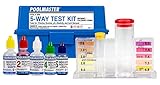
Accurate readings make every chlorine, pH, alkalinity, calcium, and CYA dose safer.
View on AmazonGet exact pool chemical doses
Pool Chemical Calculator turns your test readings, pool volume, and target levels into exact treatment amounts for chlorine, pH, alkalinity, calcium, stabilizer, salt, and more.
Open the Pool Chemical Calculator app for iOS, Android, or web.