
Baking Soda Pool Calculator: Exactly How Much to Add for Perfect Alkalinity
Keyword: baking soda pool calculator
Quick answer
Baking Soda Pool Calculator: Exactly How Much to Add for Perfect Alkalinity: Keyword: baking soda pool calculator Quick Answer Add 1.5 pounds of baking soda per 10,000 gallons to raise total alkalinity by 10 ppm. For a typical 15,000-gallon pool with alkalinity at 60 ppm (target: 100 ppm).
Quick Answer
Add 1.5 pounds of baking soda per 10,000 gallons to raise total alkalinity by 10 ppm. For a typical 15,000-gallon pool with alkalinity at 60 ppm (target: 100 ppm), you’d need about 9 pounds of baking soda. But don’t add it all at once — max out at 2.5 pounds per 10,000 gallons per treatment to avoid pH spikes.
Need the exact amount for your pool? Use our free alkalinity calculator to get a precise dosage in seconds.
Low alkalinity creates a frustrating chain reaction in your pool. Your pH bounces around like a ping-pong ball, chlorine burns off too fast, and your pool surfaces slowly corrode. A baking soda pool calculator takes the guesswork out of fixing this common problem. Instead of dumping in random amounts and hoping for the best, you’ll know exactly how many pounds to add based on your pool’s volume and current readings.
I’ve seen pool owners waste $50+ on unnecessary chemicals because they overcorrected alkalinity, then had to buy acid to bring it back down. That’s money you could spend on pool floats or, you know, literally anything else.
Let’s get your alkalinity dialed in correctly the first time.
Why Baking Soda Works (And When to Use It)
Baking soda — the same stuff sitting in your pantry — is sodium bicarbonate. It raises total alkalinity with minimal impact on pH. This makes it perfect for situations where your alkalinity is low but your pH is already in a decent range.
Use baking soda when:
- Total alkalinity reads below 80 ppm
- pH is between 7.2 and 7.6 (or close to it)
- You want a gradual, controlled alkalinity increase
Consider soda ash instead when:
- Both alkalinity AND pH are very low
- pH is below 7.0
- You need a bigger pH bump alongside alkalinity
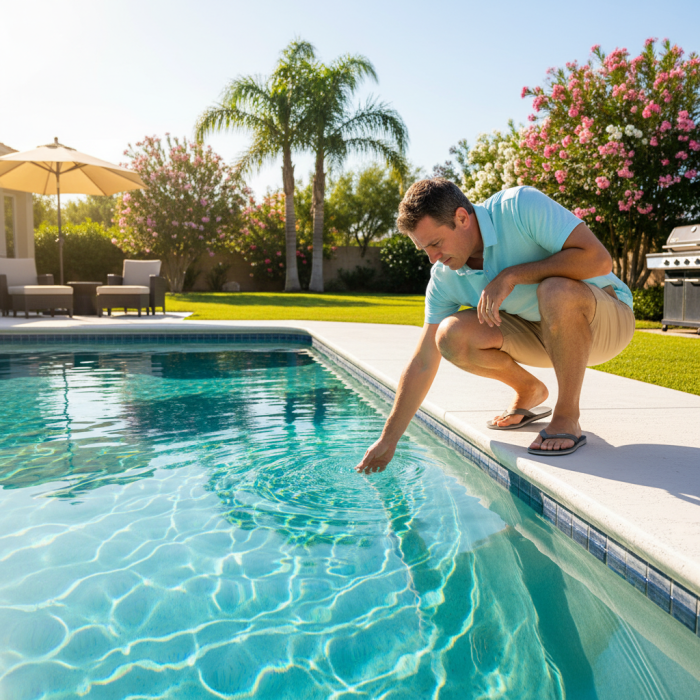
Don’t know your current levels? You can’t fix what you can’t measure. Grab some reliable pool test strips or a liquid test kit before adding anything.
Exact Dosage Rules for Baking Soda
Here’s the math made simple:
The Core Formula
1.5 pounds of baking soda per 10,000 gallons raises total alkalinity by approximately 10 ppm.
This ratio holds consistent across pool sizes. A 20,000-gallon pool needs 3 pounds for a 10 ppm increase. A 5,000-gallon above-ground pool needs 0.75 pounds (about 12 ounces).
Maximum Safe Dosage Per Treatment
Never add more than 2.5 pounds per 10,000 gallons at one time. Why? Two reasons:
- Large doses spike your pH temporarily, even with baking soda
- Dumping too much creates cloudy water that takes hours to clear
If you need to raise alkalinity by 40 ppm or more, split it into multiple treatments over 2-3 days.
Pool Volume Matters — A Lot
Guessing your pool volume leads to overdosing or underdosing. Neither is fun to fix. If you’re unsure, use our pool volume calculator to get an accurate number. The difference between a 12,000-gallon and 18,000-gallon pool is significant when you’re measuring pounds of chemicals.
Baking Soda Dosing Chart
Find your pool size and current alkalinity, then follow across to your target:
For 10,000-Gallon Pools
| Current TA | Target: 80 ppm | Target: 100 ppm | Target: 120 ppm |
|————|—————-|—————–|—————–|
| 40 ppm | 6 lbs | 9 lbs | 12 lbs |
| 50 ppm | 4.5 lbs | 7.5 lbs | 10.5 lbs |
| 60 ppm | 3 lbs | 6 lbs | 9 lbs |
| 70 ppm | 1.5 lbs | 4.5 lbs | 7.5 lbs |
| 80 ppm | — | 3 lbs | 6 lbs |
| 90 ppm | — | 1.5 lbs | 4.5 lbs |
For 15,000-Gallon Pools
| Current TA | Target: 80 ppm | Target: 100 ppm | Target: 120 ppm |
|————|—————-|—————–|—————–|
| 40 ppm | 9 lbs | 13.5 lbs | 18 lbs |
| 50 ppm | 6.75 lbs | 11.25 lbs | 15.75 lbs |
| 60 ppm | 4.5 lbs | 9 lbs | 13.5 lbs |
| 70 ppm | 2.25 lbs | 6.75 lbs | 11.25 lbs |
| 80 ppm | — | 4.5 lbs | 9 lbs |
For 20,000-Gallon Pools
| Current TA | Target: 80 ppm | Target: 100 ppm | Target: 120 ppm |
|————|—————-|—————–|—————–|
| 40 ppm | 12 lbs | 18 lbs | 24 lbs |
| 50 ppm | 9 lbs | 15 lbs | 21 lbs |
| 60 ppm | 6 lbs | 12 lbs | 18 lbs |
| 70 ppm | 3 lbs | 9 lbs | 15 lbs |
| 80 ppm | — | 6 lbs | 12 lbs |
Remember: Split large doses. For amounts over 2.5 lbs per 10,000 gallons, add in stages 6-8 hours apart or on consecutive days.
For odd pool sizes or specific targets, the alkalinity calculator handles the math automatically.
Step-by-Step: How to Add Baking Soda to Your Pool
Step 1: Test Your Water
Check total alkalinity and pH before doing anything. Write down both numbers — you’ll need them.
Ideal ranges:
- Total Alkalinity: 80-120 ppm (100 ppm is the sweet spot)
- pH: 7.4-7.6
Step 2: Calculate Your Dose
Use the chart above, the formula (1.5 lbs per 10,000 gallons per 10 ppm), or the alkalinity calculator for precision.
Step 3: Measure the Baking Soda
A standard kitchen scale works great. One pound equals approximately 2 cups of baking soda, but measuring by weight is more accurate.
For regular pool maintenance, buy baking soda in bulk. This 13.5-pound bag is the same sodium bicarbonate as the expensive “pool alkalinity increaser” at the pool store — just way cheaper per pound.
Step 4: Add to the Pool
With the pump running, slowly pour the baking soda in front of a return jet. This distributes it throughout the water faster. Avoid dumping it all in one spot, especially near the skimmer.
For above-ground pools, walk around the perimeter while sprinkling the baking soda across the surface.
Step 5: Circulate for 6-8 Hours
Keep your pump running. The baking soda needs time to fully dissolve and distribute evenly.
Step 6: Retest and Adjust
After 6-8 hours (or the next morning), test again. If you’re still below target and didn’t hit your max dose, add more. If you overshot, see the troubleshooting section below.
Troubleshooting Common Baking Soda Problems
Problem: pH Rose Too High After Adding Baking Soda
Why it happens: Baking soda does raise pH slightly — about 0.1-0.2 for every 10 ppm alkalinity increase. Large doses amplify this effect.
The fix: Wait 24 hours for levels to stabilize before panicking. If pH is above 7.8, you have two options:
- Add muriatic acid (this lowers both pH AND alkalinity, so calculate carefully)
- Use dry acid/pH decreaser for a smaller adjustment
Our pH calculator helps you figure out how much acid to add without overcorrecting.
Problem: Cloudy Water After Treatment
Why it happens: You added too much at once, or you added it while the pump was off. Undissolved baking soda creates temporary cloudiness.
The fix: Keep the pump running continuously for 12-24 hours. The cloudiness should clear on its own. Speed things up by brushing the pool walls and floor to help circulation. A quality pool brush makes this easier and gets residue off surfaces.
Problem: Alkalinity Won’t Stay Up
Why it happens: Usually one of three culprits:
- Low pH: Acidic water (below 7.2) eats through alkalinity. Fix pH first.
- Heavy rainfall: Rain is slightly acidic and dilutes your pool. Test after storms.
- Acid erosion: If you’re frequently adding muriatic acid for pH control, you’re battling yourself.
The fix: Test chlorine and pH levels too. They’re all connected. Sometimes the real problem is upstream from alkalinity.
Problem: You Added Way Too Much Baking Soda
Why it happens: Math errors, measuring cups instead of weighing, or just eyeballing it.
The fix: High alkalinity (140+ ppm) causes scaling, cloudy water, and makes pH harder to control. Lower it by:
- Adding muriatic acid (lowers both pH and TA)
- If pH stays reasonable, aerate the pool (run water features, point returns upward) to raise pH, then add acid — this preferentially drops alkalinity
This is tedious. Much easier to dose conservatively upfront.
Baking Soda vs. Alkalinity Increaser: What’s the Difference?
Here’s a secret the pool store doesn’t advertise: most “alkalinity up” or “alkalinity increaser” products are just sodium bicarbonate — literally baking soda with a pool-themed label and a 300% markup.
Check the active ingredient. If it says sodium bicarbonate, save your money and buy the same thing at Costco or Amazon.
The only exception: some alkalinity products contain sodium carbonate (soda ash), which raises pH more aggressively. Read labels carefully.
How Often Should You Check Alkalinity?
Test alkalinity at least once a week during swimming season. Also test after:
- Heavy rain (dilution)
- Adding lots of fresh water
- Pool parties (bather load affects chemistry)
- Any pH adjustment
Alkalinity is your water chemistry foundation. When it’s stable, pH stays stable. When pH stays stable, chlorine works efficiently. When chlorine works efficiently, your pool stays clear and sanitized.
It’s a chain reaction — and it starts with proper alkalinity.
Frequently Asked Questions
How long after adding baking soda can I swim?
You can swim safely about 20-30 minutes after adding baking soda, as long as the pump has been running and the powder is fully dissolved. Baking soda isn’t harmful — it’s the same stuff people put in cookies. That said, waiting an hour ensures even distribution.
Can I use baking soda from the grocery store?
Yes. Arm & Hammer or any store-brand baking soda is pure sodium bicarbonate, identical to pool-branded products. Buying in bulk saves significant money if you’re treating a large pool or have frequent alkalinity issues.
How much baking soda do I need for a 5,000-gallon above-ground pool?
For a 5,000-gallon pool, you need 0.75 pounds (12 ounces) of baking soda to raise total alkalinity by 10 ppm. If your alkalinity is at 60 ppm and you want to reach 100 ppm, that’s a 40 ppm increase — so 3 pounds total, split into two 1.5-pound doses.
Will baking soda clear a green pool?
No. Baking soda raises alkalinity but has zero sanitizing power. A green pool means algae, which requires shocking with chlorine and possibly algaecide. Fix the alkalinity AFTER you’ve killed the algae and the water is clear.
What’s the difference between baking soda and soda ash for pools?
Baking soda (sodium bicarbonate) primarily raises alkalinity with a small pH increase. Soda ash (sodium carbonate) raises both pH and alkalinity more aggressively. Use baking soda when your pH is already okay; use soda ash when both readings need a boost.
Get Your Exact Dosage in Seconds
Tired of doing math and cross-referencing charts? The Pool Chemical Calculator app calculates your exact baking soda dose based on your pool’s specific volume and current readings. Just enter your test results and get step-by-step instructions for perfect water chemistry.
Try the free Pool Chemical Calculator →
Recommended pool supplies
As an Amazon Associate, Pool Chemical Calculator earns from qualifying purchases.

Raises total alkalinity so pH is less likely to bounce around after treatment.
View on Amazon
Useful for algae cleanup, cloudy water, high bather load, and weekly oxidation routines.
View on Amazon
Accurate readings make every chlorine, pH, alkalinity, calcium, and CYA dose safer.
View on AmazonGet exact pool chemical doses
Pool Chemical Calculator turns your test readings, pool volume, and target levels into exact treatment amounts for chlorine, pH, alkalinity, calcium, stabilizer, salt, and more.
Open the Pool Chemical Calculator app for iOS, Android, or web.