
How Long Does It Take to Fill a Pool? Calculate Your Exact Fill Time
The Pool Fill Time Formula (With Real Examples)
Here’s the math you need:
Quick answer
How Long Does It Take to Fill a Pool? Calculate Your Exact Fill Time: The Pool Fill Time Formula (With Real Examples) Here's the math you need: Fill Time (hours) = Pool Volume (gallons) ÷ Flow Rate (GPM) ÷ 60 Let's break this down with a real example: Pool volume: 20,000 gallons Garden.
Fill Time (hours) = Pool Volume (gallons) ÷ Flow Rate (GPM) ÷ 60
Let’s break this down with a real example:
- Pool volume: 20,000 gallons
- Garden hose flow rate: 8 GPM
- Calculation: 20,000 ÷ 8 ÷ 60 = 41.7 hours
That’s almost two full days of continuous filling.
Don’t know your pool’s volume? Use our Pool Volume Calculator to get an accurate number in seconds. You’ll need length, width, and average depth—the calculator handles the math for rectangular, round, and oval pools.
Pool Fill Time Table: Find Your Estimate Fast
I’ve calculated fill times for common pool sizes across different flow rates. Find your closest match:
Residential Pool Fill Times
| Pool Size (Gallons) | 5 GPM (Slow Hose) | 8 GPM (Average Hose) | 12 GPM (Fast Hose) | 17 GPM (Two Hoses) |
|———————|——————-|———————-|——————–|——————–|
| 5,000 (small above-ground) | 17 hours | 10.4 hours | 7 hours | 5 hours |
| 10,000 (medium above-ground) | 33 hours | 21 hours | 14 hours | 10 hours |
| 15,000 (large above-ground) | 50 hours | 31 hours | 21 hours | 15 hours |
| 20,000 (small inground) | 67 hours | 42 hours | 28 hours | 20 hours |
| 30,000 (average inground) | 100 hours | 63 hours | 42 hours | 29 hours |
| 40,000 (large inground) | 133 hours | 83 hours | 56 hours | 39 hours |
Translation for the 20,000-gallon pool owner: You’re looking at 2-4 days depending on your hose flow. Plan accordingly.
How to Measure Your Actual Hose Flow Rate
That table is useless if you don’t know your GPM. Here’s how to measure it:
The Bucket Test (Free Method)
- Grab a 5-gallon bucket (the orange ones from Home Depot work great)
- Turn your hose to the exact setting you’ll use for filling
- Time how long it takes to fill the bucket
- Do the math: 5 gallons ÷ seconds × 60 = GPM
Example: Bucket fills in 45 seconds. 5 ÷ 45 × 60 = 6.7 GPM
Use a Flow Meter (Accurate Method)
For precise measurements—and to monitor filling progress—a hose flow meter attaches directly to your spigot. It displays real-time GPM and tracks total gallons delivered. Worth the $25 if you’re filling a pool, managing a well, or just curious about water usage.
Typical Flow Rates by Source
- Standard garden hose (½”): 5-8 GPM
- Heavy-duty garden hose (⅝”): 8-12 GPM
- Fire hydrant fill (permitted): 50-200 GPM
- Water delivery truck: 6,000 gallons per load
- Well pump: Varies wildly (3-20 GPM)
Step-by-Step: How to Fill Your Pool Safely
Filling a pool isn’t complicated. But doing it wrong can damage equipment, waste money, or create water chemistry nightmares. Follow these steps:
Step 1: Calculate Your Pool Volume
You can’t plan without knowing your target. Measure your pool and plug the numbers into our Pool Volume Calculator.
For quick reference:
- Rectangular pools: Length × Width × Average Depth × 7.5 = Gallons
- Round pools: Diameter × Diameter × Average Depth × 5.9 = Gallons
- Oval pools: Length × Width × Average Depth × 6.7 = Gallons
Step 2: Test Your Hose Flow Rate
Use the bucket method described above. Write down the number—you’ll need it.
Step 3: Position Your Hose Properly
Drop the hose into the deep end. Why? Three reasons:
- Weight keeps the hose in place (no hose flipping out of the pool overnight)
- Deep water cushions the fall of incoming water
- You’ll see progress faster as water rises in the shallow end
Pro tip: For above-ground pools, drape the hose over the wall and let it rest against the liner. Don’t let it hang and potentially damage the liner edge.
Step 4: Use a Filter for Well Water or Hard Water
Municipal water is typically fine. But if you’re on well water or your tap water leaves mineral deposits, attach a hose filter to remove metals, sediment, and excess minerals before they enter your pool. This saves you from battling staining and metal-related issues later.
Step 5: Check Progress and Monitor Your System
- Check every 4-6 hours to ensure the hose hasn’t moved
- Monitor your well if applicable (see troubleshooting section)
- Watch for leaks in above-ground pools—now’s when you’ll spot them
Step 6: Stop at the Right Level
Fill until water reaches the middle of your skimmer opening. Too low and your pump sucks air. Too high and debris floats over the skimmer instead of into it.
Mark the halfway point of your skimmer with a piece of tape on the pool wall. Much easier than eyeballing it at 2 AM.
Step 7: Test and Balance Your Water Immediately
Fresh water isn’t ready-to-swim water. As soon as filling completes:
- Test pH, chlorine, alkalinity, and calcium hardness
- Use the Pool Chemical Calculator app to get exact chemical doses
- Add chemicals according to results
- Run your pump for 24 hours to circulate
You’ll likely need to add chlorine, adjust pH, and boost alkalinity. Municipal water often comes in with low chlorine (it dissipates quickly) and variable pH.
For accurate testing, grab a set of pool test strips or use a liquid test kit. Test strips are faster; liquid kits are more accurate. Either works for initial fill testing.
Troubleshooting Common Pool Filling Problems
Slow Fill or Low Pressure
Symptoms: Water barely trickles. Fill time estimate doubled.
Causes and fixes:
- Kinked hose — Walk the length of your hose and straighten any bends
- Clogged hose washer — Remove and clean the rubber washer at the spigot connection
- Partially closed valve — Confirm the spigot is fully open (turn counterclockwise until it stops)
- Low municipal pressure — Fill during off-peak hours (late night works best)
- Undersized hose — A ½” hose restricts flow. Upgrade to a ⅝” heavy-duty garden hose for 30-50% better flow
Quick fix: Run two hoses from different spigots. This won’t double your speed (pressure drops when you split supply), but it typically adds 40-60% more flow.
Filling from a Well: Don’t Run It Dry
Wells have limited recovery rates. Push too hard, and you’ll suck air, damage your pump, or—worst case—collapse your well.
Safe well filling strategy:
- Know your well’s recovery rate (check your well inspection report or call your well company)
- Fill in cycles: Run water for 2-3 hours, then stop for 1-2 hours
- Monitor pressure: If your house pressure drops significantly, stop immediately
- Watch for sediment: Brown or cloudy water means you’re pulling too fast
General rule: If your well produces 10 GPM, don’t pull more than 5-7 GPM continuously. Leave headroom for recovery.
Alternative for well owners: Order a water delivery. Trucks carry 6,000-8,000 gallons per load. For a 20,000-gallon pool, three loads plus garden hose finishing might cost $400-600 total—but saves your well and gets you swimming faster.
When to Stop Filling (and How Not to Overflow)
Forgot about the hose overnight? It happens. Here’s how to prevent disaster:
- Set phone timers based on your calculated fill time
- Use a hose timer with auto-shutoff (mechanical timers are cheap and work great)
- Calculate your check points: If total fill time is 36 hours, set alarms at 12, 24, and 32 hours
Already overfilled? Water above the skimmer isn’t an emergency. Your pool just won’t skim properly until the level drops through evaporation and splash-out. Don’t drain to fix it—that’s wasteful. Just wait a few days.
Filling in Cold Weather
Filling below 60°F? A few considerations:
- Vinyl liners get stiff in cold temps. Fill slowly to let the liner settle into position
- Freeze risk is real if temps drop below 32°F overnight. A half-filled pool can freeze, expand, and damage walls or liners
- Wait for warmer weather if possible. There’s no good reason to fill a pool you can’t swim in for months
Should You Fill Faster? Alternative Methods
Garden hoses work. But they’re slow. Here are faster options:
Water Delivery Trucks
Speed: 6,000+ gallons in 30 minutes
Cost: $150-300 per truckload (varies by location)
Best for: Large pools, well systems, or anyone who values time over money
Call local water haulers for quotes. Many pool builders use them exclusively.
Fire Hydrant Fill
Speed: 50-200 GPM (ridiculously fast)
Cost: Permit fee ($50-200) plus water usage
Reality check: Many municipalities don’t allow this for residential. Call your water department to ask.
Multiple Hoses
Speed: 50-80% faster than single hose
Cost: Just the extra hoses
Limitation: You need multiple outdoor spigots
Two hoses from opposite sides of your house minimizes pressure loss.
How Much Does It Cost to Fill a Pool?
Water isn’t free. Here’s what to budget:
Average municipal water cost: $0.005-0.015 per gallon
| Pool Size | Low Estimate | High Estimate |
|———–|————–|—————|
| 10,000 gallons | $50 | $150 |
| 20,000 gallons | $100 | $300 |
| 30,000 gallons | $150 | $450 |
Your bill also includes sewer fees in most cities—even though pool water doesn’t go down the drain. Some municipalities offer credits for pool fills. Call and ask before filling; they may adjust your sewer charges.
Well water cost: Just electricity to run the pump. Typically $20-50 for a full pool fill.
FAQ: Pool Filling Questions Answered
How long does it take to fill a 10,000 gallon above-ground pool?
With a standard garden hose flowing at 7-8 GPM, expect 21-24 hours of continuous filling. Using two hoses cuts this to approximately 14-16 hours. Above-ground pools in this size range are manageable with overnight filling—start in the evening, and you’ll be close to full by the next evening.
Can I fill my pool overnight unattended?
Yes, with precautions. Secure your hose so it won’t flip out of the pool. Set a phone alarm to check progress. And calculate whether overnight hours will cause an overflow—if your fill time is 30 hours and you’re 20 hours in, the remaining 10 hours of overnight filling won’t overflow.
Will filling my pool damage my well?
It can if you’re not careful. Well pumps aren’t designed for continuous maximum-output operation. Fill in cycles (2-3 hours on, 1-2 hours off) and monitor your house water pressure. If pressure drops significantly or water turns brown, stop immediately and let the well recover.
How much does a water delivery truck cost for pool filling?
Water delivery typically runs $150-300 per 6,000-gallon truckload. A 20,000-gallon pool needs 3-4 loads, totaling $450-1,200. Prices vary significantly by region—desert areas and rural locations cost more. The upside: a truck fills 6,000 gallons in 30 minutes versus 12+ hours by hose.
What’s the fastest way to fill a swimming pool?
Fire hydrant fills are fastest (permitted use only), delivering 50-200 GPM. Water delivery trucks are next, dropping 6,000 gallons in under an hour. For DIY, running multiple garden hoses from separate spigots is your best bet—two ⅝” hoses can deliver 15-20 GPM combined.
Do I need to treat water immediately after filling?
Yes. Fresh tap water contains minimal chlorine (it evaporates during filling) and often has unbalanced pH. Test your water within an hour of completing the fill, then add chemicals based on results. Running the pump 24 hours before swimming ensures proper mixing.
Ready to Calculate Your Chemicals After Filling?
Once that water hits the skimmer line, the real work begins. Fresh water needs balancing—chlorine, pH, alkalinity, and more.
Skip the guesswork. The Pool Chemical Calculator app tells you exactly what to add and how much. Enter your pool volume, input your test results, and get precise dosing instructions. No more overdosing, no more green pools, no more wasted chemicals.
Calculate Your Pool Chemicals Now →
Recommended pool supplies
As an Amazon Associate, Pool Chemical Calculator earns from qualifying purchases.
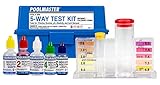
Accurate readings make every chlorine, pH, alkalinity, calcium, and CYA dose safer.
View on Amazon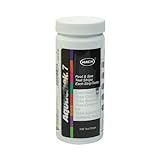
Fast daily checks between full liquid tests, especially during heavy swim season.
View on Amazon
Useful for algae cleanup, cloudy water, high bather load, and weekly oxidation routines.
View on AmazonGet exact pool chemical doses
Pool Chemical Calculator turns your test readings, pool volume, and target levels into exact treatment amounts for chlorine, pH, alkalinity, calcium, stabilizer, salt, and more.
Open the Pool Chemical Calculator app for iOS, Android, or web.