
How Much Stabilizer to Add to Your Pool: The Complete Dosing Guide
Keyword: how much stabilizer to add to pool
Quick answer
How Much Stabilizer to Add to Your Pool: The Complete Dosing Guide: Keyword: how much stabilizer to add to pool Quick Answer: To calculate how much stabilizer (cyanuric acid) to add to your pool, use this formula: pounds of CYA = pool gallons × desired ppm increase ÷ 120,000 . For a.
Quick Answer: To calculate how much stabilizer (cyanuric acid) to add to your pool, use this formula: pounds of CYA = pool gallons × desired ppm increase ÷ 120,000. For a 15,000-gallon pool needing a 30 ppm boost, that’s 3.75 pounds of dry stabilizer. Most outdoor chlorine pools should maintain 30-50 ppm of cyanuric acid, while saltwater pools perform better at 60-80 ppm. Always test your current level before adding anything.
Got a pool that’s eating through chlorine like crazy? You’re probably dealing with a stabilizer problem. Knowing how much stabilizer to add to your pool saves you money on chlorine and keeps your water crystal clear all season. But add too much, and you’ll create a whole new headache.
I’ve seen pool owners dump in a full container of stabilizer because “more is better,” only to spend weeks draining and refilling their pool. Don’t be that person. This guide gives you the exact math, step-by-step instructions, and real-world examples to get your cyanuric acid levels right the first time.
What Pool Stabilizer Actually Does
Pool stabilizer — also called cyanuric acid or CYA — acts like sunscreen for your chlorine. Without it, UV rays from the sun destroy chlorine molecules within hours. We’re talking about losing 90% of your free chlorine in just two hours on a sunny day.
Think of it this way: chlorine is expensive, and sunlight is relentless. CYA creates a protective bond with chlorine molecules, shielding them from UV degradation. Your chlorine sticks around 3-5 times longer, which means fewer trips to the pool store and more money in your pocket.
But here’s where it gets tricky. Too much stabilizer actually works against you. When CYA levels climb above 100 ppm, chlorine becomes sluggish. It’s still there, but it can’t effectively kill bacteria and algae. Pool pros call this “chlorine lock,” and the only real fix is diluting your water.
For a deeper understanding of how stabilizer interacts with your other pool chemicals, check out our complete guide to pool stabilizer and cyanuric acid.
Target Stabilizer Levels for Different Pool Types
Your ideal CYA level depends on what type of pool you’re running and how you sanitize it.
Standard Chlorine Pools (Outdoor)
Target range: 30-50 ppm
This sweet spot protects your chlorine from sunlight while keeping it effective against contaminants. If you’re using chlorine tablets (trichlor), they actually contain stabilizer — about 50% by weight. So your CYA will naturally climb over time. Start on the lower end if you rely heavily on tablets.
Saltwater Pools
Target range: 60-80 ppm
Saltwater generators produce chlorine continuously, but they produce it slowly. Higher stabilizer levels help that chlorine last longer between production cycles. You can push toward 70-80 ppm without issues, but stay under 100 ppm.
Indoor Pools
Target range: 0-20 ppm (or none)
No sun means no UV degradation. Indoor pools rarely need stabilizer at all. If you’re dealing with large windows that let in significant sunlight, 10-20 ppm might help. But most indoor pool owners skip it entirely.
The Stabilizer Dosing Formula
Here’s the math you need to calculate exactly how much cyanuric acid to add:
Pounds of dry CYA = (Pool Gallons × Desired PPM Increase) ÷ 120,000
Not sure about your pool’s volume? Use our pool volume calculator to get an accurate number. Getting this wrong throws off all your chemical calculations.
Real-World Dosing Examples
Let’s run through the most common pool sizes:
10,000-Gallon Pool
- To raise CYA by 10 ppm: 0.83 pounds (about 13 ounces)
- To raise CYA by 20 ppm: 1.67 pounds
- To raise CYA by 30 ppm: 2.5 pounds
15,000-Gallon Pool
- To raise CYA by 10 ppm: 1.25 pounds
- To raise CYA by 20 ppm: 2.5 pounds
- To raise CYA by 30 ppm: 3.75 pounds
20,000-Gallon Pool
- To raise CYA by 10 ppm: 1.67 pounds
- To raise CYA by 20 ppm: 3.33 pounds
- To raise CYA by 30 ppm: 5 pounds
Want to skip the math entirely? Our stabilizer calculator does the work for you. Just enter your current level, target level, and pool size.
How to Add Stabilizer to Your Pool: Step-by-Step
Adding stabilizer isn’t complicated, but doing it wrong leads to problems — undissolved granules clogging your skimmer, inaccurate readings, or overshooting your target. Follow these steps for best results.
Step 1: Test Your Current CYA Level
Before adding anything, you need to know where you’re starting. Standard test strips often skip CYA, so grab a dedicated cyanuric acid test. I recommend CYA test strips from Amazon — they’re affordable and reasonably accurate for home use.
Take your sample from elbow-deep water, away from return jets. Test in the shade if possible, since bright sunlight can affect results.
Step 2: Calculate the Exact Amount Needed
Use the formula above or plug your numbers into the Pool Chemical Calculator app. The app factors in your pool volume, current CYA level, and target level to give you a precise dose.
Don’t guess. Seriously. Cyanuric acid doesn’t evaporate or break down like chlorine does. Whatever you add stays in your water until you dilute it through draining or splash-out.
Step 3: Choose Your Stabilizer Form
You’ve got three main options:
Granular/Powder CYA (Most Common)
Dissolves in 2-7 days. Cheapest option per pound. You can find quality cyanuric acid stabilizer on Amazon.
Liquid Stabilizer
Dissolves immediately but costs more and adds more water. Easier for small adjustments.
Stabilized Chlorine (Trichlor/Dichlor)
Not a great choice for raising CYA quickly since it contains only ~50% stabilizer. Better for maintaining levels over time.
For most pool owners, granular CYA is the way to go. It’s economical and works perfectly fine — you just need patience.
Step 4: Dissolve Stabilizer in a Sock or Bucket Method
Here’s the technique that prevents problems:
Sock Method (Recommended for large doses):
- Fill an old tube sock or mesh bag with granular CYA
- Tie off the end securely
- Hang the sock in front of a return jet or place in the skimmer basket
- Let it dissolve over 2-4 days
- Squeeze the sock occasionally to speed up dissolving
Bucket Method (Faster, but messier):
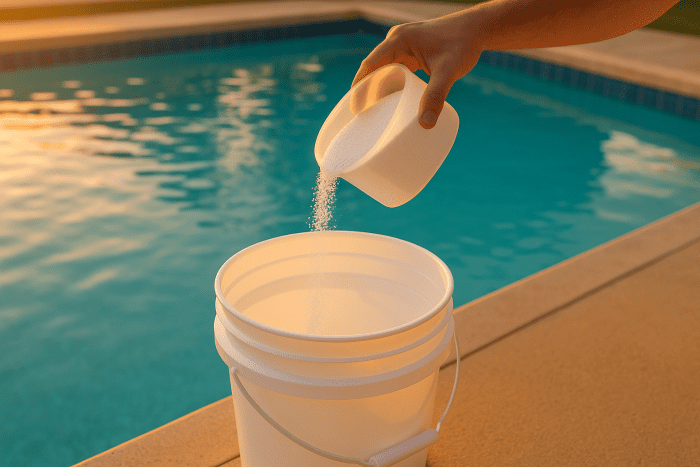
- Fill a 5-gallon bucket halfway with warm pool water
- Add the calculated CYA amount
- Stir vigorously for 5 minutes
- Pour the mixture around the pool perimeter with the pump running
The sock method wins for large doses (2+ pounds) because CYA dissolves slowly. Dumping undissolved granules directly in can damage pool surfaces and clog equipment.
Step 5: Run Your Pump Continuously for 48 Hours
CYA needs circulation to dissolve and distribute evenly throughout your pool. Run your pump non-stop for at least 48 hours after adding stabilizer. This also helps your filter move the dissolved CYA through the system.
If you used the sock method, the stabilizer might take up to 7 days to fully dissolve. That’s normal. Don’t add more because you’re impatient.
Step 6: Retest After One Week
Here’s why patience matters: CYA readings won’t be accurate until the stabilizer fully dissolves and mixes throughout your pool. Wait a full 7 days, then test again.
If you’re still below your target, calculate another dose. But you’ll usually find you’re right where you want to be.
Step 7: Adjust Chlorine Levels Accordingly
Higher stabilizer levels mean you need slightly higher free chlorine to maintain the same sanitizing power. The general rule:
- At 30 ppm CYA: maintain 2-3 ppm free chlorine
- At 50 ppm CYA: maintain 3-4 ppm free chlorine
- At 70-80 ppm CYA: maintain 4-6 ppm free chlorine
Use our chlorine calculator to dial in the right chlorine dose for your new stabilizer level.
Common Stabilizer Mistakes (And How to Avoid Them)
Adding too much at once. Always err on the side of adding less. You can easily add more stabilizer, but you can’t remove it without draining water.
Testing too soon after adding. You’ll get a false low reading and think you need more. Wait the full week.
Forgetting about trichlor tablets. Every chlorine tablet adds stabilizer to your pool. A 20,000-gallon pool using 3 tablets per week gains roughly 4-5 ppm of CYA per month. Track this so you don’t overshoot.
Ignoring high CYA until it’s a crisis. Test monthly during swim season. If levels creep above 80 ppm, drain 1/4 of your water and refill. That’s much easier than dealing with chlorine lock at 150 ppm.
What If Your Stabilizer Is Too High?
Unfortunately, there’s no chemical that removes cyanuric acid. Your only options:
Partial drain and refill. Drain 25-50% of your water and refill with fresh. This dilutes everything, so you’ll need to rebalance chlorine, pH, and alkalinity afterward.
CYA reducer products. A few products claim to break down CYA biologically. Results are mixed, and they’re expensive. Draining remains more reliable.
Wait for natural dilution. Splash-out, backwashing, and rainwater overflow gradually reduce CYA. But this takes months and isn’t practical if you’re at crisis levels.
Frequently Asked Questions
How Long Does Pool Stabilizer Take to Dissolve?
Granular cyanuric acid takes 2-7 days to fully dissolve, depending on water temperature and circulation. Warmer water dissolves it faster. The sock method in front of a return jet typically takes 3-4 days for complete dissolution.
Can You Swim After Adding Stabilizer?
Yes, but with caveats. If you used the sock method in your skimmer, wait 20-30 minutes for initial circulation. If you added granules directly (not recommended), keep swimmers out until all visible granules dissolve — usually 24-48 hours. Granular CYA can irritate skin and eyes on contact.
How Often Should I Add Stabilizer to My Pool?
Most pools need stabilizer added once at the beginning of the season, then possibly a small top-up mid-summer. If you use chlorine tablets, you might not need to add any standalone stabilizer — the tablets contribute CYA continuously. Test monthly and add only when levels drop below 30 ppm (outdoor pools) or 60 ppm (saltwater pools).
Does Rain Lower Cyanuric Acid Levels?
Heavy rain dilutes all your pool chemicals, including CYA. A major rainstorm adding 2-3 inches of water to a typical 15,000-gallon pool might lower CYA by 5-10%. This is usually welcome, since most pools run on the high side of CYA by late summer.
What’s the Difference Between Stabilizer and Conditioner?
Nothing — they’re the same thing. “Stabilizer,” “conditioner,” and “cyanuric acid” all refer to CYA. Marketing teams just like variety. When you see “pool conditioner” at the store, check the active ingredient. It should say cyanuric acid.
Keep Your Pool Chemistry Balanced
Getting your stabilizer level right is just one piece of the puzzle. But it’s an important piece — the wrong CYA level undermines everything else you do with chlorine.
Test your cyanuric acid monthly during swim season. Add stabilizer slowly and patiently. And remember: it’s much easier to add more than to remove it.
Ready to take the guesswork out of pool chemistry? Try our free Pool Chemical Calculator to get precise doses for stabilizer, chlorine, pH adjusters, and more. Just enter your pool size and current readings — we’ll tell you exactly what to add and how much.
Recommended pool supplies
As an Amazon Associate, Pool Chemical Calculator earns from qualifying purchases.

Slow-dissolving tablets help keep routine free chlorine steady in floaters or chlorinators.
View on Amazon
Accurate readings make every chlorine, pH, alkalinity, calcium, and CYA dose safer.
View on Amazon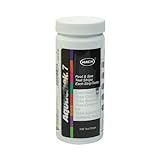
Fast daily checks between full liquid tests, especially during heavy swim season.
View on AmazonGet exact pool chemical doses
Pool Chemical Calculator turns your test readings, pool volume, and target levels into exact treatment amounts for chlorine, pH, alkalinity, calcium, stabilizer, salt, and more.
Open the Pool Chemical Calculator app for iOS, Android, or web.