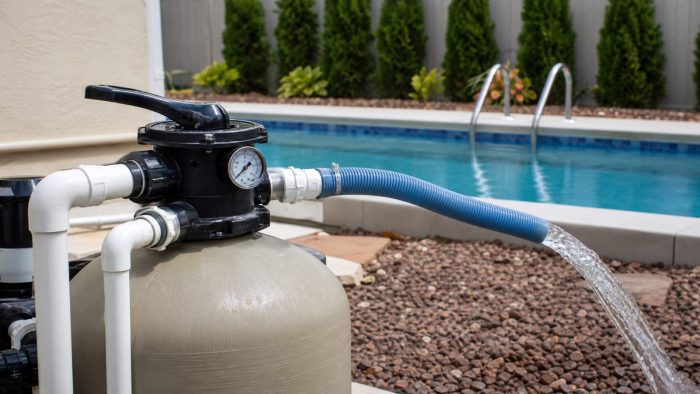

How to Winterize a Sand Filter: A Complete Pool Closing Guide
Quick answer
To winterize a sand filter, finish the pool closing chemistry first, backwash until the waste water is clear, rinse for about 30–60 seconds, shut off power at the breaker, relieve pressure, remove the filter tank drain cap, and let the tank empty completely. Move the multiport valve to WINTERIZE; if your model has no winterize setting, follow its manual’s storage position, which may be between settings. Drain the pump, heater, chlorinator, sight glass, gauge, hoses, and exposed plumbing separately. Store removable plugs and gauges indoors, leave the tank drain cap off, and never turn the multiport handle while the pump is running.
Quick answer
How to Winterize a Sand Filter: A Complete Pool Closing Guide: Quick answer To winterize a sand filter, finish the pool closing chemistry first, backwash until the waste water is clear, rinse for about 30–60 seconds, shut off power at the breaker, relieve pressure, remove the.
The exact valve position and line-blowing method vary by equipment model, so your filter and pool manufacturer’s instructions take priority.
What you need
- A garden hose and a backwash/waste discharge path
- The filter and pump manufacturer manuals
- Screwdriver or the correct tool for drain caps and unions
- Silicone pool O-ring lubricant
- A labeled container or bag for drain plugs, gauge, and small fittings
- A pool closing blower or low-pressure air source if your closing method requires blowing out lines
- Winterizing plugs, skimmer protection, and pipe insulation as appropriate for your plumbing
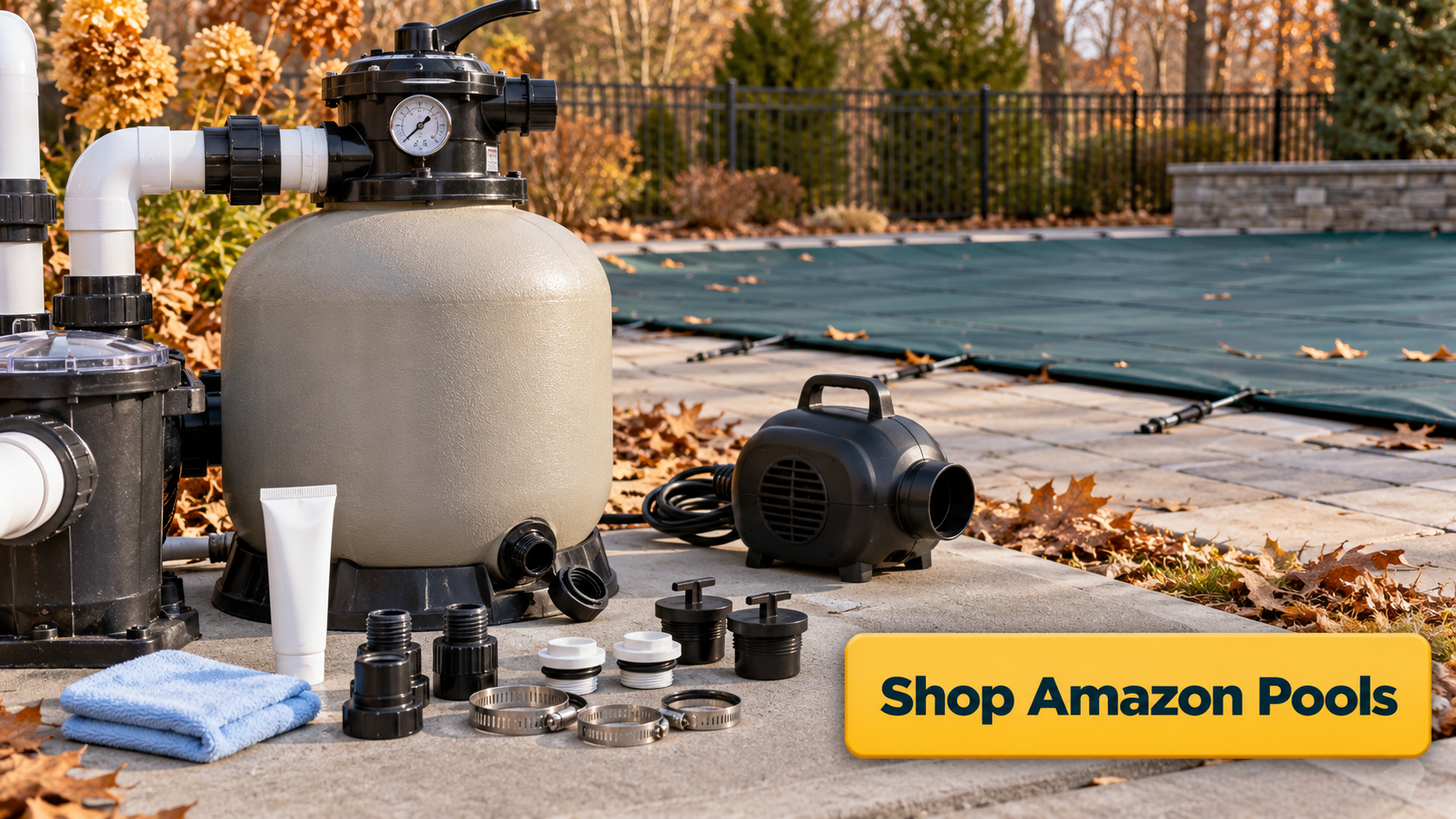
If you need replacement plugs, O-ring lubricant, a pressure gauge, or line-blowing accessories, compare sand filter winterizing supplies on Amazon. As an Amazon Associate, Pool Chemical Calculator may earn from qualifying purchases.
Before you drain the filter
Winterize the filter after the pool itself is ready to close. Remove leaves, brush the walls and floor, vacuum debris, and correct the water balance. A filter cannot compensate for closing dirty or badly unbalanced water.
For a typical closing, verify the pool volume and dose from actual test readings with the Pool Chemical Calculator. Use the pool volume calculator, free chlorine calculator, and pH calculator when you need exact amounts rather than guessing.
Step-by-step: how to winterize a sand filter
Step 1: Choose the right closing temperature and finish the pool
Close after the water is consistently cool enough for your local climate and closing method, commonly around 60–65°F for seasonal pools. Follow local practice and the pool-cover manufacturer’s instructions. Balance the water, complete the final sanitizer treatment, and add only the closing chemicals your product labels call for.
Do not pour random winterizing chemicals into the filter tank. Chemicals belong in the pool unless the filter manufacturer specifically directs otherwise.
Step 2: Backwash the sand filter
Turn the pump off before moving the multiport handle. Set the valve to BACKWASH, confirm the waste line is connected and safe, then restart the pump. Backwash until the water in the sight glass or waste stream is clear, following the filter manual’s normal time and pressure guidance.
Backwashing removes trapped debris from the sand bed before the equipment sits idle. Never change valve positions while the pump is running; that can damage the multiport valve spider gasket or create a dangerous pressure event.
Step 3: Rinse the filter
Turn the pump off, move the valve to RINSE, and run the pump for about 30–60 seconds, or for the time specified by your manual. Rinsing settles the sand bed and flushes loose debris from the valve and waste plumbing. Turn the pump off again when finished.
Step 4: Shut off power and release pressure
Switch the pump off at the timer and at the circuit breaker. Close or isolate valves as needed for your plumbing layout. Open the filter’s air-relief valve, if equipped, and wait until the pressure gauge reads zero.
Do not loosen a clamp, union, gauge, drain plug, or valve while the system is pressurized. If the equipment sits below the pool waterline, use the isolation valves or lower the water only according to the pool manufacturer’s instructions.
Step 5: Put the multiport valve in its winter position
Move the handle only after the pump is off and pressure is relieved. If the valve has a labeled WINTERIZE position, use it. That position opens the internal passages intended to prevent water from remaining trapped in the valve.
Some six-position valves have no separate winterize label. Do not guess based on a generic internet diagram. Check the manual; some manufacturers specify leaving the handle between detents so the spring is not compressed and water can drain. The correct position is model-specific.
Step 6: Drain the sand tank completely
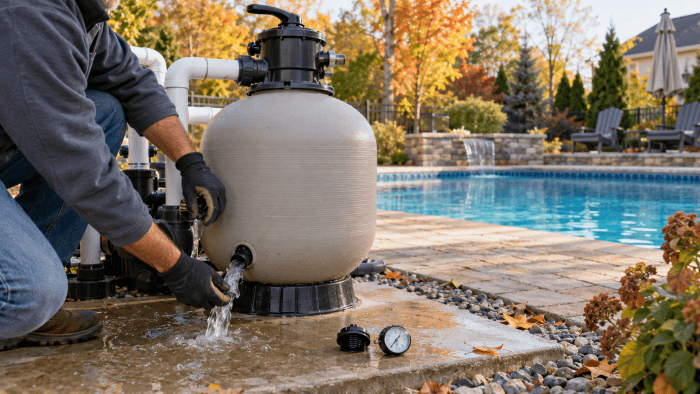
Remove the drain cap or plug at the bottom of the sand filter tank. Open the air-relief valve so air can enter while water leaves. Allow the tank to drain fully; this may take several minutes.
Leave the drain opening uncapped during the freezing season unless your manufacturer says otherwise. Store the cap and its O-ring in a labeled bag. Do not remove the multiport valve or empty the sand for ordinary seasonal winterization. The sand stays in the tank; removing it creates unnecessary work and can damage the standpipe or laterals.
Step 7: Drain the valve, gauge, sight glass, and connected equipment
Small components can trap enough water to crack when frozen. Remove or drain the parts your manual identifies, including:
- Pressure gauge
- Backwash sight glass
- Pump strainer housing and pump drain plugs
- Heater and chlorinator drain points
- Flexible hoses and exposed unions
- Any automatic chemical feeder or booster-pump plumbing
Keep the pressure gauge and clear sight glass indoors where they cannot freeze. Lubricate sound O-rings with a thin film of silicone pool lubricant; replace O-rings that are cracked, flattened, or brittle. Never use petroleum jelly on pool-equipment O-rings.
Step 8: Blow out pool lines only with the correct method
If your closing method requires blowing out suction and return lines, use a pool closing blower or a controlled, low-pressure setup designed for pool plumbing. Follow the pool and plumbing manufacturer’s instructions, plug each line as water is displaced, and do not exceed the pressure rating of the equipment.
Compressed air can damage fittings or create a hazard if used carelessly. If the plumbing layout is unclear, the filter is below water level, or a line will not clear, stop and call a pool professional rather than increasing pressure.
Step 9: Protect the equipment pad
After drainage, protect the equipment from leaves and direct weather without sealing moisture inside. A breathable cover can keep debris off the motor and valve, but do not wrap a damp filter or pump in airtight plastic. Keep drain openings open, label every removed part, and take sensitive gauges or electronics indoors.
Common sand-filter winterization mistakes
Leaving the drain cap installed
A closed drain can hold water in the tank. When that water freezes and expands, it can crack the tank or fittings. Remove the cap and store it where you will find it in spring.
Removing sand unnecessarily
Seasonal winterization does not normally require replacing or removing filter sand. Consider a sand change only when the media is due, contaminated, channeling, or no longer filtering correctly.
Moving the valve with the pump on
This is one of the fastest ways to damage a multiport valve. Always stop the pump, wait for zero pressure, move the handle, and then restart only when the selected position is correct.
Forgetting the pump or heater
Draining the sand tank does not winterize the rest of the pad. Pumps, heaters, salt cells, feeders, and exposed pipes each have their own drain points and instructions.
Using high-pressure air to force a blockage
More pressure is not a better winterization method. A blocked line may indicate a closed valve, frozen water, a plug, or a plumbing problem. Diagnose it before applying more air.
Spring restart checklist
When opening the pool, work backward carefully:
- Reinstall the drain cap, gauge, sight glass, pump plugs, and other parts using fresh or inspected O-rings.
- Reconnect hoses, unions, heater, chlorinator, and any line plugs according to the equipment manuals.
- Set the multiport valve to FILTER with the pump off.
- Fill and prime the pump, open the correct valves, and start the system while watching for leaks.
- Bleed trapped air according to the filter instructions.
- Backwash and rinse if the manufacturer calls for it before normal filtration.
- Test the pool and use the Pool Chemical Calculator app to calculate exact opening doses.
If the tank leaks, the valve will not move, sand returns to the pool, or the pressure gauge behaves abnormally, shut the system down and repair the issue before swimming.
Affiliate disclosure: As an Amazon Associate, Pool Chemical Calculator may earn from qualifying purchases.
Frequently Asked Questions
Do I remove the sand from a sand filter for winter?
No. Normal seasonal winterization leaves the sand in the tank. Drain the water, protect the valve and connected plumbing, and remove sand only when a manufacturer procedure or a needed media replacement calls for it.
Should the sand-filter drain plug stay out all winter?
Usually, yes. Many manufacturers direct owners to leave the bottom drain cap or plug out so water cannot collect and freeze in the tank. Confirm the instruction for your exact filter model.
What position should a sand-filter multiport valve be in during winter?
Use the labeled WINTERIZE position when the valve has one. If it does not, use the storage position in the manufacturer’s manual; some valves are left between settings. Never rely on a generic position chart.
Do I need to remove the pressure gauge?
In freezing climates, removing and storing the gauge indoors is a sensible precaution because a small water pocket can freeze inside it. Follow the gauge and filter manufacturer’s instructions and release all pressure first.
Can I use a regular air compressor to blow out pool lines?
Only if the setup and pressure are appropriate for the pool plumbing and your manufacturer-approved closing method. A pool closing blower or professional service is safer than forcing high-pressure air into unknown plumbing.
How do I know the sand filter is fully drained?
With power off and the air-relief valve open, water should stop flowing from the bottom drain. Check the pump, valve, sight glass, heater, feeder, hoses, and exposed unions separately; draining the tank alone does not empty the entire system.
Sources and manufacturer guidance
- Intermatic: How do I winterize a sand filter?
- Pentair Sand Dollar filter system guide
- Raypak pool equipment winterizing guidance
Recommended pool supplies
As an Amazon Associate, Pool Chemical Calculator earns from qualifying purchases.

Raises free chlorine quickly without adding stabilizer, which is useful when CYA is already high.
View on Amazon
Accurate readings make every chlorine, pH, alkalinity, calcium, and CYA dose safer.
View on Amazon
Removes leaves and debris before they consume chlorine and stain the pool.
View on AmazonGet exact pool chemical doses
Pool Chemical Calculator turns your test readings, pool volume, and target levels into exact treatment amounts for chlorine, pH, alkalinity, calcium, stabilizer, salt, and more.
Open the Pool Chemical Calculator app for iOS, Android, or web.