
Pool Antifreeze in Plumbing: What to Use and How to Winterize Safely
Quick answer
Use only swimming-pool or RV plumbing antifreeze labeled for plumbing and made with propylene glycol. Never use automotive antifreeze, which commonly contains toxic ethylene glycol. First drain or blow out as much water as your pool equipment instructions require. Then use antifreeze only in plumbing sections that can retain water, following the product label and equipment manufacturer instructions. Antifreeze belongs in isolated plumbing lines, not in the pool, filter media, salt cell, or chemical feeder.
Quick answer
Pool Antifreeze in Plumbing: What to Use and How to Winterize Safely: Quick answer Use only swimming-pool or RV plumbing antifreeze labeled for plumbing and made with propylene glycol. Never use automotive antifreeze, which commonly contains toxic ethylene glycol. First drain or blow out.
Pool antifreeze is backup protection, not a substitute for removing water. Water left in a pump, filter, heater, valve, or pipe can still freeze and expand if the line is not properly drained or purged.
What pool antifreeze is for
Pool antifreeze protects plumbing that cannot be completely emptied during winter closing. A small amount of water can remain in low spots, elbows, underground lines, skimmer plumbing, or equipment housings. A propylene-glycol product lowers the freezing risk of that remaining liquid when used at the label concentration.
The main winterization goal is still to remove water. Pool professionals commonly use a blower or shop vacuum made for the job to clear return, skimmer, and cleaner lines, then plug the lines so water cannot flow back in. Some systems are designed to be winterized without antifreeze. Others have sections where a pool-specific antifreeze adds useful insurance. Your equipment manuals and local climate should determine the method.
Do not pour antifreeze into the pool water. It is intended for closed plumbing sections that will be drained and flushed before the pool is started again.
Which antifreeze is safe for pool plumbing?
Choose a product that clearly says it is for swimming pools, spas, RV plumbing, or potable-water plumbing and lists propylene glycol. Read the label instead of relying on the color. Pink liquid is common, but color alone does not prove the ingredients or the correct freeze-protection rating.
Never use automotive antifreeze in pool plumbing. Automotive formulas may contain ethylene glycol and corrosion-inhibitor additives that are toxic and inappropriate for pool equipment. Do not use boiler antifreeze, windshield washer fluid, or an unlabeled surplus chemical either.
Pentair equipment guidance specifically warns against antifreeze solutions except propylene glycol and describes non-toxic propylene glycol RV antifreeze for areas that retain water. It also gives a 40 percent propylene glycol and 60 percent water solution as an example for protecting certain equipment to about -50°F. That is equipment-specific guidance, not a universal mixing recipe. Follow the manual and the exact product label for your system.
How to put antifreeze in pool plumbing
These steps are a general framework. Shut off power before opening equipment, and use the instructions for your pump, filter, heater, valves, chlorinator, and cover system whenever they differ.
Step 1: Balance and clean the pool first
Remove leaves, brush the walls and floor, clean baskets, and test the water. Record free chlorine, pH, total alkalinity, calcium hardness, and cyanuric acid. A closing chemical plan is easier to follow when you know the starting numbers. The Pool Chemical Calculator app can turn your pool size and test results into dosing guidance.
Step 2: Turn off power and isolate equipment
Switch off the pump and the correct electrical breakers. Close or label valves as needed. Never move a multiport valve while the pump is running. If you are unsure which breaker or valve controls a component, stop and use a qualified pool professional.
Step 3: Drain equipment completely
Remove the pump drain plugs, filter drain plug, heater drain points, chlorinator, and other removable plugs specified by the manufacturer. Let water drain before adding any antifreeze. Keep drain plugs together in a labeled bag for spring opening.
Step 4: Blow out or vacuum the plumbing lines
Clear the return lines, skimmer lines, cleaner lines, and other exposed circuits using the approved winterizing method. Close or plug each line as soon as it is cleared so water cannot run back into it. Main-drain plumbing may use an air lock instead of a plug. Do not improvise a high-pressure connection that could damage fittings or equipment.
Step 5: Identify places that can retain water
Look for low sections, valve bodies, pump housings, heater passages, and lines that cannot be fully drained. Antifreeze is most useful in these areas when the manual permits it. Do not assume that every pipe needs a gallon of product. Overfilling creates more spring cleanup and can send unnecessary chemical into the pool.
Step 6: Add the correct product in the correct line
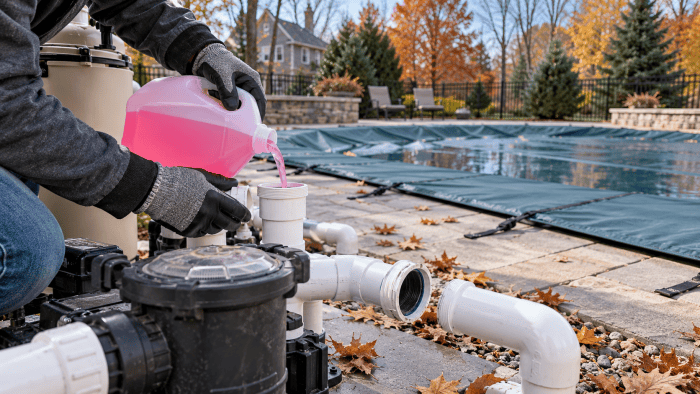
Use a hand pump, funnel, or method approved by the equipment instructions. Add only the amount and concentration on the label. Keep the antifreeze out of the pool, filter tank, salt cell, heater bypasses, and chemical feeders unless the manufacturer specifically directs otherwise. Cap or plug the line after filling it.
Step 7: Label what you did
Write down the product, concentration, lines treated, and the date. Photograph valve positions and plug locations. This prevents confusion when someone opens the pool in spring.
Step 8: Secure the system and cover
Confirm that equipment is drained, plugs are stored, valves are in the correct winter position, and the cover is installed according to its instructions. Keep the pump motor ventilated. Do not wrap an outdoor motor tightly in plastic because trapped condensation can cause corrosion.
Common mistakes and troubleshooting
I added antifreeze before draining the lines
Do not assume the antifreeze displaced all the water. Shut down safely and check the product label and equipment manual. If the line is accessible, remove the mixture using the recommended drain or purge method. If automotive antifreeze was used, keep it out of the pool, do not start the system, and contact a pool professional or hazardous-materials disposal service for product-specific advice.
I used automotive antifreeze by mistake
Do not circulate it through the pool. Isolate the affected equipment and line, save the container or product information, and call a qualified pool service for safe removal. Do not dilute it into the pool and do not drain it to a storm drain, soil, or septic system. Disposal rules vary by location.
The pump or filter still has water in it
Turn off power and reopen the manufacturer-specified drain points. Check for a clogged drain, trapped air, a closed valve, or a missing drain plug. Do not rely on antifreeze to protect an equipment housing that remains full of water. A cracked pump housing or filter tank can cause flooding and expensive spring repairs.
I cannot tell whether antifreeze is already in the line
Do not add another dose blindly. Check your closing notes, labels, and the appearance of the liquid at an accessible low point only if the equipment manual allows it. When records are missing, have a pool professional identify the line and remove or test the existing fluid before reopening.
How do I remove pool antifreeze in spring?
Follow the product label and equipment manuals. Drain the treated lines where possible, reconnect plugs and fittings, fill the system with fresh pool water, and flush to waste or the approved discharge point before normal circulation. Never send a concentrated chemical mixture into the pool without confirming that the product and equipment instructions allow it. Retest the water after the system is running.
Shop Amazon Pools for pool winterization supplies.
Shop pool and RV plumbing antifreeze on Amazon and confirm the label says propylene glycol and is intended for plumbing use.
Frequently asked questions
Can I use RV antifreeze in pool plumbing?
Use it only when the label identifies propylene glycol and the product is intended for plumbing or potable-water systems. Follow the pool equipment manual and the product directions. RV antifreeze is not automatically safe just because it says RV on the bottle.
Is pool antifreeze necessary every winter?
No. A properly drained and blown-out system may not need it, depending on the plumbing layout, climate, and manufacturer instructions. It is most useful as supplemental protection for sections that can retain water or cannot be cleared reliably.
How much pool antifreeze should I add?
There is no safe universal amount. Use the volume and concentration specified on the product label or by the equipment manufacturer. Adding extra does not make an improperly drained line safe and makes spring flushing harder.
Can pool antifreeze go into the pool?
No. Pool antifreeze goes into isolated plumbing sections during winterization, not into the pool water. Keep it out of the filter media, salt cell, heater, chemical feeder, and other components unless their manuals specifically say otherwise.
What is the difference between propylene glycol and ethylene glycol antifreeze?
Propylene glycol is the type commonly used in pool, RV, and potable-water plumbing products. Ethylene glycol is common in automotive antifreeze and is toxic, so it must not be used in pool plumbing or allowed to enter pool water.
What should I check before a hard freeze?
Confirm that the pump and filter are drained, lines are cleared and plugged, valves are in the winter position, exposed equipment is protected, and the cover is secure. If the forecast is changing quickly or you cannot verify the plumbing, call a pool professional before temperatures fall below freezing.
Sources consulted: Pentair pump and filter winterization manuals, Association of Pool & Spa Professionals winterizing guidance, and PHTA winterization notes.
Recommended pool supplies
As an Amazon Associate, Pool Chemical Calculator earns from qualifying purchases.

Raises calcium hardness to reduce corrosive water risk in plaster, concrete, and equipment.
View on Amazon
Raises total alkalinity so pH is less likely to bounce around after treatment.
View on Amazon
Accurate readings make every chlorine, pH, alkalinity, calcium, and CYA dose safer.
View on AmazonGet exact pool chemical doses
Pool Chemical Calculator turns your test readings, pool volume, and target levels into exact treatment amounts for chlorine, pH, alkalinity, calcium, stabilizer, salt, and more.
Open the Pool Chemical Calculator app for iOS, Android, or web.