
Winter Pool Maintenance Checklist: What to Check All Season
Quick answer
A closed pool is not a forgotten pool. Use this winter pool maintenance checklist once a month—and after every major storm—to inspect the cover, remove standing water and debris, check the water level, look for leaks, and protect the equipment pad from freezing. In mild climates, also test sanitizer and pH periodically and run the circulation system according to your equipment manufacturer’s freeze-protection instructions. Never walk on a cover, pump water into the pool, or turn on a pump that may contain ice.
Quick answer
Winter Pool Maintenance Checklist: What to Check All Season: Quick answer A closed pool is not a forgotten pool. Use this winter pool maintenance checklist once a month—and after every major storm—to inspect the cover, remove standing water and debris, check the water level.
The exact routine depends on whether your pool is fully winterized or kept open for winter. A fully closed pool needs cover, water-level, and freeze-damage checks. A pool that remains open needs regular chemistry testing and circulation.
Winter pool maintenance checklist
Keep this list with your pool supplies:
- Inspect the cover, anchors, cable, water bags, springs, and perimeter for damage.
- Remove leaves and debris before they stain the cover or fall into the pool.
- Pump rainwater or melted snow off a solid cover before it becomes heavy.
- Check the pool water level without entering the pool or placing weight on the cover.
- Look for unusual water loss, exposed liner, shifted cover edges, or new stains.
- Check skimmer protection, return plugs, winterizing plugs, and visible plumbing for movement or cracking.
- Confirm that the equipment pad is drained and protected from freezing water.
- Inspect the pump, filter, heater, chlorinator, and automation enclosure for leaks, ice, or storm damage.
- Store ladders, floats, hoses, cleaners, and test equipment in a dry place.
- In an open winter pool, test and adjust water chemistry on a regular schedule.
1. Check the pool cover after storms
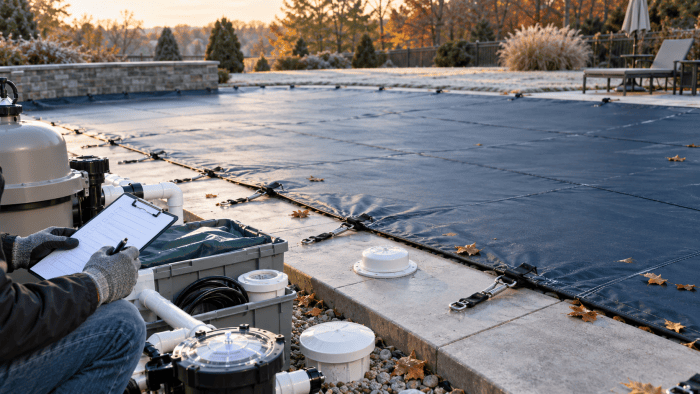
The cover is the first line of defense, but it is not designed to support people. From the deck, inspect for torn material, loose anchors, broken springs, leaking water bags, and branches that could puncture the cover. A safety cover should remain taut and properly anchored; a tarp-style cover should remain secured without sharp objects or masonry sitting on it.
Remove leaves with a cover rake designed for your cover. Do not drag a standard garden rake across the fabric, and do not use a leaf blower where it could push debris underneath the cover edge.
If water collects on a solid cover, use a cover pump with a working automatic shutoff or a manual pump that you can supervise. Keep electrical connections away from standing water and use a GFCI-protected outlet. Never use a pump that is frozen, damaged, or missing its screen.
2. Check water level and signs of a leak
Rain and snow can raise the water level, while evaporation or a plumbing leak can lower it. A sudden drop is more important than a small seasonal change. Mark the level on a skimmer or take a photo from the same location each time you inspect it.
Do not drain a winterized pool simply because the level looks high. The correct level depends on the pool construction, cover type, and winterization method. Lowering it too far can expose a vinyl liner, reduce support for an above-ground pool wall, or create hydrostatic pressure problems.
If the level falls unusually fast, check the cover and visible plumbing first. Stop adding water until you know whether the loss is evaporation, a cover problem, or a leak. A pool professional can perform a pressure or dye test when the source is not obvious.
3. Protect equipment and plumbing from freezing
Freezing water expands and can crack pump housings, filters, heaters, salt cells, valves, and rigid plumbing. For a fully closed pool, verify that drain plugs were removed from equipment during closing and that exposed lines were blown out or drained according to the system’s instructions. Keep removed plugs together in the pump basket so they are available at opening.
For a pool that stays open, use the system’s built-in freeze protection if it is working and configured correctly. That normally means circulation starts when the air temperature approaches freezing, but settings vary. Do not assume a timer alone protects the plumbing.
After a freeze, do not force a valve, open a pump lid, or start the motor until ice has thawed and the system has been inspected. If a heater, pump, or controller shows an error, shut off power and call a qualified pool technician rather than repeatedly resetting it.
4. Test water chemistry when the pool remains open
A fully winterized pool may not need the same weekly chemistry routine as a swimming pool in summer. An open or partially open pool still needs testing because leaves, rain, sunlight, and warmer spells can consume sanitizer and change pH.
Use a reliable test kit or fresh test strips and record:
- Free chlorine and combined chlorine
- pH
- Total alkalinity
- Cyanuric acid when chlorine is used outdoors
- Calcium hardness when the pool has a plaster or other calcium-sensitive surface
Adjust based on your pool’s surface, sanitizer type, local water, and product label. Do not pour multiple chemicals together or add concentrated products in the same spot. If you need exact dosing, use the Pool Chemical Calculator app, which detects iOS or Android automatically.
For volume-based corrections, use the pool volume calculator, chlorine calculator, and pH calculator.
5. Keep the area around the pool and equipment dry
Clear leaves from the deck, drains, skimmer area, and equipment pad. Make sure downspouts are not discharging against the pool wall or equipment. Standing water around electrical equipment is a safety issue, not merely a housekeeping problem.
Store chemicals in their original labeled containers in a cool, dry, ventilated location away from fuel, fertilizers, and incompatible chemicals. Keep lids closed and never store oxidizers beside acids. Follow the product label and local rules for winter storage.
Step-by-step: what to do after a winter storm
1. Inspect the cover from the deck
Stay off the cover and inspect it from the deck.
2. Remove loose debris safely
Remove branches and loose debris only if you can do so without pulling or puncturing the cover.
3. Pump standing water off the cover
Pump standing water off a solid cover with a safe, supervised cover pump.
4. Check cover hardware
Check cover anchors, springs, water bags, and the perimeter for movement or damage.
5. Check the pool water level
Check the water level, but do not lower it unless your pool-specific closing instructions require it.
6. Inspect the equipment pad
Inspect the equipment pad for ice, cracked housings, leaking fittings, and exposed electrical damage.
7. Test an open pool
If the pool is open, test water chemistry after debris and stormwater have been addressed.
8. Stop if equipment may be frozen
If any pump, heater, or plumbing may be frozen, leave it off and call a professional.
9. Document damage
Photograph damage and make repairs before the next freeze or storm.
Troubleshooting common winter problems
The pool cover is sagging
Remove accumulated water with a cover pump and inspect the cover for a tear or a failed support. Do not add bricks, rocks, or other sharp weights. Replace leaking water bags or damaged hardware with the correct parts for the cover.
The water level keeps dropping
Rule out cover drainage and evaporation, then mark the level and monitor it for 24 hours. A continuing loss can indicate a leak in the pool, skimmer, return line, or underground plumbing. Avoid repeated refilling until the cause is identified.
The pool is green under the cover
Do not dump random chemicals into a closed pool. At opening, remove debris, circulate only when the system is safe, test the water, and follow a measured algae-treatment plan. The pool shock calculator can help calculate a dose after you know the pool volume and product strength.
The pump will not start after a freeze
Turn off power and check for visible ice, a tripped breaker, or a frozen impeller only after the equipment is safe to access. Never bypass a breaker or run a motor that hums, leaks, or smells overheated. A technician should inspect freeze-damaged equipment.
Useful winter pool supplies
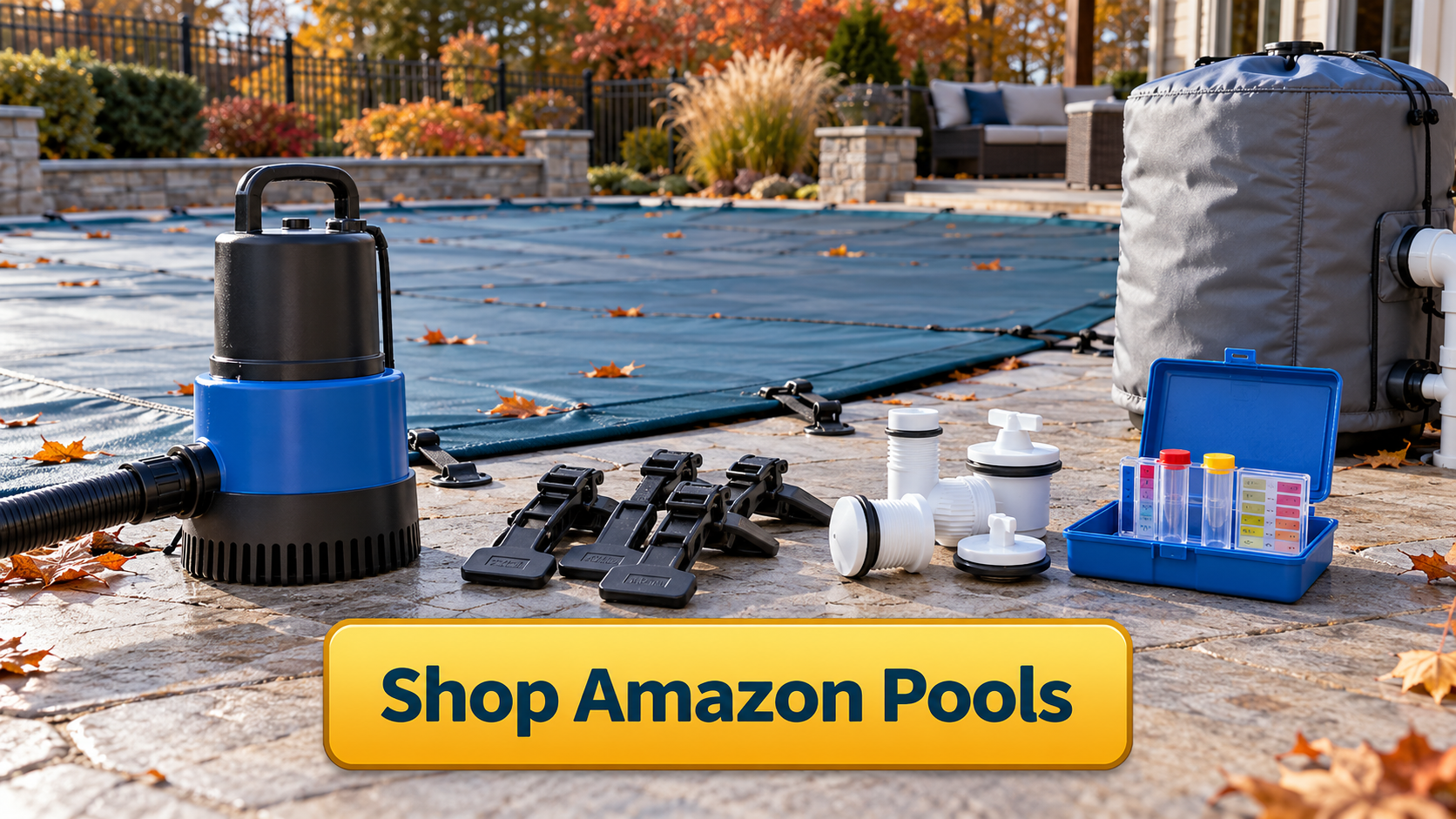
For cover pumps, winterizing plugs, replacement water bags, pipe insulation, and pool-safe maintenance supplies, compare options on Amazon. As an Amazon Associate, Pool Chemical Calculator may earn from qualifying purchases.
Affiliate disclosure: As an Amazon Associate, Pool Chemical Calculator may earn from qualifying purchases.
FAQ
How often should I check my pool in winter?
Inspect a closed pool at least monthly and after heavy rain, snow, high winds, or a hard freeze. An open pool needs chemistry and equipment checks more often, based on weather and the manufacturer’s instructions.
Should I run my pool pump during winter?
If the pool remains open, run it according to the circulation and freeze-protection plan for your equipment. If the pool is fully winterized, do not run a drained or plugged system. Never operate a pump that may contain ice.
Can I leave water on a pool cover?
Do not leave large amounts of water on a solid cover because the weight can damage the cover and anchors. Pump it off safely. Mesh and safety-cover drainage behavior differs, so follow the cover manufacturer’s instructions.
Should I add chlorine to a closed pool?
Only add chemicals when your closing method calls for them and you can measure the water safely. Do not guess at doses or mix products. For an open pool, test first and calculate the correction from the pool volume and product strength.
What temperature is dangerous for pool equipment?
Any forecast near freezing can be dangerous when water is trapped in equipment or plumbing. The risk depends on wind, duration, insulation, and whether circulation is operating. Prepare before the first freeze rather than waiting for ice to form.
Related Pool Chemical Calculator tools
- Pool Chemical Calculator for water-balance tools and guides.
- Pool Chemical Calculator app for mobile dosing help.
- Pool volume calculator before any chemical correction.
Recommended pool supplies
As an Amazon Associate, Pool Chemical Calculator earns from qualifying purchases.

Accurate readings make every chlorine, pH, alkalinity, calcium, and CYA dose safer.
View on Amazon
Fast daily checks between full liquid tests, especially during heavy swim season.
View on Amazon
Raises calcium hardness to reduce corrosive water risk in plaster, concrete, and equipment.
View on AmazonGet exact pool chemical doses
Pool Chemical Calculator turns your test readings, pool volume, and target levels into exact treatment amounts for chlorine, pH, alkalinity, calcium, stabilizer, salt, and more.
Open the Pool Chemical Calculator app for iOS, Android, or web.