
When to Add Winter Algaecide to a Pool
Quick answer
Add winter algaecide near the end of pool closing—after the water is clean and balanced, after the final chlorine shock has circulated, and before you put on the winter cover. In many closing routines, that means waiting until free chlorine has returned to the range stated on the algaecide label, often about 24 hours after shocking. Do not add it immediately after a chlorine shock unless the product label specifically says you can. Keep the pump running long enough to distribute the product, then finish lowering the water, winterizing the plumbing, and covering the pool.
Quick answer
When to Add Winter Algaecide to a Pool: Quick answer Add winter algaecide near the end of pool closing—after the water is clean and balanced, after the final chlorine shock has circulated, and before you put on the winter cover. In many closing routines.
The label on your specific algaecide is the authority for dose, chlorine limits, circulation time, and temperature. Pool volume matters, so use the Pool Chemical Calculator before measuring any chemical.
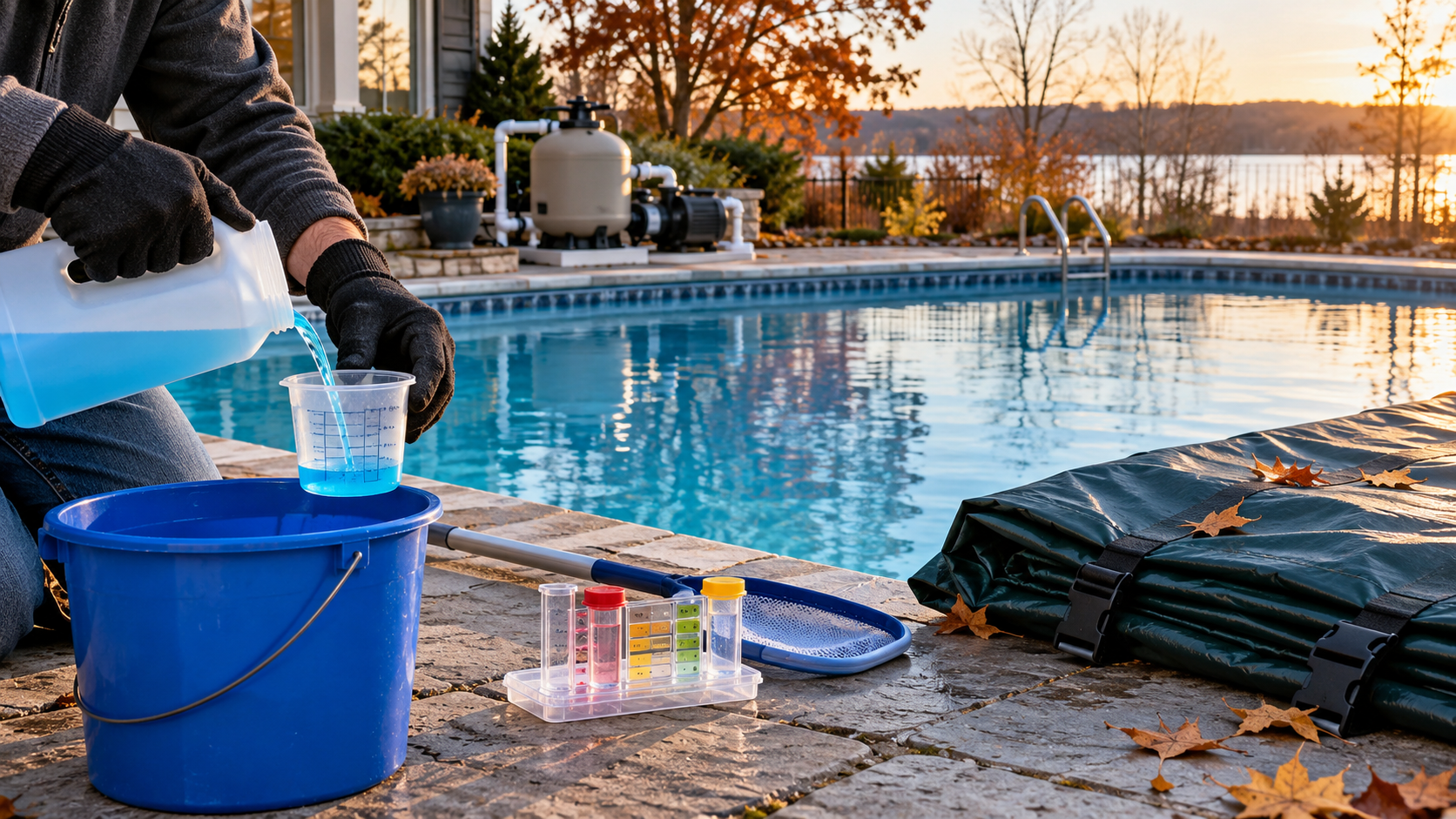
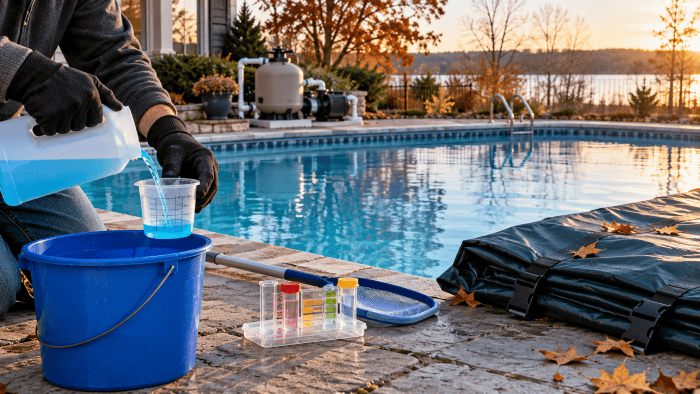
!Homeowner adding winter algaecide beside a clean pool during fall closing
When should you add winter algaecide?
Add winter algaecide as the last water-treatment step of closing, after these conditions are met:
- The pool has been brushed, skimmed, and vacuumed.
- The water is clear, with no active algae bloom.
- pH, total alkalinity, and calcium hardness are in the closing targets recommended for your pool and region.
- The final shock has circulated and the free-chlorine reading is within the algaecide label’s permitted range.
- You are ready to circulate the algaecide and then cover the pool.
For most owners, the simplest timing is: balance the water, shock the pool, wait until the next day to retest, add the winter algaecide if chlorine is no longer excessively high, circulate it, and then complete the mechanical winterization. If warm weather is returning, delay the final chemical step until you are actually closing; adding it too early can waste the treatment while the pool remains warm and uncovered.
Why you should not add it immediately after shock
A chlorine shock is intentionally strong. Depending on the product and dose, that high oxidizer level can reduce the effectiveness of some algaecides, especially when the two products are poured together. The result is wasted algaecide and a closing process that looks complete but gives the water less protection than expected.
That does not mean every algaecide requires the same waiting period. Some labels allow use with a particular chlorine level or specify a circulation window. Follow the exact label, and never assume that a dose from one product applies to another. If the label is unclear, wait, retest free chlorine, and ask the manufacturer or a qualified pool professional.
Target the water before adding winter algaecide
Algaecide is not a substitute for water balance or sanitation. Before the final dose, test and correct the basics:
- pH: commonly maintained around 7.2–7.6, unless your pool professional or product directions specify another target.
- Total alkalinity: commonly around 80–120 ppm for many residential pools.
- Free chlorine: use the target and maximum level printed on the algaecide label, taking cyanuric acid into account.
- Cyanuric acid: keep it appropriate for the sanitizer system; very high CYA can make chlorine less effective.
- Calcium hardness: keep it in the recommended range for your surface to reduce scaling or corrosion risk.
Use a reliable drop test or fresh test strips, and test at more than one point if the pool has poor circulation. If the water is green or visibly cloudy, fix that problem before closing. Winter algaecide is a preventative step, not a rescue treatment for an active algae outbreak.
Step-by-step: adding winter algaecide safely
1. Choose the correct product
Select a product labeled for winter pool use and verify that it is compatible with your sanitizer, surface, and filtration system. Polyquat-based winter products are commonly used, but the bottle’s label—not a generic recipe—controls compatibility and dose. Avoid adding a copper product when your water has a history of metal staining unless the label and a professional specifically support it.
2. Calculate the actual pool volume
Measure the pool’s volume as accurately as possible, including an average depth for irregular pools. Enter that volume into the pool chemical calculators and compare the result with the product label. Never estimate by “one bottle per pool” when the manufacturer gives a gallons-based dose.
3. Clean and balance the pool
Remove leaves, brush the walls and floor, vacuum debris, and clean or backwash the filter as appropriate. Correct pH and alkalinity before shocking. If the pool already has algae, follow a complete algae-treatment process and confirm the water is clear before proceeding.
4. Shock separately
Add the chlorine shock according to its own label and circulate the pool. Brush again if needed so the shock reaches surfaces. Do not pour shock and algaecide into the same bucket, add them at the same time, or mix them together.
5. Wait and retest
Wait for the shock’s required circulation time, commonly until the next day for a closing routine, then test free chlorine. Continue waiting if chlorine is above the winter algaecide label’s limit. If you cannot obtain a trustworthy reading, do not guess—follow the product’s directions or get professional help.
6. Add the algaecide with circulation running
With the pump operating, measure the label dose and distribute it around the pool perimeter or as directed. Keep your face away from fumes, wear the protective equipment specified on the label, and pour carefully to avoid splashing. Do not add it directly into the skimmer unless the label explicitly instructs you to do so.
7. Circulate, then finish closing
Run the pump for the number of hours stated on the algaecide label—some products specify several hours. Then complete the rest of your closing checklist: lower water only as appropriate for the pool and cover, blow out and plug plumbing where required, drain equipment, remove accessories, and secure the winter cover. Never substitute pool antifreeze for proper plumbing winterization, and never pour automotive antifreeze into pool water.
Common timing mistakes
- Adding algaecide before shocking: the shock can reduce the algaecide’s useful effect.
- Closing while algae is still present: the cover hides the problem until spring and can make cleanup much harder.
- Using a summer maintenance dose: winter products have different concentrations and directions.
- Ignoring water temperature: closing too early in warm water gives algae more opportunity to grow.
- Skipping circulation: chemicals poured into a still pool may not distribute evenly.
- Adding chemicals by calendar date alone: local weather and water temperature matter more than a fixed date.
- Mixing chemicals: keep chlorine, acids, algaecide, and other products separate unless the label explicitly permits the combination.
What if you already added algaecide right after shock?
Do not add another dose automatically. Keep the pump circulating, read both product labels, and test the water when the required waiting period has passed. If the water remains clear and the product label does not call for a corrective dose, leave it alone. Overdosing can create new problems and does not guarantee better winter protection. Contact the algaecide manufacturer or a pool professional if the product combination was not permitted or if the water becomes cloudy, foamy, or stained.
For future closings, save the sequence: clean → balance → shock → wait and retest → winter algaecide → circulate → cover.
Frequently Asked Questions
How long after shocking can I add winter algaecide?
Often about 24 hours, but the correct answer is the time and chlorine limit on your specific algaecide label. Retest rather than relying on the clock alone.
Can I add winter algaecide and shock at the same time?
Usually, no. Keep them separate unless both product labels explicitly allow simultaneous use. High chlorine can reduce the effectiveness of some algaecides.
Should the pump be running when I add winter algaecide?
Generally yes. Circulation helps distribute the product, but follow the label if it gives a different instruction. Run the pump for the specified post-dose period before covering.
Can winter algaecide clear a green pool?
It is intended primarily for prevention during the off-season. Clear active algae first with the appropriate cleaning, filtration, testing, and chlorine-treatment process.
What temperature should the pool be before closing?
There is no universal temperature for every climate, cover, or winterization method. Close late enough that water will remain cold, and follow local practice and equipment guidance; many owners wait until water is consistently near 60–65°F.
Is winter algaecide required for every pool?
Not necessarily. A properly balanced, sanitized, covered pool may not need it, while pools with a history of spring algae or covers that admit light may benefit from the label-directed treatment. Treat it as an optional preventive tool, not a replacement for proper closing.
Affiliate disclosure
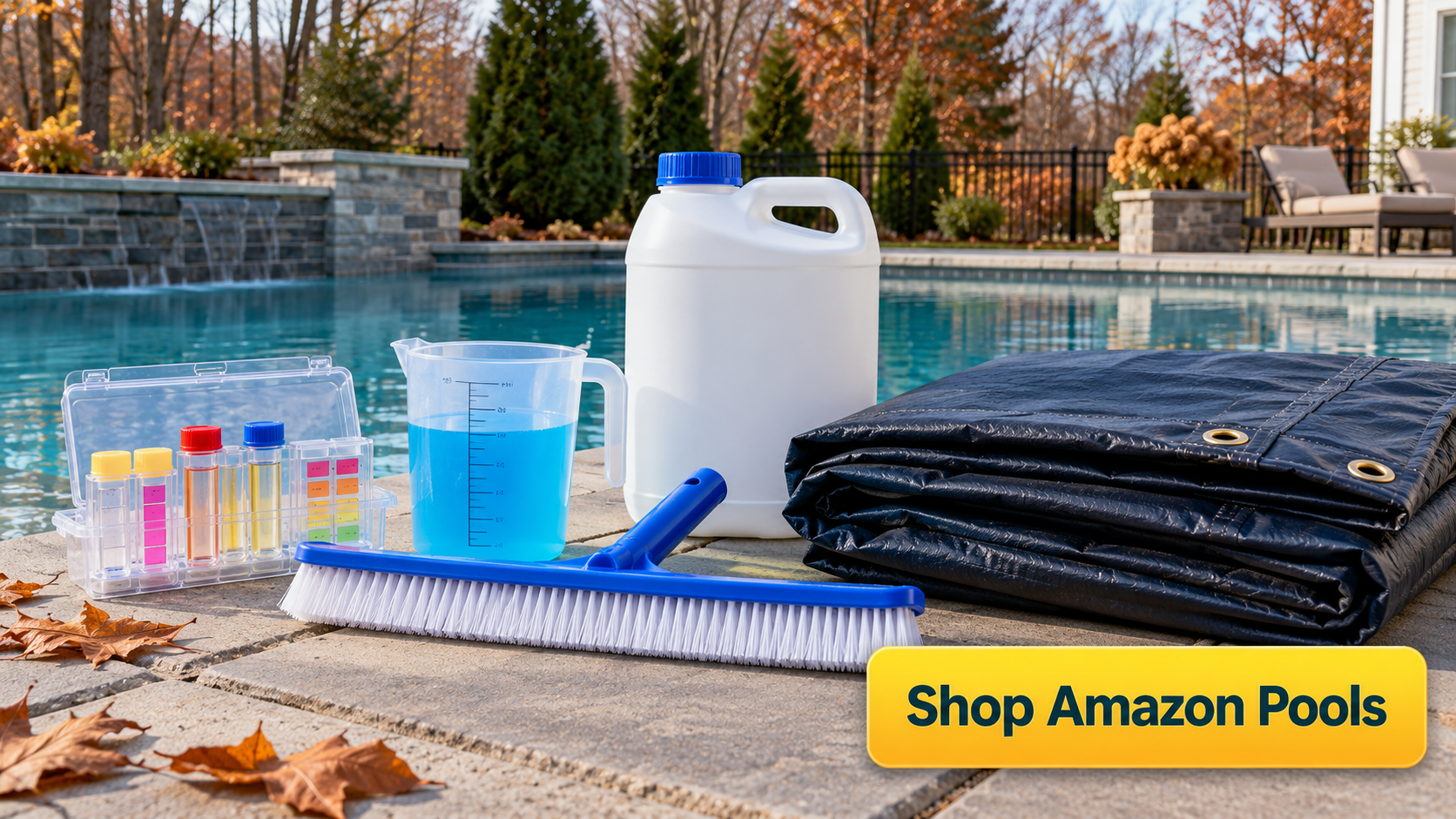
Some links on this page are affiliate links. If you buy through them, Pool Chemical Calculator may earn a commission at no additional cost to you. Shop Amazon pool winterizing supplies and always follow the product label.
Use the app before you close
The Pool Chemical Calculator app helps you calculate pool volume and chemical amounts for your specific water. Check the numbers before you measure, then verify the product label before adding anything.
Recommended pool supplies
As an Amazon Associate, Pool Chemical Calculator earns from qualifying purchases.

Useful for algae cleanup, cloudy water, high bather load, and weekly oxidation routines.
View on Amazon
Fast daily checks between full liquid tests, especially during heavy swim season.
View on Amazon
Accurate readings make every chlorine, pH, alkalinity, calcium, and CYA dose safer.
View on AmazonGet exact pool chemical doses
Pool Chemical Calculator turns your test readings, pool volume, and target levels into exact treatment amounts for chlorine, pH, alkalinity, calcium, stabilizer, salt, and more.
Open the Pool Chemical Calculator app for iOS, Android, or web.