
How Long Does Pool Clarifier Take to Work? (What to Expect)
You poured clarifier into your pool last night and you’re staring at the water this morning wondering why it still looks like skim milk. Totally normal reaction.
Quick answer
How Long Does Pool Clarifier Take to Work? (What to Expect): You poured clarifier into your pool last night and you're staring at the water this morning wondering why it still looks like skim milk. Totally normal reaction. Quick answer: Pool clarifier typically takes 2–3 days to.
Quick answer: Pool clarifier typically takes 2–3 days to fully clear a cloudy pool. You’ll usually see noticeable improvement within 24 hours, but complete clarity — where you can see the drain from the surface — takes 48–72 hours in most cases. Severely cloudy water can take up to 5 days.
The actual timeline depends on a few things: how cloudy the water was to start, whether your filter is running properly, and whether your other chemical levels are balanced. This guide walks through what to expect at each stage and what to do if clarifier isn’t working.
How Pool Clarifier Actually Works
Before getting into timelines, it helps to know what clarifier is actually doing.
Your pool filter is good, but it’s not perfect. Sand filters can only catch particles down to about 20–40 microns. Cartridge filters get down to 10–20 microns. Even DE filters — the most powerful — only reliably catch particles around 3–5 microns.
Cloudiness comes from particles smaller than that: dead algae, bacteria byproducts, sunscreen residue, body oils, fine dust, and pollen. These tiny particles stay suspended in the water instead of sinking, and they pass right through your filter and back out the return jets.
Clarifier is a coagulant — usually a polymer or aluminum-based compound. It carries a positive electrical charge, and those suspended particles carry a negative charge. The clarifier molecules bind to multiple particles simultaneously, creating larger clumps. Once those clumps are big enough, your filter can catch them.
That clumping and filtering process is what takes time.
The Clarifier Timeline: What to Expect Hour by Hour
Hours 1–6: The Waiting Phase
Nothing visible happens yet. The clarifier is dispersing through your pool water and starting to bond with suspended particles. Keep your pump running continuously — clarifier needs circulation to distribute properly.
Don’t check the pool every 30 minutes. The chemistry is working even when you can’t see it.
Hours 6–24: Early Signs
By the end of day one, you’ll usually notice one of two things:
- The water is slightly hazier — This sounds counterintuitive, but it can mean the clarifier is working. Particles are clumping together but haven’t been filtered out yet.
- Slight improvement at the edges or surface — Sometimes you’ll notice the water near the walls looks a bit clearer first.
Keep the pump running. If you have a filter pressure gauge, check it. It may start creeping up as your filter captures more material.
Day 2 (24–48 hours): Visible Progress
This is when most people start seeing real results. The cloudiness should have shifted from “can’t see the bottom” to “hazy but improving.” You might be able to make out the shallow end floor now.
If you have a sand or cartridge filter, this is a good time to backwash or rinse the filter cartridge. A clogged filter will slow down the clearing process significantly.
Day 3 (48–72 hours): Near Clarity
Most pools are substantially clear by day three. The water should look close to normal — you can see the main drain, the bottom tiles, and the waterline all the way around. There may still be a slight haze in deep water, which typically clears overnight.
If your pool is still significantly cloudy at the 72-hour mark, see the troubleshooting section below.
Day 4–5: Complete Clarity
For stubborn cloudiness or larger pools (20,000+ gallons), full clarity can take up to 5 days. This is also the case if:
- Your cloudiness was caused by algae (even dead algae takes extra time)
- Your filter hasn’t been cleaned recently
- The clarifier was slightly under-dosed
What Affects How Fast Clarifier Works
1. Severity of Cloudiness
A mildly hazy pool (you can see the bottom but it’s fuzzy) will clear in 24–48 hours. A pool where you can’t see past 12 inches will take 3–5 days.
2. Filter Type and Condition
DE filters clear clarifier-treated water fastest because they have the finest filtration. Cartridge filters are next. Sand filters are slowest but still effective.
A dirty filter makes everything slower. If you haven’t cleaned your filter in the past month, do it before or right after adding clarifier.
3. Pump Run Time
Clarifier requires your pump to run continuously — or at minimum 12–18 hours per day. If your pump is on a timer that only runs it 4–6 hours a day, results will take longer. Override the timer and run the pump non-stop until the pool is clear.
4. Chemical Balance
Clarifier works best when your pool’s chemistry is in the normal range:
- pH: 7.4–7.6
- Alkalinity: 80–120 ppm
- Free Chlorine: 1–3 ppm
- CYA: 30–50 ppm
If your pH is way off or chlorine is near zero, fix those first. Clarifier is less effective in chemically imbalanced water.
You can check all these levels instantly with the Pool Chemical Calculator app — it calculates exactly what to add based on your pool size and current readings.
5. Dosage
More is not better with clarifier. Over-dosing can actually make things worse — too much clarifier creates particles that are too large for the filter but too small to settle. Follow label directions exactly. Typical dosage is 1–2 oz per 5,000 gallons for cloudy water treatment.
How to Speed Up Pool Clarifier
If you want to get results faster, here are a few things that actually help:
Run the pump 24/7. Don’t give the filter a break until the water is clear. Continuous circulation is the single biggest factor in clearing time.
Clean your filter first. A fresh, clean filter captures clarifier-clumped particles much faster than one that’s already loaded with debris. Backwash your sand filter or rinse your cartridge before adding clarifier.
Vacuum the pool bottom. Before adding clarifier, vacuum any visible debris. Less particulate in the water means the clarifier can work faster on what’s actually causing the cloudiness.
Use the right clarifier. Polymer-based clarifiers (most retail products) work well for general cloudiness. For really heavy cloudiness, some pool owners combine a low dose of clarifier with a partial dose of flocculant to drop the worst of it fast, then let clarifier handle the rest. (Note: don’t use full doses of both — you’ll overwhelm your system.)
Pool Clarifier Not Working? Here’s Why
If you’ve waited 3+ days and the pool still looks cloudy, something is preventing it from working.
The Filter Is Overwhelmed or Clogged
This is the most common issue. Check your filter pressure. If it’s 8–10 psi above your clean starting pressure, the filter is clogged and can’t capture any more particles. Backwash immediately, then let the pump run another 24 hours.
pH Is Too High or Too Low
Clarifier effectiveness drops significantly outside the 7.2–7.8 range. Test your pH and adjust if needed. Muriatic acid lowers pH; baking soda raises alkalinity and can help stabilize pH.
The Water Is Saturated With Debris
If there was a heavy algae bloom, a lot of people in the pool, or a recent storm, the sheer amount of suspended particles can be more than clarifier alone can handle. In this case, consider using a flocculant first to drop the bulk of the material, then vacuum to waste, then add clarifier for the remainder.
Wrong Product for the Problem
Clarifier only works on suspended particles. It won’t fix:
- Green water from active algae (you need to kill the algae first with chlorine shock)
- Brown or yellow water from metals like iron or copper (you need a metal sequestrant)
- Water that’s cloudy due to very high calcium hardness causing precipitation
Test your water thoroughly before throwing clarifier at the problem.
Clarifier vs. Flocculant: Which Is Faster?
If speed is your priority and you can’t wait 3 days, pool flocculant (floc) is faster — 12–24 hours vs. 48–72 hours for clarifier.
The tradeoff: flocculant works by sinking particles to the bottom of your pool in a thick layer of sediment, which you then have to vacuum to waste manually. It’s faster, but more work.
Clarifier is set-it-and-forget-it. Flocculant is faster but requires manual labor.
For a same-day party: use flocculant.
For a weekend pool party 3 days out: use clarifier.
Best Pool Clarifiers
Clorox Pool & Spa Super Water Clarifier — Reliable polymer clarifier for most residential pools. Works in 48–72 hours for moderate cloudiness.
BioGuard Pool Tonic Ultra — Stronger formula for stubborn cloudiness. Good for post-algae treatment.
HTH Super Clarifier — Budget-friendly option. Effective for light-to-moderate haze.
Step-by-Step: How to Use Pool Clarifier Correctly
- Test your water — Check pH (target 7.4–7.6), alkalinity (80–120 ppm), and free chlorine (1–3 ppm). Fix anything out of range before adding clarifier.
- Clean the filter — Backwash sand/DE filters or rinse cartridge filters before starting.
- Calculate your dose — Read the label. Most clarifiers recommend 1–2 oz per 5,000 gallons for cloudy water.
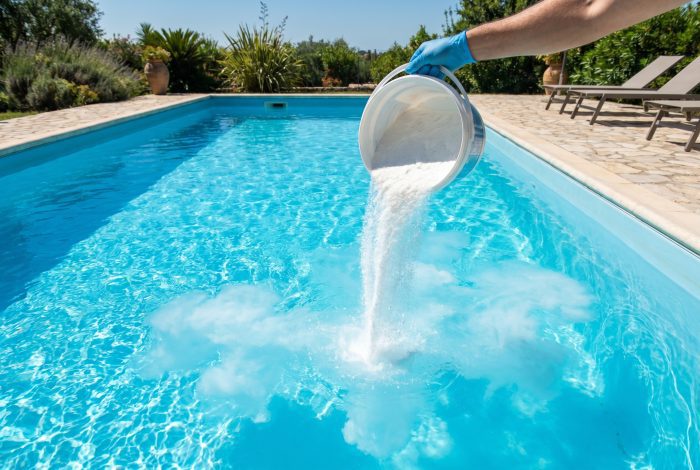
- Add clarifier to the pool — Pour slowly near a return jet while the pump is running. Don’t add near the skimmer.
- Run the pump continuously — Keep it running 24/7 until the water clears.
- Check pressure daily — Backwash or clean the filter whenever pressure rises 8–10 psi above normal.
- Give it 48–72 hours — Resist the urge to add more clarifier after 24 hours if the water hasn’t cleared. Wait the full 72 hours before troubleshooting.
- Test again after clearing — Once the water looks clear, retest your chemistry and make any final adjustments.
FAQ
How long does pool clarifier take to work?
Most pool clarifiers take 48–72 hours to fully clear cloudy water. You’ll see noticeable improvement within 24 hours, but complete clarity — especially in deep sections — typically takes 2–3 days. Severely cloudy or large pools can take up to 5 days.
Can I swim while clarifier is working?
Yes, it’s generally safe to swim while clarifier is working, as most polymer-based clarifiers are non-toxic. However, swimming disturbs the water and can slow down the filtering process. Ideally, minimize pool use for the first 24–48 hours after adding clarifier.
Should I run the pump after adding clarifier?
Yes — run the pump continuously. Clarifier requires constant water circulation to distribute properly and to move the clumped particles through your filter. Shutting off the pump will significantly slow clearing time.
Why is my pool still cloudy after 3 days of clarifier?
The most common reasons are: a clogged filter that needs backwashing, pH out of range (making clarifier less effective), under-dosing, or a larger underlying problem like active algae that clarifier alone can’t fix. Check your filter pressure first and clean it, then retest your water chemistry.
Can I add more clarifier if it’s not working?
Wait at least 72 hours before adding a second dose. Adding too much clarifier can actually reverse-coagulate particles and make cloudiness worse. If 72 hours have passed and the water isn’t clearing, check and clean your filter first, then consider a second half-dose.
What’s the difference between clarifier and flocculant?
Clarifier sends particles to your filter; flocculant sinks them to the pool floor for manual vacuuming. Clarifier is lower effort but takes 2–3 days. Flocculant works in 12–24 hours but requires vacuuming to waste. Use flocculant when you need results fast and don’t mind the extra work.
Does clarifier work for green pools?
No — not directly. Green water is caused by algae, and clarifier doesn’t kill algae. You need to shock the pool with a high dose of chlorine to kill the algae first. Once the algae is dead (water turns gray or white-cloudy), then clarifier can help clear the dead algae particles.
Can pool clarifier damage my pool?
No, when used at correct doses, pool clarifier is safe for pool surfaces, equipment, and swimmers. The only risk is over-dosing, which can make cloudiness worse but doesn’t damage anything permanently.
Bottom Line
Pool clarifier takes 2–3 days to fully clear cloudy water under normal conditions. The process is largely passive — you add it, run your pump, and let the filter do the work. Clean your filter before and during the process, keep your pump running continuously, and make sure your other chemical levels are balanced.
If you’re not seeing improvement after 72 hours, check your filter first (it’s almost always the culprit), then look at your pH and chlorine levels.
For exact chemical dosing based on your pool’s size and current readings, the Pool Chemical Calculator app can tell you precisely what you need — no guessing.
As an Amazon Associate, Pool Chemical Calculator earns from qualifying purchases. A clean cartridge improves circulation and helps cloudy water clear faster. Drops suspended particles to the floor for vacuuming to waste when water is severely cloudy. Helpful for spot-cleaning settled debris, dead algae, and problem areas after treatment.Recommended pool supplies


Get exact pool chemical doses
Pool Chemical Calculator turns your test readings, pool volume, and target levels into exact treatment amounts for chlorine, pH, alkalinity, calcium, stabilizer, salt, and more.
Open the Pool Chemical Calculator app or download it from the App Store and Google Play.