
Borax Pool Calculator: How to Raise pH Safely with Exact Dosing Examples
Quick answer
Use borax when your pool pH is low but total alkalinity is already close to range. As a starting estimate, 20 Mule Team Borax often raises pH in a 10,000 gallon pool by roughly 0.1 to 0.2 per 10-20 ounces, but the exact dose depends on current pH, target pH, alkalinity, borate level, and pool volume. Add it in small doses, circulate 30-60 minutes, and retest before adding more. For exact dosing, use the Pool Chemical Calculator app: https://poolchemicalcalculator.com/app
Quick answer
Borax Pool Calculator: How to Raise pH Safely with Exact Dosing Examples: Quick answer Use borax when your pool pH is low but total alkalinity is already close to range. As a starting estimate, 20 Mule Team Borax often raises pH in a 10,000 gallon pool by roughly 0.1 to 0.2 per 10-20 ounces.
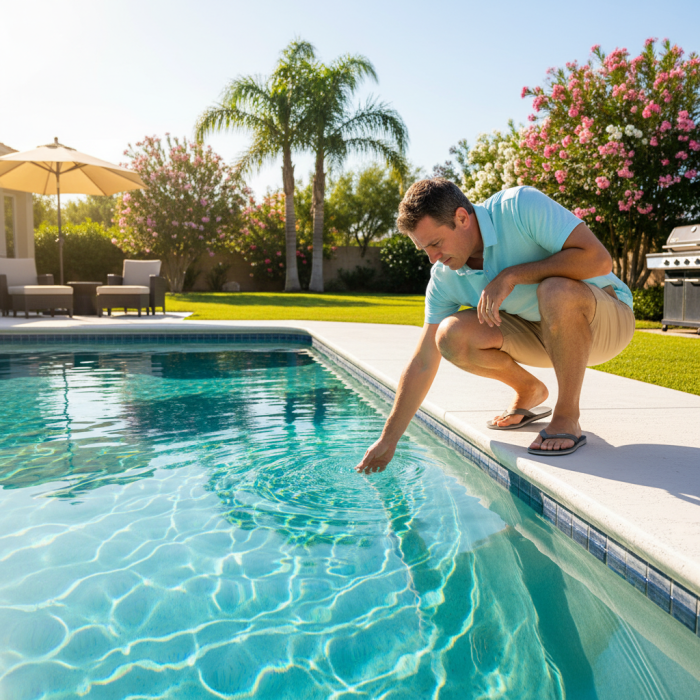
Your pool’s pH just tested low again. Maybe it’s sitting at 7.0, and your eyes burned after yesterday’s swim. You’ve heard borax can fix this without spiking your alkalinity through the roof. But how much do you actually need?
A borax pool calculator takes the guesswork out of pH adjustment. Unlike soda ash, which raises both pH and total alkalinity (TA), borax nudges your pH upward while leaving TA relatively stable. That’s a big deal if your alkalinity is already where you want it. The challenge? Getting the dose right. Too little and you’re back testing tomorrow. Too much and you’ve got cloudy water and potential scaling issues.
I’ve put together dosing scenarios, safety steps, and a side-by-side comparison with soda ash so you can make this adjustment confidently—and safely.
What We Analyzed: Borax pH Adjustment Scenario Matrix
To help you calculate borax doses for your specific situation, I created a scenario matrix using widely cited pool chemistry guidelines. This isn’t based on user surveys or proprietary testing—it’s calculated from industry-standard rules of thumb that experienced pool owners have used for decades.
Methodology: These calculations use the commonly referenced guideline that 20 ounces of borax (by weight) per 10,000 gallons raises pH by approximately 0.2-0.3 units and adds roughly 8-10 ppm of borates to pool water. The exact pH increase varies based on your starting total alkalinity, water temperature, and other dissolved minerals.
Limitations: Pool chemistry isn’t perfectly linear. Higher TA levels act as a buffer, requiring more borax to achieve the same pH shift. These figures represent starting points—always test and adjust. Your actual results may differ by 10-20%.
Borax Dosing Scenarios by Pool Volume and pH Target
| Pool Volume | Current pH | Target pH | Current TA (ppm) | Borax Dose (oz) | Est. Borate Increase | TA Impact |
|————-|———–|———–|——————|—————–|———————|———–|
| 10,000 gal | 7.0 | 7.4 | 80 | 40-50 oz | 16-20 ppm | +2-4 ppm |
| 10,000 gal | 7.2 | 7.4 | 100 | 20-25 oz | 8-10 ppm | +1-2 ppm |
| 15,000 gal | 7.0 | 7.4 | 80 | 60-75 oz | 16-20 ppm | +2-4 ppm |
| 15,000 gal | 7.2 | 7.4 | 100 | 30-38 oz | 8-10 ppm | +1-2 ppm |
| 20,000 gal | 7.0 | 7.4 | 80 | 80-100 oz | 16-20 ppm | +2-4 ppm |
| 20,000 gal | 7.2 | 7.4 | 100 | 40-50 oz | 8-10 ppm | +1-2 ppm |
| 25,000 gal | 7.0 | 7.4 | 100 | 100-125 oz | 16-20 ppm | +2-4 ppm |
| 25,000 gal | 7.2 | 7.4 | 120 | 60-75 oz | 8-10 ppm | +1-2 ppm |
How to use this table: Find your pool volume in the left column, then match your current pH and approximate TA level. The borax dose column shows the recommended starting amount. Always add the lower amount first, wait 4-6 hours with the pump running, then retest before adding more.
Notice how pools with lower TA need more borax to hit the same pH target? That buffering effect is real. If your TA is on the higher end (120+ ppm), you might need 20-30% more borax than these estimates suggest.
Understanding How Borax Affects Your Pool Chemistry
Borax—specifically sodium tetraborate decahydrate, the stuff you’ll find as 20 Mule Team Borax—works differently than other pH increasers. When it dissolves, it creates boric acid and sodium hydroxide. The sodium hydroxide is what actually raises pH.
The pH-TA Relationship
Here’s what makes borax special: it raises pH with minimal impact on total alkalinity. Compare that to soda ash (sodium carbonate), which hammers both numbers at once.
Borax vs. Soda Ash: Side-by-Side Comparison
| Chemical | Dose per 10,000 gal | pH Increase | TA Increase | Best Use Case |
|———-|——————-|————-|————-|—————|
| Borax | 20 oz | +0.2-0.3 | +1-2 ppm | pH low, TA already in range (80-120 ppm) |
| Soda Ash | 6 oz | +0.2 | +5-7 ppm | pH low AND TA low |
| Baking Soda | 6 oz | +0.1 | +10 ppm | TA low, pH okay |
See the pattern? Borax is your go-to when pH needs a bump but alkalinity doesn’t. If both are low, soda ash handles two problems at once. And if only TA needs work, baking soda is the answer.
Borate Benefits Beyond pH
Adding borax does more than fix pH. You’re also building borate levels in your water. At 30-50 ppm, borates provide:
- pH buffering that reduces how often you need to adjust
- Algae inhibition since algae can’t use borates as a food source
- Softer-feeling water that swimmers actually notice
- Reduced chlorine demand because stable pH means chlorine works more efficiently
The EPA and NSF recommend keeping borates at or below 50 ppm for swimming pools. Using the table above, you can estimate how much each dose adds to your borate level.
Safety Checklist: Before You Add Borax
Borax is relatively safe compared to other pool chemicals, but “relatively” is doing heavy lifting there. Before you start pouring, run through this checklist.
Personal Protective Equipment
- Chemical-resistant gloves – Borax irritates skin with prolonged contact
- Safety glasses or goggles – Getting powder in your eyes causes significant irritation
- Long pants and closed-toe shoes – Cover your skin
- N95 mask or respirator – The fine powder irritates lungs when inhaled
Don’t skip the gloves. I’ve seen pool owners handle borax bare-handed for years without issue, then suddenly develop contact dermatitis. It’s not worth the risk when gloves cost a couple bucks.
Environmental Safety Steps
- Keep pets away – Borax is toxic to dogs and cats if ingested. A dog drinking pool water immediately after treatment could get sick.
- Check the weather – Don’t add borax if rain is forecast within 4-6 hours. Dilution messes up your dosing.
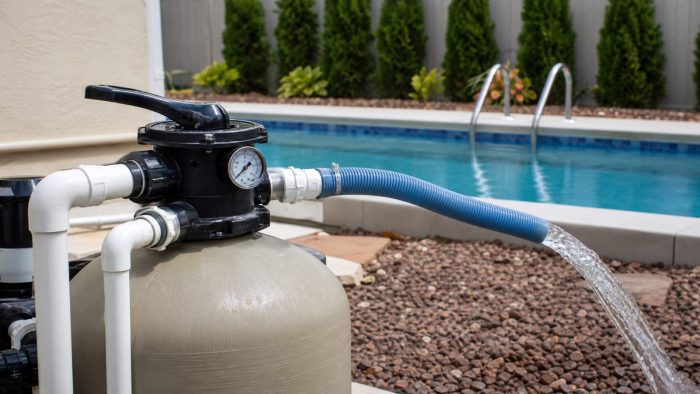
- Ensure the pump is running – You need water circulation for even distribution.
- Remove pool covers – You want ventilation and proper dissolution.
What You’ll Need
- Digital kitchen scale (borax doses are by weight, not volume)
- 5-gallon bucket
- Pool test kit or strips (pH and TA at minimum)
- Wooden stir stick
- Borax (20 Mule Team brand works fine—no need for expensive pool-specific versions)
Step-by-Step: Adding Borax to Your Pool
Once you’ve got your safety gear on and supplies ready, here’s the process.
Step 1: Test Your Water
Test for pH and total alkalinity before adding anything. Write down both numbers. If you don’t know your current levels, you can’t calculate the right dose.
Ideal ranges:
- pH: 7.4-7.6
- Total Alkalinity: 80-120 ppm
- Borates: 30-50 ppm (if you’re maintaining them)
Step 2: Calculate Your Dose
Use the scenario matrix above or this quick formula:
Borax needed (oz) = (Pool gallons ÷ 10,000) × 20 × (Desired pH increase ÷ 0.2)
Example: 15,000-gallon pool, need to raise pH from 7.0 to 7.4 (0.4 unit increase)
- (15,000 ÷ 10,000) × 20 × (0.4 ÷ 0.2) = 1.5 × 20 × 2 = 60 oz
Always round down and add less than you think you need. You can always add more. You can’t take it out.
Step 3: Pre-Dissolve the Borax
Don’t dump powder directly into your pool. It sinks, clumps, and dissolves unevenly.
- Fill a 5-gallon bucket with pool water
- Add borax slowly while stirring
- Keep stirring until fully dissolved (2-3 minutes)
- Water will turn slightly milky—that’s normal
You can dissolve about 30-40 oz per bucket. For larger doses, use multiple batches.
Step 4: Add to the Pool
Pour the dissolved borax solution around the pool perimeter, walking slowly to distribute evenly. Focus on areas with good circulation—near return jets works well.
Never pour directly into the skimmer. The concentrated solution can damage equipment.
Step 5: Circulate and Wait
Run your pump for at least 4-6 hours. Overnight is better. Borax needs time to fully integrate into your water chemistry.
Step 6: Retest and Adjust
After circulation, test pH and TA again. If you’re still below target, calculate and add another partial dose. Repeat until you hit your target range.
What Happens If You Add Too Much Borax?
Overdosing isn’t catastrophic, but it creates problems:
- High pH (above 7.8) – Chlorine becomes less effective. Scale starts forming.
- Cloudy water – Excess borates can cause temporary cloudiness.
- Scaling on surfaces – Calcium deposits become more likely at high pH.
- Skin and eye irritation – pH above 7.8 irritates swimmers.
- Pet toxicity risk – Higher borate concentrations increase danger if pets drink pool water.
How to fix it: Add muriatic acid to lower pH. Test carefully and add in small increments. If borate levels get too high (above 50 ppm), partial water replacement is the only real solution.
When Should You Use Borax Instead of Soda Ash?
Choose borax when:
- Your pH is low (below 7.2) BUT your TA is already 80-120 ppm
- You want to establish or maintain borate levels
- You’re tired of pH constantly drifting and want better buffering
Choose soda ash when:
- Both pH AND TA are low
- You need a quick pH fix and don’t care about borates
- You’re not planning to maintain borate levels long-term
Choose baking soda when:
- TA is low but pH is fine
- You need to raise only alkalinity
Frequently Asked Questions
How long after adding borax can I swim?
Wait until the pump has circulated the water for at least 4-6 hours and you’ve confirmed pH is back in the 7.2-7.8 range. Most pool owners add borax in the evening and swim the next day.
Is 20 Mule Team Borax safe for pools?
Yes. It’s pure sodium tetraborate decahydrate—the same chemical sold in pool stores at higher prices. Check that the box says 100% borax with no added fragrances or surfactants.
Does borax kill algae?
Not directly. Borax raises pH, which can slow algae growth, and the borate residue it leaves behind prevents algae from metabolizing certain nutrients. But it’s not an algaecide. If you have active algae, you need chlorine shock first.
How often should I add borax to my pool?
Once you’ve established borate levels at 30-50 ppm, you typically only need to add more after heavy rain, backwashing, or partial water replacement. Borates don’t degrade or evaporate—they only leave when water leaves.
Can I use borax with a saltwater pool?
Absolutely. Saltwater pools benefit from borate buffering just like traditional chlorine pools. The same dosing guidelines apply.
Sources
- Aiper Pool Borax Calculator – Detailed borax dosing guidelines and calculator methodology
- Beatbot: Raising Pool pH With Borax – Application timing and quantity recommendations
- PoolShark H2O: Borates in Pools – Benefits and ideal borate level maintenance
Take the Guesswork Out of Pool Chemistry
Ready to calculate exact borax doses for your pool? Use our free Pool Chemical Calculator to get personalized recommendations based on your pool volume, current chemistry, and target levels. No more math on paper towels—just enter your numbers and get the answer.
Recommended pool supplies
As an Amazon Associate, Pool Chemical Calculator earns from qualifying purchases.

Lowers high pH and helps bring alkalinity down when used carefully.
View on Amazon
Raises low pH to protect swimmers, plaster, liners, heaters, and metal equipment.
View on Amazon
Useful for algae cleanup, cloudy water, high bather load, and weekly oxidation routines.
View on AmazonGet exact pool chemical doses
Pool Chemical Calculator turns your test readings, pool volume, and target levels into exact treatment amounts for chlorine, pH, alkalinity, calcium, stabilizer, salt, and more.
Open the Pool Chemical Calculator app for iOS, Android, or web.