
Pool Heating Time Calculator: How Long Until Your Pool Is Swim-Ready?
The BTU Formula That Calculates Everything
Every pool heating calculation starts with one formula:
Quick answer
Pool Heating Time Calculator: How Long Until Your Pool Is Swim-Ready?: The BTU Formula That Calculates Everything Every pool heating calculation starts with one formula: Hours to Heat = (Pool Volume × 8.34 × Temperature Rise) ÷ Heater BTU Output Let me break that down: Pool volume in.
Hours to Heat = (Pool Volume × 8.34 × Temperature Rise) ÷ Heater BTU Output
Let me break that down:
- Pool volume in gallons (not sure? Calculate your pool volume here)
- 8.34 = weight of one gallon of water in pounds
- Temperature rise = desired temp minus current temp
- Heater BTU output = your heater’s rating (found on the unit or manual)
Real-World Example
Your pool holds 20,000 gallons. Current water temp is 70°F, and you want 85°F. You have a 400,000 BTU gas heater.
Calculation:
- (20,000 × 8.34 × 15) ÷ 400,000
- (2,502,000) ÷ 400,000
- 6.25 hours
But wait—that’s in a perfect world. Real conditions add 20-30% to that number because of heat loss to air, wind, and evaporation. So budget closer to 8 hours.
Heating Times by Heater Type
Different heaters work at dramatically different speeds. Here’s what to expect:
Gas Heaters: The Speed Champions
Gas heaters (natural gas or propane) pump out 200,000-400,000 BTUs and heat fastest.
| Pool Size | Temp Rise | 250K BTU | 400K BTU |
|———–|———–|———-|———-|
| 10,000 gal | 15°F | 5 hours | 3 hours |
| 15,000 gal | 15°F | 7.5 hours | 4.7 hours |
| 20,000 gal | 20°F | 13 hours | 8 hours |
| 25,000 gal | 20°F | 17 hours | 10.5 hours |
Gas heaters cost more to operate ($3-5 per hour), but they’re unmatched when you need heat fast.
Heat Pumps: Slow and Steady
Heat pumps typically produce 50,000-140,000 BTUs. They pull heat from surrounding air, which means they work best when ambient temps are 50°F+.
| Pool Size | Temp Rise | 100K BTU Heat Pump |
|———–|———–|——————-|
| 10,000 gal | 15°F | 12.5 hours |
| 15,000 gal | 15°F | 19 hours |
| 20,000 gal | 20°F | 33 hours |
| 25,000 gal | 20°F | 42 hours |
Heat pumps shine for maintaining temperature—not racing to reach it. Operating costs run $1-2 per hour, about half of gas.
For detailed comparisons and sizing help, check out our pool heater calculator guide.
Solar Heating: Free But Weather-Dependent
Solar panels add 5-10°F over 3-5 sunny days for most pools. You can’t really “calculate” solar heating time because clouds, ambient temperature, and panel efficiency vary wildly.
General expectations:
- Full sun, 80°F day: 1-2°F rise per day
- Partial clouds: 0.5-1°F rise per day
- Overcast: Minimal gain
Solar works best as a supplement. Run solar during the day, then a heat pump overnight to maintain gains.
The Cover Factor: Don’t Skip This
A solar cover changes everything. Without one, your pool loses 4-5°F overnight through evaporation. That’s like having a heater that runs backward while you sleep.
With a quality solar cover:
- Reduce heat loss by 50-70%
- Cut heating time by 25-30%
- Save $50-100/month on heating costs
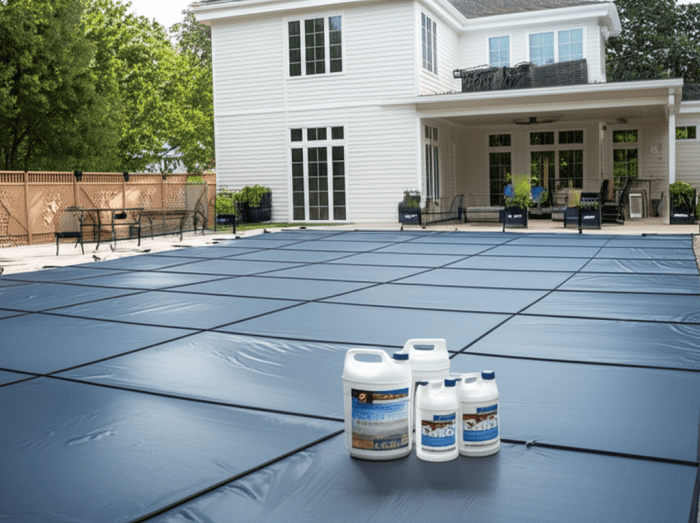
A 12-mil solar cover like this one pays for itself within the first season. Thicker covers retain more heat and last longer than cheap bubble covers.
For accurate planning, track your local weather conditions using our pool forecast tool to see how outdoor temps affect your heating schedule.
Step-by-Step: Calculate Your Pool Heating Time
Here’s exactly how to figure out when to start your heater:
Step 1: Measure Your Current Pool Temperature
Guessing doesn’t work here. Grab a reliable pool thermometer and take readings at multiple spots—surface water is warmer than water near drains.
Record the average temperature. Morning readings are most accurate since the water hasn’t absorbed daytime sun yet.
Step 2: Determine Your Pool Volume
You need gallons, not guesses. Rectangle pools: Length × Width × Average Depth × 7.5. Oval or irregular? Use our pool volume calculator for accurate results.
Write this number down somewhere permanent—you’ll use it constantly for chemical dosing too.
Step 3: Find Your Heater’s BTU Rating
Check the data plate on your heater unit. It’ll say something like “Input: 400,000 BTU” or “Output: 380,000 BTU.”
Use the input number for gas heaters (they’re about 80-95% efficient). Use the output number for heat pumps.
Step 4: Calculate Temperature Rise Needed
Subtract current temp from your target. Most people aim for 82-86°F for swimming comfort.
Example: 68°F water, want 84°F = 16°F temperature rise.
Step 5: Run the Formula
Plug everything into:
(Volume × 8.34 × Temp Rise) ÷ BTU Output = Hours
Then add 25% for real-world heat loss. If you’re using a cover, add only 10-15%.
Step 6: Plan Your Start Time Backward
Have a party at 2 PM Saturday? Calculated heating time is 10 hours with heat loss buffer? Start your heater at midnight Friday.
Better to overshoot slightly—you can always turn it off early. Explaining cold water to guests is awkward.
Why Your Calculated Time Might Be Wrong
Math is perfect. Real life isn’t. Here’s what throws off calculations:
Wind
A 15 mph breeze can double your heat loss rate. Wind strips heat through evaporation faster than still air. If it’s windy, add 20-40% to your heating estimate.
Ambient Temperature
Heating when it’s 55°F outside takes longer than heating when it’s 85°F. Heat pumps especially struggle below 50°F—they need warm air to extract heat from.
Old or Dirty Equipment
A heater caked with scale operates at 60-70% of its rated capacity. Dirty filters restrict flow, reducing heat transfer. Annual maintenance keeps your BTU output honest.
No Cover
I’ll say it again because it matters that much: an uncovered pool loses heat constantly. It’s like heating your house with all the windows open.
Heat Pump Sizing: Bigger Isn’t Always Better
Oversized heat pumps short-cycle (turn on and off repeatedly), which wears them out faster. Undersized ones run constantly and never catch up.
For proper sizing, visit our pool heater sizing calculator. The general rule: 50,000 BTUs per 10,000 gallons for maintenance, double that for rapid heating.
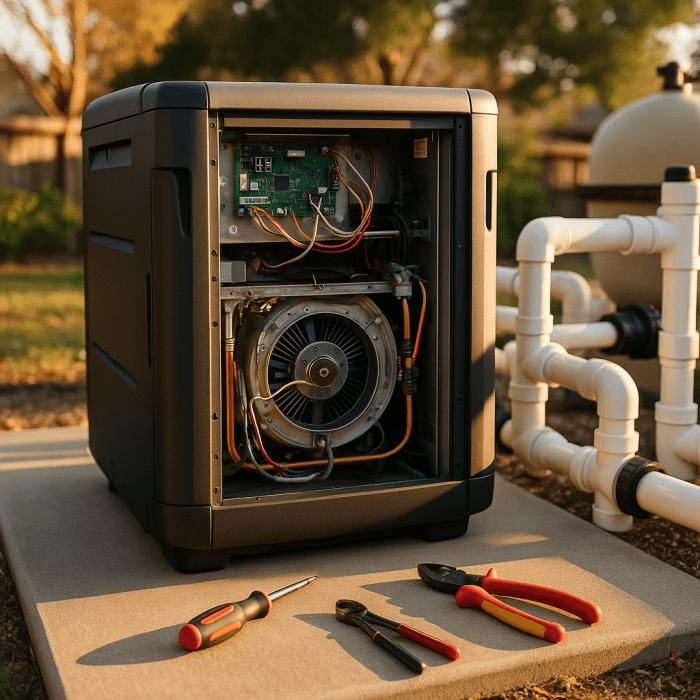
If you’re shopping for a heat pump, units like this 140K BTU model handle most residential pools efficiently while keeping operating costs manageable.
Money-Saving Heating Strategies
Heat During Off-Peak Hours
Many utilities charge less for electricity between 9 PM and 6 AM. Run your heat pump overnight and you’ll save 20-40% on electricity costs.
Use Your Cover Religiously
Every time you swim, pull the cover back. Every time you’re done, put it back on. This single habit cuts heating costs by hundreds annually.
Maintain Instead of Reheat
Once you reach target temperature, it takes far less energy to maintain than to reheat from scratch. A heat pump using 5,000 watts for 4 hours daily beats a gas heater running 8 hours once a week.
Check Tomorrow’s Forecast
Why fight nature? If cold rain is coming, heating today wastes money. Plan your pool use around weather using our forecast tool.
Frequently Asked Questions
How long does it take to heat a pool 10 degrees?
For a 15,000-gallon pool: about 3-4 hours with a 400K BTU gas heater, 12-15 hours with a 100K BTU heat pump, or 2-3 sunny days with solar panels. Using a cover reduces these times by 25-30%.
Can I heat my pool overnight?
Yes, and it’s often the best strategy. Heat pumps run efficiently overnight when electricity rates are lower. A 20,000-gallon pool with a 100K BTU heat pump can gain 8-10°F in an 8-hour overnight run. Cover the pool to prevent heat loss.
Why is my pool taking so long to heat?
Check for: dirty filters restricting water flow, scale buildup on heat exchanger, undersized heater for your pool volume, no cover allowing evaporation, or wind and cold temperatures increasing heat loss. A heater losing 30% efficiency from neglected maintenance makes every calculation wrong.
Is it cheaper to keep a pool heated or reheat it?
Keeping it heated wins—by a lot. Maintaining 85°F costs roughly 40-50% less energy weekly than letting it drop to 70°F and reheating each weekend. This assumes you’re using a cover between swims.
Should I run my pool heater all the time?
Only if you’re using a cover and swimming frequently. Without a cover, you’re literally heating the atmosphere. With a cover and a heat pump, continuous low-level heating is more efficient than periodic blast-heating with gas.
Get Your Exact Heating Time Now
Tired of doing math on paper? Our smart calculator handles all these variables automatically. Just enter your pool specs, heater type, and current conditions.
It factors in your local weather, cover usage, and heater efficiency to give you a realistic heating timeline—not just textbook math. No more cold surprises. No more wasted energy. Just a warm pool ready exactly when you need it.
Recommended pool supplies
As an Amazon Associate, Pool Chemical Calculator earns from qualifying purchases.

Accurate readings make every chlorine, pH, alkalinity, calcium, and CYA dose safer.
View on Amazon
Fast daily checks between full liquid tests, especially during heavy swim season.
View on Amazon
Removes leaves and debris before they consume chlorine and stain the pool.
View on AmazonGet exact pool chemical doses
Pool Chemical Calculator turns your test readings, pool volume, and target levels into exact treatment amounts for chlorine, pH, alkalinity, calcium, stabilizer, salt, and more.
Open the Pool Chemical Calculator app for iOS, Android, or web.