
Pool Timer Keeps Tripping Breaker: Fix It Fast With This Step-by-Step Guide
Nothing kills a Saturday morning faster than walking out to check your pool and finding the pump silent, the timer dark, and your breaker flipped again. When your pool timer keeps tripping the breaker, you’re dealing with an electrical issue that ranges from a simple fix to a serious safety hazard. Either way, you need to solve it before your pool turns green.
Quick answer
Pool Timer Keeps Tripping Breaker: Fix It Fast With This Step-by-Step Guide: Nothing kills a Saturday morning faster than walking out to check your pool and finding the pump silent, the timer dark, and your breaker flipped again. When your pool timer keeps tripping the breaker, you're dealing.
I’ve seen pool owners make this problem worse by just resetting the breaker over and over. Don’t do that. A tripping breaker is your electrical system telling you something’s wrong. Ignoring that warning can damage equipment, start fires, or create electrocution hazards around water — which is about as dangerous as it gets.
Quick Answer
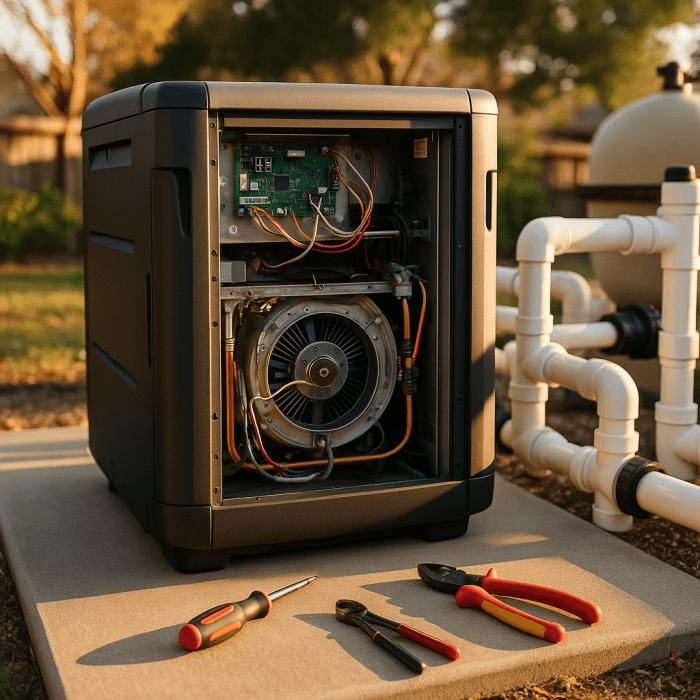
Your pool timer trips the breaker due to one of these common causes: moisture inside the timer enclosure, a faulty GFCI outlet, an overloaded circuit, a bad pump motor or capacitor, damaged wiring, or the timer mechanism itself shorting out. Start by turning off power at the main breaker panel, then inspect the timer box for water intrusion and burnt components. If you see damaged wiring, smell burning plastic, or can’t identify the cause, call a licensed electrician immediately.
Why Does a Pool Timer Trip the Breaker?
Before you start troubleshooting, it helps to understand what’s happening. A circuit breaker trips for three reasons:
- Overload — Too much electrical draw on the circuit (over 80% of rated capacity)
- Short circuit — Hot wire touches neutral or ground, causing massive current spike
- Ground fault — Current leaks to ground through an unintended path (like water)
Pool equipment commonly trips breakers because it lives outdoors, runs for hours daily, and sits next to thousands of gallons of water. That’s a tough environment for electrical components.
⚠️ Electrical Safety Warnings — Read This First
Pool electrical work can kill you. Water and electricity don’t mix, and your pool equipment runs on 120V or 240V circuits that can deliver fatal shocks.
Before touching anything:
- Turn off power at the main breaker panel — not just the timer switch
- Verify power is off using a non-contact voltage tester
- Never work in wet conditions or while standing in water
- Don’t attempt to test live voltage unless you’re a licensed electrician
- If you see melted plastic, burnt wires, or smell burning, stop and call a pro
- All pool electrical equipment must have GFCI protection per NEC code
When to call a licensed electrician:
- Any damaged, melted, or discolored wiring
- Breaker trips instantly when reset (indicates hard short)
- You’re not comfortable identifying the problem
- The issue involves the breaker panel itself
- Your pool equipment lacks proper GFCI protection
Got it? Good. Let’s troubleshoot.
Step-by-Step Troubleshooting Guide
Step 1: Turn Off Power and Document the Problem
Head to your main electrical panel. Find the breaker for your pool equipment — it’s usually a dedicated 20A or 30A breaker labeled “pool” or “pump.” Flip it to OFF.
Before you reset it, note these details:
- Does the breaker trip immediately when you turn it on?
- Does it trip after a few seconds or minutes?
- Does it only trip when the timer activates the pump?
- Is the breaker hot to the touch?
These clues matter. Immediate trips suggest a short circuit. Delayed trips often indicate overload or a motor problem. Trips only when the pump runs point to the pump or its wiring.
Pro tip: A breaker that feels hot means it’s been working hard. This could indicate a failing breaker itself — they don’t last forever, typically 25-40 years.
Step 2: Inspect the Timer Enclosure for Moisture
With power OFF, open your pool timer box. Look for:
- Standing water at the bottom of the enclosure
- Condensation on components
- Rust or corrosion on terminals and wires
- Water stains or mineral deposits
- Damaged gaskets or seals around the enclosure door
Moisture is the number one cause of pool timer electrical issues. Water gets in through cracked housings, failed seals, or condensation during temperature swings. Once inside, it creates ground faults that trip your breaker.
If you find moisture:
- Let the enclosure dry completely (use a fan or wait 24-48 hours)
- Replace damaged seals or gaskets
- Consider upgrading to a weatherproof enclosure
A quality weatherproof timer enclosure runs about $30-50 and prevents most moisture-related failures.
Step 3: Check the GFCI Outlet or Breaker
Pool equipment requires GFCI (Ground Fault Circuit Interrupter) protection. This might be:
- A GFCI outlet near the timer
- A GFCI breaker in your main panel
- Both
GFCIs trip when they detect current imbalance — even tiny amounts (4-6 milliamps) that wouldn’t trip a standard breaker. They’re sensitive by design, which makes them prone to “nuisance tripping.”
Test your GFCI:
- Press the TEST button — it should click and cut power
- Press RESET — power should restore
- If it won’t reset, the GFCI itself may be faulty
You can verify GFCI function with a GFCI outlet tester. Plug it in and press the test button — the tester will tell you if the outlet is wired correctly and if the GFCI responds properly. Every pool owner should have one of these ($15-20) in their toolbox.
GFCIs wear out over time. If yours is older than 10 years and trips frequently, replacement is often the fix.
Step 4: Test for Circuit Overload
Your pool circuit has a capacity limit. A 20-amp circuit handles about 2,400 watts. A 30-amp 240V circuit handles about 7,200 watts.
Add up what’s on the circuit:
- Pool pump motor: 1,200-2,400 watts (varies by HP)
- Timer mechanism: 5-15 watts
- Pool light: 300-500 watts
- Any other equipment on the same circuit
If the total exceeds 80% of circuit capacity, you’ve found your problem. The breaker trips to prevent overheating.
Solutions for overload:
- Run equipment at different times (pump and light on separate schedules)
- Move equipment to a dedicated circuit
- Upgrade to a variable-speed pump (uses 80% less electricity)
Knowing your pool’s actual volume helps you right-size equipment. Use our pool volume calculator to get accurate numbers.
Step 5: Examine the Timer Mechanism and Contacts
Pool timers use mechanical or digital mechanisms to switch your pump on and off. Both can fail.
Mechanical timers (with the dial and trippers):
- Look for burnt or pitted contacts
- Check if trippers are bent, broken, or stuck
- Spin the dial manually — it should rotate smoothly
- Listen for grinding or clicking sounds
Stuck contacts are a common problem. If the contacts weld together, the pump runs continuously and eventually overheats the circuit. Replacement trippers cost just a few dollars and are easy to swap.
Digital timers:
- Check the display — is it functioning?
- Look for error codes
- Inspect the relay (usually a small box that clicks when switching)
- Test if manual override works
If your timer clicks but nothing happens, the internal relay may have failed. If it works on manual but not automatic, the programming or time clock mechanism is the issue.
Step 6: Inspect the Pump Motor and Capacitor
Here’s where things get serious. Pump motor problems cause a huge percentage of breaker trips, but diagnosing them requires some electrical knowledge.
Signs of a failing pump motor:
- Humming but not starting
- Running hot (too hot to touch)
- Starting slowly or struggling
- Making grinding or screeching noises
- Tripping the breaker after running 5-30 minutes
The capacitor issue:
Your pump uses a start capacitor (and sometimes a run capacitor) to get the motor spinning. A bad capacitor makes the motor draw excessive current trying to start, which trips the breaker.
Capacitors look like small cans, usually black, mounted on or near the motor. Warning signs:
- Bulging or swollen top
- Leaking fluid
- Burnt smell
- Visible damage
Important: Capacitors store electrical charge even when power is off. Don’t touch the terminals. If you suspect a capacitor problem, call a pool technician or electrician.
To properly diagnose motor and capacitor issues, you’d need a digital multimeter and knowledge of how to use it safely on high-voltage circuits. For most homeowners, this is where professional help makes sense.
Step 7: Look for Damaged Wiring
With power confirmed OFF at the breaker, visually inspect all wiring between the breaker, timer, and pump.
Look for:
- Cracked, brittle, or deteriorated wire insulation
- Burn marks or discoloration
- Melted wire nuts or connectors
- Exposed copper
- Rodent damage (chew marks)
- Loose connections
Pay special attention to:
- Wire connections inside the timer box
- The whip (flexible conduit) running to the pump
- Where wires enter conduit or junction boxes
Any damaged wiring requires professional repair. Don’t tape over damaged insulation and hope for the best — that’s how pool equipment fires start.
Step 8: Verify Timer Voltage Compatibility
This sounds basic, but I’ve seen it cause problems: is your timer rated for your circuit voltage?
Pool pumps typically run on either:
- 120V — Smaller pumps, above-ground pools
- 240V — Most in-ground pool pumps
Your timer must match. Installing a 120V timer on a 240V circuit will damage the timer and likely trip the breaker. The voltage rating should be printed on the timer’s label or in its manual.
Also check that the timer’s amp rating exceeds your pump’s draw. A timer rated for 20 amps controlling a 25-amp pump load will eventually fail.
Common Causes Summary
| Cause | Symptoms | DIY Fix? |
|——-|———-|———-|
| Moisture in timer box | Intermittent trips, visible water | Yes |
| GFCI tripping | Trips even with timer off | Yes |
| Overloaded circuit | Trips after running a while | Maybe |
| Bad capacitor | Motor hums, won’t start | Call a pro |
| Failing pump motor | Hot motor, slow start | Call a pro |
| Damaged wiring | Burn marks, exposed wire | Call a pro |
| Wrong timer voltage | Immediate trip, new installation | Call a pro |
| Stuck timer contacts | Pump runs constantly | Yes |
Preventing Future Problems
Once you’ve fixed the immediate issue, take steps to prevent recurrence:
- Install a weatherproof enclosure if your timer is exposed
- Apply dielectric grease to wire connections to prevent corrosion
- Schedule annual inspections of all pool electrical equipment
- Keep vegetation trimmed away from electrical boxes
- Run your pump during off-peak times to reduce heat stress on electrical components
And while you’re maintaining your pool, don’t forget water chemistry. Imbalanced water damages equipment faster than you’d think. Keep your chlorine levels between 1-3 ppm and pH between 7.2-7.6 to protect your investment.
Weather affects both your electrical equipment and your water chemistry. Check our pool chemistry forecast to stay ahead of changes.
FAQ
Can I just use a higher amp breaker to stop the tripping?
Absolutely not. Breakers protect your wiring from overheating and starting fires. If you install a 30-amp breaker on a circuit wired with 12-gauge wire (rated for 20 amps), the wire can overheat before the breaker trips. That’s a fire waiting to happen. Always match the breaker to the wire gauge, never to the equipment.
Why does my pool timer only trip the breaker when it rains?
Water is getting into the electrical system somewhere. Check the timer enclosure seals, conduit connections, and the pump motor housing. Even small amounts of moisture can create a ground fault that trips your GFCI. Seal any entry points and consider adding weather shields over outdoor electrical boxes.
My breaker trips when the pump first turns on but not during manual operation. What gives?
The timer’s internal relay or contacts may be failing. When contacts degrade, they create resistance, which generates heat and can cause arcing. Try replacing the timer mechanism or the entire timer unit. If that doesn’t work, the issue might be a pump capacitor that’s borderline — the slight delay from the timer relay is enough to cause startup problems.
Is it safe to run my pool pump without the timer while I troubleshoot?
You can temporarily bypass the timer by connecting the pump directly to power, but only if: (1) you maintain GFCI protection, (2) you use appropriately rated wire and connections, and (3) you supervise operation. Don’t leave a bypassed pump running overnight or unattended. And remember, running your pump 24/7 wastes significant electricity compared to timed operation.
How often should I replace my pool timer?
Mechanical pool timers typically last 7-12 years with proper maintenance. Digital timers often last longer (10-15 years) but their relays can fail sooner. If your timer is approaching 10 years old and causing problems, replacement (about $50-150) is often more cost-effective than repeated repairs.
Take Control of Your Pool Maintenance
Troubleshooting electrical issues is important, but so is staying on top of daily pool chemistry. A tripped breaker means your pump wasn’t running — and even a few hours without circulation can throw off your water balance, especially in hot weather.
Once you’ve got your timer sorted, make sure your chemicals are dialed in. The free Pool Calculator app helps you track chemistry, calculate exact chemical doses for your pool size, and catch problems before they turn into expensive algae treatments. Give it a try — your pool (and your wallet) will thank you.
As an Amazon Associate, Pool Chemical Calculator earns from qualifying purchases. Accurate readings make every chlorine, pH, alkalinity, calcium, and CYA dose safer. Raises free chlorine quickly without adding stabilizer, which is useful when CYA is already high. Useful for algae cleanup, cloudy water, high bather load, and weekly oxidation routines.Recommended pool supplies


Get exact pool chemical doses
Pool Chemical Calculator turns your test readings, pool volume, and target levels into exact treatment amounts for chlorine, pH, alkalinity, calcium, stabilizer, salt, and more.
Open the Pool Chemical Calculator app for iOS, Android, or web.