
Pool Bleach Calculator: How Much Bleach to Add to Your Pool
Keyword: pool bleach calculator
Quick answer
Pool Bleach Calculator: How Much Bleach to Add to Your Pool: Keyword: pool bleach calculator Adding bleach to your pool is one of the cheapest and most effective ways to sanitize your water. But here's the thing — pour in too little and algae takes over. Pour in too much and.
Adding bleach to your pool is one of the cheapest and most effective ways to sanitize your water. But here’s the thing — pour in too little and algae takes over. Pour in too much and you’re wasting money while irritating swimmers’ eyes. A pool bleach calculator takes the guesswork out of dosing by factoring in your pool’s volume, current chlorine level, target level, and the bleach strength you’re using.
Standard 6% household bleach and pool-grade 12.5% liquid chlorine both work. The dose changes because the strength changes. This guide gives you the formulas, real-world dosage charts, and step-by-step instructions to get your free chlorine where it needs to be.
Quick Answer
For a 10,000-gallon pool using standard 8.25% household bleach:
- To raise free chlorine by 1 ppm: Add 10 fluid ounces (about 1.25 cups)
- To raise free chlorine by 2 ppm: Add 20 fluid ounces (about 2.5 cups)
- To raise free chlorine by 3 ppm: Add 30 fluid ounces (about 3.75 cups)
For 12.5% pool-grade liquid chlorine (sodium hypochlorite):
- To raise free chlorine by 1 ppm in 10,000 gallons: Add 6.5 fluid ounces
Want exact calculations for your specific pool? Use our free pool chemical calculator app — just plug in your numbers and get instant results.
Understanding Bleach Strength: Why It Matters
Not all bleach is created equal. The percentage on the label tells you how much sodium hypochlorite (the active sanitizer) is actually in the bottle. Higher percentages mean you need less product.
Common Bleach Concentrations
| Bleach Type | Sodium Hypochlorite % | Best For |
|————-|———————-|———-|
| Bargain household bleach | 6% | Small pools, hot tubs |
| Standard household bleach (Clorox) | 8.25% | Most residential pools |
| Pool-store liquid chlorine | 10% | Regular maintenance |
| Commercial pool-grade | 12.5% | Large pools, heavy use |
Here’s why this matters: If you follow a dosing chart for 12.5% liquid chlorine but you’re using 6% household bleach, you’ll only add half the chlorine you intended. Your water stays under-sanitized, and you’re scratching your head wondering why.
Pro tip: Always check the label. Household bleach brands have shifted concentrations over the years. Clorox moved from 6% to 8.25% about a decade ago. Store brands vary wildly.
The Pool Bleach Dosage Formula
Here’s the practical math behind every bleach calculator:
Fluid ounces needed = (Pool gallons ÷ 10,000) × Desired ppm increase × ounces per 1 ppm
Use these ounces per 1 ppm in 10,000 gallons:
- 6% bleach: about 13 fluid ounces
- 8.25% bleach: about 10 fluid ounces
- 10% liquid chlorine: about 8 fluid ounces
- 12.5% liquid chlorine: about 6.5 fluid ounces
Let’s break that down with a real example:
- Pool size: 15,000 gallons
- Current free chlorine: 1 ppm
- Target free chlorine: 4 ppm
- Desired increase: 3 ppm
- Bleach strength: 8.25%
Calculation: (15,000 ÷ 10,000) × 3 × 10 = 45 fluid ounces
That’s about 5.6 cups, or a little over one-third of a gallon, of 8.25% bleach.
Don’t want to do math? The Pool Chemical Calculator handles this automatically.
Dosage Charts by Pool Size
10,000 Gallon Pool
| Desired Increase | 6% Bleach | 8.25% Bleach | 10% Bleach | 12.5% Bleach |
|—————–|———–|————–|————|————–|
| +1 ppm | 13 oz | 10 oz | 8 oz | 6.5 oz |
| +2 ppm | 26 oz | 20 oz | 16 oz | 13 oz |
| +3 ppm | 39 oz | 30 oz | 24 oz | 19.5 oz |
| +5 ppm | 65 oz | 50 oz | 40 oz | 32.5 oz |
15,000 Gallon Pool
| Desired Increase | 6% Bleach | 8.25% Bleach | 10% Bleach | 12.5% Bleach |
|—————–|———–|————–|————|————–|
| +1 ppm | 19.5 oz | 15 oz | 12 oz | 9.75 oz |
| +2 ppm | 39 oz | 30 oz | 24 oz | 19.5 oz |
| +3 ppm | 58.5 oz | 45 oz | 36 oz | 29.25 oz |
| +5 ppm | 97.5 oz | 75 oz | 60 oz | 48.75 oz |
20,000 Gallon Pool
| Desired Increase | 6% Bleach | 8.25% Bleach | 10% Bleach | 12.5% Bleach |
|—————–|———–|————–|————|————–|
| +1 ppm | 26 oz | 20 oz | 16 oz | 13 oz |
| +2 ppm | 52 oz | 40 oz | 32 oz | 26 oz |
| +3 ppm | 78 oz | 60 oz | 48 oz | 39 oz |
| +5 ppm | 130 oz | 100 oz | 80 oz | 65 oz |
Not sure of your pool’s volume? Use our pool volume calculator to get an accurate gallon count based on your pool’s shape and dimensions.
The CYA Factor: Why Stabilizer Changes Everything
Your cyanuric acid (CYA) level dramatically affects how much free chlorine you actually need. CYA acts like sunscreen for chlorine — it protects it from UV degradation. But it also binds to chlorine molecules, reducing their sanitizing power.
Recommended Chlorine Levels Based on CYA
| CYA Level | Minimum Free Chlorine | Target Free Chlorine |
|———–|———————-|———————|
| 0 ppm (indoor pool) | 1 ppm | 2 ppm |
| 30 ppm | 2 ppm | 3 ppm |
| 50 ppm | 3 ppm | 4 ppm |
| 70 ppm | 5 ppm | 6 ppm |
| 80+ ppm | 6+ ppm | Consider dilution |
If your CYA is at 70 ppm and your free chlorine is 2 ppm, your water isn’t actually sanitized — even though 2 ppm sounds reasonable. The chlorine is bound up and can’t kill bacteria effectively.
The rule of thumb: Maintain free chlorine at roughly 7.5% of your CYA level. A pool with 40 ppm CYA needs about 3 ppm free chlorine.
How to Add Bleach to Your Pool: Step-by-Step
What You’ll Need
- Pool test kit or test strips (test for free chlorine, not just total chlorine)
- Measuring cup or gallon jug
- Chemical-resistant gloves — I recommend these heavy-duty nitrile gloves that won’t degrade from chlorine exposure
- Bleach or liquid chlorine
Step 1: Test Your Current Free Chlorine
Use a reliable test kit. I like the Taylor K-2006 test kit because it uses the FAS-DPD method, which gives accurate readings even at high chlorine levels. Test strips work for quick checks, but a drop-based kit is more precise for dosing calculations.
Record your current free chlorine reading. Not combined chlorine. Not total chlorine. Free chlorine.
Step 2: Determine Your Target Level
Based on your CYA level (see chart above), decide where you need your free chlorine to be. For most residential pools with CYA around 30-50 ppm, aim for 3-5 ppm.
Step 3: Calculate Your Dose
Use the formula, charts above, or the Pool Chemical Calculator app to determine exactly how much bleach you need.
Step 4: Add Bleach Properly
- Run your pump — circulation distributes the chlorine evenly
- Add bleach near a return jet — not into the skimmer
- Pour slowly — splashing concentrated bleach can damage pool surfaces
- Walk the perimeter — for large doses, pour in multiple locations around the pool
Step 5: Wait and Retest
Give the chlorine 30 minutes to circulate fully before retesting. If you’re still below target, add more. If you overshot slightly, the sun will burn off excess chlorine within a few hours.
Troubleshooting Common Bleach Problems
Chlorine Won’t Rise
You keep adding bleach but your free chlorine reads zero or near-zero. What’s happening?
Cause 1: High chlorine demand. Your pool has a buildup of organic contaminants that are consuming chlorine faster than you’re adding it. This happens after heavy use, storms, or neglect.
Solution: Perform a shock treatment. You need to add enough chlorine at once to overwhelm the demand — typically 10-30 ppm depending on severity. Add bleach at dusk (UV won’t destroy it overnight), and keep adding until you hold a chlorine reading.
Cause 2: High CYA levels. Your test might be reading “free chlorine” but the chlorine is actually bound to stabilizer and can’t do its job.
Solution: Dilute your pool water by partially draining and refilling. There’s no chemical that removes CYA.
Green Pool
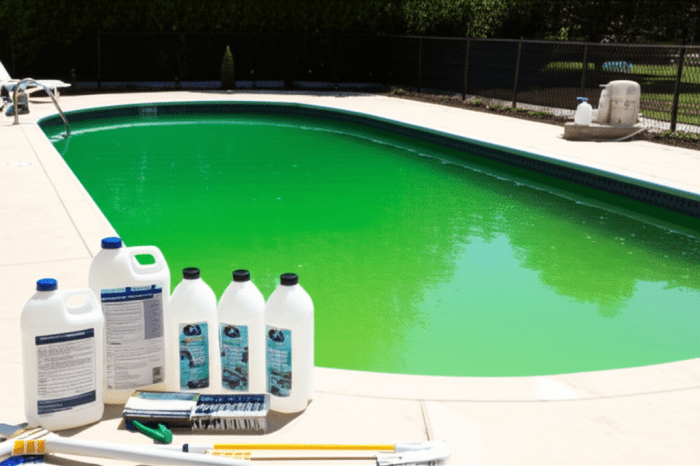
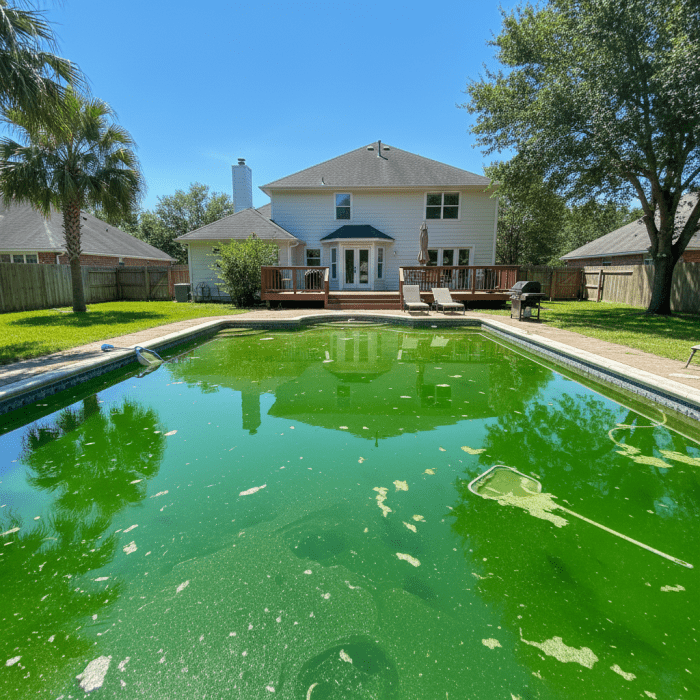
A green pool means algae has established itself. Regular bleach doses won’t cut it — you need to shock hard.
Treatment protocol:
- Brush all surfaces to break up algae colonies
- Run your pump 24/7 during treatment
- Add enough liquid chlorine to reach 10-30 ppm (depending on severity)
- Maintain elevated chlorine until water clears and holds a reading overnight
- Vacuum dead algae to waste
A mildly green pool might clear in 24-48 hours. A swamp needs 4-7 days of aggressive treatment. For severe cases, you might go through 10+ gallons of liquid chlorine — stock up with pool-grade sodium hypochlorite.
Cloudy Water After Adding Bleach
Cloudiness immediately after adding bleach usually means one of two things:
- Dead algae particles — the chlorine killed organisms that are now floating in the water. Run your filter continuously and backwash frequently.
- High pH causing precipitation — bleach has a pH around 11-13 and will temporarily raise your pool’s pH. If pH gets above 8.0, calcium can precipitate out of solution.
Solution: Test and lower pH to 7.4-7.6 using muriatic acid. Run the filter until water clears.
Accidentally Added Too Much Bleach
First, don’t panic. Bleach dissipates naturally, especially in sunlight. Here’s what to do:
- 10-15 ppm: Wait 24-48 hours. Don’t swim until levels drop below 5 ppm.
- 15-25 ppm: Same approach, but it may take 2-3 days.
- Above 25 ppm: You can wait it out or partially drain and refill to dilute immediately.
Do not add chlorine neutralizers unless absolutely necessary — they add unnecessary chemicals and can create rebound issues.
Bleach vs. Pool-Store Liquid Chlorine: Which Is Better?
They’re chemically identical. Household bleach and pool-store liquid chlorine are both sodium hypochlorite dissolved in water. The differences are:
Household bleach (6-8.25%):
- Cheaper per gallon
- Available everywhere
- Lower concentration means hauling more product
- May contain small amounts of surfactants (minimal impact)
Pool-store liquid chlorine (10-12.5%):
- Higher concentration = less to haul
- Often more expensive per actual chlorine content
- Fresher (chlorine degrades over time, and pool stores turn inventory faster)
My recommendation: Use whatever’s cheapest per ounce of actual chlorine. For small maintenance doses, grocery store bleach is convenient. For shocking or large pools, pool-grade liquid chlorine makes more sense.
Just avoid bleach with added scents, thickeners, or “splash-less” formulas. Plain bleach only.
FAQ
How much bleach do I add to a 10,000 gallon pool?
Using standard 8.25% household bleach, add 10 fluid ounces (1.25 cups) to raise free chlorine by 1 ppm in a 10,000-gallon pool. To raise chlorine by 3 ppm, add 30 fluid ounces (about 4 cups). For 12.5% pool-grade liquid chlorine, reduce these amounts by about 35%.
Can I use regular Clorox bleach in my pool?
Yes. Regular, unscented Clorox bleach is safe for pool use. It’s 8.25% sodium hypochlorite — the same active ingredient in pool-store liquid chlorine. Avoid scented varieties, “splash-less” formulas, or bleach with added cleaners. Check the label: you want sodium hypochlorite and water, nothing else.
How long after adding bleach can I swim?
Wait until your free chlorine level drops below 5 ppm before swimming. After a normal maintenance dose, this usually means 15-30 minutes with the pump running. After a shock treatment, wait 8-24 hours and retest before entering the water.
Why does my chlorine disappear so fast after adding bleach?
Three common causes: high chlorine demand from organic contaminants, UV degradation from sunlight, or high CYA binding up the chlorine. If chlorine disappears within hours, your pool likely has high demand — shock it heavily until chlorine holds overnight. If it disappears over 1-2 days, your CYA may be too low (add stabilizer) or too high (dilute pool water).
Is liquid chlorine better than bleach for pools?
They’re the same chemical. Pool-store liquid chlorine is simply a higher concentration (10-12.5%) of sodium hypochlorite compared to household bleach (6-8.25%). Choose based on cost per ounce of actual chlorine and convenience. For large pools or shock treatments, the higher concentration means less lugging of heavy jugs.
Get Exact Dosing in Seconds
Tired of doing math every time you need to add chlorine? The Pool Chemical Calculator app gives you instant, precise dosing recommendations based on your exact pool size, current readings, and the specific bleach concentration you’re using. No formulas, no guesswork — just accurate results.
Try the free Pool Chemical Calculator now
Recommended pool supplies
As an Amazon Associate, Pool Chemical Calculator earns from qualifying purchases.

Raises free chlorine quickly without adding stabilizer, which is useful when CYA is already high.
View on Amazon
Useful for algae cleanup, cloudy water, high bather load, and weekly oxidation routines.
View on Amazon
Lowers high pH and helps bring alkalinity down when used carefully.
View on AmazonGet exact pool chemical doses
Pool Chemical Calculator turns your test readings, pool volume, and target levels into exact treatment amounts for chlorine, pH, alkalinity, calcium, stabilizer, salt, and more.
Open the Pool Chemical Calculator app for iOS, Android, or web.