
What Does Pool Shock Do? The Complete Guide to Shocking Your Pool the Right Way
Quick answer: Pool shock temporarily raises your sanitizer level high enough to destroy algae, break down chloramines (the stuff that causes that “chlorine smell” and eye irritation), and eliminate bacteria that normal chlorine levels can’t touch. Think of it as a deep clean for your water — regular chlorine maintains, shock resets.
Quick answer
What Does Pool Shock Do? The Complete Guide to Shocking Your Pool the Right Way: Quick answer: Pool shock temporarily raises your sanitizer level high enough to destroy algae, break down chloramines (the stuff that causes that "chlorine smell" and eye irritation), and eliminate bacteria that normal.
But here’s what most pool guides don’t tell you: shock does two completely different jobs depending on your situation. Sometimes you’re killing living organisms (algae, bacteria). Other times you’re oxidizing chemical compounds (chloramines, swimmer waste, organic debris). The product you choose and the dose you use depends on which job you’re trying to accomplish.
Let’s break this down so you know exactly what to do.
What We Analyzed: Pool Shock Job Matrix by Water Problem
Before we get into the how-to, I built a comparison matrix showing what shock actually does in different real-world scenarios. This helps you pick the right product and set the right expectation.
Methodology: I compared common residential pool problems using free chlorine readings, combined chlorine levels, CYA (stabilizer) ranges, and shock product characteristics. All doses are calculated for a 10,000-gallon pool so you can scale to your actual volume.
Limitations: Your exact dose depends on your product’s available chlorine percentage, actual pool volume, water temperature, pH level, and current CYA. This matrix is a planning guide — always follow your product label and test after treatment.
| Problem Observed | Current FC / CC | CYA Range | Recommended Shock Type | What Shock Is Doing | Goal FC Level | Main Caution |
|——————|—————–|———–|————————|———————|—————|————–|
| Strong chlorine smell, eye irritation | FC 1 ppm / CC 0.5+ ppm | 30-50 ppm | Cal-hypo or liquid chlorine | Oxidizing chloramines (breakpoint chlorination) | 10× combined chlorine level | Cal-hypo adds calcium; check hardness first |
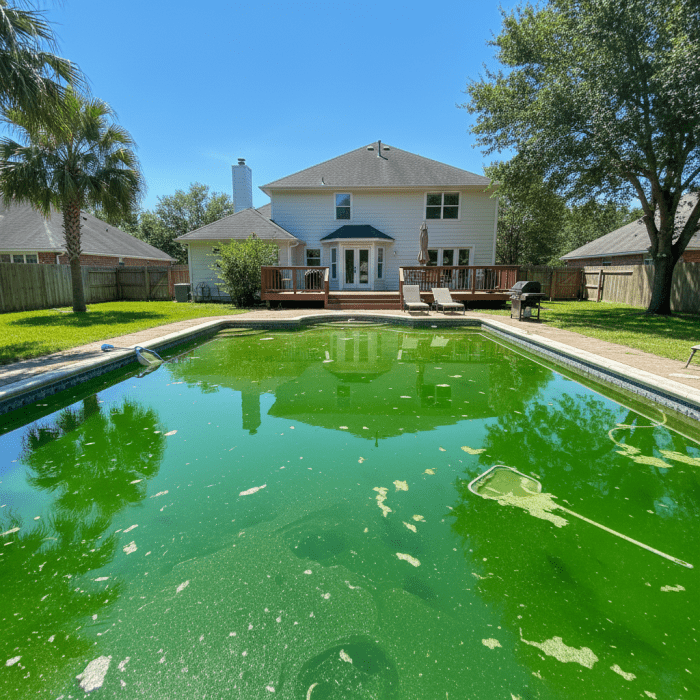
| Visible green algae | FC 0-2 ppm / CC varies | 30-50 ppm | Cal-hypo or liquid chlorine | Killing algae cells | 30+ ppm (maintained overnight) | High CYA requires proportionally higher FC |
| Post-party cloudy water | FC 2 ppm / CC 0.3 ppm | 30-50 ppm | Non-chlorine (MPS) or chlorine shock | Oxidizing swimmer waste, oils, organics | Return to 3 ppm FC | Non-chlorine won’t kill algae if present |
| After heavy rain/storm | FC dropped below 1 ppm | Diluted | Dichlor or cal-hypo | Restoring sanitizer + killing introduced contaminants | 5-10 ppm | Dichlor adds CYA; don’t use if CYA already high |
| Mustard/black algae | FC 0-1 ppm / CC varies | Any | Cal-hypo (high dose) + brushing | Penetrating algae’s protective layer | 30+ ppm for 24+ hours | Requires aggressive brushing; may need multiple treatments |
Use our Pool Volume Calculator to get your exact gallon count before dosing.
The Two Jobs Shock Actually Does
Job 1: Killing Algae and Bacteria
When you have visible algae or suspect bacterial contamination (post-storm, dead animal in pool, illness outbreak), you need chlorine shock — specifically calcium hypochlorite (cal-hypo) or liquid chlorine (sodium hypochlorite).
Why chlorine? Because killing living organisms requires a sanitizer, not just an oxidizer. You need to raise free chlorine to levels that overwhelm the algae’s defenses. For green algae, that means hitting 30 ppm and holding it overnight. Your regular 1-3 ppm maintenance level won’t cut it.
Important: If your CYA (stabilizer) is high — say, above 50 ppm — you’ll need even more chlorine. The CDC recommends maintaining proper chlorine-to-CYA ratios because stabilizer “locks up” some of your chlorine’s killing power.
Job 2: Oxidizing Chloramines and Organic Waste
That strong “pool smell”? It’s not chlorine. It’s chloramines — compounds that form when chlorine binds with ammonia from sweat, urine, and body oils. According to CMAHC guidelines, combined chlorine (chloramines) should stay below 0.4 ppm in properly maintained pools.
Shocking for chloramines requires hitting “breakpoint chlorination” — roughly 10 times your combined chlorine reading. If your test shows 0.5 ppm combined chlorine, you need to add enough shock to raise free chlorine by about 5 ppm.
For this job, non-chlorine shock (potassium monopersulfate/MPS) can work if you don’t have algae. But here’s what most articles miss: non-chlorine shock oxidizes but doesn’t sanitize. It’s great for a quick reset after heavy swimmer load, but it won’t kill algae or bacteria.
How to Shock Your Pool: Step-by-Step Instructions
Before You Start: The Pre-Shock Checklist
- Test your water — You need to know your current free chlorine, combined chlorine, pH, and CYA levels. Can’t dose correctly without this data.
- Check your pH — Get it between 7.2-7.4 before shocking. Chlorine works dramatically better at lower pH. At pH 8.0, chlorine is only about 20% effective. Use our pH Calculator to dial this in.
- Know your pool volume — Guessing leads to under-dosing (waste of money) or over-dosing (bleached liners, irritated skin). Our Volume Calculator handles rectangular, oval, and kidney-shaped pools.
- Check CYA levels — If your stabilizer is above 70 ppm, shocking becomes expensive and less effective. You may need to drain and dilute first. See the CMAHC cyanuric acid guidelines for recommended ranges.
Step 1: Calculate Your Dose
For calcium hypochlorite (65-73% available chlorine):
- Breakpoint chlorination: 1 lb per 10,000 gallons raises FC by approximately 10 ppm
- Algae treatment: 2-3 lbs per 10,000 gallons for visible green algae
For liquid chlorine (12.5% sodium hypochlorite):
- Breakpoint chlorination: 1 gallon per 10,000 gallons raises FC by approximately 10 ppm
Use our Chlorine Shock Calculator to get your exact dose based on your pool size and target level.
Recommended product: In The Swim Cal-Hypo Pool Shock (24-pack) — 73% available chlorine, dissolves quickly, cost-effective for regular maintenance.
Step 2: Prepare the Shock
For granular shock (cal-hypo or dichlor):
- Fill a 5-gallon bucket with pool water
- Add shock slowly while stirring
- Let it dissolve completely — undissolved granules bleach liner and damage surfaces
For liquid chlorine:
- No prep needed. Pour directly into pool water.
Step 3: Add Shock to Your Pool
- Shock at dusk or night. Sunlight destroys unstabilized chlorine within hours.
- Pour the dissolved solution around the pool perimeter
- Avoid dumping it all in one spot
- Keep the pump running for at least 8 hours to circulate
Step 4: Test and Wait
- Wait at least 8 hours before testing
- For algae treatment, maintain high FC levels — retest and add more if FC drops below 10 ppm before algae is dead
- Don’t swim until FC drops to 5 ppm or below (most test kits top out at 5 ppm, so if you can get a reading, you’re close)
Troubleshooting: When Shock Doesn’t Work
Problem: Pool Is Still Green After Shocking
Likely causes:
- Not enough shock — Green algae needs 30+ ppm chlorine. If you only hit 10 ppm, algae laughs at you.
- CYA too high — Above 70-80 ppm, chlorine becomes largely ineffective regardless of concentration. Test CYA and dilute if needed.
- pH too high — At pH 8.0+, chlorine is mostly ineffective. Lower pH to 7.2 before re-shocking.
- Didn’t maintain levels — Shocking once isn’t enough for established algae. You need to hold high chlorine for 24-48 hours.
Fix: Test and adjust pH, verify CYA is under 50 ppm, then double your shock dose. Brush walls and floor aggressively — algae has a protective layer that chlorine can’t penetrate without mechanical disruption.
Problem: Pool Is Cloudy After Shocking
Likely causes:
- Dead algae particles — Good news: you killed the algae. Bad news: corpses cloud the water.
- Calcium precipitation — Cal-hypo adds calcium. If your hardness was already high, you may have clouded the water with calcium carbonate.
- Filter overwhelmed — Your filter can only process so much debris.
Fix: Run your filter 24/7. Backwash or clean it every 12-24 hours. Add pool clarifier to clump particles so your filter can catch them. For severe cloudiness, try Pool Mate Pool Clarifier.
Problem: Chlorine Level Won’t Hold
Likely causes:
- High CYA locks up chlorine — Test with our Stabilizer Calculator
- Organic load too high — Lots of leaves, pollen, or debris consuming chlorine faster than you’re adding it
- Direct sunlight — Unstabilized chlorine (liquid chlorine, cal-hypo) disappears within hours without CYA protection
Fix: Clear debris, verify CYA is 30-50 ppm, and consider using dichlor shock which adds stabilizer. But watch your CYA — too much creates a bigger problem.
Understanding Shock Products: Quick Comparison
| Product Type | Available Chlorine | Adds CYA? | Adds Calcium? | Best For |
|————–|——————-|———–|—————|———-|
| Calcium Hypochlorite (cal-hypo) | 65-73% | No | Yes | Algae, routine shocking |
| Sodium Hypochlorite (liquid) | 10-12.5% | No | No | Algae, daily maintenance |
| Dichlor | 56-62% | Yes | No | Post-rain, low-CYA pools |
| Non-chlorine (MPS) | 0% (oxidizer only) | No | No | Quick oxidation, hot tubs |
For most pool owners, cal-hypo offers the best balance of effectiveness and cost. I recommend DryTec Calcium Hypochlorite Chlorinating Shock for serious algae problems.
Frequently Asked Questions
Does pool shock add chlorine or just activate existing chlorine?
Chlorine-based shock (cal-hypo, dichlor, liquid chlorine) adds new chlorine to your pool. Non-chlorine shock (MPS) doesn’t add chlorine — it oxidizes contaminants but relies on your existing chlorine for sanitation. If your free chlorine is zero, non-chlorine shock won’t sanitize your water.
Will pool shock kill algae?
Chlorine shock will kill algae if you use enough and maintain high levels long enough. Non-chlorine shock won’t kill algae at all — it can only oxidize organic compounds. For visible algae, always use cal-hypo or liquid chlorine and target 30+ ppm free chlorine overnight.
How long after shocking can I swim?
Wait until free chlorine drops to 5 ppm or below. For breakpoint chlorination (around 10 ppm), this usually takes 8-24 hours with the pump running. For heavy algae treatment (30+ ppm), expect 24-48 hours. Always test — don’t guess.
Why does my pool smell like chlorine if the chlorine level is fine?
That smell is chloramines (combined chlorine), not free chlorine. Ironically, a strong “chlorine smell” means you need to add more chlorine to reach breakpoint and destroy the chloramines. Test for combined chlorine — if it’s above 0.3 ppm, shock your pool.
Can I shock my pool during the day?
You can, but you’ll waste product. Sunlight degrades unstabilized chlorine (cal-hypo and liquid chlorine) by up to 90% within a few hours. Shock at dusk or night for maximum effectiveness.
Sources
- CDC — Home Pool and Hot Tub Water Treatment and Testing
- CMAHC — Combined Chlorine and Chloramines Guidelines
- CMAHC — Cyanuric Acid Requirements
- National Collaborating Centre for Environmental Health — Pool Chlorination Guidelines
Get Your Exact Shock Dose in Seconds
Tired of math? Our free Pool Chemical Calculator does the work for you. Enter your pool size and current readings, and get precise dosing instructions for shock, chlorine, pH adjusters, alkalinity, and stabilizer.
Try the Smart Pool Calculator App →
No guessing. No wasted chemicals. Just clear, balanced water.
Related Pool Chemical Calculator Tools
- Pool chlorine calculator
- Pool shock calculator
- Pool pH calculator
- Pool alkalinity calculator
- Pool stabilizer calculator
- Pool volume calculator
Recommended pool supplies
As an Amazon Associate, Pool Chemical Calculator earns from qualifying purchases.

Raises free chlorine quickly without adding stabilizer, which is useful when CYA is already high.
View on Amazon
Accurate readings make every chlorine, pH, alkalinity, calcium, and CYA dose safer.
View on Amazon
Useful for algae cleanup, cloudy water, high bather load, and weekly oxidation routines.
View on AmazonGet exact pool chemical doses
Pool Chemical Calculator turns your test readings, pool volume, and target levels into exact treatment amounts for chlorine, pH, alkalinity, calcium, stabilizer, salt, and more.
Open the Pool Chemical Calculator app for iOS, Android, or web.