
The Best Algaecide for Pools: A Complete Comparison Guide for Homeowners
Quick Answer
The best algaecide for most pools is a non-foaming polyquat 60 formula because it prevents green algae without adding copper or creating foam. Use it as prevention after balancing pH and chlorine, and use shock first if algae is already visible.
Quick answer
The Best Algaecide for Pools: A Complete Comparison Guide for Homeowners: Quick Answer The best algaecide for most pools is a non-foaming polyquat 60 formula because it prevents green algae without adding copper or creating foam. Use it as prevention after balancing pH and chlorine, and use.
You’ve spotted that familiar green tinge creeping across your pool water. Or maybe you’re trying to prevent it from happening in the first place. Either way, finding the best algaecide for pools can feel overwhelming when you’re staring at a shelf full of bottles with confusing labels and percentages.
Here’s the thing: not all algaecides work the same way. Some are gentle preventatives. Others are heavy-duty killers designed for stubborn black algae. Pick the wrong one, and you might end up with stained pool walls, foamy water, or an algae problem that refuses to budge.
I’ve put together this guide to help you understand exactly which algaecide matches your situation — your pool type, your algae problem, and your budget.
What We Analyzed: Pool Algaecide Comparison Table
Before we get into the details, let’s look at how the five main algaecide types stack up against each other. This comparison synthesizes information from multiple pool chemical suppliers and industry resources to give you a clear picture of what you’re choosing between.
| Algaecide Type | Best For | Foaming | Staining Risk | Vinyl Safe? | Salt System Safe? | Relative Cost | Key Advantage | Key Disadvantage |
|—————-|———-|———|—————|————-|——————-|—————|—————|——————|
| Quat (Quaternary Ammonium) | Green algae prevention | High | Low | Yes | Yes | $ | Cheapest option, widely available | Causes foam, weaker on tough algae |
| Polyquat (Polyquaternary Ammonium) | All-purpose prevention | None | Low | Yes | Yes | $$ – $$$ | No foam, no staining, versatile | Higher cost per treatment |
| Copper-Based | Green & yellow algae treatment | None | High | Caution | Caution | $$ | Powerful killer, long-lasting | Can stain plaster and turn hair green |
| Silver-Based | Bacterial control + prevention | None | Medium | Yes | Yes | $$$ | Antibacterial properties | Expensive, limited algae-killing power |
| Sodium Bromide | Black & yellow algae treatment | None | Low | Yes | No | $$ | Activates with chlorine for deep kill | Must be used with shock, single-use |
Methodology: This comparison was constructed by synthesizing product specifications, application guidelines, and compatibility warnings from multiple pool chemical retailers and manufacturer resources. Relative cost estimates reflect typical market positioning based on concentration and dosage requirements — not specific product prices.
Limitations: Actual effectiveness varies by brand, active ingredient concentration, and your specific pool conditions. A 10% polyquat costs less per bottle but requires higher doses than a 60% polyquat. Always check product labels for exact dosing instructions.
Understanding the Five Main Algaecide Types
Quaternary Ammonium Compounds (Quats): The Budget Option
Quat algaecides are the most affordable option you’ll find. They work by disrupting algae cell membranes, making them effective for routine prevention and mild green algae problems.
Best for: Weekly maintenance, light green algae, budget-conscious pool owners
The catch: Quats foam. A lot. If you over-dose (easy to do), your pool will look like a bubble bath. They also increase chlorine demand slightly, so you’ll use a bit more sanitizer.
Typical dosing: 1-2 oz per 10,000 gallons for weekly prevention
A solid budget option is In The Swim Super Algaecide, which works well for regular maintenance without breaking the bank.
Polyquaternary Ammonium Compounds (Polyquats): The Premium All-Rounder
Polyquats are the upgraded version of quats. They don’t foam, won’t stain, and work on all pool surfaces. You’ll pay more upfront, but you get cleaner results.
Here’s where concentration matters:
- 10% polyquat: Cheaper per bottle, but you need 4-6 oz per 10,000 gallons
- 30% polyquat: Middle ground, typically 2-3 oz per 10,000 gallons
- 60% polyquat: Premium pricing, but only 1-2 oz per 10,000 gallons
When you do the math, a $30 bottle of 60% polyquat often lasts longer than two $12 bottles of 10% polyquat. Calculate your cost per treatment, not cost per bottle.
Best for: Vinyl liner pools, fiberglass pools, anyone who hates foam, regular prevention
Copper-Based Algaecides: The Heavy Hitters
Copper algaecides are the nuclear option for stubborn algae. Copper ions penetrate algae cell walls and kill them from the inside. They’re particularly effective against yellow (mustard) algae that laughs at regular treatments.
But copper comes with risks:
- Can stain light-colored plaster pools (blue-green stains)
- May turn blonde hair greenish
- Builds up in water over time
- Can damage pool heaters with copper heat exchangers
Use copper algaecides when: You have a serious algae infestation that won’t respond to shock and polyquat treatment.
Avoid copper algaecides if: You have a plaster pool, saltwater system, or anyone with light-colored hair swims regularly.
For tough infestations, PoolRX Algaecide Unit offers a controlled-release copper solution that minimizes staining risk while delivering powerful algae control.
Silver-Based Algaecides: The Specialty Choice
Silver algaecides are less about killing existing algae and more about preventing bacterial growth. They’re often combined with copper for a dual-action formula.
Best for: Hot tub and spa use, pools with recurring bacterial issues
The reality: For most backyard pools, silver algaecides are overkill. You’re paying premium prices for antibacterial properties that proper chlorination already provides.
Sodium Bromide: The Black Algae Specialist
Sodium bromide works differently from other algaecides. On its own, it doesn’t do much. But when you add chlorine shock, it converts to hypobromous acid — a powerful oxidizer that penetrates the protective slime layer black algae uses as armor.
Critical application note: You must shock your pool immediately after adding sodium bromide. The two chemicals work together. Bromide without shock is just expensive pool water.
Best for: Black algae (the kind with roots that grows in plaster), yellow/mustard algae that won’t die
Not compatible with: Saltwater chlorine generators (bromide interferes with the salt cell)
Which Algaecide for Which Algae?
Green Algae: The Common Enemy
Green algae is what most pool owners face. It turns water cloudy and green, usually after a rainstorm, a chlorine lapse, or heavy swimmer loads.
Treatment protocol:
- Brush all pool surfaces
- Shock with 2-3 lbs of calcium hypochlorite per 10,000 gallons
- Wait 24 hours
- Add polyquat algaecide at treatment dose
- Run filter continuously until water clears
Best algaecide choice: 30% or 60% polyquat — effective, no staining risk, no foam
Yellow/Mustard Algae: The Stubborn One
Yellow algae looks like sand or pollen on pool walls and floor. It brushes off easily but comes right back. Standard chlorine levels don’t kill it because it has a protective coating.
Treatment protocol:
- Brush thoroughly (this breaks the protective layer)
- Triple-shock the pool (3x normal shock dose)
- Add copper-based or sodium bromide algaecide while chlorine is high
- Keep chlorine elevated for 3-4 days
- Wash all swimsuits, floats, and equipment that touched the infected water
Best algaecide choice: Copper-based (for non-plaster pools) or sodium bromide + shock combo
Black Algae: The Nightmare
Black algae isn’t actually algae — it’s cyanobacteria with deep roots that grow into plaster and grout. Those black spots you see? They’re just the tip. The organism extends into your pool surface.
This requires aggressive treatment:
- Lower pH to 7.2 (improves chlorine effectiveness)
- Use a stainless steel brush on affected areas (nylon won’t cut it)
- Apply granular trichlor directly to spots (turn off pump first)
- Add sodium bromide, then immediately shock
- Repeat daily until spots are gone
- Continue algaecide treatment weekly for a month
Best algaecide choice: Sodium bromide combined with heavy chlorine shock. Copper-based algaecides can help but won’t eliminate established black algae alone.
Algaecide vs. Shock: When to Use Each
This confuses a lot of pool owners, so let’s clear it up.
Shock kills algae. It’s your primary weapon against an active bloom. Calcium hypochlorite or liquid chlorine at high doses oxidizes and destroys algae cells.
Algaecide prevents algae (and helps finish off weakened cells after shocking). Think of it as the cleanup crew that makes sure nothing survives.
The correct order:
- Shock first
- Wait 24 hours for chlorine to drop below 5 ppm
- Add algaecide
- Resume normal maintenance
Adding algaecide to a green pool without shocking first is like spraying air freshener in a dirty room. You’re masking the problem, not solving it.
Step-by-Step: How to Treat Algae With Algaecide
Step 1: Test and balance the water
Test free chlorine, pH, alkalinity, and stabilizer before adding anything. Bring pH to 7.2-7.4 so chlorine works efficiently, then use the Pool Chemical Calculator chlorine calculator to size your shock dose.
Step 2: Brush every affected surface
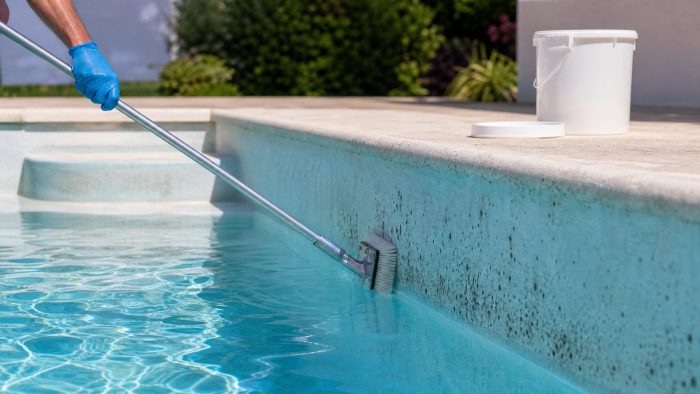
Brush walls, steps, ladders, corners, light niches, and the waterline. Algae protects itself with a slick biofilm, and brushing breaks that layer so shock and algaecide can reach the cells.
Step 3: Shock the pool first
Add the correct shock dose for your pool volume and algae severity. Keep the pump running, and do not add algaecide immediately unless the product label specifically tells you to pair it with shock.
Step 4: Wait for chlorine to drop
Wait about 24 hours, then retest. Add algaecide after free chlorine drops below 5 ppm so the chlorine does not burn off the algaecide before it can help prevent regrowth.
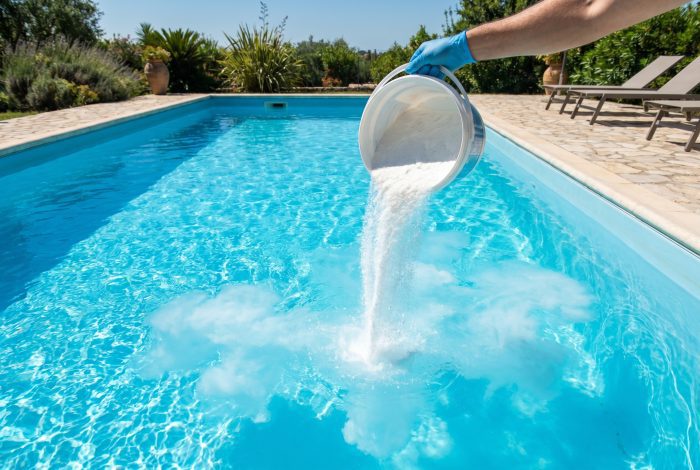
Step 5: Add the right algaecide dose
Measure the dose from your product label based on your actual pool gallons. If you are not sure about volume, use the Pool Chemical Calculator volume calculator before pouring.
Step 6: Filter, clean, and retest
Run the pump continuously until the water clears. Backwash or rinse the filter as pressure rises, vacuum dead algae from the floor, and retest chlorine the next day.
Cost Comparison: What You’re Actually Paying
Let’s do some real math for a 20,000-gallon pool:
| Treatment Scenario | Product Type | Dose Needed | Cost Per Bottle | Cost Per Treatment |
|——————–|————–|————-|—————–|——————-|
| Weekly prevention | 10% Quat | 4 oz | $8-12 | $0.50-0.75 |
| Weekly prevention | 30% Polyquat | 2 oz | $18-25 | $0.60-0.80 |
| Weekly prevention | 60% Polyquat | 1 oz | $28-35 | $0.45-0.55 |
| Green algae treatment | 60% Polyquat | 4 oz | $28-35 | $1.80-2.20 |
| Yellow algae treatment | Copper-based | 6 oz | $20-30 | $1.50-2.25 |
| Black algae treatment | Sodium Bromide | 16 oz | $25-35 | $6.25-8.75 |
The takeaway: Higher-concentration polyquats often cost less per application than cheap quats, plus you don’t deal with foam. For prevention, 60% polyquat gives you the best value over a season.
Compatibility Guide: Protecting Your Pool Investment
Vinyl Liner Pools
Avoid copper-based algaecides entirely. Copper can stain vinyl, and the stains are permanent. Stick with polyquat algaecides — they’re specifically designed to be liner-safe.
Plaster/Gunite Pools
Most algaecides work fine, but be cautious with copper. If your plaster is white or light-colored, copper staining shows up as blue-green discoloration. Test in a small area first, or just use polyquat to be safe.
Fiberglass Pools
Polyquat is your friend. Copper won’t stain fiberglass, but it’s still unnecessary when polyquat works just as well without the risks.
Saltwater Pools
Avoid sodium bromide — it interferes with salt cell function and can damage the chlorine generator. Polyquat algaecides are fully compatible with saltwater systems.
Clorox Pool&Spa Green Algae Eliminator 2 is a solid polyquat option that works safely with all pool types, including saltwater systems.
Why Your Algaecide Might Not Be Working
If you’ve added algaecide and still have algae, check these common issues:
1. Your chlorine is too low. Algaecide supports chlorine — it doesn’t replace it. Keep free chlorine at 1-3 ppm minimum.
2. Your CYA (stabilizer) is too high. When cyanuric acid exceeds 80 ppm, chlorine becomes ineffective even at normal levels. This lets algae thrive despite algaecide treatment.
3. You didn’t brush first. Algae creates a biofilm that protects it from chemicals. Brushing breaks this layer and exposes algae to treatment.
4. Your filter isn’t running enough. Dead algae needs to be filtered out. Run your pump 12-24 hours after treatment.
5. You’re under-dosing. Treatment doses are typically 2-4x the maintenance dose. Read the label carefully.
How Often Should You Add Algaecide?
For prevention: Once weekly, at the maintenance dose listed on your product. Add it after your regular shock treatment has dissipated.
After an algae bloom: Use treatment dose, then switch to weekly maintenance.
Before vacation: Double your normal dose before leaving for a week or more.
Winterizing: Add a quality algaecide when closing your pool. Polyquat works well because it remains stable in cold water.
Frequently Asked Questions
Should I add shock or algaecide first when my pool is green?
Shock first, always. Wait 24 hours for chlorine levels to drop below 5 ppm, then add algaecide. The shock does the heavy killing; algaecide prevents regrowth and finishes off survivors.
Can copper-based algaecides stain my pool?
Yes. Copper can leave blue-green stains on plaster, vinyl, and fiberglass surfaces — especially if water pH rises above 7.8 or if you overdose. Light-colored surfaces show staining more dramatically. If you use copper algaecide, maintain pH between 7.2-7.4 and never exceed the recommended dose.
What’s the difference between 30% and 60% polyquat algaecide?
The percentage indicates active ingredient concentration. A 60% polyquat is twice as concentrated as 30%, so you use half as much per treatment. While 60% costs more per bottle, it typically offers better value per application and lasts longer.
How much algaecide do I need for my pool size?
For maintenance: typically 1-2 oz of 60% polyquat per 10,000 gallons weekly. For treatment: 3-4 oz per 10,000 gallons. A 15,000-gallon pool would need about 2 oz weekly for prevention or 5-6 oz to treat an active bloom. Always verify with your specific product’s label.
Why does my pool foam after adding algaecide?
You’re using a quat-based (quaternary ammonium) algaecide. These products are known for causing foam, especially when overdosed or combined with recent shocking. Switch to a polyquat algaecide if foaming bothers you — they’re specifically formulated to be foam-free.
Sources
- Halogen Supply: Which Algaecide Is Best For Your Pool — Detailed breakdown of algaecide types and their applications
- Pool Parts To Go: What Are The Best Algaecides For Pools — Comprehensive guide to algaecide selection
- Splash Super Center: Which Algaecide Is Best For Your Pool — Comparison of algaecide effectiveness by algae type
- In The Swim: Swimming Pool Algaecides — Industry resource on algaecide chemistry and usage
Take the Guesswork Out of Pool Chemistry
Choosing the right algaecide is just one piece of the puzzle. Your chlorine, pH, alkalinity, and stabilizer levels all work together to keep algae away.
Ready to calculate exactly what your pool needs? Head over to Pool Chemical Calculator to get precise dosing recommendations based on your pool size, test results, and treatment goal.
Get Exact Pool Doses
Use the Pool Chemical Calculator app to size your pool, balance chlorine and pH, and avoid guessing on chemical doses: https://poolchemicalcalculator.com/app
Related guide: Pool chlorine calculator
Related guide: Pool volume calculator
Recommended pool supplies
As an Amazon Associate, Pool Chemical Calculator earns from qualifying purchases.

Helps prevent algae from returning after brushing, shocking, and correcting circulation.
View on Amazon
Useful for algae cleanup, cloudy water, high bather load, and weekly oxidation routines.
View on Amazon
Raises free chlorine quickly without adding stabilizer, which is useful when CYA is already high.
View on AmazonGet exact pool chemical doses
Pool Chemical Calculator turns your test readings, pool volume, and target levels into exact treatment amounts for chlorine, pH, alkalinity, calcium, stabilizer, salt, and more.
Open the Pool Chemical Calculator app for iOS, Android, or web.