
Pool Chlorine Demand Test: How to Find Out Why Your Chlorine Keeps Disappearing
What Causes Chlorine Demand in the First Place?
Chlorine demand isn’t a mystery — it’s chemistry. Your pool water contains stuff that reacts with chlorine. Until all that stuff is oxidized, you won’t hold a chlorine residual.
Quick answer
Pool Chlorine Demand Test: How to Find Out Why Your Chlorine Keeps Disappearing: What Causes Chlorine Demand in the First Place? Chlorine demand isn't a mystery — it's chemistry. Your pool water contains stuff that reacts with chlorine. Until all that stuff is oxidized, you won't hold a chlorine.
Organic Contaminants
This is the big one. Organic matter includes:
- Algae (even dead algae or early-stage growth you can’t see)
- Body oils, sweat, and sunscreen from swimmers
- Leaves, pollen, and grass clippings that blew in
- Urine and fecal matter (yes, really — about 1 in 5 adults admit to peeing in pools)
- Bacteria and microorganisms
A single heavy pool party can introduce enough organic load to create demand for days.
Inorganic Contaminants
These are sneakier because they’re often invisible:
- Ammonia and nitrogen compounds from fertilizer runoff or certain algaecides
- Metals like iron and copper (often from well water or cheap algaecides)
- Phosphates that feed algae growth
Environmental Factors
Your pool’s surroundings matter:
- UV sunlight breaks down unstabilized chlorine rapidly — up to 90% loss in 2 hours without CYA
- Rain dilutes chlorine and introduces airborne contaminants
- High bather loads combined with warm temperatures accelerate everything
How to Perform a DIY Chlorine Demand Test
Here’s the step-by-step process. Plan to start this in the late afternoon or evening so UV loss doesn’t skew your results.
Step 1: Test Your Current Chemistry
Before adding anything, test and record. If you are not sure about your pool size, calculate it first with the pool volume calculator, because every chlorine dose depends on gallons.
- Free chlorine (FC): This is probably near zero if you’re reading this article. Use the chlorine calculator to translate your target ppm into ounces, pounds, or gallons of product.
- pH: Adjust to 7.2–7.4 before shocking. The pH calculator helps you dose muriatic acid, dry acid, soda ash, or borax without guessing.
- CYA (cyanuric acid): Affects your target FC level
- Total alkalinity: If alkalinity is far out of range, use the alkalinity calculator before chasing pH.
A reliable test kit like the Taylor K-2006 Complete Test Kit gives you accurate readings that strips can’t match at high chlorine levels.
Step 2: Calculate Your Initial Shock Dose
Use the dosing chart above, run the exact dose in the Pool Chemical Calculator app, or calculate manually:
For liquid chlorine (10% sodium hypochlorite):
- 10 oz per 1,000 gallons = 1 ppm FC increase
- For 15 ppm in a 15,000-gallon pool: 15 × 15 × 10 oz ÷ 1,000 = 225 oz (about 1.75 gallons)
For cal-hypo (68%):
- 2 oz per 10,000 gallons = 1 ppm FC increase
- For 15 ppm in a 15,000-gallon pool: 15 × 1.5 × 2 oz = 45 oz (2.8 lbs)
I recommend liquid chlorine like Champion Liquid Chlorinating Shock for demand treatment because it doesn’t add CYA or calcium to your water.
Step 3: Add Chlorine and Run the Pump
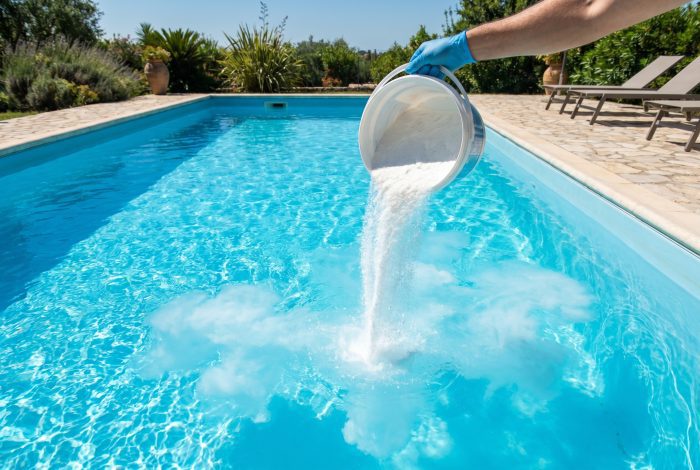
Add your calculated dose with the pump running. Distribute it around the pool’s perimeter, not all in one spot. Keep the pump running continuously throughout this entire process — circulation is critical.
Step 4: Wait 3-4 Hours and Retest
Set a timer. After 3-4 hours, test free chlorine again. Record the result.
This is your chlorine demand measurement. If you added 15 ppm worth of chlorine and only 5 ppm remains, your pool had a chlorine demand of 10 ppm.
Step 5: Repeat Until You Hold Chlorine Overnight
The demand test isn’t complete until your pool holds chlorine overnight. Keep adding shock based on your retest results (use the matrix above), retesting every 4-8 hours.
You’ve “broken” the demand when:
- Free chlorine drops no more than 1-2 ppm overnight
- Water appears noticeably clearer
- Combined chlorine (chloramines) stays below 0.5 ppm
This process can take anywhere from 12 hours to several days depending on contamination severity.
What About CYA Levels During Chlorine Demand Treatment?
This is where a lot of pool owners get confused. Cyanuric acid (stabilizer) protects chlorine from UV breakdown — but it also reduces chlorine’s killing power.
During a chlorine demand situation, you need to think about CYA differently:
If Your CYA Is Low (Under 30 ppm)
Your chlorine is getting destroyed by sunlight AND by contaminants. This makes demand situations worse. Consider using dichlor for part of your shock treatment to add some stabilizer while you shock.
But watch the math: every 10 ppm of chlorine from dichlor adds about 9 ppm of CYA.
If Your CYA Is High (Over 70 ppm)
High CYA means your chlorine is “bound up” and works more slowly. You’ll need higher absolute FC levels to get the same sanitizing effect.
Many pool pros recommend maintaining FC at roughly 7.5% of your CYA level. So if your CYA is 80 ppm, you’d want FC around 6 ppm for normal maintenance — and much higher during shock treatment.
The CYA-Adjusted Shock Target
For demand treatment with high CYA, aim for FC levels of 30-40% of your CYA reading. At 60 ppm CYA, that means shocking to 18-24 ppm FC. If you want the math spelled out, use the breakpoint chlorination calculator guide alongside the app.
Chlorine Demand vs. Chlorine Lock: They’re Not the Same
You’ll see these terms used interchangeably online. They’re different problems.
Chlorine demand means your water is consuming chlorine faster than you can add it because of contamination. The solution is adding more chlorine until you’ve oxidized all the contaminants.
Chlorine lock is a controversial term that some professionals say doesn’t exist. The theory is that extremely high CYA levels (150+ ppm) render chlorine ineffective no matter how much you add. Whether or not “lock” is real, very high CYA does reduce chlorine effectiveness significantly.
If you’ve been shocking aggressively for days and still can’t hold chlorine, test your CYA. If it’s over 100 ppm, you may need to drain and refill 30-50% of your water to dilute it before continuing treatment.
Preventing Future Chlorine Demand Problems
Once you’ve fought through a demand situation, you’ll want to avoid repeating it.
Weekly Prevention Tasks
- Test FC and pH twice weekly minimum (more during heavy use)
- Shock weekly even when water looks fine — 1 lb of cal-hypo per 10,000 gallons
- Run your filter at least 8 hours daily
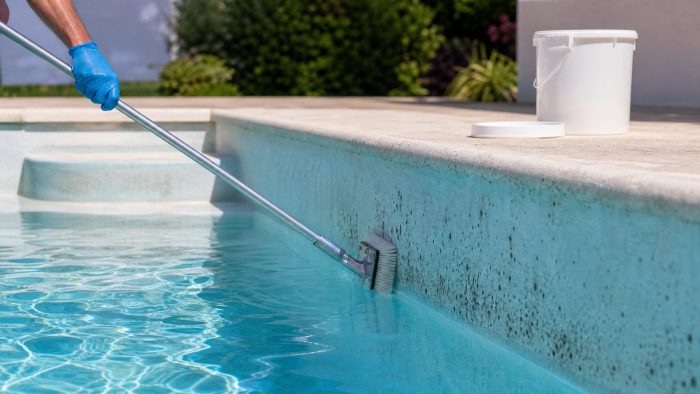
- Brush walls and floor weekly to prevent biofilm buildup
After Heavy Use
Post-party shock is mandatory. For every 10 swimmers over 2 hours, add 1 lb of shock per 10,000 gallons that evening.
After Rain
Rainwater dilutes your chlorine and introduces contaminants. Test and adjust within 24 hours of any significant rainfall.
Maintain Proper Equipment
A clean filter is essential. Backwash sand filters when pressure rises 8-10 psi above clean starting pressure. Clean cartridge filters monthly during swim season. Consider adding a secondary sanitizer system like a mineral purifier to reduce chlorine dependency.
Troubleshooting: When the Test Doesn’t Work
Sometimes you do everything right and still can’t break through. Here’s what to check:
Your Test Kit May Be Wrong
At high chlorine levels (above 10 ppm), test strips become unreliable. OTO (yellow) reagents max out around 5 ppm. You need a DPD drop-based kit for accurate high-range readings.
If your FC reads “off the scale,” dilute your water sample 50/50 with distilled water and multiply the result by 2.
Your pH May Be Too High
Chlorine’s effectiveness drops dramatically above pH 7.8. At pH 8.0, only about 22% of your chlorine is in the active (hypochlorous acid) form. Lower pH to 7.2-7.4 before shocking.
You May Have a Hidden Contamination Source
Check for:
- Dead animals in skimmer baskets or pump strainer
- Rotting debris in a main drain you can’t see
- Algae growing inside the filter
- A broken return line allowing groundwater intrusion
The Water May Be Too Far Gone
If you’ve added 60+ ppm worth of chlorine over several days and still can’t hold a residual, it’s sometimes cheaper to drain and refill. Calculate the cost of chemicals versus water — at a certain point, fresh water wins.
Sources
- Leslie’s Pool: How to Manage Chlorine Demand — Commercial pool retailer guide covering demand basics and treatment steps
- Aqua-Tech: Chlorine Demand Troubleshooting Instructions — Step-by-step diagnostic approach from a Canadian pool service company
- Pool Founder: Chlorine Demand Testing — Detailed breakdown of testing methodology and interpretation
- Caribbean Pools: All About Chlorine Demand — Covers causes and prevention strategies
Frequently Asked Questions
How long does it take to eliminate chlorine demand?
It depends on contamination severity. Mild demand (pool held some chlorine overnight but not enough) might clear in 12-24 hours with proper shocking. Severe demand — where your pool eats 15+ ppm in a few hours — can take 3-5 days of continuous treatment. The key is persistence: keep adding shock every time FC drops below 5 ppm until it holds overnight.
Can I swim during a chlorine demand test?
No. During shock treatment, your FC levels will be far above safe swimming levels (above 10 ppm). Wait until FC drops below 5 ppm — or ideally to your normal maintenance range of 1-3 ppm — before swimming. This usually takes 24-48 hours after you’ve broken through the demand.
Why does my pool have chlorine demand but looks clear?
Clarity and sanitation are different things. You can have crystal-clear water that’s consuming chlorine because of dissolved organic compounds, ammonia, or early-stage algae you can’t see yet. In fact, catching demand at the “clear but no chlorine” stage is ideal — it’s much easier to treat than after visible algae appears.
Is chlorine demand the same as high chlorine usage?
Not exactly. All pools use chlorine as part of normal operation — sunlight breaks it down, swimmers introduce contaminants that get oxidized, etc. Normal chlorine usage is gradual and predictable. Chlorine demand is abnormal consumption where the water “eats” chlorine faster than expected, usually because of accumulated contamination. If you’re adding chlorine daily and still reading zero, that’s demand, not normal usage.
Should I add stabilizer (CYA) before or after fixing chlorine demand?
After. Adding CYA before you’ve eliminated demand just reduces your chlorine’s effectiveness while you’re trying to oxidize contaminants. Shock first with unstabilized chlorine (liquid bleach or cal-hypo) until you’ve broken through. Then adjust CYA to 30-50 ppm for outdoor pools.
Get Your Pool Chemistry Right Automatically
Tired of doing chlorine calculations by hand? Our free Pool Chemical Calculator app tells you exactly how much of any chemical to add based on your current readings, pool size, and preferred products. It works on iOS, Android, and the web from one smart link.
Recommended pool supplies
As an Amazon Associate, Pool Chemical Calculator earns from qualifying purchases.

Raises free chlorine quickly without adding stabilizer, which is useful when CYA is already high.
View on Amazon
Accurate readings make every chlorine, pH, alkalinity, calcium, and CYA dose safer.
View on Amazon
Lowers high pH and helps bring alkalinity down when used carefully.
View on AmazonGet exact pool chemical doses
Pool Chemical Calculator turns your test readings, pool volume, and target levels into exact treatment amounts for chlorine, pH, alkalinity, calcium, stabilizer, salt, and more.
Open the Pool Chemical Calculator app for iOS, Android, or web.