
The Overnight Chlorine Loss Test: Your Pool’s Health Check-Up
Quick answer
Run the overnight chlorine loss test when chlorine drops fast but the cause is not obvious. Test free chlorine after sunset, test again before sunrise, and subtract the morning reading. If the pool loses more than 1 ppm overnight, something in the water is consuming chlorine and you should shock, brush, clean the filter, and keep treating until the test passes.
Quick answer
The Overnight Chlorine Loss Test: Your Pool's Health Check-Up: Quick answer Run the overnight chlorine loss test when chlorine drops fast but the cause is not obvious. Test free chlorine after sunset, test again before sunrise, and subtract the morning reading. If the pool loses.
You add chlorine before bed, and by morning it’s vanished. Sound familiar? The overnight chlorine loss test (OCLT) is the single best way to figure out what’s actually eating your chlorine — because it removes sunlight from the equation entirely. When chlorine disappears at night, you know something in your water is consuming it, not UV rays burning it off.
This simple test takes about 12 hours of your time (mostly sleeping) and can save you from dumping money into a pool that keeps fighting back. Here’s exactly how to run the test, interpret your results, and fix whatever’s lurking in your water.
What We Analyzed: The Overnight Chlorine Loss Diagnostic Matrix
Before we get into the how-to, let’s talk about what the numbers actually mean. Most guides tell you “more than 1 ppm loss = bad.” That’s true, but it’s not the whole picture. Your chlorine loss needs context — water clarity, recent use, temperature, and your CYA levels all change what those numbers mean.
We built this diagnostic matrix by combining common OCLT scenarios with the factors that influence chlorine consumption. Use your test results plus these observations to pinpoint the most likely cause.
Diagnostic Matrix: What Your Results Mean
| FC Loss (ppm) | Water Clarity | Recent Activity | CYA Level | Water Temp | Most Likely Cause | Recommended Action |
|—————|—————|—————–|———–|————|——————-|——————-|
| 0–0.5 | Crystal clear | None/Light | 30–50 ppm | Any | Normal consumption | No action needed; pool is healthy |
| 0.5–1.0 | Crystal clear | Heavy party (6+ swimmers) | 30–50 ppm | 75–85°F | Residual bather waste | Run pump 8 hours, retest tomorrow |
| 0.5–1.0 | Slightly dull | None | 30–50 ppm | >85°F | Early organic buildup | Brush walls/floor, clean skimmer, retest |
| 1.0–2.0 | Slightly dull | None | <30 ppm | Any | Low CYA + mild contamination | Raise CYA to 30–50 ppm, shock to 10 ppm |
| 1.0–2.0 | Cloudy | Rain/storm recently | 30–50 ppm | 75–85°F | Organic debris contamination | Vacuum, clean filter, shock to breakpoint |
| 2.0–3.0 | Dull/hazy | None | 30–50 ppm | >85°F | Early-stage algae (not visible yet) | Begin SLAM process immediately |
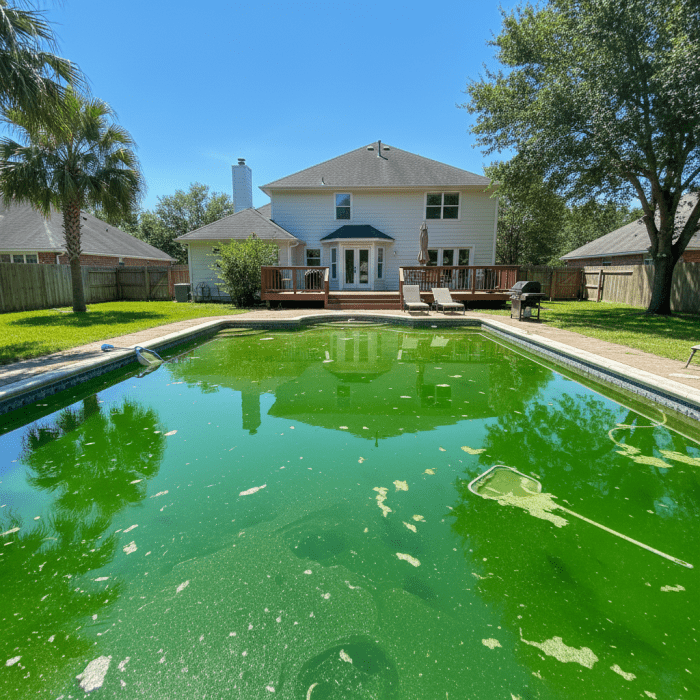
| 3.0+ | Greenish tint | Any | Any | Any | Active algae bloom | SLAM process until 3 consecutive OCLTs pass |
| 2.0+ | Clear | None | Normal | Any | Ammonia or combined chlorine | Test for ammonia; breakpoint chlorinate |
Methodology: Perform an OCLT by measuring Free Chlorine (FC) after sunset and again before sunrise (minimum 8 hours apart). Keep the pump running all night. Record your FC loss, then observe water clarity, note recent bather load and weather, test your CYA level, and record water temperature. Cross-reference these inputs against the matrix above.
Limitations: This matrix covers common scenarios but can’t account for every unique situation. Accuracy depends on reliable FC and CYA testing — cheap test strips won’t cut it here. Complex issues (persistent ammonia, phosphate problems, or equipment failures) may need professional diagnosis.
How to Perform the Overnight Chlorine Loss Test
The OCLT is straightforward, but precision matters. A sloppy test gives you useless data.
What You’ll Need
- A reliable test kit — Taylor K-2006 or FAS-DPD drop test preferred
- A way to add chlorine (liquid chlorine works best for precise dosing)
- A notebook or your phone to record results
- About 12 hours overnight
Step-by-Step Instructions
Step 1: Wait for sunset. Don’t start this test at 3 PM. You need darkness to eliminate UV as a variable. Begin 30–60 minutes after the sun goes down.
Step 2: Test your current Free Chlorine (FC). Use the FAS-DPD method if possible — it’s accurate to 0.2 ppm. Test strips can be off by 1 ppm or more, which defeats the purpose. Write down your starting FC.
Step 3: Ensure no one swims overnight. Swimmers introduce sweat, sunscreen, and other organics that consume chlorine. Even one midnight swim invalidates your test.
Step 4: Keep the pump running all night. You need water circulation to distribute chlorine evenly. If your pump runs on a timer, override it for one night.
Step 5: Cover the pool (optional but helpful). A solar cover prevents debris from falling in overnight. This isn’t required, but it removes one more variable.
Step 6: Test again before sunrise. Aim for at least 8 hours between tests. More is fine — 10 or 12 hours works. Test FC again and record the number.
Step 7: Calculate the difference. Subtract your morning FC from your evening FC. That’s your overnight chlorine loss.
Interpreting Your Results: What’s Normal?
Here’s where most guides oversimplify. “Less than 1 ppm loss is fine” is a decent rule of thumb, but let’s break it down further.
0–0.5 ppm Loss: Healthy Pool
Your pool chemistry is working correctly. The small amount of chlorine that disappeared went toward normal oxidation of trace organics, bacteria, and microscopic debris that filters through even clean water. No action needed.
0.5–1.0 ppm Loss: Watch Zone
This is technically passing, but pay attention to context. Did 8 kids have a pool party yesterday? That explains it. Did nobody swim for three days? That’s a yellow flag.
If you’re consistently seeing 0.5–1.0 ppm loss with light use, your pool might be developing early organic buildup. Brush the walls and floor thoroughly, clean your filter, and retest in a few days.
1.0–2.0 ppm Loss: Something’s Wrong
You’ve got chlorine demand — something in your water is actively consuming sanitizer. Common culprits:
- Organic debris (leaves, pollen, dirt that settled)
- Early algae that’s not visible yet
- Bather waste buildup (oils, sweat, sunscreen)
- Low CYA combined with any of the above
Your move: shock the pool to 10 ppm FC, brush everything, clean the filter, and run another OCLT in 24–48 hours.
2.0–3.0 ppm Loss: High Chlorine Demand
This level of consumption almost always means algae is growing, even if you can’t see green yet. Algae can be white, yellow, or just invisible at early stages. The chlorine loss tells you what your eyes can’t.
You need to start the SLAM process (more on that below) and run consecutive OCLTs until you pass with under 1 ppm loss.
3.0+ ppm Loss: Major Contamination
Your pool is fighting a serious battle. Active algae bloom, ammonia contamination, or severe organic overload. SLAM immediately and don’t swim until you’ve passed three consecutive OCLTs.
Why Is My Pool Losing Chlorine Overnight Even When the Water Looks Clear?
This is the question that trips up most pool owners. Clear water feels like healthy water. But clarity only tells you about particles large enough to scatter light — algae cells, suspended dirt, cloudiness. It tells you nothing about dissolved organics, ammonia, or early-stage contamination.
Think of it like this: you can’t see sugar dissolved in water, but it’s definitely there. Same concept. Chlorine-consuming contaminants can be completely invisible.
Common causes of overnight loss with clear water:
- Combined chlorine (chloramines). When chlorine reacts with nitrogen compounds (sweat, urine, ammonia), it forms chloramines. These are technically “combined chlorine” on your test kit. They don’t sanitize effectively and they consume fresh chlorine. Test your Total Chlorine and subtract FC — if Combined Chlorine is above 0.5 ppm, you need breakpoint chlorination.
- Ammonia contamination. Ammonia can enter your pool from fertilizer runoff, decomposing leaves, or even bird droppings. It’s invisible but creates massive chlorine demand. If you’re losing 2+ ppm overnight with clear water and no obvious cause, test for ammonia.
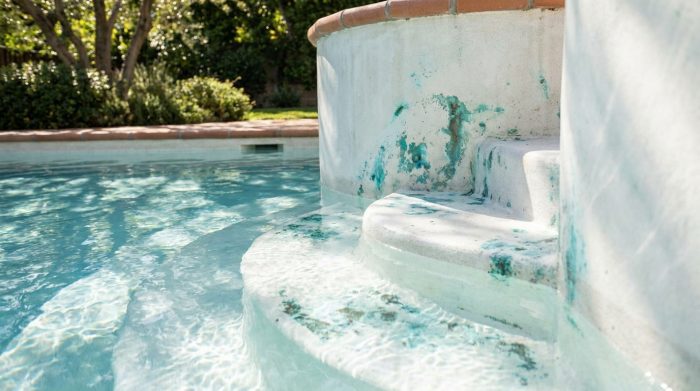
- Early biofilm. Algae doesn’t always float in the water. It can form a thin biofilm on surfaces — especially in crevices, behind ladders, and on pool steps. Your water stays clear while the surfaces quietly consume chlorine. Brush thoroughly and check.
How Water Temperature Affects Chlorine Loss
Warmer water accelerates everything in pool chemistry. Bacteria reproduce faster, algae grows quicker, and chlorine degrades more rapidly at higher temperatures.
Here’s a rough breakdown:
- Below 75°F: Chlorine lasts longer; algae growth is slow. Expect minimal overnight loss.
- 75–85°F: Standard summer conditions. Moderate chlorine consumption. This is your baseline.
- Above 85°F: Chlorine effectiveness drops significantly. You’ll need higher FC levels to achieve the same sanitation, and overnight loss increases even in healthy pools.
If your pool runs warm (above 85°F), don’t panic at 0.8–1.0 ppm overnight loss. That might be normal for your conditions. Compare your results across similar temperature days.
The SLAM Process: When Your OCLT Fails
SLAM stands for Shock Level And Maintain. It’s not just dumping shock in and hoping — it’s a sustained attack on whatever is consuming your chlorine.
How to SLAM Your Pool
- Calculate your shock level based on CYA. At 40 ppm CYA, your shock level is roughly 16 ppm FC. At 30 ppm CYA, it’s around 12 ppm FC. Use a pool calculator to dial this in.
- Raise FC to shock level. Liquid chlorine (sodium hypochlorite) is best because it doesn’t add CYA. Grab a 2-pack of liquid chlorine or buy in bulk at your local pool supply.
- Maintain shock level continuously. Test FC every few hours. When it drops below shock level, add more chlorine. Yes, this is tedious. It works.
- Brush the pool daily. Physical disruption exposes algae hiding in biofilms.
- Run the pump 24/7. Don’t give anything time to settle.
- Run an OCLT every night. SLAM is complete when you pass three consecutive nights with less than 1 ppm FC loss, your water is crystal clear, and your CC is 0.5 ppm or below.
Does Covering My Pool Prevent Chlorine Loss?
Yes and no. A pool cover does two things:
- Blocks debris. Fewer leaves, bugs, and pollen mean less organic matter consuming chlorine.
- Reduces evaporation. Chlorine can off-gas at the water surface, especially from warmer pools.
But a cover doesn’t stop chlorine demand from contaminants already in the water. If you’re losing chlorine overnight with a cover on, the problem is in your water, not falling from the sky.
A solar cover is helpful for the OCLT because it controls variables. But if you pass the test uncovered, you’ll pass it covered too.
How Different Chlorine Types Affect Your Results
Not all chlorine is created equal, and your choice affects long-term CYA management.
Liquid Chlorine (Sodium Hypochlorite)
Adds zero CYA. Best for SLAMming and maintaining pools where you already have adequate CYA. What you see is what you get.
Tablets (Trichlor)
Add CYA with every dose — roughly 0.6 ppm CYA per 1 ppm FC added. Over time, this builds CYA levels. If your CYA creeps above 80 ppm, chlorine becomes less effective and you’ll need more FC to achieve the same sanitation. This can skew your OCLT interpretation because higher CYA requires higher FC targets.
Granular Shock (Dichlor)
Also adds CYA (about 0.9 ppm CYA per 1 ppm FC). Fine for occasional shocking, but not for daily maintenance if you’re watching CYA levels.
Cal-Hypo
Adds calcium, not CYA. Good for pools with low calcium hardness. Bad for pools that already run high (especially plaster pools in hard-water areas).
If you’ve been using trichlor tabs for years and your CYA is above 70 ppm, your “normal” chlorine levels need adjustment. A loss that looks concerning at CYA 40 might be fine at CYA 70 — but you also need higher FC to begin with. Test your CYA with a quality test kit before drawing conclusions.
FAQ
How much chlorine loss is normal overnight?
A healthy pool loses 0–0.5 ppm FC overnight. Losses up to 1.0 ppm can be normal after heavy use or in warm water (above 85°F). Anything above 1.0 ppm consistently indicates chlorine demand from contaminants, organic matter, or algae.
Can I do the OCLT during a cloudy day instead of at night?
Not recommended. Even heavy clouds let through UV rays that degrade chlorine. The point of the test is eliminating UV entirely. Stick to the overnight timing — after sunset to before sunrise.
My pool passed the OCLT but I’m still losing chlorine during the day. What’s wrong?
If daytime loss is your problem, UV degradation is likely the cause. Check your CYA level. Below 30 ppm, sunlight destroys chlorine rapidly. Raise CYA to 30–50 ppm for outdoor pools, and your daytime retention will improve dramatically.
How often should I run an OCLT?
For routine maintenance, once a month is plenty if your pool seems healthy. Run it immediately anytime you notice faster-than-usual chlorine loss, cloudy water, or visible algae. During SLAM, run it every night until you pass three in a row.
What if I keep failing the OCLT even after SLAMming?
Persistent failure usually means one of three things: you’re not maintaining shock level continuously (test and add chlorine more frequently), you have ammonia contamination (requires extreme chlorine levels to burn off), or you have an equipment issue like a filter that’s recycling algae back into the pool. Consider professional diagnosis if you’ve SLAM’d correctly for 5+ days with no improvement.
Calculate the Fix Before You Add Chemicals
Before you shock again, use the Pool Chemical Calculator app to calculate the exact chlorine dose for your pool volume, current free chlorine, target shock level, and product strength. The same smart app link works on iOS and Android.
Sources
- Why Is My Pool Chlorine Disappearing Overnight — Smart ways to identify the real cause of rapid chlorine loss
- Overnight Chlorine Loss Test Guide — Detailed OCLT instructions and interpretation
- Why Does My Pool Lose Chlorine Overnight Even When Covered — Explanation of covered pool chlorine loss causes
- Chlorine Loss in Florida Pools — Temperature and regional factors affecting chlorine
Take Control of Your Pool Chemistry
The overnight chlorine loss test is one of the most useful diagnostics you can run — and it costs nothing but 12 hours. Once you know what you’re dealing with, fixing it becomes straightforward.
Need help calculating exactly how much chlorine to add, or figuring out your shock level based on CYA? Head over to Pool Chemical Calculator and let the math work for you. Clear water is closer than you think.
Recommended pool supplies
As an Amazon Associate, Pool Chemical Calculator earns from qualifying purchases.

Raises free chlorine quickly without adding stabilizer, which is useful when CYA is already high.
View on Amazon
Useful for algae cleanup, cloudy water, high bather load, and weekly oxidation routines.
View on Amazon
Accurate readings make every chlorine, pH, alkalinity, calcium, and CYA dose safer.
View on AmazonGet exact pool chemical doses
Pool Chemical Calculator turns your test readings, pool volume, and target levels into exact treatment amounts for chlorine, pH, alkalinity, calcium, stabilizer, salt, and more.
Open the Pool Chemical Calculator app for iOS, Android, or web.