
Combined Chlorine in Your Pool: What It Is, Why It Stinks, and How to Eliminate It
Quick answer
Combined chlorine in a pool is used-up chlorine that has reacted with sweat, urine, sunscreen, algae, or other contaminants. Keep combined chlorine below 0.5 ppm. If it reaches 0.5 ppm or higher, test free chlorine and total chlorine, calculate the difference, adjust pH to 7.2-7.4, then shock at dusk to reach breakpoint chlorination. Use the Pool Chemical Calculator app to calculate the exact dose for your pool size and product strength.
Quick answer
Combined Chlorine in Your Pool: What It Is, Why It Stinks, and How to Eliminate It: Quick answer Combined chlorine in a pool is used-up chlorine that has reacted with sweat, urine, sunscreen, algae, or other contaminants. Keep combined chlorine below 0.5 ppm. If it reaches 0.5 ppm or higher, test free.
That “chlorine smell” wafting from your pool? It’s not actually chlorine doing its job. It’s combined chlorine — the chemical byproduct of chlorine that’s already been used up fighting contaminants. And here’s the kicker: that smell means your pool needs more chlorine, not less.
Combined chlorine in your pool creates that eye-burning, skin-irritating experience that makes swimmers miserable. It’s the reason indoor pools at hotels smell so harsh and why your eyes turn red after a swim. Understanding what combined chlorine is, how to measure it, and — most importantly — how to get rid of it will transform your pool from a chemical assault to the refreshing oasis it should be.
What We Analyzed: Breakpoint Chlorination Dosage Chart
Before we get into the science, let’s give you what you actually came here for: how much shock you need to eliminate combined chlorine from your pool.
We calculated the required shock dosages for achieving breakpoint chlorination across common pool sizes and combined chlorine levels. Breakpoint chlorination requires raising your free chlorine to approximately 10 times your combined chlorine reading — this is the threshold where chloramines get destroyed rather than just shuffled around.
Methodology: These calculations use standard chemical conversion formulas based on each product’s available chlorine percentage and the breakpoint chlorination principle (10x CC level). We assumed a target of reaching 10 ppm free chlorine for a pool with 1.0 ppm combined chlorine as the baseline scenario.
Limitations: Your actual results will vary based on current pH, cyanuric acid levels, water temperature, and additional organic contamination. These figures represent starting points — you may need to add more if combined chlorine persists after the first treatment.
Shock Dosage Chart for 10,000 Gallon Pool
| Current Combined Chlorine | Liquid Chlorine 12.5% | Cal-Hypo 73% | Dichlor 56% |
|————————–|———————-|————–|————-|
| 0.5 ppm (target 5 ppm FC boost) | 0.5 gallons | 8.5 oz | 11 oz |
| 1.0 ppm (target 10 ppm FC boost) | 1.0 gallon | 17 oz (1.1 lbs) | 22 oz (1.4 lbs) |
| 2.0 ppm (target 20 ppm FC boost) | 2.0 gallons | 34 oz (2.1 lbs) | 44 oz (2.75 lbs) |
Shock Dosage Chart for 20,000 Gallon Pool
| Current Combined Chlorine | Liquid Chlorine 12.5% | Cal-Hypo 73% | Dichlor 56% |
|————————–|———————-|————–|————-|
| 0.5 ppm (target 5 ppm FC boost) | 1.0 gallon | 17 oz (1.1 lbs) | 22 oz (1.4 lbs) |
| 1.0 ppm (target 10 ppm FC boost) | 2.0 gallons | 34 oz (2.1 lbs) | 44 oz (2.75 lbs) |
| 2.0 ppm (target 20 ppm FC boost) | 4.0 gallons | 68 oz (4.25 lbs) | 88 oz (5.5 lbs) |
Shock Dosage Chart for 30,000 Gallon Pool
| Current Combined Chlorine | Liquid Chlorine 12.5% | Cal-Hypo 73% | Dichlor 56% |
|————————–|———————-|————–|————-|
| 0.5 ppm (target 5 ppm FC boost) | 1.5 gallons | 25.5 oz (1.6 lbs) | 33 oz (2.1 lbs) |
| 1.0 ppm (target 10 ppm FC boost) | 3.0 gallons | 51 oz (3.2 lbs) | 66 oz (4.1 lbs) |
| 2.0 ppm (target 20 ppm FC boost) | 6.0 gallons | 102 oz (6.4 lbs) | 132 oz (8.25 lbs) |
Pro tip: Liquid chlorine won’t add cyanuric acid to your pool, making it the preferred choice for breakpoint chlorination when CYA levels are already adequate. Dichlor adds about 0.9 ppm of CYA per 1 ppm of chlorine, which can compound over time.
A reliable test kit makes all the difference here. The Taylor K-2006 Complete Test Kit uses the DPD-FAS titration method and gives you accurate free and total chlorine readings — which is exactly what you need to calculate combined chlorine.
Understanding Combined Chlorine: The Chemistry Behind the Smell
Free Chlorine vs. Combined Chlorine vs. Total Chlorine
Think of chlorine like soldiers in your pool. Free chlorine is fresh troops ready to fight bacteria, algae, and contaminants. Combined chlorine is soldiers who’ve already been in battle — they’re exhausted and can’t fight anymore. And total chlorine? That’s your entire army, both active and spent.
The math is simple:
Total Chlorine – Free Chlorine = Combined Chlorine
So if your test shows 3.0 ppm total chlorine and 2.5 ppm free chlorine, you’ve got 0.5 ppm of combined chlorine hanging around.
What Creates Combined Chlorine?
When free chlorine encounters nitrogen-based compounds, it binds to them and forms chloramines. These nitrogen compounds come from:
- Sweat (contains ammonia and urea)
- Urine (yes, we need to talk about this)
- Body oils and lotions
- Cosmetics and sunscreen
- Environmental debris like leaves and grass clippings
- Fertilizer runoff from nearby lawns
Here’s the uncomfortable truth: the average swimmer introduces about 0.14 grams of urine into a pool per swim session through normal body surface contamination alone. Add in the swimmers who… don’t make it to the bathroom… and you’ve got a significant nitrogen source.
This is why pools with heavy bather loads (backyard parties, swim lessons, hot summer weekends) develop combined chlorine problems faster than lightly-used pools.
Why Combined Chlorine Is Bad News
Combined chlorine causes problems at multiple levels:
Health effects:
- Eye irritation and redness (that “chlorine burn”)
- Skin dryness and itching
- Respiratory irritation, especially in indoor pools
- Worsening of asthma symptoms
- The distinctive “pool smell” that clings to hair and swimsuits
Pool chemistry effects:
- Reduced sanitizing power (chloramines are 40-60 times less effective than free chlorine)
- Cloudy water appearance
- Difficulty maintaining proper chlorine levels
- Higher overall chlorine consumption
The smell itself tells you something important. Properly chlorinated pools shouldn’t smell strongly of chlorine. When you walk into a pool area and get hit with that harsh chemical odor, you’re smelling chloramines — proof the water quality needs attention.
Testing for Combined Chlorine
The Calculation Method
Most pool owners don’t need a separate combined chlorine test. You just need tests that measure both free chlorine and total chlorine.
With a DPD test kit:
- Test for free chlorine first (usually the first reading)
- Add the second reagent to test total chlorine (same sample)
- Subtract: Total – Free = Combined
Digital testers can simplify this process. The LaMotte ColorQ Pro 7 displays both readings digitally, removing the guesswork of color matching.
Acceptable Combined Chlorine Levels
The target is simple: keep combined chlorine below 0.5 ppm. Ideally, you want it at zero.
Here’s how to interpret your readings:
| Combined Chlorine Level | Status | Action Needed |
|————————|——–|—————|
| 0 – 0.2 ppm | Excellent | Normal maintenance |
| 0.2 – 0.5 ppm | Acceptable | Monitor closely, consider mild shock |
| 0.5 – 1.0 ppm | Problematic | Breakpoint chlorination needed |
| Above 1.0 ppm | Urgent | Aggressive breakpoint chlorination required |
Test frequency matters too. Weekly testing works for most residential pools, but increase to 2-3 times weekly during heavy use periods or after pool parties.
How to Eliminate Combined Chlorine: Breakpoint Chlorination
What Is Breakpoint Chlorination?
Breakpoint chlorination is the process of adding enough free chlorine to completely oxidize (destroy) all chloramines in your pool. You need to raise free chlorine to approximately 10 times the combined chlorine level — this is the “breakpoint” where chloramines get converted to nitrogen gas and dissipate into the air.
Below this threshold, you’re just creating more chloramines. It’s counterintuitive, but adding too little chlorine can actually make the problem worse.
Choosing Your Shock Product
Liquid Chlorine (Sodium Hypochlorite 10-12.5%):
- Pros: No CYA added, no residue, fast-acting, inexpensive
- Cons: Degrades quickly in sunlight, heavy to transport
- Best for: Pools with adequate CYA levels, regular maintenance shocking
Calcium Hypochlorite (Cal-Hypo 65-73%):
- Pros: Powerful, long shelf life, no CYA added
- Cons: Adds calcium (watch hardness levels), must pre-dissolve
- Best for: Pools with low calcium hardness, severe combined chlorine problems
Dichlor (Sodium Dichloro-s-Triazinetrione 56%):
- Pros: Dissolves quickly, pH neutral
- Cons: Adds CYA with every use, more expensive
- Best for: Initial pool setup, pools with low CYA — use sparingly for shocking
Step-by-Step Breakpoint Chlorination Process
Step 1: Test your water
Record your current free chlorine, total chlorine, pH, and cyanuric acid levels. Calculate your combined chlorine.
Step 2: Adjust pH if necessary
Chlorine works best at pH 7.2-7.4. If your pH is above 7.6, the shock treatment will be significantly less effective. Add pH reducer first and retest.
Step 3: Calculate your shock dose
Use the tables above, multiply your combined chlorine by 10, or run the exact dose in the Pool Chemical Calculator app. If you also need to adjust pH first, use the app’s pH calculator so you don’t overshoot.
Step 4: Add shock at dusk
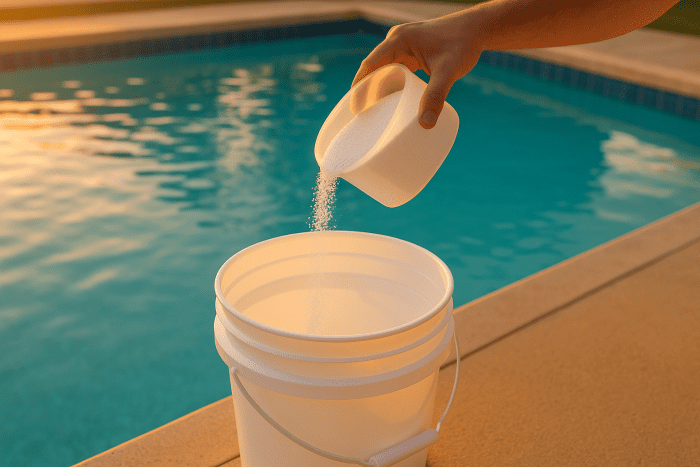
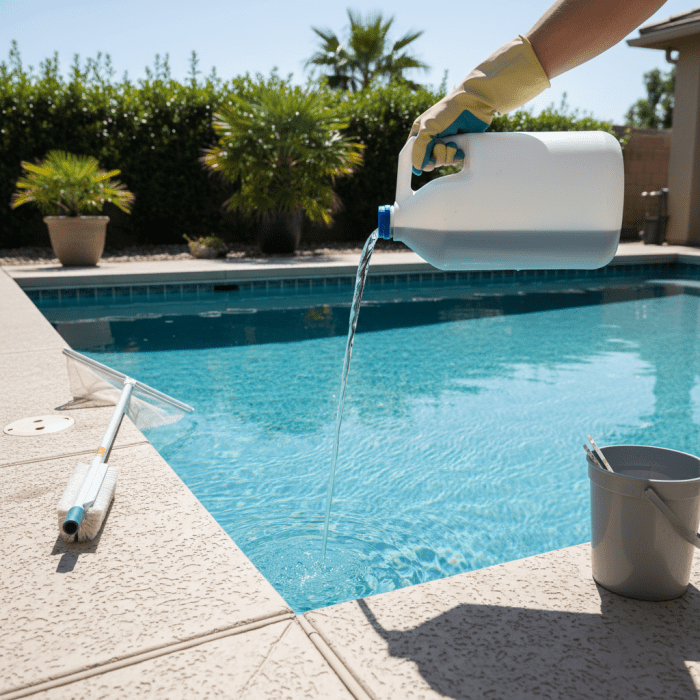
Sunlight destroys chlorine rapidly. Adding shock in the evening gives it maximum time to work. Pour liquid chlorine around the pool perimeter while the pump runs, or pre-dissolve granular shock in a bucket of pool water before adding.
Step 5: Run the pump continuously
Keep circulation going for at least 8-12 hours. This ensures thorough mixing and helps off-gas the destroyed chloramines.
Step 6: Retest in the morning
Check your levels after 8-12 hours. Combined chlorine should be below 0.5 ppm. If it’s still elevated, you didn’t reach breakpoint — add more shock.
Step 7: Wait to swim
Don’t swim until free chlorine drops below 5 ppm. This typically takes 8-24 hours after shocking, depending on your dose and sunlight exposure.
When Breakpoint Chlorination Doesn’t Work: Troubleshooting
Sometimes you shock your pool and the combined chlorine comes right back. Or it never drops in the first place. Here’s what might be happening:
High Cyanuric Acid (CYA) Interference
CYA protects chlorine from UV degradation, but too much CYA also slows down chlorine’s oxidation ability. If your CYA is above 80 ppm, your chlorine becomes sluggish.
The solution: You need proportionally more free chlorine when CYA is high. The Pool Calculator community recommends maintaining free chlorine at approximately 7.5% of your CYA level for daily sanitation. For breakpoint chlorination with high CYA, you may need to aim for 15-20x your combined chlorine reading, not just 10x.
If CYA exceeds 100 ppm, partial water replacement becomes the only practical fix.
pH Issues Undermining Your Shock
At pH 7.2, about 66% of your chlorine exists as hypochlorous acid (the active sanitizing form). At pH 8.0, only about 21% is active. That’s a massive drop in effectiveness.
Always check pH before shocking. If it’s above 7.6, add muriatic acid or dry acid to bring it down first.
Continuous Contamination Source
Is someone regularly adding contaminants faster than you can shock them out? Consider:
- Encourage (require?) showering before swimming
- Check for fertilizer runoff entering the pool
- Look for organic debris accumulation
- Ensure adequate filtration runtime (8+ hours daily minimum)
Biofilm in Plumbing
Bacterial biofilm in your pipes can continuously release contaminants. If combined chlorine returns within 24-48 hours after successful breakpoint, consider adding a biofilm-removing product or running a pipe-cleaning treatment.
Related guide: if chlorine keeps disappearing even after treatment, run a pool chlorine demand test and an overnight chlorine loss test to separate sunlight loss from real contamination.
Preventing Combined Chlorine Buildup
The best offense is a good defense. These practices minimize chloramine formation:
Maintain Adequate Free Chlorine
Keep free chlorine between 2-4 ppm (or appropriate levels for your CYA). Chlorine that’s too low lets contaminants accumulate faster than oxidation can occur.
Encourage Pre-Swim Showers
A quick rinse removes most sweat, lotions, and other contaminants. This single habit can reduce combined chlorine formation dramatically.
Shock Regularly — Even When Water Looks Fine
Weekly oxidation treatments (even at half the breakpoint dose) prevent chloramine accumulation. Don’t wait until you smell that chemical odor.
Run Your Filter Adequately
Minimum 8 hours daily, 12+ hours during heavy use periods. Good circulation means better chemical distribution and faster contaminant removal.
Manage Bather Load
More swimmers = more nitrogen compounds = more combined chlorine potential. After parties or heavy-use days, shock that evening rather than waiting.
The CYA-Chlorine Relationship and Combined Chlorine
This deserves special attention because it confuses many pool owners.
Cyanuric acid is a chlorine stabilizer — it protects chlorine from sunlight degradation. But the relationship is nuanced:
- CYA below 30 ppm: Chlorine burns off too fast in sunlight
- CYA 30-50 ppm: Ideal range for most pools
- CYA 50-80 ppm: Still functional, but chlorine becomes less aggressive
- CYA above 80 ppm: Chlorine effectiveness drops significantly
When CYA is too high, your free chlorine becomes “bound” to the stabilizer molecules (though still technically “free” on your test). This slowed chlorine doesn’t oxidize contaminants as efficiently, leading to faster combined chlorine buildup.
The fix: maintain that 30-50 ppm CYA sweet spot. And remember, dichlor shock adds about 9 ppm CYA for every 10 ppm chlorine it adds. Cal-hypo and liquid chlorine add zero CYA.
FAQ
What is combined chlorine in a pool?
Combined chlorine is chlorine that has already reacted with contaminants such as sweat, urine, body oils, sunscreen, algae, or organic debris. It is also called chloramine. Unlike free chlorine, it has weak sanitizing power and causes the strong “chlorine smell” many people associate with dirty pools.
What should combined chlorine be in a swimming pool?
Combined chlorine should be below 0.5 ppm, and zero is ideal. If your reading is 0.5 ppm or higher, plan to shock the pool to breakpoint. If it is above 1.0 ppm, treat it as an urgent water-quality problem.
How do I calculate combined chlorine?
Test free chlorine and total chlorine, then subtract free chlorine from total chlorine. The formula is: total chlorine – free chlorine = combined chlorine. For example, 3.0 ppm total chlorine minus 2.4 ppm free chlorine equals 0.6 ppm combined chlorine.
Can I swim with combined chlorine in the pool?
Do not swim if combined chlorine is 0.5 ppm or higher, especially if the pool smells harsh, irritates eyes, or looks cloudy. Treat the water first, then wait until free chlorine returns to the safe swim range listed on your test kit or local code.
What is the fastest way to lower combined chlorine?
The fastest fix is breakpoint chlorination at dusk. Adjust pH to 7.2-7.4, add enough shock to reach roughly 10 times the combined chlorine level, run the pump overnight, and retest in the morning. For exact dosing, use the Pool Chemical Calculator app.
Calculate the Exact Shock Dose
Combined chlorine treatment is one of those jobs where guessing wastes money fast. Open the Pool Chemical Calculator app, enter your pool size, current readings, and shock product strength, and it will tell you exactly how much to add. The same smart link works for iOS, Android, and web.
Sources
- Atlas Scientific: Free Chlorine vs Combined Chlorine — Detailed breakdown of the chemistry differences between chlorine types and their measurement methods.
- Taylor Technologies: Difference Between Free, Combined, and Total Chlorine — Technical explanation from a leading test kit manufacturer on measuring and interpreting chlorine readings.
- Florida Swimming Pool Association: The Importance of Testing for Combined Chlorine — Industry perspective on why combined chlorine monitoring matters for pool safety.
- Grey Shark Pools: Combined Chlorine Guide — Practical treatment approaches and calculation
Recommended pool supplies
As an Amazon Associate, Pool Chemical Calculator earns from qualifying purchases.

Raises free chlorine quickly without adding stabilizer, which is useful when CYA is already high.
View on Amazon
Accurate readings make every chlorine, pH, alkalinity, calcium, and CYA dose safer.
View on Amazon
Useful for algae cleanup, cloudy water, high bather load, and weekly oxidation routines.
View on AmazonGet exact pool chemical doses
Pool Chemical Calculator turns your test readings, pool volume, and target levels into exact treatment amounts for chlorine, pH, alkalinity, calcium, stabilizer, salt, and more.
Open the Pool Chemical Calculator app for iOS, Android, or web.