
Breakpoint Chlorination Calculator: How Much Shock to Destroy Chloramines
Quick Answer: To calculate breakpoint chlorination, multiply your combined chlorine reading by 10 to get your target free chlorine level, then subtract your current free chlorine. That’s the ppm increase you need. For a 15,000-gallon pool with 0.5 ppm combined chlorine and 2 ppm free chlorine, you’d need to raise free chlorine by 3 ppm — that’s about 1.5 gallons of liquid chlorine or 12 oz of cal-hypo shock.
Quick answer
Breakpoint Chlorination Calculator: How Much Shock to Destroy Chloramines: Quick Answer: To calculate breakpoint chlorination, multiply your combined chlorine reading by 10 to get your target free chlorine level, then subtract your current free chlorine. That's the ppm increase you need. For.
Got that chloramine smell? The one people wrongly blame on “too much chlorine”? That odor actually means you don’t have enough active chlorine. Your pool has reached a frustrating middle ground where chlorine has partially reacted with contaminants but hasn’t finished the job.
A breakpoint chlorination calculator helps you figure out exactly how much shock to add. Get it right, and you’ll destroy those irritating chloramines. Get it wrong — too little shock — and you’ll just create more of them.
What We Analyzed: Breakpoint Chlorination Dose Matrix
Before you grab your shock bucket, you need to know three things: your combined chlorine level, your current free chlorine, and your pool volume in gallons.
We calculated dosing scenarios using the standard breakpoint formula across common pool sizes and three popular chlorine products. Here’s the methodology:
How we calculated these doses:
- Combined chlorine = Total chlorine − Free chlorine
- Target free chlorine = Combined chlorine × 10
- Required ppm increase = Target free chlorine − Current free chlorine
- Product dose = (Pool gallons × Required ppm increase × 0.00013) ÷ Product strength factor
Limitations: The 10× multiplier is a practical field estimate, not a guarantee. It assumes accurate test readings, reasonable CYA levels (under 50 ppm), and no ongoing contamination source. This calculation doesn’t replace product label directions, local health codes, or professional help after fecal/vomit incidents.
Breakpoint Chlorination Dose Matrix
| Pool Size | Combined Cl | Current Free Cl | Required Increase | Liquid Chlorine (12.5%) | Cal-Hypo (68%) | Dichlor (56%) |
|———–|————-|—————–|——————-|————————|—————-|—————|
| 10,000 gal | 0.3 ppm | 1.5 ppm | 1.5 ppm | 0.5 gallon | 4 oz | 5 oz |
| 10,000 gal | 0.6 ppm | 2.0 ppm | 4.0 ppm | 1.3 gallons | 10 oz | 12 oz |
| 15,000 gal | 0.5 ppm | 2.0 ppm | 3.0 ppm | 1.5 gallons | 12 oz | 14 oz |
| 15,000 gal | 0.8 ppm | 1.0 ppm | 7.0 ppm | 3.5 gallons | 28 oz | 33 oz |
| 20,000 gal | 0.4 ppm | 3.0 ppm | 1.0 ppm | 0.7 gallon | 5 oz | 6 oz |
| 20,000 gal | 1.0 ppm | 1.5 ppm | 8.5 ppm | 5.6 gallons | 44 oz | 52 oz |
| 25,000 gal | 0.5 ppm | 2.5 ppm | 2.5 ppm | 2.0 gallons | 16 oz | 19 oz |
Product assumptions: Liquid chlorine at 12.5% sodium hypochlorite (common pool-grade). Cal-hypo at 68% available chlorine. Dichlor at 56% available chlorine. Your products may vary — always check the label.
Understanding the Breakpoint Chlorination Formula
Think of chlorine like a cleaning crew. When chlorine first encounters ammonia and nitrogen compounds (from sweat, urine, and body oils), it doesn’t destroy them immediately. Instead, it binds with them, creating chloramines. These chloramines are your “combined chlorine” — chlorine that’s tied up and can’t sanitize effectively.
The breakpoint is like calling in reinforcements. When you add enough free chlorine — typically 10 times the combined chlorine level — you overwhelm those chloramines and break them apart completely. They convert to nitrogen gas and escape into the air.
The Math, Step by Step
Step 1: Test your water accurately
You need both total chlorine and free chlorine readings. A DPD or FAS-DPD test kit gives you both numbers. Digital testers and basic strips often don’t measure total chlorine separately.
Step 2: Calculate combined chlorine
Combined chlorine = Total chlorine − Free chlorine
If your total reads 3.5 ppm and your free reads 2.5 ppm, your combined chlorine is 1.0 ppm.
Step 3: Find your target free chlorine
Target = Combined chlorine × 10
With 1.0 ppm combined chlorine, your target is 10 ppm free chlorine.
Step 4: Calculate the increase needed
Required increase = Target − Current free chlorine
You’re at 2.5 ppm free chlorine and need 10 ppm. That’s a 7.5 ppm increase.
Step 5: Convert ppm to product dose
This is where most online guides fail you. They give you the ppm number and leave you guessing about actual product amounts.
For liquid chlorine (12.5%), multiply your pool gallons by the ppm increase, then divide by 12,000. A 20,000-gallon pool needing 7.5 ppm increase requires: (20,000 × 7.5) ÷ 12,000 = 12.5 gallons of liquid chlorine.
For cal-hypo shock (68%), use about 1.3 oz per 10,000 gallons per ppm increase. That same scenario needs roughly 20 oz.
Step-by-Step Treatment Instructions
Ready to hit breakpoint? Here’s how to do it safely and effectively.
What You’ll Need
- Accurate test kit (FAS-DPD recommended for high chlorine readings)
- Enough pool shock for your calculated dose
- Chemical-resistant gloves and eye protection
- Plastic measuring container (not metal)
- Stirring stick for granular products
Treatment Steps
1. Test and record your baseline
Write down your total chlorine, free chlorine, and combined chlorine readings. Also note your CYA level — if it’s above 50 ppm, breakpoint becomes harder to achieve and maintain.
2. Calculate your dose using the formula or matrix above
Double-check your math. Undershooting creates more chloramines. That’s worse than starting over.
3. Add shock at dusk
UV light degrades chlorine rapidly. Adding shock in the evening gives you 8-10 hours of darkness for the chemistry to work.
4. Run your pump continuously
Keep the water circulating for at least 8 hours. This distributes the chlorine evenly and helps off-gas the nitrogen compounds.
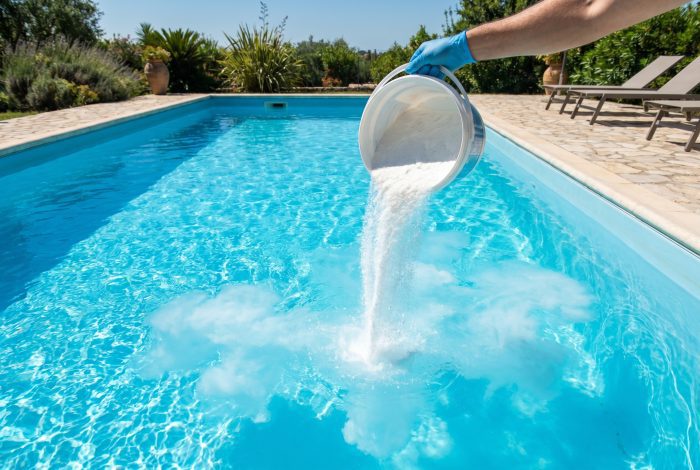
5. Broadcast granular shock across the surface
Don’t dump it all in one spot. Spread cal-hypo or dichlor across the deep end while walking the perimeter. For liquid chlorine, pour slowly in front of a return jet.
6. Wait and retest
Test after 8 hours. If combined chlorine is still above 0.2 ppm, you didn’t quite reach breakpoint. You’ll need another dose.
7. Confirm swim-safe conditions
Don’t let anyone swim until:
- Free chlorine drops below 5 ppm (check your local code — some allow up to 10 ppm)
- Combined chlorine reads below 0.2 ppm
- pH is between 7.2 and 7.8
This typically takes 24-48 hours after successful breakpoint treatment.
When Breakpoint Chlorination Won’t Work
Here’s something most guides skip: sometimes the 10× rule isn’t your real problem.
High CYA Levels
Cyanuric acid (stabilizer) protects chlorine from sunlight, but it also reduces chlorine’s killing power. If your CYA is above 70 ppm, your “free chlorine” is mostly locked up and sluggish. You might need 15× or 20× the combined chlorine to reach breakpoint — or you might need to partially drain and refill first.
Inaccurate Testing
DPD tests can bleach out at high chlorine levels, giving falsely low readings. If you’ve shocked heavily and your test shows zero chlorine, don’t trust it. Use a FAS-DPD titration kit or dilute your sample before testing.
Ongoing Contamination
If someone’s adding contaminants faster than chlorine can destroy them — think a heavy bather load, a party, or (sorry) someone with a stomach bug — you won’t sustain breakpoint. The math keeps changing. Remove the source first.
Poor Ventilation (Indoor Pools)
Indoor pools can’t off-gas chloramines effectively. The nitrogen compounds hang in the air above the water surface. You’ll smell chloramines even after reaching breakpoint because they’re not escaping. Increase ventilation dramatically during and after treatment.
You’re Actually Reading Interference
Certain algaecides, metals, and other chemicals can interfere with DPD readings. If your math doesn’t add up — say, you’re adding enormous amounts of chlorine but combined chlorine keeps rising — get a professional water analysis.
Practical Calculator Examples
Let’s work through three real scenarios.
Example 1: Mild Chloramine Problem
Your readings: Free chlorine 2.5 ppm, Total chlorine 3.0 ppm, Pool size 12,000 gallons
Combined chlorine = 3.0 − 2.5 = 0.5 ppm
Target free chlorine = 0.5 × 10 = 5.0 ppm
Required increase = 5.0 − 2.5 = 2.5 ppm
Dose needed:
- Liquid chlorine (12.5%): About 1 gallon
- Cal-hypo (68%): About 6 oz
This is a routine maintenance shock. You’ll likely be swim-ready by the next afternoon.
Example 2: Moderate Chloramine Issue
Your readings: Free chlorine 1.0 ppm, Total chlorine 2.5 ppm, Pool size 18,000 gallons
Combined chlorine = 2.5 − 1.0 = 1.5 ppm
Target free chlorine = 1.5 × 10 = 15 ppm
Required increase = 15 − 1.0 = 14 ppm
Dose needed:
- Liquid chlorine (12.5%): About 8.5 gallons
- Cal-hypo (68%): About 34 oz (just over 2 lbs)
This is aggressive treatment. You’re looking at 36-48 hours before swim-safe conditions.
Example 3: Heavy Chloramine Load
Your readings: Free chlorine 0.5 ppm, Total chlorine 3.0 ppm, Pool size 25,000 gallons
Combined chlorine = 3.0 − 0.5 = 2.5 ppm
Target free chlorine = 2.5 × 10 = 25 ppm
Required increase = 25 − 0.5 = 24.5 ppm
Dose needed:
- Liquid chlorine (12.5%): About 20 gallons
- Cal-hypo (68%): About 80 oz (5 lbs)
This is a significant treatment. Consider whether there’s an underlying problem causing such high combined chlorine — heavy bather loads, inadequate daily chlorination, or possible contamination.
Maintaining Low Combined Chlorine
Once you’ve hit breakpoint, keep it that way.
Test twice weekly. Combined chlorine above 0.2 ppm means you’re drifting toward another chloramine problem. Catch it early with a small shock rather than waiting for a major treatment.
Maintain proper free chlorine. Use our chlorine calculator to keep free chlorine at 2-4 ppm (or higher if your CYA is elevated).
Shower before swimming. Seriously. A quick rinse removes most of the sweat, lotions, and body oils that create chloramines.
Shock weekly during heavy use. If you’re swimming daily or hosting frequent guests, a preventive weekly shock keeps combined chlorine from building up.
Frequently Asked Questions
How do I calculate breakpoint chlorination?
Subtract your free chlorine from your total chlorine to get combined chlorine. Multiply combined chlorine by 10 to find your target free chlorine level. Subtract your current free chlorine from that target — the difference is how many ppm you need to raise. Convert that ppm increase to product amounts using your pool’s gallon volume.
Do I multiply combined chlorine by 10, or subtract my current free chlorine first?
Both, in order. First multiply combined chlorine by 10 to get your target free chlorine level. Then subtract your current free chlorine from that target. The result is the ppm increase required.
How much shock do I add for my pool size?
It depends on your combined chlorine reading and which product you’re using. For a rough guide: 1 lb of cal-hypo (68%) raises chlorine about 6 ppm in 10,000 gallons. 1 gallon of liquid chlorine (12.5%) raises it about 10 ppm in 10,000 gallons. Scale proportionally to your pool size and required ppm increase.
When is it safe to swim after breakpoint chlorination?
Wait until free chlorine drops below 5 ppm (or your local code limit) AND combined chlorine is below 0.2 ppm. This typically takes 24-48 hours. Don’t rely on time alone — always retest before swimming.
Why do I still smell chlorine after shocking?
That smell is chloramines, not free chlorine. If you still smell it after shocking, you probably didn’t reach breakpoint. Retest your combined chlorine. If it’s above 0.2 ppm, you need another dose. And remember: proper free chlorine has almost no odor.
Sources
- CDC: Chloramines and Pool Operation — Federal guidance on combined chlorine management and health implications
- Orenda Technologies: Breakpoint Chlorination Explained — Technical breakdown of the chemistry behind breakpoint oxidation
- In The Swim: Breakpoint Chlorination Guide — Practical treatment guidance for residential pools
Skip the Math — Let the Calculator Handle It
Tired of doing chlorine calculations by hand? The Pool Calculator app automatically factors your pool volume, current readings, and preferred products to give you exact doses. No math, no guesswork.
Try the free Pool Calculator →
Recommended pool supplies
As an Amazon Associate, Pool Chemical Calculator earns from qualifying purchases.

Raises free chlorine quickly without adding stabilizer, which is useful when CYA is already high.
View on Amazon
Accurate readings make every chlorine, pH, alkalinity, calcium, and CYA dose safer.
View on Amazon
Protects chlorine from sunlight, especially in outdoor pools with low stabilizer.
View on AmazonGet exact pool chemical doses
Pool Chemical Calculator turns your test readings, pool volume, and target levels into exact treatment amounts for chlorine, pH, alkalinity, calcium, stabilizer, salt, and more.
Open the Pool Chemical Calculator app for iOS, Android, or web.