
How Much Algaecide to Use When Closing a Pool: A Complete Dosage Guide
How Pool Size Affects Algaecide Dosage
This seems obvious, but I see homeowners get it wrong constantly. You need to know your actual pool volume — not a guess, not what the previous owner told you.
Quick answer
How Much Algaecide to Use When Closing a Pool: A Complete Dosage Guide: How Pool Size Affects Algaecide Dosage This seems obvious, but I see homeowners get it wrong constantly. You need to know your actual pool volume — not a guess, not what the previous owner told you. Quick Volume.
Quick Volume Calculations
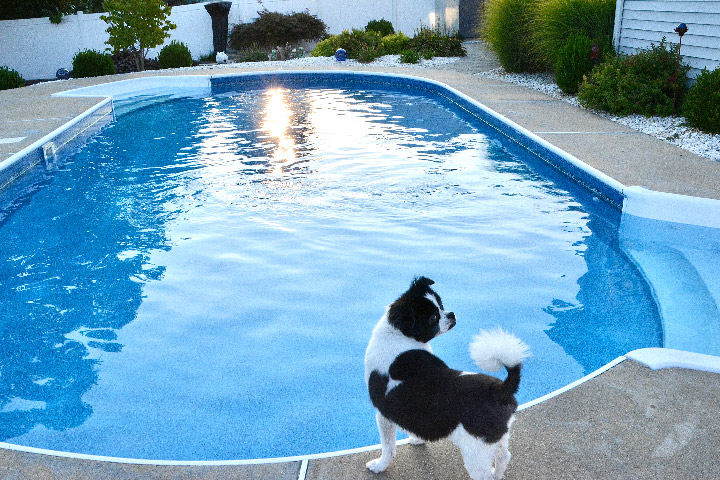
- Rectangular pool: Length × Width × Average Depth × 7.5 = gallons
- Oval pool: Length × Width × Average Depth × 5.9 = gallons
- Round pool: Diameter × Diameter × Average Depth × 5.9 = gallons
A pool you think is 15,000 gallons might actually be 18,000 or 12,000. That 20-25% error means you’re either underdosing (hello, spring algae) or wasting product.
If you are not sure, start with the pool volume calculator before dosing anything. Every winter chemical dose depends on that number.
Dosage by Pool Size (Polyquat 60 Baseline)
For a clear pool in good condition with a solid cover and cold winter:
| Pool Volume | Polyquat 60 Dose |
|————-|——————|
| 10,000 gal | 10-12 oz |
| 15,000 gal | 16 oz |
| 20,000 gal | 20-24 oz |
| 25,000 gal | 24-32 oz |
| 30,000 gal | 32 oz |
These numbers assume you’ve balanced your water and shocked properly before adding algaecide.
The Right Order: When to Add Algaecide During Pool Closing
Timing matters more than most people realize. Add algaecide at the wrong time and it won’t work properly.
Step 1: Balance Your Water First
Before any closing chemicals go in, your water needs to be balanced:
- pH: 7.2-7.6
- Alkalinity: 80-120 ppm
- Calcium Hardness: 200-400 ppm
Why? Because algaecide (especially copper-based) can react badly with unbalanced water. High pH reduces chlorine effectiveness and can cause copper to precipitate out of solution and stain your pool.
Helpful tools: pH calculator, alkalinity calculator, and calcium hardness calculator.
Step 2: Shock the Pool
Add your winterizing shock — typically calcium hypochlorite or a non-chlorine shock. Follow package directions for dosage. Run the pump for at least 2-4 hours to distribute.
Critical: Wait until chlorine drops below 5 ppm before adding algaecide. High chlorine levels degrade most algaecides, making them less effective over winter. This usually takes 24-48 hours.
Use the chlorine calculator if you need to raise chlorine to a specific winter shock target.
Step 3: Add Algaecide
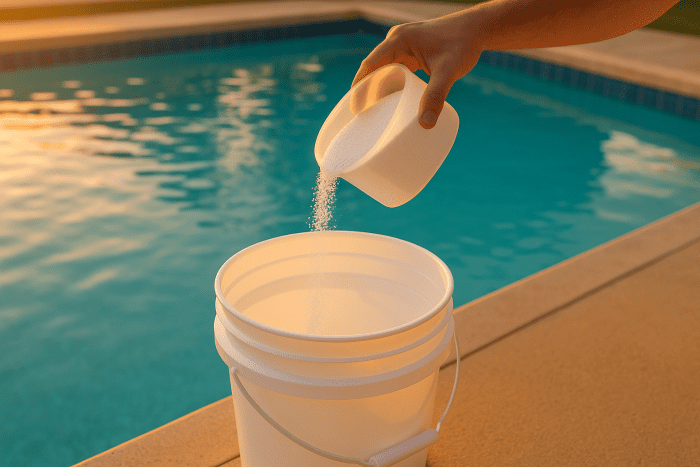
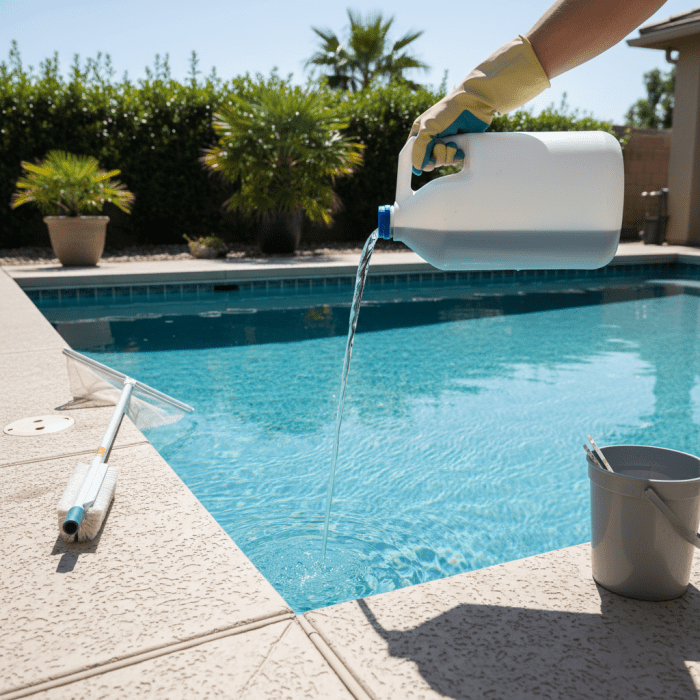
Once chlorine is below 5 ppm, add your algaecide. Pour it around the pool perimeter while the pump runs. Let it circulate for 2-4 hours.
Step 4: Add Other Closing Chemicals
Stain preventers, enzyme treatments, and other specialty chemicals go in after algaecide. Metal sequestrants are especially important if you’re using copper-based algaecide.
What If Your Pool Has Algae at Closing Time?
This is a common scenario that most guides gloss over. You meant to close the pool two weeks ago, but life happened. Now there’s a green tint to the water. What do you do?
Mild Algae (Green Tint, Walls Still Visible)
Don’t just dump in extra algaecide. That’s throwing money at a problem that requires chlorine.
- Brush the walls and floor to break up algae colonies
- Triple shock (3 lbs calcium hypochlorite per 10,000 gallons)
- Run the filter 24-48 hours until water clears
- Vacuum to waste if possible
- Rebalance chemistry, then proceed with normal algaecide dose
Severe Algae (Dark Green, Can’t See Bottom)
Don’t close this pool. I know you want to be done with pool season, but closing a severely algae-infested pool is setting yourself up for a nightmare in spring. The algae will die over winter, settle on surfaces, and stain permanently.
Your better option:
- Quadruple shock and run the filter continuously
- Add a quality algaecide like PoolRX Algaecide Unit for mineral-based killing power
- Wait until the pool is clear before closing — even if it takes another week or two
- Then proceed with normal winterization
Yes, it’s more work now. But it’s far less work than draining and acid-washing a stained pool in spring.
How Your Cover Type Affects Algaecide Needs
Solid Covers
Solid winter covers block sunlight completely. No sunlight means no photosynthesis, which means algae can’t grow even if spores survive. Solid covers require the least algaecide — standard dosing is usually plenty.
Mesh Covers
Mesh covers let some light through. They also allow rainwater and snowmelt to dilute your pool water and your closing chemicals. This is why mesh-covered pools often have more issues in spring.
Adjust dosage: Increase algaecide by 25-50% over solid cover recommendations. Consider a mid-winter reapplication if you have a long off-season and can access the pool safely.
No Cover
Some warmer-climate pools stay uncovered all winter. This is the hardest scenario for algaecide performance. Sunlight, debris, and temperature fluctuations all encourage algae growth.
Adjust dosage: Double the standard dose, and plan for monthly maintenance treatments if the pool remains accessible.
Regional Climate Considerations
Cold, Long Winters (Northern States, Canada)
If your pool freezes solid and stays that way from November to April, standard algaecide dosing works well. Cold temperatures inhibit algae growth, and a frozen pool doesn’t stratify chemicals.
Recommendation: Stick with baseline dosing. One application of Polyquat 60 should last all winter.
Mild, Short Winters (Southern States)
Pools in Texas, Florida, Arizona, and similar climates face a different challenge. Water rarely freezes, and temperatures can spike into the 60s or 70s in winter, creating perfect algae conditions.
Recommendation: Use the upper end of dosage ranges. Consider a copper-based algaecide for its residual killing power, and plan for at least one mid-winter check.
Fluctuating Temperatures (Mid-Atlantic, Pacific Northwest)
This is the trickiest scenario. Your pool might freeze one week and thaw the next. Temperature swings allow algae to activate periodically.
Recommendation: Polyquat 60 at the higher end of dosing, mesh cover users should increase by 50%, and check the pool during any prolonged warm spell.
Common Mistakes That Waste Your Algaecide
Adding Algaecide to High-Chlorine Water
Chlorine above 5 ppm destroys most algaecides. You shocked yesterday and added algaecide today? You probably just poured money down the drain. Wait 24-48 hours after shocking.
Not Running the Pump
Algaecide needs to circulate. Pouring it in one spot and immediately covering the pool means uneven distribution. Run the pump for at least 2 hours after adding algaecide.
Using Expired Product
Algaecide doesn’t last forever. That bottle from 2019 in your garage has likely degraded significantly. Check expiration dates and buy fresh product for closing.
Guessing at Pool Volume
A 20% error in pool volume means 20% under- or over-dosing. Take 10 minutes to measure and calculate properly.
Affiliate disclosure: As an Amazon Associate, Pool Chemical Calculator may earn from qualifying purchases.
Recommended Products for Winter Pool Closing
For straightforward winterizing, HTH Super Winter Algaecide offers good value with a long-lasting polyquat formula. One quart treats up to 25,000 gallons for the entire off-season.
Frequently Asked Questions
Can I use regular algaecide instead of winter-specific formulas?
You can, but it’s not ideal. Regular maintenance algaecides are designed to last 1-2 weeks with regular chlorine support. Winter algaecides (especially Polyquat 60) are formulated to remain active for 4-6 months without degrading. The extra cost is worth it.
What happens if I add too much algaecide?
Overdosing polyquat algaecide rarely causes problems — it’s expensive but not harmful. Overdosing quat algaecides causes excessive foaming. Overdosing copper-based algaecides can lead to staining, especially in high-pH water. When in doubt, follow label maximums.
Should I add algaecide if I’m using a winter chemical kit?
Check what’s in the kit. Most kits include algaecide already, but the concentrations vary. If your kit includes a full dose of Polyquat 60 for your pool size, you’re covered. If it only includes a small bottle of quat algaecide, supplementing with additional Polyquat 60 is smart.
How do I know if my algaecide worked when I open the pool?
Clear water in spring means it worked. Green water means it didn’t — or you underdosed. Cloudy but not green usually indicates dead organic matter (including dead algae), which is manageable with shocking and filtering.
Can I substitute chlorine for algaecide at closing?
Extra chlorine alone won’t protect your pool all winter. Chlorine dissipates within days or weeks, leaving months of winter unprotected. Algaecide provides that extended residual protection that chlorine can’t.
Sources
- In The Swim Pool Closing Chemicals Guide — Detailed breakdown of closing chemical types and application order
- Swim University Pool Closing Kit Guide — Explains what’s typically included in winterizing kits and what to add
- River Pools: How to Winterize a Pool — Step-by-step winterization process with chemical timing
Calculate Your Exact Dosage
Want to take the guesswork out of pool closing chemicals? Use the free Pool Chemical Calculator app to get precise recommendations for shock and balancing chemicals based on your exact pool volume and current water chemistry. No more estimating — just accurate numbers that make spring opening easier.
Recommended pool supplies
As an Amazon Associate, Pool Chemical Calculator earns from qualifying purchases.

Raises calcium hardness to reduce corrosive water risk in plaster, concrete, and equipment.
View on Amazon
Useful for algae cleanup, cloudy water, high bather load, and weekly oxidation routines.
View on Amazon
Helpful for spot-cleaning settled debris, dead algae, and problem areas after treatment.
View on AmazonGet exact pool chemical doses
Pool Chemical Calculator turns your test readings, pool volume, and target levels into exact treatment amounts for chlorine, pH, alkalinity, calcium, stabilizer, salt, and more.
Open the Pool Chemical Calculator app for iOS, Android, or web.