
How Low Should Pool Water Be for Winter? A Complete Guide to Getting It Right
Quick answer
For winter closing, lower pool water below the skimmer only far enough to protect the skimmer and return lines: usually 1-2 inches below the skimmer for solid covers, 3-6 inches below for mesh covers, and below the return fittings only when your winterizing method or cover manufacturer requires it. Do not drain too low, because low winter water can stress liners, covers, and pool walls. Balance the water first, confirm volume with Pool Chemical Calculator, then lower the level slowly and winterize the plumbing.
Quick answer
How Low Should Pool Water Be for Winter? A Complete Guide to Getting It Right: Quick answer For winter closing, lower pool water below the skimmer only far enough to protect the skimmer and return lines: usually 1-2 inches below the skimmer for solid covers, 3-6 inches below for mesh covers, and.
I’ve seen homeowners make expensive mistakes on both ends of the spectrum. One neighbor drained his vinyl liner pool completely “to be safe” and spent $8,000 replacing the liner that dried out and cracked. Another left the water at normal height with no skimmer protection, and a hard freeze split his skimmer housing clean in half. Both situations were entirely preventable.
Let’s get you the right answer for your specific setup.
What We Analyzed: Winter Pool Water Level Decision Matrix
Before we go further, I built a decision matrix that combines the key variables affecting your ideal winter water level. This isn’t guesswork—it’s based on standard industry practices and manufacturer recommendations across multiple pool types and climates.
Methodology
I analyzed winterization guidance from pool manufacturers, professional pool service companies, and industry resources to create a matrix that accounts for four primary variables: pool construction type, winter cover type, skimmer protection method, and typical climate severity. The recommendations represent ranges because local conditions, specific equipment, and manufacturer warranties vary.
Limitations
These are general guidelines based on common practices. Your pool manufacturer’s specific warranty requirements always take precedence. Local building codes may have additional requirements. Unusual pool designs, unique equipment configurations, or extreme weather events may require adjustments.
Winter Water Level Recommendation Matrix
| Pool Type | Cover Type | Skimmer Protection | Climate | Recommended Level Below Skimmer | Key Notes |
|———–|————|——————-|———|——————————–|———–|
| Gunite/Concrete | Solid Cover | Skimmer Gizmo | Moderate Freeze | 4-6 inches | Gizmo absorbs ice expansion; solid cover prevents debris but collects water/snow |
| Gunite/Concrete | Mesh Safety Cover | Lines Blown & Capped | Severe Freeze | 12-18 inches below tile line | Lower level prevents ice reaching tile; mesh allows precipitation through |
| Vinyl Liner | Solid Cover | Skimmer Plug | Mild Freeze | 1-2 inches below skimmer | Never drain more than 1/3; liner needs water weight support |
| Vinyl Liner | Mesh Safety Cover | Gizmo + Winterized Lines | Moderate Freeze | 4-6 inches | Mesh cover means water level rises with rain/snow melt |
| Fiberglass | Solid Cover | Lines Blown & Capped | Severe Freeze | 6-8 inches | Shell can pop up if groundwater pressure exceeds pool water weight |
| Fiberglass | Automatic Cover | Integrated System | Mild Freeze | Normal operating level | Follow manufacturer specs exactly; auto covers have specific requirements |
| Any Pool | No Cover | No Protection | Mild Freeze Only | Normal level + daily monitoring | Only viable in warmest climates; not recommended for most regions |
How to use this matrix: Find your pool type in the first column, match your cover and skimmer protection, then factor in your climate. The “Recommended Level” gives you your target range. When in doubt, err toward less draining rather than more.
Why Water Level Matters So Much in Winter
Water inside your pool does two critical jobs during winter. It provides structural support to the pool walls and floor. And it acts as a buffer against ice damage when positioned correctly.
The Physics of Freezing Water
Water expands about 9% when it freezes. That expansion generates massive force—roughly 30,000 psi in a confined space. Your skimmer is a confined space attached to your pool. If water freezes inside it without room to expand, something cracks. Usually the skimmer housing. Sometimes the plumbing behind it.
But here’s what many homeowners miss: the water level in your pool directly affects how much water sits in your skimmer throat. Lower the pool level below the skimmer opening, and you eliminate that risk entirely. Pair that with a skimmer gizmo that absorbs any remaining ice expansion, and you’ve got solid protection.
Structural Support Requirements
Your pool shell wasn’t designed to be empty. Gunite and concrete pools can handle being drained better than vinyl or fiberglass, but even they face risks. Groundwater pressure pushes against the outside of your pool. The water inside pushes back. Remove that water, and the external pressure wins.
For vinyl liner pools, the liner itself needs water weight pressing it against the walls and floor. Drain too much, and the liner shrinks, wrinkles, or pulls away from the walls. These wrinkles become permanent creases that trap algae and eventually crack.
Fiberglass pools face the most dramatic risk. An empty or nearly-empty fiberglass pool can literally pop out of the ground if groundwater levels rise during winter rains. I’ve seen photos of fiberglass shells sitting 2 feet above grade. That’s a total loss.
Solid Covers vs. Mesh Safety Covers: The Water Level Difference
Your cover type significantly changes the equation.
Solid Winter Covers
Solid covers block everything—sunlight, debris, rain, and snow. They’re excellent at preventing algae growth and keeping your pool clean. But they also collect water and snow on top.
A heavy snow load on a solid cover pushes down on your pool water. If your water level is too low, the cover sags dramatically, potentially pulling anchors loose or dumping all that melted snow into the pool at once.
With solid covers, keep water levels higher—typically 4-6 inches below the skimmer. You want enough water to support the cover’s weight but enough drop to protect the skimmer. You’ll also need a cover pump to remove accumulated water and snowmelt periodically throughout winter.
Mesh Safety Covers
Mesh covers let water pass through while catching debris. Rain and snowmelt filter directly into your pool. This means your water level will rise throughout winter.
Because the water level increases naturally, you can—and often should—start with a lower level. With properly winterized plumbing (lines blown out and plugged), you can drop to 12-18 inches below the tile line for severe freeze climates. The incoming precipitation raises the level gradually, and since the cover isn’t holding water weight, there’s less concern about cover stress.
Automatic Covers
Automatic safety covers are their own category. Most manufacturers have very specific requirements about water level during winter operation. Some systems require water at normal operating height. Others need slight reductions.
Check your owner’s manual first. Then check it again. Automatic cover mechanisms are expensive to repair, and warranty claims get denied when you don’t follow winterization specs.
Skimmer Protection Methods Explained
How you protect your skimmer directly impacts how low you need to drain.
Skimmer Gizmos
A gizmo is a hollow plastic cylinder that screws into your skimmer’s bottom fitting. It’s designed to compress when water inside the skimmer freezes, absorbing that 9% expansion instead of letting it crack the skimmer walls.
With a gizmo installed, you don’t need to drain water completely below the skimmer. Keeping water 4-6 inches below the skimmer mouth means minimal water in the skimmer throat, and the gizmo handles any ice that does form. This is the most common method for solid cover setups.
Skimmer Plugs and Plates
Skimmer plugs block the skimmer opening entirely, preventing pool water from entering the skimmer chamber. Some pool owners use skimmer cover plates that go over the entire skimmer face.
With a plug or plate, you’re isolating the skimmer from pool water completely. This allows for slightly higher water levels since no water enters the skimmer to freeze. However, you still want some drop to account for any water that seeps past the seal.
Blown-Out and Capped Lines
This is the professional approach. A compressor blows all water out of the plumbing lines—skimmer line, return lines, main drain line, everything. Then each line gets plugged or capped.
With properly blown lines, you have the most flexibility on water level. There’s no water in the plumbing to freeze, regardless of pool level. This method is essential for severe freeze climates and allows the lowest recommended water levels when combined with mesh covers.
Climate Considerations: How Cold Does It Actually Get?
Your local freeze severity changes everything.
Mild Freeze Climates
If you get occasional light freezes—temperatures dipping to 28-32°F a few nights per winter but rarely staying below freezing for 24+ hours—your winterization needs are minimal. The pool surface might skim over with ice, but deep freezing that damages equipment is unlikely.
In mild climates, you might only drop water 1-2 inches below the skimmer, install a gizmo, and call it done. Some pool owners in these regions don’t even cover their pools, just reduce circulation to maintenance mode.
Moderate Freeze Climates
Regular freezes—multiple nights per week below freezing, occasional extended cold snaps below 20°F—require standard winterization. This is where the 4-6 inch recommendation for solid covers and gizmos applies.
Your plumbing should be protected either by continuous low-flow circulation (risky if power fails) or by draining and blowing out lines. Skimmer protection is mandatory.
Severe Freeze Climates
Prolonged deep freezes—weeks of continuous sub-freezing temps, regular drops below 0°F—demand maximum protection. Water needs to be low enough that even if ice forms on the pool surface, it can’t reach vulnerable tile lines or skimmer openings.
For severe climates with mesh covers, drop to 12-18 inches below the tile line. All plumbing must be blown out and capped. Equipment should be drained completely—pumps, filters, heaters, chlorinators. Use antifreeze rated for pools in any lines you can’t fully drain.
How to Lower Your Pool Water Level Correctly
You’ve got a few options for draining.
Using Your Filter Pump
Most pool pumps have a “waste” or “drain” setting on the multiport valve. This bypasses the filter and sends water directly out. It’s the fastest method for significant water removal.
Connect a backwash hose and route it to an appropriate drainage area—not into storm drains in most municipalities. Run the pump until you reach your target level. This method can drop water several inches per hour depending on your pump’s flow rate.
Submersible Pump Method
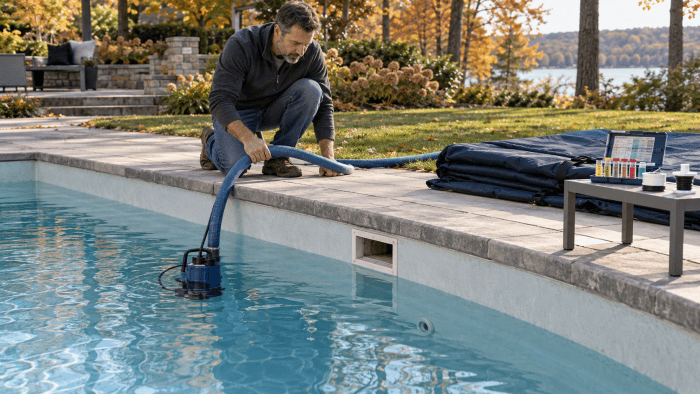
If you don’t want to use your filter system (maybe you’ve already winterized it), a small submersible pump works well. Drop it in the shallow end, run a hose to your drainage area, and let it work.
A 1/4 HP submersible pump moves about 1,500 gallons per hour. For a 20,000-gallon pool, dropping the water 6 inches (roughly 900 gallons in a typical 15×30 pool) takes less than an hour.
Siphon Method
For small adjustments, a garden hose siphon works fine. Fill the hose with water, submerge one end in the pool, and drop the other end lower than the pool water level. Physics does the rest, slowly.
This method is slow but free and requires no equipment. Good for fine-tuning that last inch or two.
Common Mistakes to Avoid
Don’t make these errors.
Draining too much: Never drain a vinyl or fiberglass pool more than one-third. Even gunite pools shouldn’t be emptied without professional guidance and often require hydrostatic relief valves to prevent lifting.
Ignoring groundwater: If you’ve had heavy rains before closing, groundwater levels are high. This is the worst time to drain significantly. Wait for things to dry out if possible.
Forgetting the equipment: Lowering pool water means nothing if your pump, filter, and heater still have water in them. Drain all equipment completely. Remove drain plugs and store them in the pump basket so you don’t lose them.
Skipping chemistry balancing: Before lowering water, balance your chemistry. Target pH 7.2-7.6, alkalinity 80-120 ppm, and calcium hardness 200-400 ppm. Add winterizing algaecide and shock. Chemistry is harder to adjust with reduced water volume.
Step-by-Step: Lower Pool Water for Winter
1. Balance and clean the pool first
Test pH, alkalinity, calcium hardness, stabilizer, and chlorine while the pump can still circulate normally. Brush, skim, and vacuum so debris does not sit under the winter cover.
2. Confirm your cover and equipment requirements
Check whether you have a solid cover, mesh cover, safety cover, skimmer plate, return plugs, or a liner pool. The right winter water level depends on that exact setup.
3. Lower the water slowly
Use the waste setting, a submersible pump, or a controlled siphon. Stop at the target level and avoid draining below the returns unless your winterizing method requires it.
4. Winterize the plumbing
Blow out or drain lines, plug returns, protect the skimmer, and remove drain plugs from the pump, filter, heater, and chlorinator as applicable.
5. Recheck the water level before covering
Make sure the water is not too low for the cover. Safety covers and vinyl liners need enough water support through winter, especially after rain or snow adds weight.
Frequently Asked Questions
Can I completely drain my pool for winter?
No. Complete draining risks serious structural damage regardless of pool type. Vinyl liners shrink and crack without water weight. Fiberglass shells can pop out of the ground from hydrostatic pressure. Even gunite pools can crack or heave. The only time to fully drain is for major repairs, and that requires professional precautions.
What happens if it rains a lot and my water level rises too high?
With a mesh cover, rising water levels from precipitation are normal and expected. If levels get too high (within 2-3 inches of the skimmer), pump some water out. With solid covers, the cover pump should prevent water accumulation on top, keeping the pool level stable.
Should I use pool antifreeze in my plumbing lines?
If you can’t completely blow out your lines with compressed air, yes. Use only antifreeze rated for swimming pools—automotive antifreeze is toxic. Pour it into skimmer and return lines after blowing out as much water as possible. For most pools with properly blown lines, antifreeze isn’t necessary.
How do I know if my water level is too low?
Visual signs include vinyl liner wrinkling or pulling away from walls, exposed pool surfaces that weren’t designed for air exposure, or cover stress from sagging into the lowered water. If you see any of these, add water immediately.
When should I close my pool for winter?
Wait until water temperature stays consistently below 60°F. Closing too early when water is still warm promotes algae growth under the cover. In most northern climates, this means late October to mid-November.
Sources
- Sears Pool Management: Do You Have to Drain an Inground Pool for Winter
- Swimming Pool Steve: Winter Drain Guidelines
- Fronheiser Pools: Should I Drain My Pool for Winter
- Doheny’s: Closing Your Pool in Winter
- In The Swim: 10 Steps to Winterize an Inground Pool
Get Your Pool Chemistry Right Before Closing
Proper water level is just one part of winterization. Your chemistry needs to be balanced too—and that’s where most DIY pool owners struggle. Before you lower that water and close up for the season, use our free pool chemical calculator to dial in your pH, alkalinity, and sanitizer levels. It takes 30 seconds and helps ensure you open to clear water next spring instead of a green swamp.
Use the Pool Chemical Calculator app to calculate exact chemical doses before closing.
Recommended pool supplies
As an Amazon Associate, Pool Chemical Calculator earns from qualifying purchases.

Raises calcium hardness to reduce corrosive water risk in plaster, concrete, and equipment.
View on Amazon
Helps small particles clump together so the filter can clear cloudy water faster.
View on Amazon
Useful for algae cleanup, cloudy water, high bather load, and weekly oxidation routines.
View on AmazonGet exact pool chemical doses
Pool Chemical Calculator turns your test readings, pool volume, and target levels into exact treatment amounts for chlorine, pH, alkalinity, calcium, stabilizer, salt, and more.
Open the Pool Chemical Calculator app for iOS, Android, or web.