
How to Lower Pool Water Below the Skimmer: The Complete Winter Closing Guide
How Far Below the Skimmer Should You Drain?
The answer depends on your cover type more than anything else.
Quick answer
How to Lower Pool Water Below the Skimmer: The Complete Winter Closing Guide: How Far Below the Skimmer Should You Drain? The answer depends on your cover type more than anything else. For Mesh Safety Covers Mesh covers let rain and snowmelt pass through into the pool. This means your water.
For Mesh Safety Covers
Mesh covers let rain and snowmelt pass through into the pool. This means your water level will rise over winter. Start with water 4-6 inches below the skimmer opening on concrete pools, 1-2 inches below on vinyl.
The extra buffer accounts for precipitation. In areas with heavy winter rain (Pacific Northwest, for example), you might bump this to 6-8 inches on concrete pools. Just know that mesh covers with pumps work better than constantly worrying about levels.
For Solid Winter Covers
Solid covers keep rain out but trap debris and require a cover pump. Since water won’t enter the pool, you can be more precise:
- Concrete/gunite: 4-6 inches below skimmer, 1-2 inches below return jets
- Vinyl liner: At the bottom of the skimmer mouth or 1 inch below
- Fiberglass: 3-4 inches below skimmer, check manufacturer specs
For Above-Ground Pools
Above-ground pools follow different rules. The typical target: 1 inch below the return jet fitting. This is lower than the skimmer since above-ground pools use different skimmer designs and face less structural risk.
Many above-ground pool owners remove the skimmer faceplate entirely and plug the hole directly. If you go this route, water level matters less for skimmer protection.
Step-by-Step: Lower Pool Water Below the Skimmer
1. Balance the pool water first
Test and adjust pH, alkalinity, calcium hardness, and chlorine while the pump can still circulate through the skimmer. Add closing chemicals before lowering the water.
2. Drain to the skimmer mouth with the waste setting
If your filter has a waste setting, attach the backwash hose, route water to an approved drainage area, and run the pump only until the water reaches the bottom of the skimmer mouth.
3. Switch to a submersible pump
Place a submersible pump on a step or stable floor area and use it for the final few inches. This prevents the main pool pump from sucking air and losing prime.
4. Stop at the correct winter level
Stop 4-6 inches below the skimmer on most concrete pools, 1-2 inches below on vinyl liner pools, and 3-4 inches below on fiberglass pools unless your cover or builder specifies otherwise.
5. Blow out and plug the lines
After the water is lowered, blow out the skimmer and return lines, install winter plugs or a skimmer gizmo, and drain the pump, filter, heater, and chlorinator.
Three Methods to Lower Pool Water
You’ve got options. Each has trade-offs.
Method 1: Use Your Pool Pump and Filter Waste Valve (Fastest)
Best for: Concrete and fiberglass pools with multiport valves
This is the fastest method. Your pool pump can move 40-80 gallons per minute — far faster than any submersible pump you’d buy at the hardware store.
Step-by-step:
- Attach a backwash hose to your filter’s waste port
- Run the hose to a drainage area (check local codes — pool water can’t always go into storm drains)
- Turn the multiport valve to “WASTE” (never do this with the pump running)
- Turn the pump on
- Watch the water level constantly
- Stop the pump before water drops below the skimmer — if the skimmer sucks air, you’ll lose prime and potentially damage the pump
Critical warning: You cannot use this method to drain water below the skimmer. Why? Because the pump pulls water through the skimmer. Once water drops too low, the skimmer sucks air, the pump loses prime, and you’re stuck.
Use this method to lower water to the skimmer level quickly, then switch to Method 2 for the final few inches.
Method 2: Submersible Pump (Safest for Below-Skimmer Drainage)
Best for: All pool types, especially vinyl and fiberglass
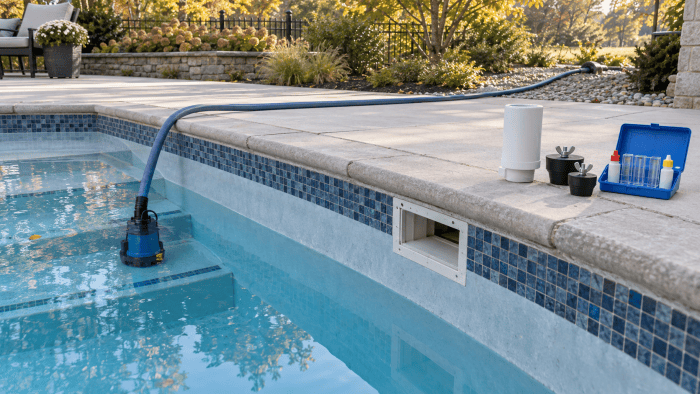
A small submersible utility pump sits directly in the pool and pushes water out through a garden hose. This is the safest way to drain below skimmer level because you control the exact stopping point.
What to buy: A 1/4 HP submersible pump handles this job easily. The Superior Pump 91250 moves about 30 gallons per minute and costs under $100. For occasional use, even a cheaper utility pump works fine — you’re only removing a few hundred gallons.
Step-by-step:
- Set the pump on the second step or a stable spot in the shallow end
- Attach a garden hose and run it to your drainage area
- Plug in the pump (use a GFCI outlet, always)
- Monitor the water level as it drops
- Reposition the pump lower as needed to reach your target depth
- Unplug when you hit your target — typically 4-6 inches below skimmer
Time estimate: A 1/4 HP pump takes roughly 1-2 hours to lower an average pool 6 inches.
Method 3: Siphon Hose (Slowest, But Free)
Best for: Small water-level adjustments, budget-conscious owners
If you only need to drop 2-3 inches, a garden hose siphon works. It’s slow — maybe 3-5 gallons per minute — but requires zero equipment purchases.
How to start a siphon:
- Submerge the entire hose in the pool until it fills with water
- Cap one end with your thumb
- Pull that end out of the pool and below the water level (your drainage point must be lower than the pool water)
- Release your thumb
Water flows automatically. It won’t win any speed awards, but it works.
The Chemistry Step Everyone Skips
Here’s a coverage gap most winterization guides miss completely: balance your water chemistry before lowering the level.
Why? Because once you drop below the skimmer, your pump can’t circulate. You won’t be able to distribute any chemicals evenly. And your water sits for 4-6 months.
Pre-Closing Chemistry Targets
Before draining a single inch:
- pH: 7.2-7.6
- Alkalinity: 80-120 ppm
- Chlorine: Shock to 10+ ppm (it’ll drop over winter)
- Calcium hardness: 200-400 ppm
Test everything with a reliable kit. The Taylor K-2006 gives you professional-grade accuracy for all these readings.
Add your closing chemical kit (algaecide, stain preventer, enzyme treatment) while the pump still runs. Give the chemicals 24 hours to circulate before you start draining.
What About Groundwater? The Hidden Risk
If your pool sits in an area with a high water table, draining too much water creates serious problems. Groundwater exerts upward pressure on your pool shell. The weight of pool water pushes back against it. Remove that weight and — in extreme cases — the shell can literally pop out of the ground.
Signs Your Pool Has Groundwater Risk
- Water seeps into the pool after heavy rain
- Your sump pump runs frequently
- Neighbors have experienced “floating” pool issues
- Your pool builder mentioned hydrostatic relief valves
If any of these apply: Drain only to the minimum level necessary (typically at or just below skimmer mouth). Consider using a gizmo or skimmer plug plus antifreeze rather than draining aggressively. And strongly consider hiring a professional for your closing.
Affiliate disclosure: As an Amazon Associate, Pool Chemical Calculator may earn from qualifying purchases.
Protecting the Skimmer and Lines After Draining
Lowering water is step one. Protecting the equipment is step two.
Blow Out the Lines
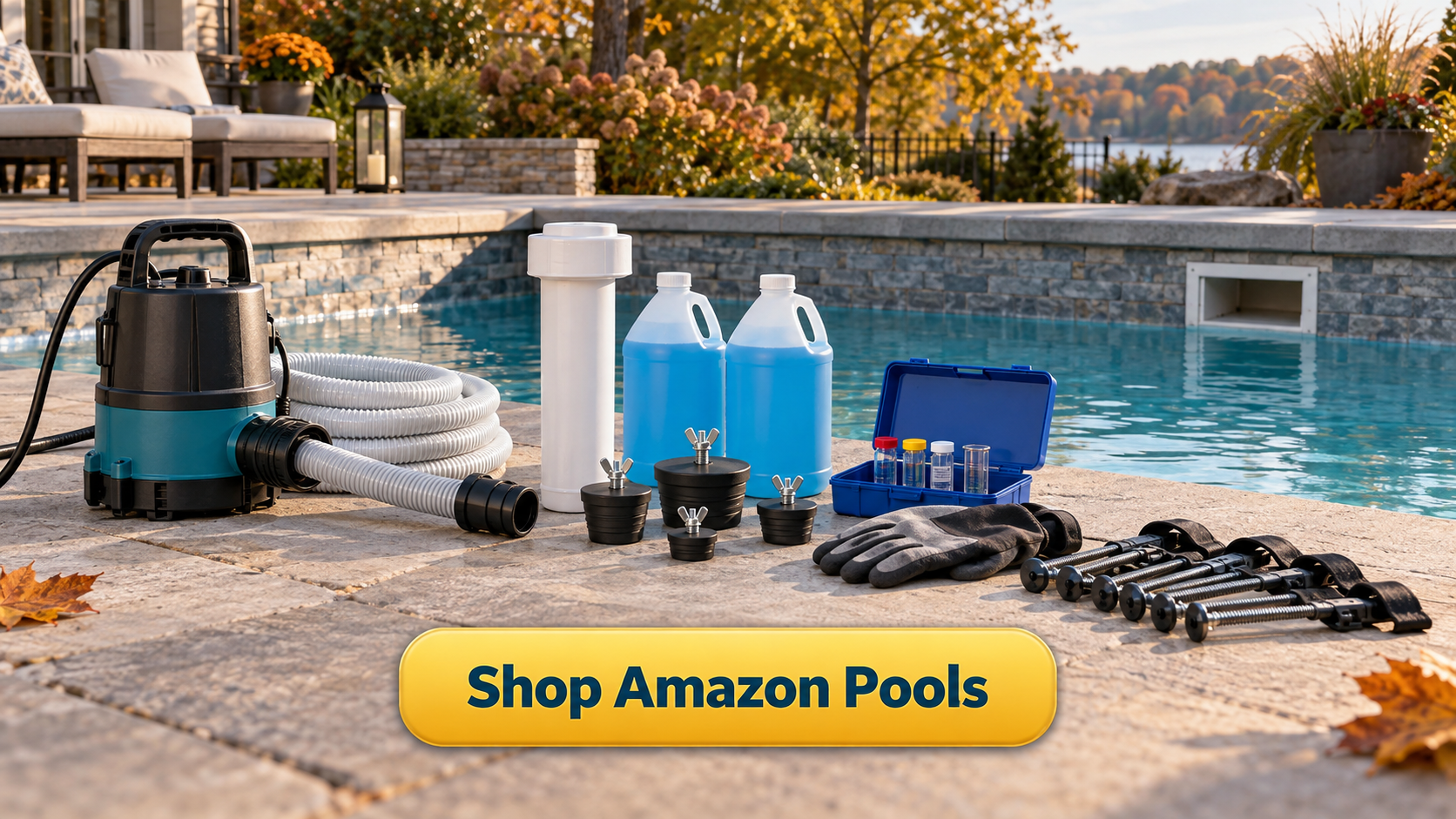
Professional pool closers use an air compressor or shop vac (in blower mode) to force water out of plumbing lines. Air goes into the skimmer, return, and main drain lines until only air (no water) bubbles up.
You’ll need:
- A shop vac with blower function, or small air compressor
- Threaded adapters for your skimmer and return fittings
- Pool antifreeze (for any lines that couldn’t be fully cleared)
Install a Skimmer Gizmo
A winter skimmer gizmo is a hollow plastic tube that threads into the skimmer hole. If ice forms around it, the gizmo compresses instead of the skimmer cracking. It’s cheap insurance — under $10 — and lasts years.
Plug the Returns
Threaded winter plugs or expansion plugs seal your return jets from the inside. This keeps antifreeze in the lines and prevents ice from forming against the fitting.
Common Mistakes (And How to Avoid Them)
Mistake 1: Using the Pool Pump to Drain Below the Skimmer
Your main pool pump cannot safely drain water below skimmer level. It will suck air, lose prime, and potentially damage the pump motor. Use it only to get water to skimmer level, then switch to a submersible pump.
Mistake 2: Draining a Vinyl Pool Too Low
Vinyl liners need water weight. Never drain more than a few inches below the skimmer on a vinyl pool unless specifically instructed by your manufacturer. High groundwater amplifies this risk.
Mistake 3: Forgetting to Disconnect the Pump and Filter
After lowering water, drain your pump housing, filter tank, and heater. Any trapped water in equipment will freeze and crack housings. Remove drain plugs and store them in the pump basket so you don’t lose them.
Mistake 4: Skipping the Chemistry Balance
Unbalanced water sits against your pool surface for five months. Low pH corrodes surfaces. High calcium precipitates out and stains. Spend 20 minutes testing and adjusting before you drain.
Frequently Asked Questions
How far below the skimmer should I lower my pool water?
For concrete pools with mesh covers, aim for 4-6 inches below the skimmer opening. Vinyl liner pools should stay at or just 1-2 inches below the skimmer mouth to maintain liner support.
Can I use my pool pump to drain below the skimmer?
No. Your pool pump pulls water through the skimmer. Once water drops below that level, the pump sucks air, loses prime, and can be damaged. Use your pump to drain to skimmer level, then switch to a submersible pump for the final few inches.
Should water be below return jets too?
Yes, in most cases. Return jets face the same freeze risk as skimmers. Typical target: 1-2 inches below the return on concrete pools. After draining, blow out the return lines and plug them to prevent any remaining water from freezing.
What if I lower too much water from a vinyl pool?
If you’ve already drained too much, carefully add water back using a garden hose. Minor over-draining usually doesn’t cause permanent damage if corrected quickly. Significant draining — especially with high groundwater — can cause the liner to shift or float, which may require professional repair.
Can I drain the pool completely for winter?
Almost never. Complete drainage causes structural problems (groundwater pressure, sun damage, liner shrinkage) that far outweigh any benefits. The only exception: concrete pools needing major repairs. Even then, work with a professional to manage groundwater and minimize exposure time.
Sources
- Doheny’s: Closing Your Pool in Winter – Comprehensive overview of winterization steps including water level guidelines
- In The Swim: How to Winterize an In-Ground Pool – Step-by-step closing process with equipment protection details
- Swimming Pool Steve: Winter Drain Guidelines – Technical guidance on safe drainage limits by pool type
- Fronheiser Pools: Should I Drain My Pool for Winter – Explanation of drainage risks and cover considerations
Get Your Pre-Closing Chemistry Right
Before you touch that submersible pump, make sure your water chemistry is dialed in. Unbalanced water sitting against your pool surfaces for five months causes more damage than you’d expect.
Head over to Pool Chemical Calculator to calculate exactly how much chlorine shock, pH adjuster, and alkalinity increaser you need for your pool size. You can also use the Pool Chemical Calculator app while you are standing at the pool pad, so you are not guessing chemical doses after the water drops below the skimmer.
Related tools: use the pool volume calculator, chlorine calculator, and pH calculator before closing.
Recommended pool supplies
As an Amazon Associate, Pool Chemical Calculator earns from qualifying purchases.

Raises calcium hardness to reduce corrosive water risk in plaster, concrete, and equipment.
View on Amazon
Accurate readings make every chlorine, pH, alkalinity, calcium, and CYA dose safer.
View on Amazon
Useful for algae cleanup, cloudy water, high bather load, and weekly oxidation routines.
View on AmazonGet exact pool chemical doses
Pool Chemical Calculator turns your test readings, pool volume, and target levels into exact treatment amounts for chlorine, pH, alkalinity, calcium, stabilizer, salt, and more.
Open the Pool Chemical Calculator app for iOS, Android, or web.